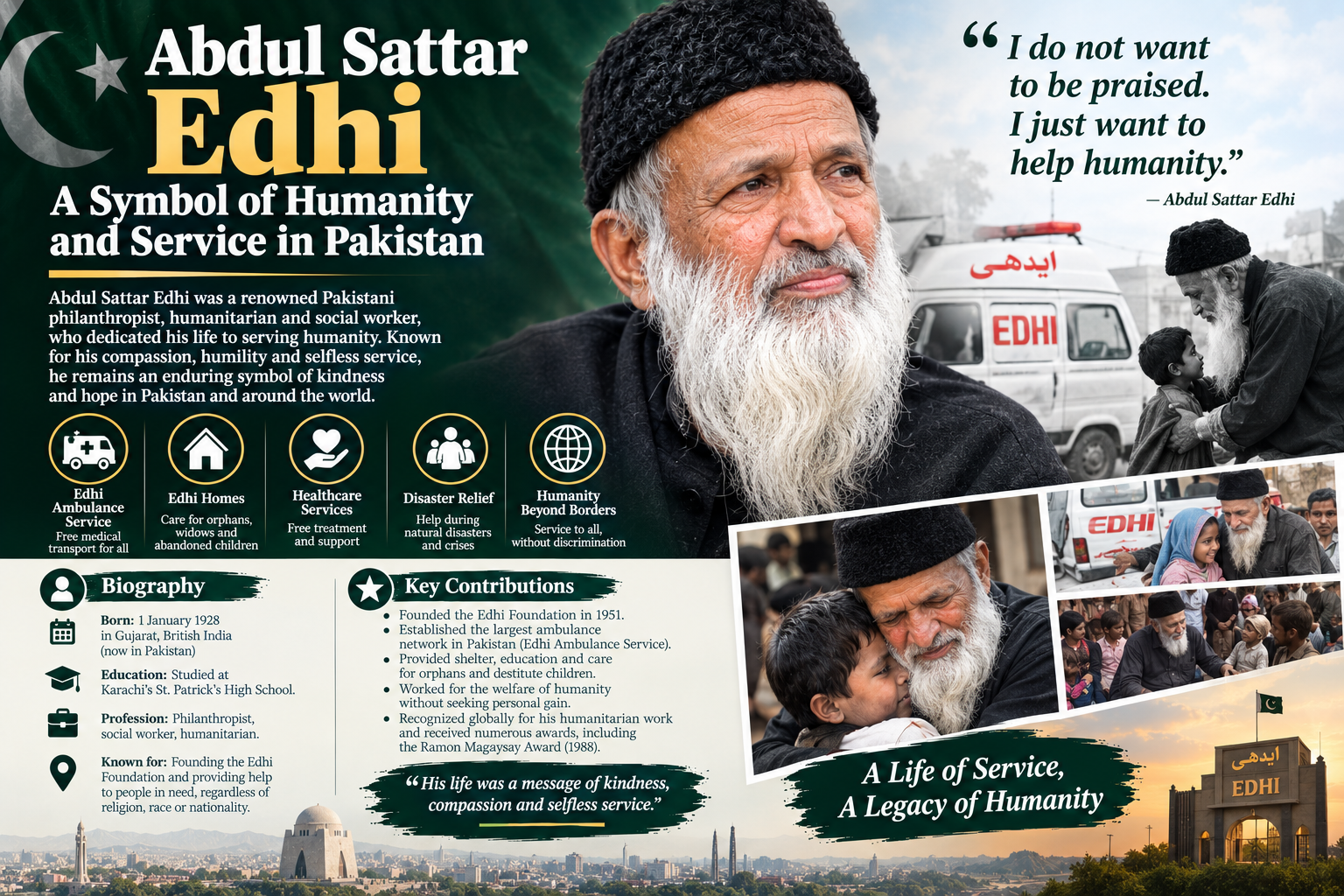
Abdul Sattar Edhi is remembered as one of the greatest humanitarian personalities in Pakistan. His life was dedicated to helping poor, sick, homeless, abandoned, and vulnerable people. He did not build his reputation through political power, wealth, or a luxurious lifestyle. Instead, he became famous because of his compassion, simplicity, honesty, and lifelong commitment to serving humanity.
The story of Abdul Sattar Edhi is inspiring because his journey began with very limited resources. He believed that helping others was a responsibility rather than a way to gain fame or personal wealth. Through years of hard work, public trust, and dedication, his small welfare efforts developed into the Edhi Foundation, one of Pakistan's most recognised welfare organisations.
The Edhi Foundation provides a wide range of services, including ambulance and emergency services, healthcare, education, children's homes, orphan care, shelters, and other forms of social welfare. Its official website describes the organisation as operating on a non-commercial, non-political, and non-communal basis and providing services without discrimination.
Abdul Sattar Edhi's life therefore represents much more than charity. It represents the power of one person's determination to create positive change in society.
Early Life of Abdul Sattar Edhi
Abdul Sattar Edhi was born in 1928 in Bantva near Junagadh in present-day India. His childhood played an important role in shaping his personality and his future humanitarian work.
According to the Edhi Foundation's official founder profile, one of the most important experiences of his early life was the illness of his mother. When Edhi was around eleven years old, his mother became seriously ill and later suffered from mental illness. Young Edhi took responsibility for caring for her and helped with her everyday needs.
This experience had a deep effect on him. Seeing someone close to him suffer taught him about helplessness, illness, and the importance of caring for people who cannot care for themselves.
Instead of allowing this experience to remain only a painful memory, Edhi turned it into a lifelong motivation to serve humanity.
His childhood therefore became one of the foundations of his humanitarian philosophy.
Migration and a New Beginning
The partition of the Indian subcontinent in 1947 changed the lives of millions of people. Abdul Sattar Edhi migrated to Pakistan during this period and eventually settled in Karachi.
Karachi became the centre of his future humanitarian activities.
At the time, the city was growing rapidly and faced many social challenges. Poverty, illness, homelessness, and lack of access to basic services affected many ordinary people.
Edhi observed these difficulties closely. Rather than waiting for someone else to solve them, he decided to begin helping people himself.
His resources were limited, but his determination was strong.
This became one of the most important characteristics of his personality: he believed that a person should begin helping with whatever resources are available rather than waiting for perfect circumstances.
The Beginning of His Welfare Journey
Abdul Sattar Edhi did not begin with a large organisation or a huge financial budget.
He started with small welfare efforts and gradually expanded them. The Edhi Foundation's official history explains that he initially established a small health centre and sought public support to develop welfare projects.
His early work depended heavily on donations from ordinary people.
This was significant because Edhi did not present himself as a wealthy benefactor. He asked people to contribute toward helping other people.
His simple message gradually attracted public support.
As more people trusted him, he was able to expand his services.
This shows an important lesson from his life: a successful welfare organisation can be built not only through large donations but also through the collective contributions of ordinary citizens.
The Development of the Edhi Foundation
With time, Abdul Sattar Edhi's welfare activities developed into the Edhi Foundation.
The organisation grew into a large social welfare network serving people in different parts of Pakistan.
Its services expanded into several areas, including healthcare, ambulance services, education, child welfare, shelters, and other forms of assistance.
The growth of the foundation reflected Edhi's understanding that poverty and social problems cannot be solved through only one type of service.
A person may need medical treatment, food, shelter, transportation, education, or emotional support at different points in life.
Therefore, Edhi's welfare model developed into a broad network designed to respond to different human needs.
The Edhi Ambulance Service
One of the most famous parts of Abdul Sattar Edhi's legacy is the ambulance service.
Emergency transportation can make an enormous difference when someone is injured, seriously ill, or involved in an accident. Reaching medical care quickly can be extremely important.
The Edhi Foundation developed ambulance and emergency transportation services as a major part of its welfare system. The foundation continues to list ambulance and emergency assistance among its major services.
Edhi understood that humanitarian service must be practical.
It is not enough to feel sympathy for someone in trouble. There must also be a system capable of delivering help.
The ambulance network became a powerful example of this idea.
It transformed compassion into an organised emergency service that could reach people when they needed assistance.
Edhi's Personal Involvement
One of the most remarkable aspects of Abdul Sattar Edhi's life was that he remained personally involved in the work.
According to the Edhi Foundation's founder profile, he collected donations, drove ambulances himself, and spent time helping people living in Edhi facilities.
This made his leadership different from simply managing an organisation from an office.
He wanted to understand the difficulties faced by ordinary people directly.
His hands-on approach also inspired workers and volunteers.
It showed that leadership in humanitarian work is not about giving orders. It is about being willing to participate in difficult tasks and stand beside people who need help.
Helping Poor People
Poverty was one of the central concerns of Abdul Sattar Edhi.
He believed that people with limited financial resources should still be treated with dignity and respect.
The Edhi Foundation developed services for people who lacked basic resources, including food, shelter, healthcare, clothing, and other forms of assistance.
His approach was based on practical support.
Instead of simply talking about poverty, he created institutions through which people could receive help.
This is one reason why his work became so influential.
He showed that social welfare can become more effective when compassion is combined with organisation.
Care for Children
Children were another important focus of Abdul Sattar Edhi's humanitarian work.
Some children are abandoned or do not have families capable of providing proper care. Such children are among the most vulnerable members of society.
The Edhi Foundation established children's homes and orphanage centres to provide care and support. Its services also include arrangements for abandoned infants and child welfare.
Edhi's approach was based on protection rather than judgment.
He believed that children should not be punished for circumstances beyond their control.
Providing them with shelter, care, and support gives them a better chance to grow into healthy and productive members of society.
The Cradle System
One of the well-known welfare ideas associated with the Edhi Foundation was the provision of safe cradles for abandoned babies.
The foundation explains that Edhi placed cradles outside Edhi centres where parents who could not care for newborns could leave them safely rather than exposing them to danger.
This initiative reflected a practical understanding of a difficult social problem.
Instead of simply criticising parents or discussing the issue, Edhi tried to create a safer alternative for vulnerable children.
The idea became an important part of his child welfare legacy.
Healthcare Services
Healthcare was another major area of Edhi's work.
Poor families can face serious difficulties when they need medical treatment but cannot afford expensive services.
The Edhi Foundation developed hospitals, medical centres, mobile dispensaries, and other healthcare initiatives to assist people in need.
This work reflected Edhi's belief that access to basic medical assistance should not be limited only to people with financial resources.
Healthcare is a fundamental human need.
By providing medical assistance to disadvantaged people, the Edhi Foundation became an important part of Pakistan's wider welfare system.
Support for Women
Women also played an important role in Edhi's welfare system.
Bilquis Edhi, Abdul Sattar Edhi's wife, was deeply involved in the organisation's work. The Edhi Foundation describes her contribution to maternity services, women's welfare, and adoption-related activities.
Her involvement demonstrated that humanitarian work could benefit from the skills and leadership of women.
Together, Abdul Sattar Edhi and Bilquis Edhi worked to expand welfare services for people from different backgrounds.
Their partnership became an important part of the history of the foundation.
Helping Homeless People
Homeless people often face many difficulties at the same time.
They may lack food, shelter, healthcare, family support, and financial resources.
The Edhi Foundation developed shelters and welfare facilities for people who had nowhere else to go. Its services include shelters and support for vulnerable groups.
Edhi's approach was based on the belief that society should not ignore people simply because they have lost their homes or financial stability.
Providing shelter can offer people not only physical protection but also a chance to rebuild their lives.
Support for Disabled People
People with disabilities can face additional barriers in education, employment, transportation, and everyday life.
Abdul Sattar Edhi's welfare work included support for disabled people, including accommodation and assistance with mobility needs. The foundation continues to describe support for people with disabilities among its welfare activities.
This reflected Edhi's broader belief that every person deserves dignity.
His work encouraged society to think about inclusion rather than leaving vulnerable people isolated.
Disaster Relief
Pakistan has experienced floods, fires, earthquakes, and other emergencies that can affect large numbers of people.
During disasters, communities may suddenly lose homes, possessions, food supplies, and access to medical care.
The Edhi Foundation's humanitarian work has included relief assistance during natural disasters and emergencies in Pakistan and abroad.
This shows the flexibility of Edhi's welfare model.
The organisation was not limited to routine services. It could also respond when large communities faced sudden crises.
Assistance Beyond Pakistan
Abdul Sattar Edhi's humanitarian vision was not limited to one city or even one country.
The Edhi Foundation states that its humanitarian efforts have included relief for refugees and assistance to people affected by disasters in different countries.
This reflects Edhi's broader understanding of humanity.
For him, helping another person was not dependent on nationality or social status.
His humanitarian message therefore gained recognition beyond Pakistan.
A Non-Discriminatory Approach
One of the strongest principles associated with Abdul Sattar Edhi was equality.
The Edhi Foundation describes its operations as non-commercial, non-political, and non-communal, with services offered without discrimination based on colour, class, or creed.
This principle was central to Edhi's philosophy.
He believed that a person who is suffering should receive help because they are a human being.
This approach allowed the foundation to serve people from different communities and backgrounds.
It also helped create a strong public image of Edhi as a humanitarian figure whose service went beyond social divisions.
His Simple Lifestyle
Abdul Sattar Edhi was famous for his simple lifestyle.
Even as his welfare organisation became widely recognised, he did not adopt a luxurious lifestyle.
The Edhi Foundation's official biography states that he lived simply, did not take a salary, and remained focused on his humanitarian mission.
His simplicity became one of the most memorable aspects of his personality.
He demonstrated that a person can achieve greatness without surrounding themselves with luxury.
For Edhi, the value of life was measured through service rather than material possessions.
Honesty and Public Trust
Public trust was essential to the success of Edhi's welfare organisation.
When he began asking people for donations, he did not have the financial resources to support a large welfare system himself.
He depended on ordinary people.
The Edhi Foundation's history explains that people trusted him with their donations because they believed he would use their money to help others.
This trust became one of the foundation's greatest strengths.
It also teaches an important lesson about leadership.
When people see honesty and dedication in a leader, they are more willing to support that person's mission.
The Importance of Small Donations
Edhi's story also demonstrates that humanitarian work does not always require huge donations.
The foundation's current website describes contributions ranging from very small amounts to larger donations, as well as support in the form of food, clothing, medicines, and other goods.
This reflects the idea that everyone can contribute something.
A student may not have a large amount of money, but they can donate books or clothes, volunteer time, or help someone learn.
Edhi's life showed that collective small contributions can create a much larger impact.
Edhi and Education
Education was also part of the welfare vision associated with the Edhi Foundation.
The organisation lists education among its services and has supported educational initiatives and training.
Education is important because welfare should not only address immediate problems.
Providing food or medical care can help a person today, while education can create opportunities for a better future.
Edhi's wider welfare approach therefore included both immediate assistance and long-term social development.
Support for Elderly People
Older people can become vulnerable when they lose family support or financial independence.
The Edhi Foundation has provided services and care for elderly and vulnerable people as part of its broader social welfare system.
This reflects another important part of Edhi's philosophy: society should care for people at different stages of life.
Children, adults, elderly people, sick individuals, and people with disabilities all deserve dignity.
Burial and Graveyard Services
Another distinctive aspect of Edhi's welfare work was assistance with unclaimed and abandoned bodies.
The Edhi Foundation describes free bathing, shrouding, and burial services for unclaimed dead people among its humanitarian activities.
This service may be difficult and emotionally demanding, but Edhi believed that even people who had died without family support deserved dignity.
This was a powerful example of his belief that humanitarian service should continue even when there is no personal benefit involved.
The Meaning of Dignity
A central theme throughout Edhi's life was human dignity.
For him, helping a person was not simply about giving them money or food.
It was about recognising their value as a human being.
A poor person should not be treated as less important than a wealthy person.
A homeless person should not be ignored.
An abandoned child should not be forgotten.
A person who dies without relatives should still receive respectful treatment.
This philosophy gave Edhi's welfare work a deeper meaning.
Abdul Sattar Edhi and Youth
Young people can learn many valuable lessons from Abdul Sattar Edhi.
His life shows that age is not a barrier to making a difference.
He began developing his sense of service at a young age because of his mother's illness.
Later, he turned that compassion into practical action.
Young people today can follow this example in simple ways.
They can volunteer, support community projects, help classmates, donate useful items, participate in educational activities, and treat vulnerable people with respect.
They do not need to wait until they become rich or powerful.
Leadership Through Service
Abdul Sattar Edhi's leadership style was based on service.
He did not lead primarily through speeches.
He led through action.
He collected donations, drove ambulances, worked with vulnerable people, established welfare centres, and remained personally involved in the organisation's activities.
This type of leadership is powerful because people can see the results directly.
Edhi's example demonstrates that a leader can earn respect by serving others rather than demanding respect.
His Relationship with Bilquis Edhi
Bilquis Edhi was an important part of Abdul Sattar Edhi's humanitarian journey.
She worked with him in the foundation and contributed to women's and children's welfare.
Their partnership demonstrates how a humanitarian mission can grow when people work together.
Although Abdul Sattar Edhi became the best-known face of the organisation, the Edhi Foundation's work was supported by a much larger team of workers, volunteers, donors, and supporters.
This is an important point because lasting social change is rarely created by one person alone.
National Recognition
Abdul Sattar Edhi received national and international recognition for his humanitarian work.
The Edhi Foundation states that Abdul Sattar Edhi and Bilquis Edhi received numerous awards and honours from governmental and non-governmental organisations at national and international levels.
Such recognition reflected the impact of their work.
However, Edhi's greatest achievement was not receiving awards.
His real achievement was building a welfare system that continued helping people.
International Respect
Abdul Sattar Edhi's humanitarian philosophy also earned respect outside Pakistan.
His work demonstrated that social welfare does not have to be limited by nationality or geography.
The foundation's international relief efforts further expanded the reach of his humanitarian vision.
His story became an example of how an individual can create meaningful social change through dedication.
Edhi's Death and Continuing Legacy
Abdul Sattar Edhi died in 2016, but his humanitarian mission did not end.
The Edhi Foundation continues to provide welfare services today.
Its current activities include ambulance services, healthcare, education, children's services, shelters, and other forms of humanitarian support.
This continuation is perhaps the strongest evidence of the strength of his legacy.
A person's life can end, but their values can continue through institutions, workers, volunteers, and the people they inspired.
The Edhi Foundation Today
Today, the Edhi Foundation remains closely associated with the values established by Abdul Sattar Edhi.
Its official website describes its mission as serving underserved communities and supporting people in need. Its services include education, ambulance services, graveyard services, children's homes, orphanage centres, and hospitals.
The organisation also continues to depend on public donations.
This means that Edhi's original idea of community-supported welfare remains relevant.
Ordinary people can continue contributing to a humanitarian system that serves vulnerable communities.
Why Edhi's Example Matters Today
Modern Pakistan continues to face challenges related to poverty, healthcare, education, unemployment, natural disasters, and social inequality.
These problems require government policies, economic development, and strong institutions.
At the same time, welfare organisations and ordinary citizens can also play an important role.
Abdul Sattar Edhi demonstrated how civil society can contribute to solving social problems.
His example remains relevant because compassion and community responsibility are needed in every generation.
A Lesson in Simplicity
One of the most powerful lessons from Edhi's life is simplicity.
In a world where success is often associated with expensive possessions, fame, and status, Edhi showed another definition of success.
He lived simply and devoted his resources and energy to other people.
His life suggests that true success can be measured by positive impact.
A person who helps others may leave behind a greater legacy than someone who only accumulates wealth.
A Lesson in Consistency
Edhi's achievements did not happen overnight.
His welfare network developed through years of continuous effort.
This teaches another important lesson: meaningful change requires consistency.
A person may begin with a small project, but if they continue working with honesty and dedication, that project can grow.
For students and young people, this lesson is especially valuable.
Success in education, career, business, or social service often comes from small efforts repeated over a long period.
A Lesson in Compassion
Perhaps the greatest lesson of Abdul Sattar Edhi's life is compassion.
He saw people who were suffering and chose to help them.
He did not ask whether helping them would make him famous.
He simply believed that human beings should care for one another.
This principle is simple, but it can have a powerful effect on society.
A compassionate society is one where people notice the difficulties of others and try to reduce them.
Abdul Sattar Edhi as a Pakistani Role Model
Abdul Sattar Edhi remains one of Pakistan's strongest examples of humanitarian leadership.
His life shows that national pride is not only about political achievements, economic progress, or international recognition.
It can also come from helping people.
His work brought honour to Pakistan because it demonstrated the positive impact that a Pakistani citizen could have on society.
For many people, Edhi represents the best qualities of Pakistan: generosity, compassion, resilience, and community spirit.
The Importance of His Message for Students
Students can especially benefit from studying Edhi's life.
Education should not only prepare students for jobs.
It should also help them become responsible members of society.
Edhi's example teaches students to care about people around them.
A student can begin with simple actions such as helping a classmate, respecting teachers and workers, donating unused books, supporting a welfare activity, or volunteering for a community project.
These actions may appear small, but they develop habits of responsibility and compassion.
The Meaning of True Success
Abdul Sattar Edhi's life provides a different definition of success.
He did not measure success through personal wealth.
Instead, his life was centred around service.
The welfare network he helped establish continues to support people after his death.
This demonstrates that the most valuable legacy may be the positive difference a person leaves behind.
Money can be spent.
Fame can disappear.
Positions can change.
But a good deed can continue to influence people for generations.
Conclusion
Abdul Sattar Edhi was a remarkable Pakistani humanitarian whose life was dedicated to serving humanity. From his early experiences caring for his sick mother to the development of a large welfare network, his journey was shaped by compassion and a strong sense of responsibility toward vulnerable people.
He built the Edhi Foundation from humble beginnings and helped develop services covering healthcare, emergency transportation, children's welfare, shelters, education, disaster relief, and other social needs.
His simple lifestyle made his message even more powerful. He demonstrated that a person does not need great wealth or political power to make a meaningful difference.
Edhi's greatest strength was his ability to turn compassion into action. He did not simply feel sorry for people who were suffering; he created practical systems to help them.
His work with Bilquis Edhi and countless volunteers and supporters also shows that lasting humanitarian work depends on teamwork and public trust.
Even after his death, the Edhi Foundation continues its welfare activities, keeping his mission alive.
For Pakistan's young generation, Abdul Sattar Edhi remains an inspiring role model. His life teaches that kindness, honesty, simplicity, hard work, and service can create a legacy that lasts far beyond a person's lifetime.
Abdul Sattar Edhi will always be remembered not simply as the founder of a famous welfare organisation, but as a person who dedicated his life to one powerful idea: humanity deserves care, dignity, and compassion.
FAQs
1. Who was Abdul Sattar Edhi?
Abdul Sattar Edhi was a Pakistani humanitarian and the founder of the Edhi Foundation, known for his lifelong service to people in need.
2. What is Abdul Sattar Edhi famous for?
He is famous for building a large humanitarian welfare network that provides services including ambulances, healthcare, child welfare, shelters, and emergency assistance.
3. What is the Edhi Foundation?
The Edhi Foundation is a major welfare organisation founded by Abdul Sattar Edhi that provides healthcare, emergency, educational, child welfare, and social services.
4. What made Abdul Sattar Edhi different from many other philanthropists?
He personally participated in welfare work, lived a simple lifestyle, collected donations, and even drove ambulances himself.
5. Is the Edhi Foundation still working today?
Yes. The Edhi Foundation continues to provide various welfare services, including ambulance, healthcare, education, children's services, shelters, and other humanitarian assistance.




