Introduction
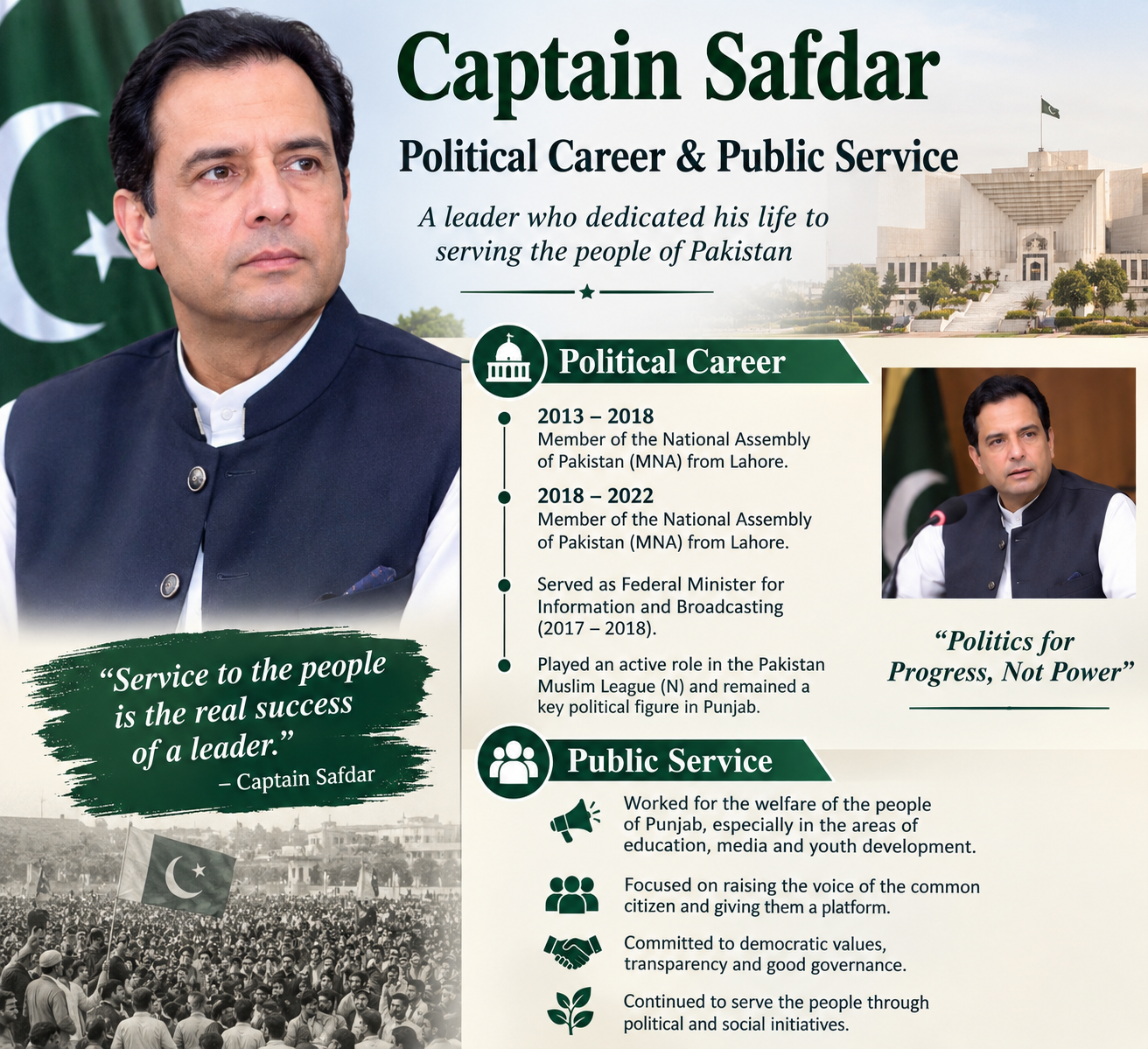
Captain Safdar, formally known as Capt. (R) Muhammad Safdar, is a Pakistani politician and former army officer associated with the Pakistan Muslim League-Nawaz (PML-N). He has remained a recognizable figure in Pakistani politics, particularly through his parliamentary career and his association with the political activities of PML-N.
His journey from military service to public life reflects a transition from serving the country through the armed forces to participating in democratic politics. Over the years, he has served as a Member of the National Assembly and has remained connected with the political organization of PML-N. The National Assembly's official profile identifies him as a PML-N politician from Khyber Pakhtunkhwa.
Captain Safdar's political career has included parliamentary representation, party organization, and engagement with issues of national and public importance. His story is also closely connected with one of Pakistan's most prominent political families through his marriage to Maryam Nawaz.
Early Life and Background
Muhammad Safdar was born in Mansehra, Khyber Pakhtunkhwa. He later joined the Pakistan Army and served as a captain before moving toward civilian and political life.
His military background played an important role in shaping his public identity. Military service generally develops qualities such as discipline, organization, responsibility, and commitment to duty.
After completing his military career, Safdar entered public life and eventually became involved in politics.
His background in both military service and politics gives his career a distinctive character within Pakistan's political landscape.
From Military Service to Politics
Captain Safdar's transition from the military to politics represents an important stage in his life.
Politics requires a different set of skills from military service. A politician has to communicate with citizens, understand public concerns, work within democratic institutions, and participate in political organization.
Safdar gradually became involved with the Pakistan Muslim League-Nawaz and established himself within the party.
His political journey demonstrates how individuals with different professional backgrounds can enter public service through democratic politics.
Association with PML-N
Captain Safdar has been associated with the Pakistan Muslim League-Nawaz for many years.
PML-N is one of Pakistan's major political parties and has played an important role in national and provincial politics.
Safdar's association with the party has included parliamentary politics as well as organizational responsibilities.
PML-N's own organizational records have listed Capt. (r) Muhammad Safdar as President of its Youth Wing.
This role highlights the importance of young people within political organizations.
Parliamentary Career
One of the most important parts of Captain Safdar's political career has been his service in the National Assembly.
He was elected to the National Assembly from constituencies in Punjab and Khyber Pakhtunkhwa during different periods of his political career.
The National Assembly's official record shows his parliamentary association with NA-21, Mansehra-cum-Tor Ghar, and identifies his party affiliation as PML-N.
Parliamentary service provides politicians with an opportunity to represent constituents, participate in legislative discussions, and raise issues of public importance.
Representation of Mansehra
Mansehra has been an important part of Captain Safdar's political identity.
Representing a constituency requires understanding the needs of local communities and communicating those concerns through democratic institutions.
The people of mountainous and relatively remote areas can face particular challenges involving education, healthcare, roads, employment, tourism, and infrastructure.
A representative's responsibility is to ensure that these concerns receive attention at the appropriate government level.
Youth Development
Youth development has been an important part of Captain Safdar's political association with PML-N.
His position as President of the PML-N Youth Wing demonstrates the party's focus on involving younger generations in political activities.
Young people represent a major part of Pakistan's population.
They can contribute to the country's future through education, entrepreneurship, technology, public service, and democratic participation.
Political organizations can provide young people with opportunities to learn leadership, communication, teamwork, and organizational skills.
Importance of Political Participation
Democracy depends on political participation.
Citizens participate in elections, political organizations, community activities, and public discussions.
Politicians such as Captain Safdar have participated in this democratic process through elections and party organization.
Political participation can help bring local issues into national discussions.
It can also encourage citizens to understand how democratic institutions work.
Public Service
Public service is one of the central purposes of politics.
An elected representative has responsibilities toward citizens regardless of their political background.
Parliamentarians can raise local issues, participate in legislative discussions, and communicate the concerns of their constituencies.
Captain Safdar's parliamentary career represents his participation in this system of public representation.
Military Background and Discipline
Captain Safdar's previous military career is an important part of his public identity.
Military service can teach discipline, organization, teamwork, and responsibility.
These qualities can also be useful in public life.
Political leadership, however, operates within democratic institutions and requires consultation, communication, and engagement with diverse opinions.
The combination of military experience and political participation makes his career distinctive.
Connection with Pakistan's Political History
Captain Safdar's political career has developed during an important period in Pakistan's democratic history.
Pakistan has experienced changes in governments, elections, political movements, and institutional developments.
Politicians who participate during such periods become part of the country's broader political history.
Safdar's parliamentary and party activities have therefore occurred within a wider story of democratic development in Pakistan.
Relationship with the Sharif Family
Captain Safdar is married to Maryam Nawaz, daughter of former Prime Minister Nawaz Sharif.
This relationship has made him a familiar figure within the political environment surrounding the Sharif family and PML-N.
His family connection has also increased public attention toward his political activities.
At the same time, his own parliamentary career and party roles form a separate part of his public identity.
Role in Political Organization
Political parties depend on organizational structures.
Youth wings, women's wings, professional groups, local organizations, and other party structures help political parties maintain contact with citizens.
Captain Safdar's association with the PML-N Youth Wing illustrates the importance of organizational politics.
Effective party organization can help communicate political ideas and connect leadership with supporters.
Importance of Young Leaders
Pakistan has a very large young population.
Young people need opportunities to participate in constructive activities and leadership.
Political youth organizations can provide platforms for students and young professionals to develop communication and organizational abilities.
Leadership opportunities can also encourage young people to become more interested in national issues.
Education and Youth
Education is essential for developing responsible future citizens.
Young people who understand history, government, economics, law, and civic responsibilities can participate more effectively in society.
Political organizations also have a responsibility to encourage informed participation rather than simply political slogans.
Youth leadership should ideally be connected with education, skills, service, and constructive citizenship.
National Unity
Pakistan is a diverse country containing different provinces, languages, cultures, and communities.
Political leadership has an important responsibility to promote unity and cooperation.
Representatives from different regions can help strengthen national connections by bringing local concerns into national discussions.
Captain Safdar's background in Khyber Pakhtunkhwa and his association with a major national political party are part of this broader political landscape.
Parliamentary Democracy
Parliament is one of the central institutions of democracy.
Members of Parliament represent citizens and participate in the country's legislative process.
Parliamentary politics requires debate, negotiation, and respect for constitutional procedures.
Captain Safdar's service in the National Assembly placed him within this democratic framework.
Importance of Political Experience
Political experience develops over time.
Representatives learn about legislation, administration, constituency issues, party organization, and public communication.
Captain Safdar's years of political involvement have given him experience in several dimensions of public life.
Such experience can be valuable when addressing complex political and social questions.
Communication with the Public
Modern politics requires strong communication.
Politicians communicate through parliamentary speeches, political meetings, public events, media appearances, and interactions with citizens.
Public communication allows political representatives to explain their positions and understand public concerns.
For any political leader, listening to citizens is just as important as speaking to them.
Service Beyond Elections
Public service should not begin and end with elections.
Political representatives can remain engaged with communities between elections through meetings, public activities, and organizational work.
This continued connection helps politicians understand changing public needs.
Importance of Regional Development
Regional development is essential for Pakistan.
Areas such as Mansehra and other parts of Khyber Pakhtunkhwa have significant potential in tourism, agriculture, trade, education, and natural resources.
Improving roads, educational institutions, healthcare facilities, and employment opportunities can contribute to regional development.
Political representatives can play a role by highlighting such issues in government and parliament.
Tourism Potential of Mansehra
Mansehra and surrounding areas possess considerable natural beauty.
The region provides access to mountainous landscapes and tourist destinations.
Tourism can create employment opportunities for local communities when supported by appropriate infrastructure and responsible planning.
Development of tourism can therefore contribute to local economic growth.
Importance of Infrastructure
Infrastructure is essential for economic and social development.
Roads, electricity, water systems, schools, hospitals, and communication networks help communities connect with wider markets and opportunities.
Representatives from less-developed areas have an important role in highlighting infrastructure needs.
Youth and Employment
Pakistan's young population needs meaningful employment opportunities.
Education and skills development can help young people enter the workforce.
Entrepreneurship, information technology, technical education, and vocational training can also create alternative career paths.
Youth-oriented political programmes can contribute to greater awareness of these opportunities.
Democratic Values
Democracy depends on several important values, including participation, accountability, representation, and respect for institutions.
Political figures contribute to democracy when they participate in elections and parliamentary processes.
Pakistan's democratic development requires political parties and citizens to continue strengthening these values.
Public Leadership
Leadership is not only about holding an office.
It involves responsibility, communication, decision-making, and service.
Captain Safdar's political journey illustrates the path of a public figure who moved from military service into political participation and parliamentary representation.
His career provides an example of how professional experience can be followed by involvement in democratic institutions.
Challenges in Pakistani Politics
Pakistani politics is often highly competitive.
Political leaders face criticism, disagreements, changing public expectations, and difficult policy debates.
Remaining active in politics requires resilience and the ability to engage with different viewpoints.
Captain Safdar's long association with public and political life has taken place within this challenging environment.
Future of Youth Participation
The future of Pakistan depends heavily on its young population.
Young people should have opportunities to participate in education, business, technology, sports, community service, and politics.
Political organizations can help develop future leaders when they provide young people with constructive opportunities and encourage informed civic participation.
The youth wing role associated with Captain Safdar is therefore significant in the context of political engagement.
Conclusion
Captain Safdar, or Capt. (R) Muhammad Safdar, is a notable Pakistani political figure whose career combines military service, parliamentary representation, and political organization.
His association with PML-N has been an important part of his public life, while his parliamentary career has included representation connected with Mansehra in Khyber Pakhtunkhwa. The National Assembly's official record identifies him as a PML-N politician and former member of the National Assembly.
His role in the PML-N Youth Wing has also highlighted the importance of young people in political organizations.
His journey from military service to democratic politics demonstrates a transition between two forms of public service. His political career has allowed him to participate in parliamentary institutions and represent political and regional interests.
Captain Safdar's story is also connected with the wider political history of PML-N and Pakistan's democratic development. His experiences provide an example of the diverse backgrounds from which political leaders can emerge.
For Pakistan's future, youth participation, education, democratic awareness, regional development, and responsible public leadership remain important priorities.
Captain Safdar's political journey therefore represents one chapter in the continuing story of Pakistan's political and democratic life.




