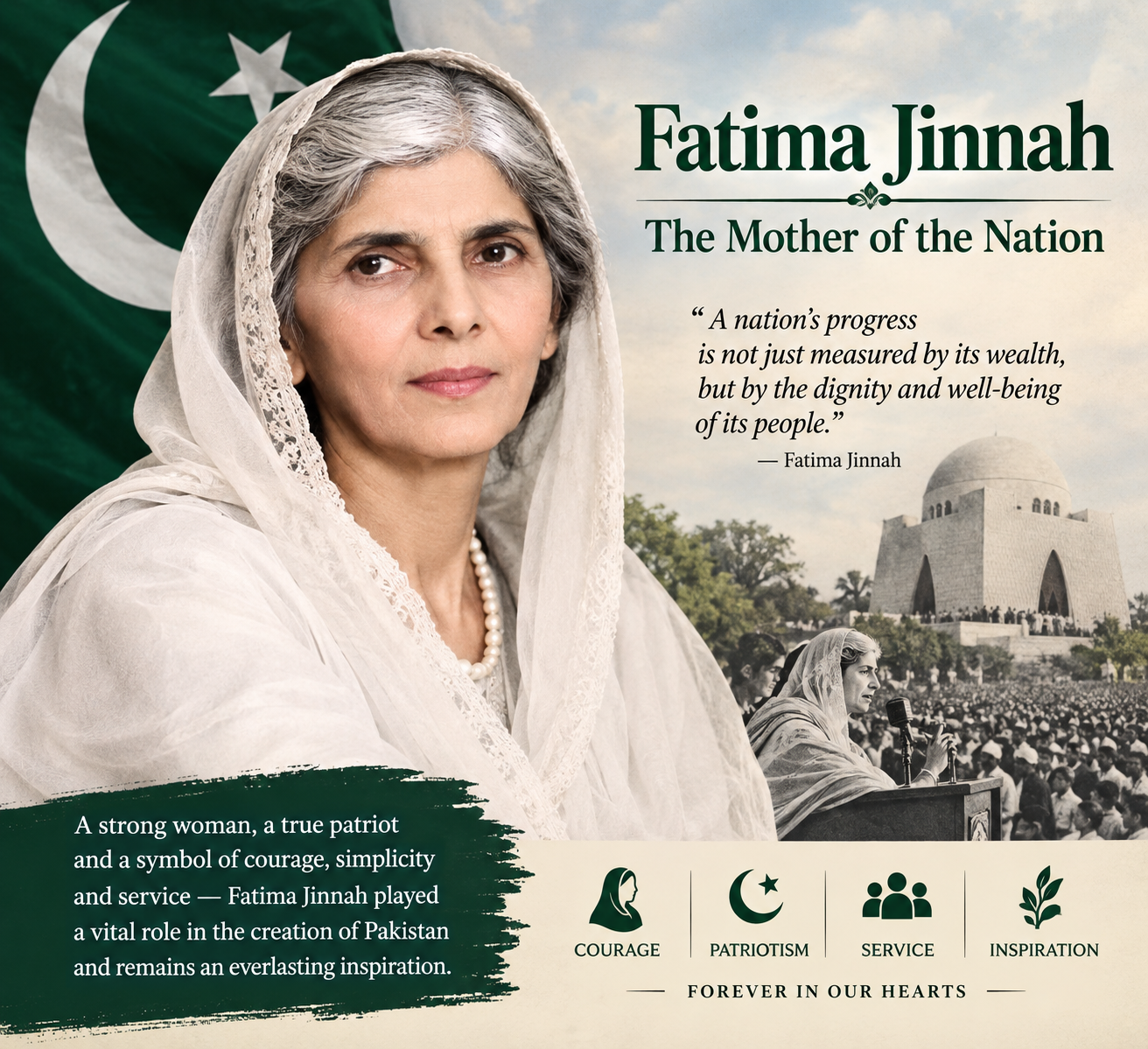
Fatima Jinnah was one of the most respected women in the history of Pakistan. She played an important role in the struggle for independence and remained a strong supporter of her brother, Quaid-e-Azam Muhammad Ali Jinnah. She is widely known as Madar-e-Millat, meaning “Mother of the Nation,” because of her services to Pakistan and her dedication to the people.
Fatima Jinnah was not only the sister of the founder of Pakistan but also a remarkable leader in her own right. She worked for the political, social, and economic improvement of Muslims of the subcontinent. At a time when women had fewer opportunities to participate in public and political life, she showed courage and determination and encouraged women to take an active role in the Pakistan Movement.
Early Life of Fatima Jinnah
Fatima Jinnah was born on 31 July 1893 in Karachi. She belonged to a respectable family and was the younger sister of Muhammad Ali Jinnah. Her family played an important role in shaping her character and values.
After the death of their parents, Muhammad Ali Jinnah took special care of his younger sister. Fatima Jinnah developed a close relationship with her brother and became one of his most trusted companions. Their relationship was based on mutual respect, affection, and understanding.
Fatima Jinnah received her education at a time when educational opportunities for Muslim girls were limited. She believed that education was essential for the progress of women and society. Her own education helped her develop confidence and independence.
Fatima Jinnah as a Dentist
Fatima Jinnah was also a trained dental surgeon. She studied dentistry and became one of the early Muslim women in the region to enter the profession.
Her decision to become a dentist was significant because professional careers for women were not common at that time. She proved that women could receive professional education and contribute to society through their skills.
After completing her education, she established a dental clinic in Calcutta. However, after the death of their mother, she eventually left her professional practice and devoted much of her time to supporting her brother.
Her professional background reflected her intelligence, discipline, and determination. She was a woman who believed in education, hard work, and self-reliance.
Relationship with Quaid-e-Azam
Fatima Jinnah had a very close relationship with Muhammad Ali Jinnah. She remained beside him during many difficult periods of his political career.
Muhammad Ali Jinnah was deeply involved in the struggle for the political rights of Muslims, and his political activities often required great sacrifices. Fatima Jinnah supported him during these challenging years.
She accompanied him on important occasions and provided personal and emotional support. Her presence gave him confidence, particularly during difficult political times.
However, Fatima Jinnah should not be remembered only as the sister of Quaid-e-Azam. She had her own identity, achievements, and political views. Her contribution to the Pakistan Movement was meaningful and deserves recognition.
Role in the Pakistan Movement
The Pakistan Movement was a historic political struggle that eventually resulted in the creation of Pakistan in 1947. Fatima Jinnah actively supported the movement.
She encouraged Muslim women to participate in political activities and understand the importance of the struggle for their community. Her participation helped demonstrate that the creation of Pakistan was not only a movement of men but also involved women.
She attended political meetings, supported Muslim League activities, and encouraged women to organize themselves. Her public presence inspired many Muslim women to become involved in national affairs.
Fatima Jinnah believed that women had an important role in building a strong society. She wanted women to become educated, responsible, and active citizens.
Encouraging Women to Participate
One of Fatima Jinnah's greatest contributions was her efforts to encourage women to participate in the Pakistan Movement.
During the independence struggle, women organized meetings, supported political campaigns, helped families affected by political unrest, and participated in public activities. Fatima Jinnah encouraged them to remain courageous and united.
She understood that a country could not progress if half of its population was excluded from national development.
Her message to women was based on education, confidence, discipline, and service. She wanted Pakistani women to become active participants in the development of the new country.
Fatima Jinnah and the Creation of Pakistan
Pakistan came into existence on 14 August 1947. The creation of the country was the result of years of political struggle and sacrifices by millions of people.
Fatima Jinnah was present during many important moments of this historic period. After independence, she continued to support the newly established state.
The early years of Pakistan were extremely difficult. Millions of people migrated across the new borders, and the country faced serious social and economic challenges.
Fatima Jinnah worked for the welfare of people affected by these difficulties. She supported relief activities and encouraged citizens to remain united.
Services After Independence
After Pakistan was created, Fatima Jinnah continued to play an important public role. She supported the government and worked for the welfare of citizens.
She particularly emphasized the importance of education, social development, and the participation of women in national life.
She also supported organizations and activities that aimed to improve the lives of women and children.
Fatima Jinnah believed that Pakistan needed educated and responsible citizens to become a successful nation. She encouraged people to work honestly and contribute to society.
Madar-e-Millat
Fatima Jinnah is commonly known as Madar-e-Millat, or Mother of the Nation. This title reflects the respect that people developed for her because of her services and dedication.
She represented qualities such as courage, dignity, honesty, discipline, and patriotism.
Her life became an example for Pakistani women. She showed that a woman could be educated, professionally successful, politically active, and socially responsible.
The title Madar-e-Millat is therefore not simply a reference to her relationship with Quaid-e-Azam. It also represents her own contribution to the country.
Presidential Election of 1965
One of the most important political moments in Fatima Jinnah's life came in 1965, when she contested the presidential election against President Ayub Khan.
Her decision to participate in the election was historic. She became an important opposition figure and received support from several political groups.
Her campaign attracted considerable public attention. Many people viewed her candidacy as an important opportunity for greater political participation and democratic values.
Although she did not win the election, her participation demonstrated her political courage.
She showed that an elderly woman could enter a major political contest and stand firmly for her beliefs.
Political Vision
Fatima Jinnah believed that democracy, constitutional government, justice, and equality were important for Pakistan.
She wanted Pakistan to become a country where citizens could enjoy their rights and live with dignity.
She also believed that women should receive equal opportunities in education and national development.
Her political ideas were strongly connected with the principles associated with the Pakistan Movement. She emphasized national unity and responsible citizenship.
Message for Pakistani Women
Fatima Jinnah's life carries an important message for Pakistani women.
She demonstrated that education can give women confidence and independence. Her own career as a dentist showed that women could enter professional fields even when social expectations were restrictive.
She also showed that women could participate in politics and public life without abandoning their values.
Her example encouraged women to develop their abilities and contribute positively to their families and communities.
Leadership Qualities
Fatima Jinnah possessed several qualities that made her an inspiring leader.
Courage
She faced political and social challenges with courage. Her decision to participate in the 1965 presidential election demonstrated her willingness to stand for her beliefs.
Determination
Fatima Jinnah remained committed to her principles despite difficulties. She continued serving the country after independence.
Education
She understood the importance of education and demonstrated its value through her own professional career.
Patriotism
Her life was closely connected with the struggle for Pakistan and the development of the new country.
Service
She devoted a large part of her life to serving people and supporting national causes.
Fatima Jinnah as a Role Model
Fatima Jinnah remains a role model for Pakistani women and young people.
Her life teaches us that success is not only about personal achievements. True success also comes from serving others and contributing to society.
She showed that women can make important contributions to politics, education, healthcare, and national development.
Young people can learn from her discipline and determination. Her story encourages students to take education seriously and develop confidence in their abilities.
Importance of Women's Education
Fatima Jinnah strongly supported women's education. She understood that educated women could contribute to the progress of their families and communities.
Education allows women to make informed decisions, develop professional skills, and participate more effectively in society.
Her own life provides a powerful example. She became a professional dentist at a time when women entering professional careers was relatively uncommon.
Today, her message remains relevant. Pakistan needs educated women in every field, including medicine, education, technology, law, business, science, and public service.
Contribution to National Unity
Fatima Jinnah also emphasized national unity. Pakistan was created through a long political struggle, and maintaining unity after independence was another major challenge.
She encouraged people to remain connected to the principles of justice, equality, and responsible citizenship.
Her public speeches and political activities reflected her concern for the country's future.
She believed that political differences should not destroy national unity. Citizens needed to work together for the progress of Pakistan.
Legacy of Fatima Jinnah
Fatima Jinnah passed away on 9 July 1967 in Karachi. Her death was deeply mourned throughout Pakistan.
Her legacy, however, continued.
Schools, colleges, hospitals, roads, public buildings, and institutions have been named after her. Her image and name remain part of Pakistan's national history.
Her contributions are remembered every year, particularly on occasions connected with the Pakistan Movement and women's development.
Her life remains an important part of the story of Pakistan because she represented both the struggle for independence and the continuing struggle for social progress.
Why Fatima Jinnah Still Matters Today
Fatima Jinnah's ideas remain relevant in modern Pakistan.
The country still needs educated citizens, strong institutions, responsible leadership, and greater opportunities for women.
Her life reminds us that women should not be limited to a single role. Women can become professionals, leaders, educators, entrepreneurs, political representatives, and community workers.
Her story also teaches the importance of standing firmly for one's principles.
In an age of rapid social and technological change, young people can learn from her discipline and commitment to national service.
Conclusion
Fatima Jinnah was one of the most influential women in Pakistan's history. She was a dentist, political activist, national leader, and an important supporter of the Pakistan Movement.
She stood beside Quaid-e-Azam during some of the most difficult periods of his political life, but her contribution went beyond being his sister. She encouraged Muslim women to participate in the struggle for independence and later remained active in the public life of Pakistan.
Her participation in the 1965 presidential election demonstrated remarkable political courage. Her support for education, democracy, women's participation, and national unity made her an enduring symbol of service.
Fatima Jinnah's title, Madar-e-Millat, reflects the deep respect she earned through her dedication to the nation.
Her life teaches us that courage, education, determination, and service can create a lasting legacy. For Pakistani women and young people, Fatima Jinnah remains an inspiring example of how one person can make a meaningful contribution to the history and future of a country.
FAQs
1. Who was Fatima Jinnah?
Fatima Jinnah was a Pakistani dentist, political leader, and the younger sister of Quaid-e-Azam Muhammad Ali Jinnah.
2. Why is Fatima Jinnah called Madar-e-Millat?
She is called Madar-e-Millat, meaning Mother of the Nation, because of her services to Pakistan and her important role in the Pakistan Movement.
3. What was Fatima Jinnah's profession?
Fatima Jinnah was a trained dental surgeon and was among the early Muslim women in the region to enter the dental profession.
4. What was Fatima Jinnah's role in the Pakistan Movement?
She supported Quaid-e-Azam, encouraged Muslim women to participate in political activities, and actively supported the struggle for Pakistan.
5. When did Fatima Jinnah die?
Fatima Jinnah died on 9 July 1967 in Karachi.




