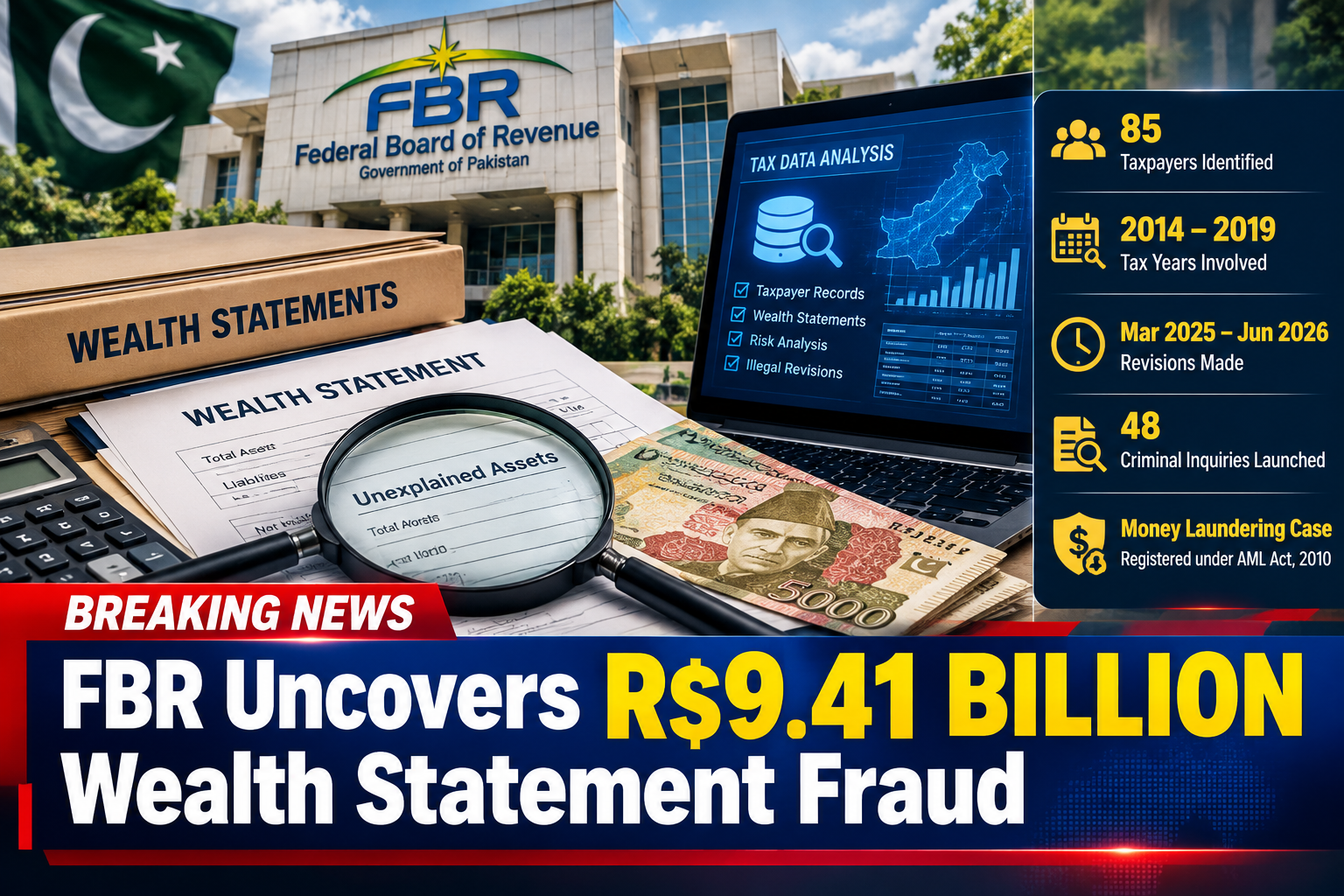
The Federal Board of Revenue (FBR) has uncovered a major wealth statement fraud involving unexplained assets worth Rs9.41 billion after detecting illegal revisions in old tax records. The development was announced by the FBR on September 30, 2026, and has raised important questions about the use of tax records, wealth declarations, undeclared assets and enforcement of Pakistan’s tax laws.
According to the FBR, its Directorate General of Intelligence and Investigation (Inland Revenue), with technical support from Pakistan Revenue Automation Limited (PRAL), analyzed the tax authority’s database and identified 85 taxpayers who had made changes to old wealth statements. These revisions were made between March 2025 and June 2026 but related to tax years from 2014 to 2019.
The tax authority said the taxpayers inserted previously undeclared assets including cash, physical gold, prize bonds, properties and business capital into their old wealth statements. The FBR said these revisions were made after the legal time limit and therefore were not permitted under the relevant provisions of the Income Tax Ordinance, 2001.
The FBR has registered a criminal case under the Anti-Money Laundering Act, 2010, while 48 criminal inquiries have been launched by regional directorates across Pakistan. Further proceedings are also underway in other cases.
What Is the Rs9.41 Billion Wealth Statement Fraud?
A wealth statement is an important part of Pakistan’s tax system. It provides information about a taxpayer’s assets, liabilities and financial position.
The latest FBR investigation found that 85 taxpayers had revised old wealth statements and added assets that had not previously appeared in their records.
According to the FBR, the total value of the unexplained assets added through these revisions was Rs9.41 billion.
The assets reportedly included:
Cash
Physical gold
Prize bonds
Properties
Business capital
The FBR described the activity as fraudulent and said the revisions were made beyond the legally permitted period.
The discovery was made through detailed database analysis rather than through a single individual complaint. This demonstrates how digital tax records can be used to identify unusual patterns in financial declarations.
How the FBR Detected the Irregularities
The Directorate General of Intelligence and Investigation (Inland Revenue) conducted an analysis of the FBR database with assistance from Pakistan Revenue Automation Limited.
The analysis focused on changes made to old wealth statements.
According to the FBR, the investigation identified 85 taxpayers who revised wealth statements relating to tax years 2014 through 2019. These revisions were made much later, between March 2025 and June 2026.
Data analysis can allow tax authorities to compare information across different years and identify unusual changes.
For example, if a taxpayer suddenly adds a large amount of cash or property to an old declaration many years after the original return, the system can flag the change for further examination.
The FBR’s investigation indicates that this type of digital analysis played an important role in identifying the alleged irregularities.
The Legal Time Limit for Revising Wealth Statements
One of the central issues in the case is the legal time limit for revising a wealth statement.
The FBR said that under the explanation to Section 116(3) of the Income Tax Ordinance, 2001, a wealth statement cannot be revised after five years from the due date of the original return.
The taxpayers identified in the investigation reportedly made revisions beyond this period.
This means the issue was not simply that new information appeared in an old tax record. According to the FBR, the revisions themselves were outside the period allowed by law.
The authority therefore treated the activity as a serious tax enforcement matter.
A Lahore Case Provides an Example
The FBR highlighted one case investigated by its Directorate of Intelligence and Investigation (Inland Revenue) in Lahore.
According to the FBR, a taxpayer revised a wealth statement for tax year 2015 in May 2026.
The taxpayer reportedly inserted fictitious funds of Rs102.8 million into the old statement.
The amount was then carried forward through subsequent wealth statements until 2025.
The FBR said these funds were later used to account for seven properties purchased in May and June 2026. The combined value of those properties was reported at Rs64.41 million.
When questioned by the authorities, the taxpayer reportedly could not explain the source of the funds.
The FBR said that the tax sought to be evaded in this individual case exceeded Rs46 million.
This case was important because it demonstrated how an old financial entry could potentially be carried forward and later used to explain the acquisition of assets.
Criminal Case Under Anti-Money Laundering Law
The FBR has registered a criminal case under the Anti-Money Laundering Act, 2010.
The case is related to the alleged manipulation of wealth statements and unexplained funds.
The FBR said the money laundering case has been registered against the taxpayer and any accomplices or abettors found to have been involved.
The authority also said additional cases were being processed.
It is important to distinguish an allegation or investigation from a final court finding. The FBR’s announcement describes the conduct it has identified and the legal action it has initiated; final criminal responsibility would depend on the relevant legal proceedings.
48 Criminal Inquiries Across Pakistan
The investigation has expanded beyond the individual Lahore case.
According to the FBR, regional directorates of Intelligence and Investigation (Inland Revenue) have launched 48 criminal inquiries across Pakistan. Proceedings in the remaining cases are also continuing.
This means the issue is being examined at a national level rather than being limited to one taxpayer or one city.
The investigations may help authorities determine the circumstances surrounding the revisions, the sources of the assets and whether other individuals participated in the alleged scheme.
Why Wealth Statements Matter
Wealth statements are important because they help tax authorities understand changes in a taxpayer’s financial position.
A person’s wealth can change because of legitimate reasons such as:
Salary or business income
Property purchases
Property sales
Investments
Inheritance
Gifts
Savings
Other legally documented sources
Tax authorities can compare declared income with changes in assets to determine whether the financial information is consistent.
If a person reports relatively limited income but later shows significant assets without an identifiable source, the information may require further examination.
This does not automatically establish wrongdoing, but it can create grounds for a tax inquiry.
The Role of Digital Tax Records
Pakistan has increasingly moved toward digital systems for tax administration.
The latest investigation illustrates the importance of electronic records in identifying unusual financial activity.
Instead of examining every wealth statement manually, data systems can help identify patterns.
For example, authorities can look for:
Large changes in old wealth statements
Unusual asset additions
Repeated revisions
Changes made long after the original filing
Differences between income and wealth
Property purchases that do not appear consistent with declared funds
The FBR’s use of database analysis with PRAL support demonstrates how technology can strengthen tax enforcement.
Unexplained Assets and Tax Compliance
The central concern in the investigation is the declaration of assets whose source could not be adequately explained.
Tax compliance depends on accurate financial reporting.
When taxpayers provide complete and accurate information, authorities can assess their tax obligations more effectively.
When financial information is incomplete or manipulated, it can become difficult for the tax system to determine the actual financial position of a taxpayer.
The FBR has therefore emphasized that its systems will continue to monitor unusual changes in tax records.
Cash, Gold and Prize Bonds
The FBR said the identified revisions involved different forms of wealth.
Cash can be difficult to verify when it is not supported by financial records.
Physical gold is another form of wealth that may appear in wealth declarations.
Prize bonds can also represent financial assets.
The inclusion of these different categories in old wealth statements shows that the alleged revisions were not limited to one type of property.
The FBR’s investigation focused on whether these assets had been properly declared and whether the revisions were legally permissible.
Property Purchases and Wealth Declarations
Property is one of the most significant forms of wealth in Pakistan.
Real estate transactions can involve substantial amounts of money, making property purchases an important area for tax authorities.
In the highlighted Lahore case, the FBR said the taxpayer used the previously inserted funds to account for seven properties acquired in May and June 2026.
The case demonstrates why tax authorities may compare property records with wealth statements.
If property ownership changes significantly, authorities can examine whether the purchase price is consistent with the buyer’s declared financial resources.
Importance for Pakistan’s Tax System
Pakistan has long faced challenges in broadening the tax base and improving compliance.
Effective enforcement can help ensure that people and businesses meet their legal tax responsibilities.
The latest investigation is significant because it involves the manipulation of historical financial information rather than simply the failure to file a current return.
The FBR’s action suggests that tax enforcement is increasingly focused on examining historical data and identifying inconsistencies.
Use of Data Analytics in Tax Enforcement
Modern tax administrations around the world increasingly use data analytics.
Large databases contain information that can be compared across different sources.
For Pakistan, this can include information related to:
Tax returns
Wealth statements
Property transactions
Business activity
Banking-related information available to authorities under applicable law
Vehicle ownership
Other financial records
When properly used, data analytics can help identify unusual patterns and allow tax officers to focus investigations where further review is necessary.
The latest FBR case is an example of this approach.
What the FBR Says About Future Enforcement
The FBR has stated that it will continue using data analytics to identify manipulation of tax records.
The authority has also made clear that individuals involved in illegal revisions may face penalties and prosecution under applicable laws.
The registration of a criminal case under the Anti-Money Laundering Act represents a significant escalation from an ordinary tax discrepancy.
Further cases are also being processed.
The outcome of these cases will depend on evidence gathered during investigations and the relevant legal proceedings.
Difference Between Tax Error and Alleged Fraud
Not every mistake in a tax declaration is necessarily fraud.
A taxpayer may sometimes make an honest mistake and later correct information according to the procedures permitted by law.
The latest FBR announcement concerns a specific set of revisions that the authority says were made beyond the legal time limit and involved previously undeclared or unexplained assets.
Because the FBR has described these cases as fraudulent, criminal inquiries have been initiated.
However, individual cases still require examination through the legal process.
This distinction is important when discussing tax investigations because an accusation does not by itself constitute a final conviction.
Impact on Taxpayers
The investigation may encourage taxpayers to pay greater attention to the accuracy of their financial records.
Taxpayers should maintain proper documentation for assets and financial transactions and comply with the applicable rules for filing and revising returns.
Keeping records can be particularly important for property purchases, investments, inheritances, gifts and business transactions.
Clear documentation can help establish the source of funds when requested by tax authorities.
Impact on Property and Business Sectors
The investigation may also have implications for Pakistan’s property and business sectors.
Real estate transactions are an important part of the country’s economy.
When tax authorities increase scrutiny of wealth declarations and property purchases, taxpayers involved in property transactions may face greater demands for documentation and financial transparency.
Businesses can similarly be affected when authorities compare declared capital with other financial information.
Greater transparency can help reduce the use of unexplained financial resources in the formal economy.
Importance of Accurate Historical Records
Historical tax records are valuable because they show how a taxpayer’s financial position changed over time.
A wealth statement from one year can be compared with statements from previous and later years.
If an asset suddenly appears in an old statement, tax authorities can examine when it was added and why.
In the latest case, the FBR specifically examined revisions made years after the original tax years.
The investigation shows why maintaining reliable historical tax data is important for tax administration.
FBR and Pakistan Revenue Automation Limited
Pakistan Revenue Automation Limited, commonly known as PRAL, provides technology-related support for Pakistan’s tax administration.
The FBR said the wealth statement fraud was detected through database analysis carried out with PRAL support.
Technology has become an increasingly important part of tax collection and compliance.
Digital systems can help reduce manual processing, improve record management and identify unusual patterns more efficiently.
The latest investigation highlights how technological infrastructure can support financial investigations.
What Happens Next?
The next stage will involve investigations and legal proceedings.
The FBR has already launched 48 criminal inquiries across Pakistan and registered a money laundering case in connection with the highlighted case.
Investigators may examine financial records, property transactions, wealth statements and other relevant evidence.
Where sufficient evidence exists, cases may proceed through the appropriate legal channels.
The final outcomes will depend on the evidence and decisions of the relevant authorities and courts.
Broader Significance for Pakistan
The Rs9.41 billion figure makes the case significant in terms of the value of assets involved.
However, the broader importance lies in the method allegedly used to introduce the assets into the tax record.
The investigation suggests that the FBR is examining not only current tax returns but also changes made to historical wealth statements.
This approach could make it more difficult to use old tax records to introduce unexplained assets into the financial history of a taxpayer.
Conclusion
The Federal Board of Revenue’s discovery of alleged wealth statement fraud involving Rs9.41 billion represents a major development in Pakistan’s tax enforcement system.
According to the FBR, 85 taxpayers revised wealth statements for tax years 2014 to 2019 between March 2025 and June 2026, adding previously undeclared cash, gold, prize bonds, properties and business capital. The authority said these revisions were made beyond the legally permitted period.
The FBR has registered a criminal case under the Anti-Money Laundering Act, 2010 and launched 48 criminal inquiries across Pakistan. One highlighted Lahore case involved Rs102.8 million in allegedly fictitious funds that were later carried forward and used to account for seven properties. The FBR said the tax sought to be evaded in that case exceeded Rs46 million.
The case also demonstrates the growing role of digital data analysis in Pakistan’s tax administration. By comparing information across multiple years, authorities can identify unusual changes and investigate potentially irregular financial activity.
At the same time, individual allegations must go through the relevant legal process before final responsibility is established.
For Pakistan’s tax system, the case highlights the importance of accurate wealth declarations, proper financial documentation, effective digital monitoring and enforcement of tax laws. Continued investigation will determine the final legal outcomes in the cases identified by the FBR.
FAQs
1. What amount of wealth statement fraud did FBR uncover?
The FBR reported unexplained assets worth Rs9.41 billion linked to the alleged illegal revisions.
2. How many taxpayers were identified?
The FBR identified 85 taxpayers whose old wealth statements had been revised.
3. Which tax years were involved?
The revisions related to wealth statements for tax years 2014 to 2019.
4. Has a criminal case been registered?
Yes. The FBR said a criminal case was registered under the Anti-Money Laundering Act, 2010.
5. How many criminal inquiries have been launched?
The FBR said its regional directorates have launched 48 criminal inquiries across Pakistan.




