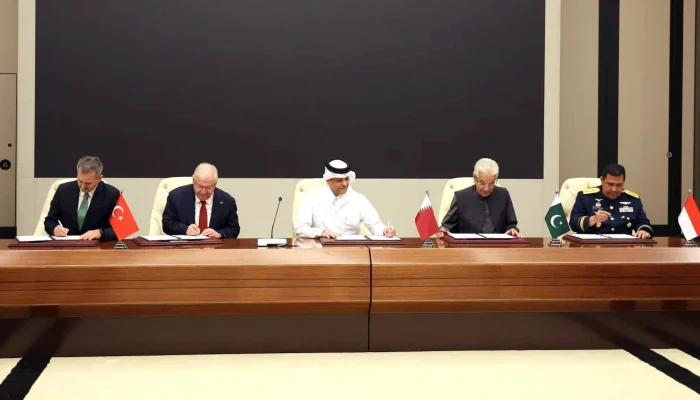
In a landmark development reshaping regional security architectures, representatives from Pakistan, Turkey, Qatar, and Indonesia have officially signed a sweeping multilateral defense cooperation agreement. Dubbed the Badr Memorandum of Understanding, the high-profile pact was inked in Doha, marking a major milestone in defense diplomacy and technological collaboration among key allied nations.
The agreement brings together four influential states spanning South Asia, the Middle East, and Southeast Asia. Represented by their respective leadership—including Pakistani Defense Minister Khawaja Muhammad Asif and Turkish National Defense Minister Yaşar Güler—the coalition aims to pool strategic assets, industrial know-how, and military capabilities to face evolving modern security challenges.
Moving Beyond Simple Procurement to Joint Innovation
At its core, the Badr accord represents a strategic evolution in how developing defense powers approach military readiness. Rather than relying on traditional buyer-seller transactions, the four nations have committed to shifting toward joint production, heavy technology transfers, supply chain integration, and deep interoperability.
Officials from Turkey’s Presidency of Defence Industries (SSB) emphasized that the framework seeks to leverage the distinct industrial strengths of each partner. Turkey brings its robust, battle-tested defense manufacturing ecosystem—boasting NATO's second-largest standing army—while nations like Pakistan, Indonesia, and Qatar contribute specialized manufacturing capacities, strategic positioning, and financial depth.
Previous bilateral successes serve as a sturdy foundation for this broader multilateral pact. Turkey and Indonesia, for instance, have previously collaborated on advanced military hardware such as the KAPLAN MT medium-weight tank production. Similarly, Turkey and Pakistan share deep-seated naval and aviation cooperation, while Qatar maintains long-standing, robust military ties with Ankara.
Broadening Scope: Training, R&D, and Exercises
Beyond hardware manufacturing, the Badr memorandum outlines extensive cooperation across multiple operational domains. According to defense statements released following the Doha summit, the framework explicitly supports:
Joint Military Exercises: Enhancing tactical coordination and interoperability through combined training drills.
Research and Development (R&D): Pooling scientific talent to co-develop next-generation defense technologies, electronic warfare systems, and modern digital architectures.
Technical Military Training: Streamlining educational exchanges and specialized programs to share institutional expertise across all four armed forces.
By institutionalizing these channels, the participating countries aim to create an integrated ecosystem capable of meeting the complex demands of contemporary security environments without relying entirely on Western supply chains.
Strategic Geopolitics and Future Outlook
The timing of the Badr accord underscores a broader trend of middle powers forging independent, collaborative security networks amid shifting global dynamics. As traditional security umbrellas face unprecedented strains, regional states are increasingly taking the initiative to fortify their sovereign borders through collective self-reliance.
For Pakistan, the pact offers an invaluable platform to expand its defense exports, share technological breakthroughs, and solidify strategic relationships across the Middle East and Asia. As implementation committees begin mapping out joint projects under the newly minted memorandum, the Badr accord stands out as a powerful testament to the future of multilateral defense cooperation.