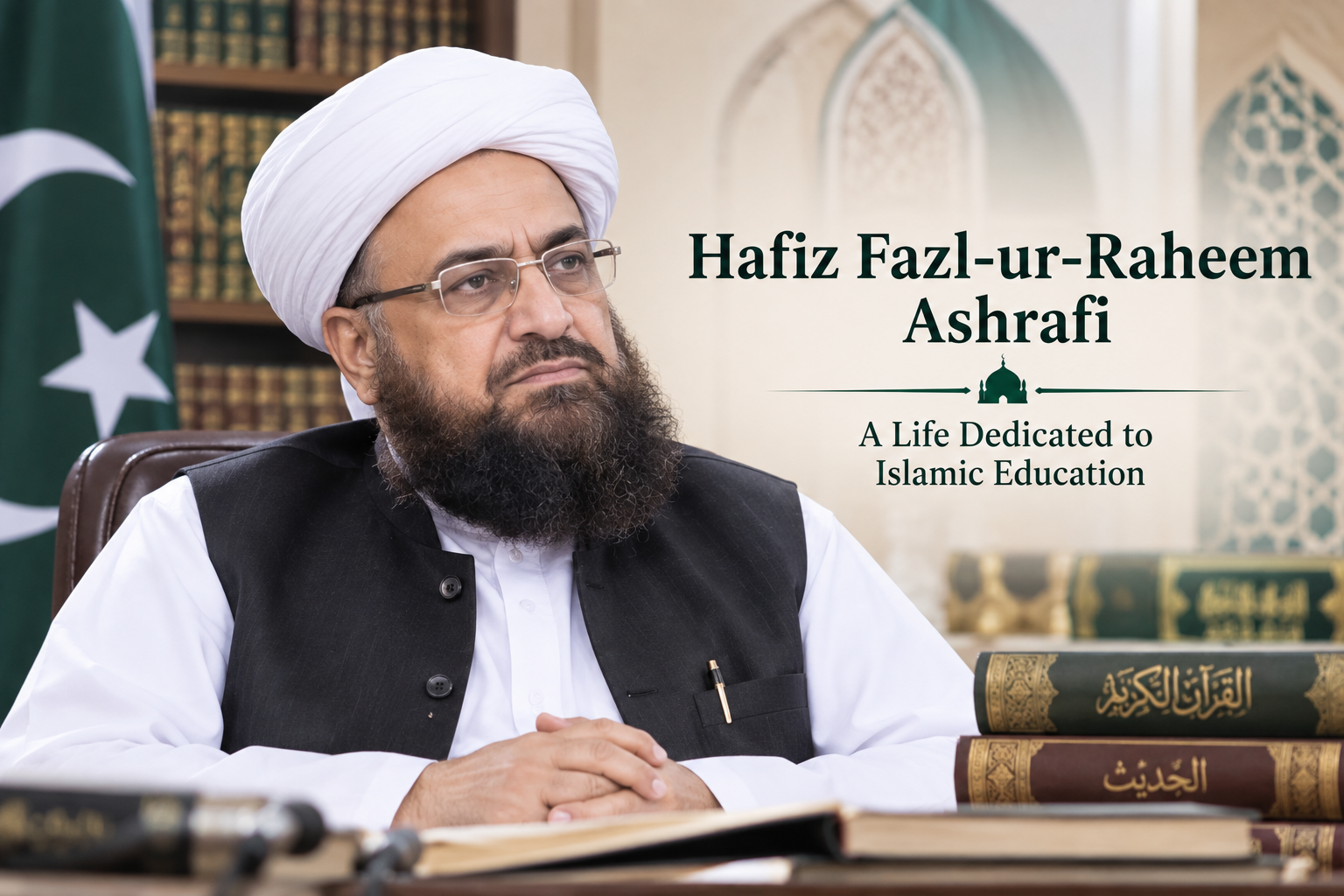
Introduction
Hafiz Fazl-ur-Raheem Ashrafi was a respected Pakistani Islamic scholar, teacher, and religious personality. He spent much of his life serving Islamic education and helping students learn the Quran, Hadith, and other areas of religious knowledge. He was closely associated with Jamia Ashrafia Lahore, one of Pakistan's well-known religious educational institutions. He served as its Chancellor and became an important name in the field of Islamic education.
His life was connected with teaching, scholarship, religious guidance, and the development of students. He was also associated with the Wifaq-ul-Madaris Al-Arabia, a major religious educational board in Pakistan. His long career showed the importance of education, discipline, knowledge, and service.
Hafiz Fazl-ur-Raheem Ashrafi was born on 10 November 1944 in Amritsar, British India. He belonged to a religious family. His father was Mufti Muhammad Hassan, who founded Jamia Ashrafia. This family environment played an important role in his early education and religious development.
For many decades, he remained connected with religious education. He taught and guided students and worked for the continuation of traditional Islamic scholarship. His death in January 2026 was mourned by many people connected with religious education. Prime Minister Shehbaz Sharif also expressed grief and described him as a distinguished religious scholar and Hadith expert who had made important contributions to religious education.
Early Life and Family
Hafiz Fazl-ur-Raheem Ashrafi was born in Amritsar in 1944. At that time, the region was part of British India. His family had a strong connection with Islamic scholarship.
His father, Mufti Muhammad Hassan, was an important religious scholar and the founder of Jamia Ashrafia. Because of this family background, religious education became an important part of Fazl-ur-Raheem Ashrafi's life from an early age.
Growing up in a family of scholars can provide a strong educational environment. He had the opportunity to learn about religious subjects, Islamic traditions, and the importance of serving students.
His later career showed that education was not simply a family tradition for him. It became a major responsibility that he continued for many years.
Connection with Jamia Ashrafia
One of the most important parts of Hafiz Fazl-ur-Raheem Ashrafi's life was his association with Jamia Ashrafia Lahore.
Jamia Ashrafia is an important religious educational institution in Pakistan. It has been associated with the teaching of Islamic sciences and the training of religious scholars.
Because his father founded the institution, the Ashrafi family had a deep connection with its development. Hafiz Fazl-ur-Raheem Ashrafi later became its Chancellor and played a major role in its administration and educational activities.
His work at Jamia Ashrafia was not limited to holding a title. The institution provided education to students, and its teachers and scholars worked to preserve traditional Islamic learning.
For students, religious seminaries can provide education in subjects such as Quran, Hadith, Arabic, Islamic jurisprudence, and other religious sciences. Hafiz Fazl-ur-Raheem Ashrafi remained connected with this educational tradition throughout his life.
Role as Chancellor
Hafiz Fazl-ur-Raheem Ashrafi served as the Chancellor of Jamia Ashrafia Lahore from 2016 until his death in 2026.
As Chancellor, he was connected with the institution's overall educational and administrative direction.
A chancellor of a large educational institution has many responsibilities. These can include supporting teachers, maintaining educational standards, helping students, and protecting the institution's academic traditions.
His position also placed him among senior figures in Pakistan's religious educational community.
The institution continued to serve students during his leadership. His role reflected the importance of experienced scholars in maintaining educational institutions.
Islamic Scholarship
Hafiz Fazl-ur-Raheem Ashrafi was recognized as an Islamic scholar and Hadith expert. Islamic scholarship requires years of study, reading, teaching, and careful understanding of religious sources.
Hadith studies are an important part of Islamic education. They involve the study of reports about the sayings, actions, and teachings of Prophet Muhammad (peace be upon him).
As a scholar, Hafiz Fazl-ur-Raheem Ashrafi remained connected with this field. His work represented the traditional educational system in which senior scholars teach younger generations.
His title as Sheikh-ul-Hadith also reflected his association with Hadith education. Through teaching and guidance, senior scholars can help students understand religious texts and develop their knowledge.
Importance of Religious Education
One of the strongest lessons from his life is the importance of education.
Education gives people knowledge and helps them understand their responsibilities. Religious education can also influence a person's character, discipline, and understanding of moral values.
Hafiz Fazl-ur-Raheem Ashrafi dedicated a major part of his life to religious education. According to a statement from the Prime Minister's Office reported by Radio Pakistan, he dedicated his life to teaching Quran and Sunnah and promoting Islamic and moral education.
This shows why teachers and scholars have an important role in society. They do not only transfer information. They can also guide students toward responsible behavior and respect for knowledge.
Service to Students
Students were an important part of Hafiz Fazl-ur-Raheem Ashrafi's professional life.
An educational institution becomes meaningful because of its students. Teachers help students develop knowledge, confidence, discipline, and a sense of responsibility.
Religious students often spend years studying different subjects. Their education requires patience and regular effort.
Senior scholars like Hafiz Fazl-ur-Raheem Ashrafi contributed to this educational environment by teaching and guiding students.
His long association with Jamia Ashrafia allowed generations of students to study in an environment connected with traditional Islamic scholarship.
Work with Wifaq-ul-Madaris
Hafiz Fazl-ur-Raheem Ashrafi was also associated with the Wifaq-ul-Madaris Al-Arabia Pakistan. He served as its patron for many years.
Wifaq-ul-Madaris is an important organization in Pakistan's religious education system. It is associated with religious seminaries and educational activities.
His association with the organization demonstrated his wider role in religious education beyond one institution.
Through such organizations, scholars and educational leaders can work on educational standards, examinations, academic programs, and the development of religious institutions.
His involvement therefore connected him with a wider network of Islamic educational institutions.
Role in Quran Education
The Quran holds a central position in Islamic education. Learning the Quran, understanding its message, and applying its moral teachings are important parts of religious learning.
Hafiz Fazl-ur-Raheem Ashrafi's educational work was closely connected with Quran and Sunnah.
Teaching the Quran requires patience and responsibility. Students need proper guidance to understand the text and its meaning.
His life reflected the importance of keeping Quranic education connected with formal learning institutions.
For young students, Quran education can also develop discipline and regular study habits. Learning religious texts requires consistency, attention, and respect for knowledge.
Teaching Hadith
Hadith education was another important part of his scholarly work.
Hadith is a major source of Islamic learning after the Quran. Scholars study Hadith through established methods and examine the texts and traditions carefully.
A teacher of Hadith has an important responsibility because students depend on teachers to understand difficult religious material.
Hafiz Fazl-ur-Raheem Ashrafi became known as a senior scholar in this field. His work as a Sheikh-ul-Hadith reflected his long connection with Hadith teaching.
Through such educational work, scholars help preserve religious knowledge from one generation to another.
Moral Education
Education is not only about books and examinations. Character is also an important part of learning.
Hafiz Fazl-ur-Raheem Ashrafi's work was connected with moral and Islamic education. The Prime Minister's condolence message highlighted his contributions to moral education and religious values.
Moral education teaches students values such as honesty, respect, patience, responsibility, kindness, and justice.
These values can be important in family life, education, professional life, and society.
A person with knowledge also needs good character. This is one of the important ideas reflected in the work of many religious teachers.
Leadership in Religious Education
Leadership in education requires responsibility.
A leader of an educational institution has to think about students, teachers, academic traditions, administration, and the future of the institution.
Hafiz Fazl-ur-Raheem Ashrafi's position as Chancellor placed him in such a leadership role.
His long service showed the importance of experienced leadership in religious institutions.
He remained connected with Jamia Ashrafia for many years and helped maintain its educational role.
Respect for Teachers
His life also provides a lesson about the importance of teachers.
Teachers spend their time helping students understand difficult subjects. Religious teachers have an additional responsibility because they deal with subjects connected with faith, values, and personal conduct.
A good teacher needs knowledge, patience, and dedication.
The work of Hafiz Fazl-ur-Raheem Ashrafi demonstrates how a teacher can influence generations of students.
Even after a teacher passes away, the knowledge taught by that teacher can continue through students.
Influence on Future Scholars
One of the most important ways a scholar leaves a legacy is through students.
A scholar may teach hundreds or thousands of students during a long career. Those students can later become teachers, scholars, writers, researchers, and community leaders.
In this way, knowledge can continue for generations.
Hafiz Fazl-ur-Raheem Ashrafi's association with Jamia Ashrafia meant that his educational work became part of a wider scholarly tradition.
The students who studied under the institution can carry their knowledge forward and teach others.
Importance of Jamia Ashrafia
Jamia Ashrafia has an important place in Pakistan's religious education.
The institution was founded by Mufti Muhammad Hassan, the father of Hafiz Fazl-ur-Raheem Ashrafi.
The institution's history is therefore closely connected with the Ashrafi family.
Over the years, it became a place where students could study Islamic sciences and prepare for religious service.
Hafiz Fazl-ur-Raheem Ashrafi's leadership as Chancellor continued this educational tradition.
His work showed how institutions can preserve knowledge while preparing new generations of students.
A Life of Dedication
A long educational career requires dedication.
Teachers have to prepare lessons, spend time with students, answer questions, and continue their own learning.
Religious scholars also have to study traditional texts and remain connected with their educational responsibilities.
Hafiz Fazl-ur-Raheem Ashrafi spent decades in this environment.
His life demonstrates that meaningful service does not always require fame in entertainment or politics. Teaching and education can also have a deep impact on society.
Passing Away in 2026
Hafiz Fazl-ur-Raheem Ashrafi passed away on 4 January 2026 at the age of 81. His funeral prayers were held in Lahore on 5 January.
His death was a significant loss for the religious education community.
Prime Minister Shehbaz Sharif expressed grief over his death and praised his contributions to religious education. The Prime Minister described him as a distinguished scholar and Hadith expert and said that his services to Quran and Sunnah education would be remembered.
The response to his death showed the respect he had earned during his long scholarly career.
His Educational Legacy
A person's legacy is not only measured by awards or official positions.
For a teacher, the greatest legacy can be the students who continue learning and teaching.
Hafiz Fazl-ur-Raheem Ashrafi's legacy is strongly connected with religious education, Jamia Ashrafia, Hadith studies, Quranic education, and moral guidance.
His years of service helped maintain a traditional educational system in which students learn from experienced scholars.
His work can therefore be remembered as part of Pakistan's broader history of religious education.
Lessons for Young People
Young people can learn several useful lessons from his life.
The first lesson is the value of education. Knowledge requires time and effort, but it can become a lifelong source of benefit.
The second lesson is discipline. Long-term educational work is not possible without regular study and dedication.
The third lesson is respect for teachers. Teachers help students build their future and should be treated with respect.
The fourth lesson is service. Knowledge becomes more valuable when it is used to benefit other people.
The fifth lesson is patience. Building an educational career takes many years.
These lessons are useful for students in every field, whether they study religion, science, technology, law, medicine, or business.
Knowledge and Character
One of the important ideas associated with religious education is that knowledge should improve character.
A person may know many facts but still need good manners and responsibility.
Education should help people become more thoughtful, honest, patient, and responsible.
The emphasis on moral education in Hafiz Fazl-ur-Raheem Ashrafi's life reflects this connection between knowledge and character.
For students today, this lesson is especially important. Academic success is valuable, but good character is also an important part of becoming a successful person.
Importance of Preserving Islamic Scholarship
Every generation has the responsibility to preserve useful knowledge.
Books, teachers, educational institutions, and students all play a role in this process.
Traditional Islamic scholarship has continued for centuries through teachers who teach students and students who later become teachers.
Hafiz Fazl-ur-Raheem Ashrafi became part of this long educational chain.
His work at Jamia Ashrafia and his connection with religious educational organizations helped continue this tradition.
A Respectable Religious Personality
Hafiz Fazl-ur-Raheem Ashrafi was respected for his association with Islamic education and scholarship.
He was not known primarily as an entertainer or politician. His main area of service was education and religious scholarship.
His career reminds us that people can make valuable contributions to society through teaching.
A teacher may not always receive the same public attention as famous personalities, but the impact of education can continue for decades.
Conclusion
Hafiz Fazl-ur-Raheem Ashrafi was an important Pakistani Islamic scholar whose life was strongly connected with education, teaching, Quran, Sunnah, and Hadith studies.
Born in 1944 in Amritsar, he came from a respected religious family. His father, Mufti Muhammad Hassan, founded Jamia Ashrafia. Hafiz Fazl-ur-Raheem Ashrafi later became Chancellor of the institution and remained connected with it until his death in 2026.
His career showed the importance of dedication to education. He served students, supported religious scholarship, and remained associated with important educational organizations.
His passing on 4 January 2026 marked the end of a long scholarly career. His services to religious education were recognized by national leaders, including Prime Minister Shehbaz Sharif.
His life gives young people an important message: knowledge, discipline, teaching, and service can create a lasting legacy.
The best way to remember an educator is not only through words but through the knowledge and values that continue through the students he taught.
FAQs
1. Who was Hafiz Fazl-ur-Raheem Ashrafi?
Hafiz Fazl-ur-Raheem Ashrafi was a Pakistani Islamic scholar, teacher, and religious educator. He was closely associated with Jamia Ashrafia Lahore.
2. What was his role at Jamia Ashrafia?
He served as the Chancellor of Jamia Ashrafia Lahore from 2016 until his death in 2026.
3. What subjects was Hafiz Fazl-ur-Raheem Ashrafi associated with?
He was associated with Islamic education, Quran, Sunnah, Hadith studies, and moral education.
4. When did Hafiz Fazl-ur-Raheem Ashrafi die?
He passed away on 4 January 2026 at the age of 81.
5. What is his main legacy?
His main legacy is connected with religious education, teaching students, Hadith scholarship, and his long service to Jamia Ashrafia Lahore.