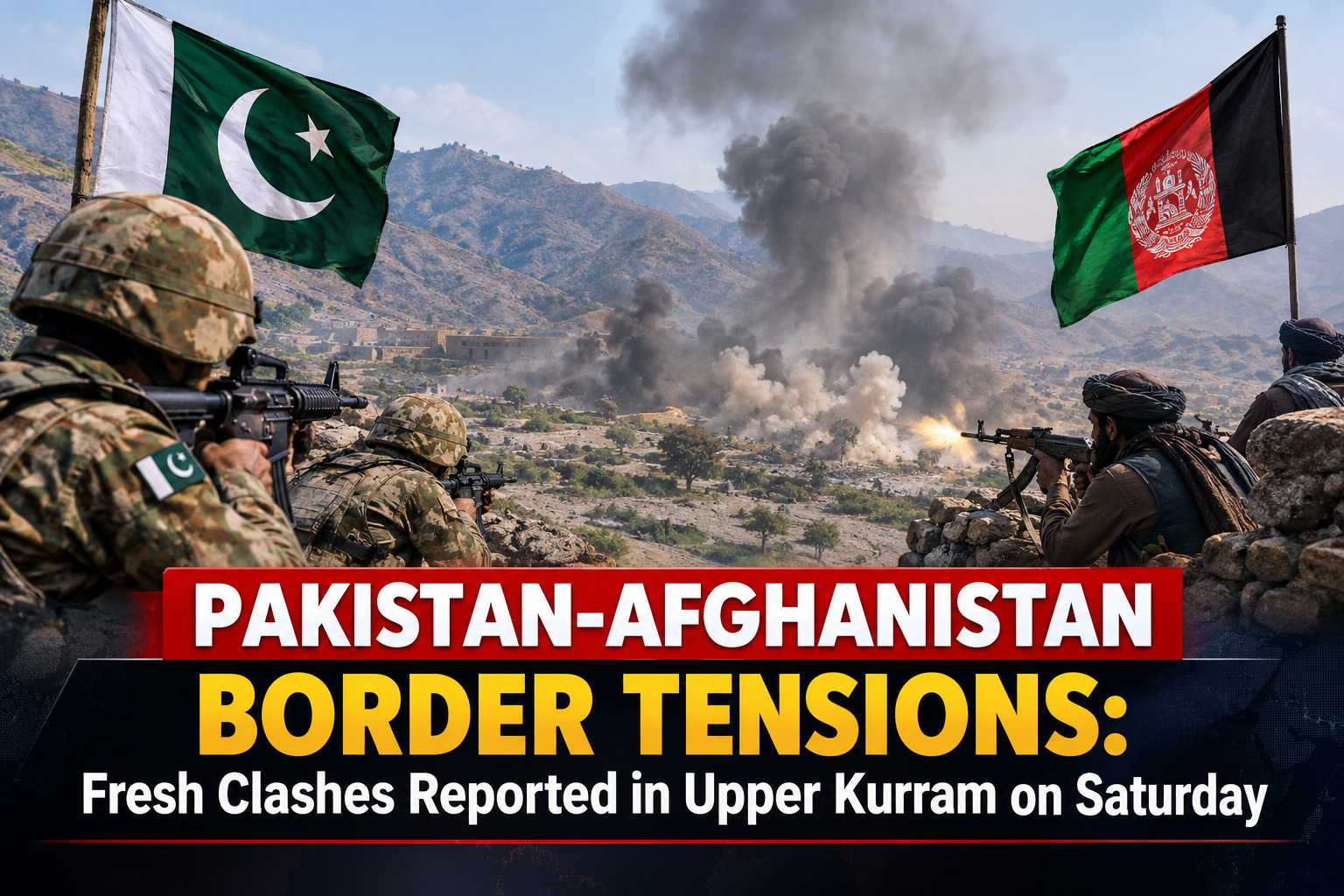
Pakistan and Afghanistan witnessed renewed border tensions on Saturday, October 17, 2026, after an exchange of fire was reported in the Upper Kurram district of Khyber Pakhtunkhwa. Pakistani security officials said that Afghan Taliban forces opened fire at several locations along the border, prompting a response from Pakistani forces. Reports carried by Pakistani media stated that several border posts were targeted during the incident.
The incident has added to existing security concerns between the two neighbouring countries. Both nations share a long border with important trade routes, communities, and historical connections. Any escalation along this frontier can affect regional security, cross-border movement, trade, and diplomatic relations.
The latest developments have also renewed attention on the importance of communication between Islamabad and Kabul. While Pakistan has repeatedly raised concerns about militant activity near its border, Afghanistan's Taliban authorities have disputed Pakistan's allegations concerning militant groups operating from Afghan territory. A lasting solution will require reliable communication, effective border management, and diplomatic engagement.
This article examines the reported border incident, its background, the potential consequences for Pakistan and Afghanistan, and the importance of peaceful efforts to reduce tensions.
1. What Happened Along the Pakistan-Afghanistan Border?
According to reports published on October 17, Pakistani security forces responded to firing in the Upper Kurram area of Khyber Pakhtunkhwa. The reported incidents involved the Taida sector and the Ghuzgarhi border area. Pakistani officials said their forces used heavy weapons and artillery against positions associated with the Afghan Taliban.
The reports also stated that Pakistani forces targeted the Topsar border post and the Shipola base camp. Security sources claimed that the base camp was destroyed and that several Afghan Taliban personnel were reportedly killed. However, an independently verified casualty figure was not available in the initial reporting, and the claims should therefore be attributed to the sources that made them.
The exchange of fire was described as lasting several hours. The Associated Press reported that Pakistani security officials said their forces had also engaged militants attempting to cross into Pakistan from eastern Afghanistan. Afghanistan's Taliban government had not immediately issued a comment on the incident in the initial reports
These details are important because border incidents can be reported differently by the parties involved. Official statements provide information about each side's position, but independent confirmation is necessary to establish the full circumstances of an incident.
For residents living near the frontier, the most immediate concern is safety. Families in border communities depend on stable conditions for education, employment, healthcare, farming, and ordinary travel. Renewed firing can disrupt these activities even when the effects are concentrated in a relatively small geographical area.
2. Why the Kurram Border Area Matters
Upper Kurram is part of Khyber Pakhtunkhwa, a province in northwestern Pakistan that shares a border with Afghanistan. Its geographical position makes it significant for Pakistan's border security and for the wider relationship between the two countries.
The Pakistan-Afghanistan frontier connects communities with long-standing family, cultural, linguistic, and commercial ties. People on both sides have historically maintained relationships across the border, although formal crossing arrangements and security restrictions affect how freely they can travel.
Kurram's location also means that developments in the area can become part of broader discussions about regional stability. Security incidents may affect the movement of people and goods, create uncertainty for local businesses, and increase pressure on officials to strengthen border controls.
For Pakistan, protecting its territory and preventing militant attacks are central security concerns. For Afghanistan, border management involves its own security priorities and relations with neighbouring countries. Because the frontier is important to both governments, incidents in the area can have consequences beyond the immediate location.
A stable border benefits ordinary citizens in several ways. It helps traders plan deliveries, allows families to make travel arrangements, and enables public services to operate more predictably. It also gives both governments greater room to pursue diplomatic and economic cooperation.
The latest incident demonstrates why border security cannot be treated as a purely military matter. It is also connected to community safety, economic activity, public confidence, and the relationship between neighbouring states.
3. Pakistan's Position on Border Security
Pakistan has repeatedly expressed concern about attacks carried out by militant groups operating near its western border. Pakistani authorities have accused groups, including Tehrik-i-Taliban Pakistan (TTP), of using Afghan territory as a base for activities against Pakistan.
Islamabad argues that Afghanistan should take effective action against armed groups that threaten Pakistani territory. Pakistani officials have made counterterrorism cooperation an important part of their demands in discussions with the Afghan authorities.
The Afghan Taliban government has rejected Pakistan's allegations that it permits militants to use Afghan territory to attack Pakistan. This disagreement remains one of the major obstacles to improving relations between the two countries.
These competing positions make it particularly important to establish reliable communication channels. When an incident occurs, both governments need ways to exchange information, clarify events, and prevent a local confrontation from developing into a wider crisis.
Pakistan's security concerns are significant because repeated militant attacks can cause loss of life, disrupt economic activity, and place additional pressure on law enforcement and public institutions. Protecting communities from violence is a fundamental responsibility of the state.
At the same time, an effective long-term response requires more than statements made after an incident. It depends on intelligence sharing where appropriate, coordinated border management, credible investigations, and practical steps to prevent armed groups from threatening communities.
The effectiveness of these measures will ultimately be judged by whether they reduce attacks and help people live and work safely.
4. Afghanistan's Role in Reducing Border Tensions
Afghanistan's geographical position makes its cooperation important to efforts aimed at reducing cross-border militancy. Pakistan and Afghanistan share a frontier that is difficult to manage without communication between authorities on both sides.
From Pakistan's perspective, cooperation from Kabul is essential to addressing concerns about militant networks. From Afghanistan's perspective, dialogue with Pakistan can help prevent border disputes from undermining its security, economic activity, and relationships with neighbouring states.
The Afghan Taliban authorities have their own security responsibilities and have disputed allegations that Afghan territory is being used to support attacks inside Pakistan. A constructive diplomatic process would need to address these differences through specific evidence, clear commitments, and mechanisms for assessing whether agreed measures are working.
Public accusations alone are unlikely to resolve a complicated security dispute. Both governments need dependable ways to communicate about suspicious movements, investigate reported violations, and distinguish confirmed information from unverified claims.
Border coordination could also include timely communication between local officials, arrangements for raising urgent concerns, and procedures for preventing misunderstandings during tense situations. Such mechanisms are especially important when communities on both sides are vulnerable to disruption.
The goal should be to prevent security disagreements from becoming a permanent source of instability. Pakistan and Afghanistan may disagree on particular incidents, but they share an interest in reducing violence, protecting civilians, and keeping essential economic routes functioning.
5. Diplomatic Dialogue Remains Important
The latest border incident occurred amid wider diplomatic tensions. On October 16, Pakistan's Foreign Office said that engagement with Afghanistan remained possible but could not be unconditional. It also stated that Pakistan was open to sincere efforts by friendly countries to help address security concerns and promote regional peace.
This position indicates that, despite disagreements, diplomatic engagement has not been ruled out. The challenge is to turn statements supporting dialogue into practical arrangements that produce measurable improvements.
Diplomacy offers an opportunity to clarify competing accounts of incidents, discuss security requirements, and identify steps that both governments can accept. It can also provide a channel for dealing with emergencies before they escalate.
For dialogue to be effective, it needs clear objectives. These may include reducing border firing, preventing unauthorised crossings, sharing relevant security information, and establishing procedures for investigating incidents.
Confidence-building measures can be useful even when a complete political agreement is not immediately possible. Regular meetings between relevant officials, reliable emergency communication, and mutually understood border procedures can reduce the risk of accidental escalation.
Friendly countries may also encourage both sides to maintain communication and pursue peaceful solutions. However, lasting progress ultimately depends on the willingness of Pakistan and Afghanistan to address their disagreements directly.
The wider lesson is that security and diplomacy are not necessarily competing approaches. Responsible security measures can protect communities in the short term, while sustained dialogue can address the disputes that contribute to repeated confrontations.
6. Impact on People Living Near the Border
People living near an international border are often among the first to experience the consequences of a security incident. Even when a confrontation is limited to a particular area, uncertainty can affect daily routines and decisions.
Families may become concerned about travelling to nearby towns, sending children to school, visiting relatives, or accessing medical services. Local businesses may delay deliveries, while transport operators may face uncertainty about routes and operating conditions.
These consequences are not limited to Pakistan. Communities across the border can also experience disruption when tensions rise. Ordinary residents generally have little control over diplomatic disputes, yet their livelihoods may depend on the stability of the surrounding region.
Local authorities therefore have an important role in communicating accurate information. Residents need timely updates about any official safety instructions, road restrictions, crossing arrangements, and the availability of essential services.
Clear communication can reduce unnecessary confusion. It can also help people distinguish confirmed information from rumours spreading through social media or messaging applications.
Schools and healthcare facilities require particular attention during periods of instability. Where authorities consider restrictions necessary, arrangements should be made to protect access to essential services whenever conditions permit.
Community support is equally important. Local organisations and public institutions can help identify the needs of vulnerable families, communicate reliable guidance, and coordinate assistance when normal activities are interrupted.
Ultimately, the success of border security measures should be assessed not only by official statements but also by their ability to protect civilians and restore normal life.
7. Economic Consequences of Continued Tensions
Pakistan and Afghanistan have economic connections that extend beyond the immediate border districts. Cross-border commerce supports traders, transport operators, wholesalers, farmers, and other businesses that depend on predictable movement between markets.
When security conditions deteriorate, businesses may face delays, uncertainty, and additional operating costs. Even without a formal border closure, concerns about possible restrictions can affect commercial decisions.
Perishable goods are particularly sensitive to delays because they may lose value when transportation takes longer than expected. Transport companies can also experience scheduling difficulties, while smaller traders may have fewer resources to absorb unexpected costs.
Long periods of uncertainty can discourage investment. Businesses are more likely to expand when they can estimate transport times, understand regulations, and rely on consistent arrangements.
The effects may extend to consumers. If the movement of particular goods becomes more difficult or expensive, traders may pass some of the additional costs on to buyers. The actual impact depends on the products involved, the duration of disruption, and the availability of alternative supply routes.
Stable relations between Pakistan and Afghanistan could create opportunities to improve trade, transport links, and regional connectivity. However, economic cooperation depends on confidence that goods and people can move according to established rules.
This is one reason why reducing border tensions matters to both countries. Peaceful conditions are not simply a diplomatic objective; they also support employment, business activity, and more predictable economic planning.
8. The Regional Security Picture
Pakistan-Afghanistan relations form part of a wider regional security environment. Both countries face challenges connected to militancy, border management, political differences, and the movement of people across the frontier.
The Associated Press reported that militant violence in Pakistan had increased in recent months, while the United Nations Assistance Mission in Afghanistan had documented substantial civilian casualties linked to cross-border violence in Afghanistan during 2026. These reports illustrate the human cost associated with continuing instability.
Such figures should be interpreted carefully. Different reports may cover different periods, geographical areas, and categories of violence. Nevertheless, they underline the importance of reducing the risks faced by civilians.
Instability can also affect the calculations of other regional countries. Neighbours have an interest in preventing cross-border disputes from disrupting trade, encouraging further violence, or creating new humanitarian pressures.
Regional cooperation can support practical solutions, including communication between governments, efforts to prevent militant activity, and assistance with diplomatic engagement. Such cooperation works best when it is focused on verifiable outcomes rather than competing political claims.
It is equally important to avoid treating ordinary people as responsible for the actions of armed groups or governments. Pakistanis and Afghans have diverse views and experiences, and many families on both sides share cultural and historical connections.
A responsible approach to regional security should therefore combine firm attention to threats with respect for civilians and an understanding of the long-term value of peaceful relations.
9. The Importance of Reliable Information
During a border confrontation, information can change quickly. Initial reports may rely on statements from security officials, while independent confirmation may not be immediately available.
This makes responsible reporting especially important. News organisations should identify the source of claims, distinguish allegations from established facts, and update their coverage when additional evidence becomes available.
For example, reports about the October 17 incident attributed claims concerning the firing, damage to positions, and casualties to Pakistani security sources. The absence of an immediate response from Afghanistan's Taliban government in the initial reports does not independently establish every detail of Pakistan's account.
Readers should therefore pay attention to the wording of news reports. Terms such as reported, according to officials, and could not be independently verified communicate meaningful differences in the strength of available evidence.
Social media can spread updates rapidly, but speed does not guarantee accuracy. Old photographs, unrelated footage, unverified casualty figures, and misleading captions can create confusion during a tense situation.
Readers can make better decisions by comparing reputable news coverage, checking publication dates, and looking for confirmation from multiple independent sources. Official safety instructions should take priority over unverified online claims.
Accurate reporting also helps prevent unnecessary hostility between communities. Presenting confirmed information carefully allows people to understand developments without relying on speculation or inflammatory language.
10. What Could Happen Next?
The next stage will depend on developments along the border, the decisions of security authorities, and the willingness of both governments to maintain communication.
One possible outcome is that the exchange of fire remains limited to the immediate area and officials take steps to prevent further incidents. If communication channels remain functional, both sides may be able to manage the situation without a broader escalation.
Another possibility is that continued disagreements over militant activity and border security lead to further restrictions or confrontations. Such an outcome could increase uncertainty for residents, traders, and transport operators.
Diplomatic engagement offers a further path. Pakistan's Foreign Office has indicated that dialogue remains possible, while emphasising the need to address its security concerns. Whether this produces progress will depend on the positions taken by both governments and the implementation of any arrangements they reach.
It would be premature to predict a particular outcome based on the initial reports alone. Developments should be assessed using updated information rather than assumptions about either government's intentions.
In the coming days, important indicators will include whether further firing is reported, whether official statements provide additional details, whether border movement is affected, and whether diplomatic contacts lead to practical steps.
For residents and businesses, reliable updates about local conditions will remain particularly important. For policymakers, the priority should be to reduce immediate risks while addressing the underlying security disagreements.
A stable outcome would benefit both countries by protecting civilians, reducing economic disruption, and creating more space for cooperation.
11. Why Peaceful Relations Matter for Pakistan and Afghanistan
Pakistan and Afghanistan cannot change their geographical proximity. Their shared border means that decisions taken in either country can influence the security and economic conditions of the other.
Although their governments have serious disagreements, practical cooperation remains possible in areas of mutual interest. These include countering militant threats, improving border management, supporting legitimate trade, and ensuring that civilians can access essential services.
Peaceful relations do not require the two governments to agree on every political issue. They require reliable procedures for managing disagreements and a willingness to prevent disputes from causing unnecessary harm.
For Pakistan, effective security arrangements are essential to protecting its citizens and maintaining stability in border regions. For Afghanistan, constructive engagement can help reduce tensions, support economic connections, and improve relations with its neighbour.
Both governments can benefit from clear communication and realistic agreements. Commitments should be specific enough to assess, and disagreements should be addressed through established channels wherever possible.
The international community can encourage dialogue, but it cannot replace the responsibility of the two countries to manage their relationship. Long-term progress will depend on practical action, mutual accountability, and sustained engagement.
For ordinary families, the benefits of improved relations are straightforward: safer communities, fewer disruptions, more predictable travel, and better opportunities for work and education.
Conclusion
The border confrontation reported on Saturday, October 17, 2026, highlights the continuing security challenges facing Pakistan and Afghanistan. Pakistani officials reported an exchange of fire in Upper Kurram and described a military response against positions along the frontier. The incident occurred amid wider disagreements over militant activity and border security.
The situation requires careful monitoring, reliable reporting, and efforts to prevent further escalation. Claims about the incident should continue to be assessed against independently verified information as it becomes available.
Pakistan has a legitimate interest in protecting its citizens and territory, while stability in Afghanistan and peaceful relations between the neighbours are also important to the wider region. Addressing these concerns requires practical security measures alongside meaningful diplomatic engagement.
The long-term objective should be a border where communities can live safely, businesses can operate with confidence, and disagreements do not repeatedly lead to confrontation. Achieving that objective will take sustained effort from both governments, but the potential benefits for ordinary Pakistanis and Afghans make it an important goal.
FAQs
1. What happened on the Pakistan-Afghanistan border on October 17, 2026?
An exchange of fire was reported in Upper Kurram, Khyber Pakhtunkhwa, between Pakistani forces and Afghan Taliban personnel.
2. Where did the reported border clashes take place?
Reports identified Upper Kurram, including the Taida sector and Ghuzgarhi border area.
3. Why are Pakistan and Afghanistan experiencing border tensions?
A major source of tension is Pakistan's concern about militant attacks and its allegations that armed groups operate from Afghan territory. Afghanistan's Taliban authorities have disputed these allegations.
4. How could border tensions affect Pakistan's economy?
Prolonged tensions can disrupt cross-border trade, delay transportation, increase business costs, and create uncertainty for traders and local communities.
5. Can Pakistan and Afghanistan resolve their border disputes peacefully?
Diplomatic dialogue, reliable communication, border coordination, and verifiable security commitments could help reduce tensions and prevent further confrontations.




