Introduction
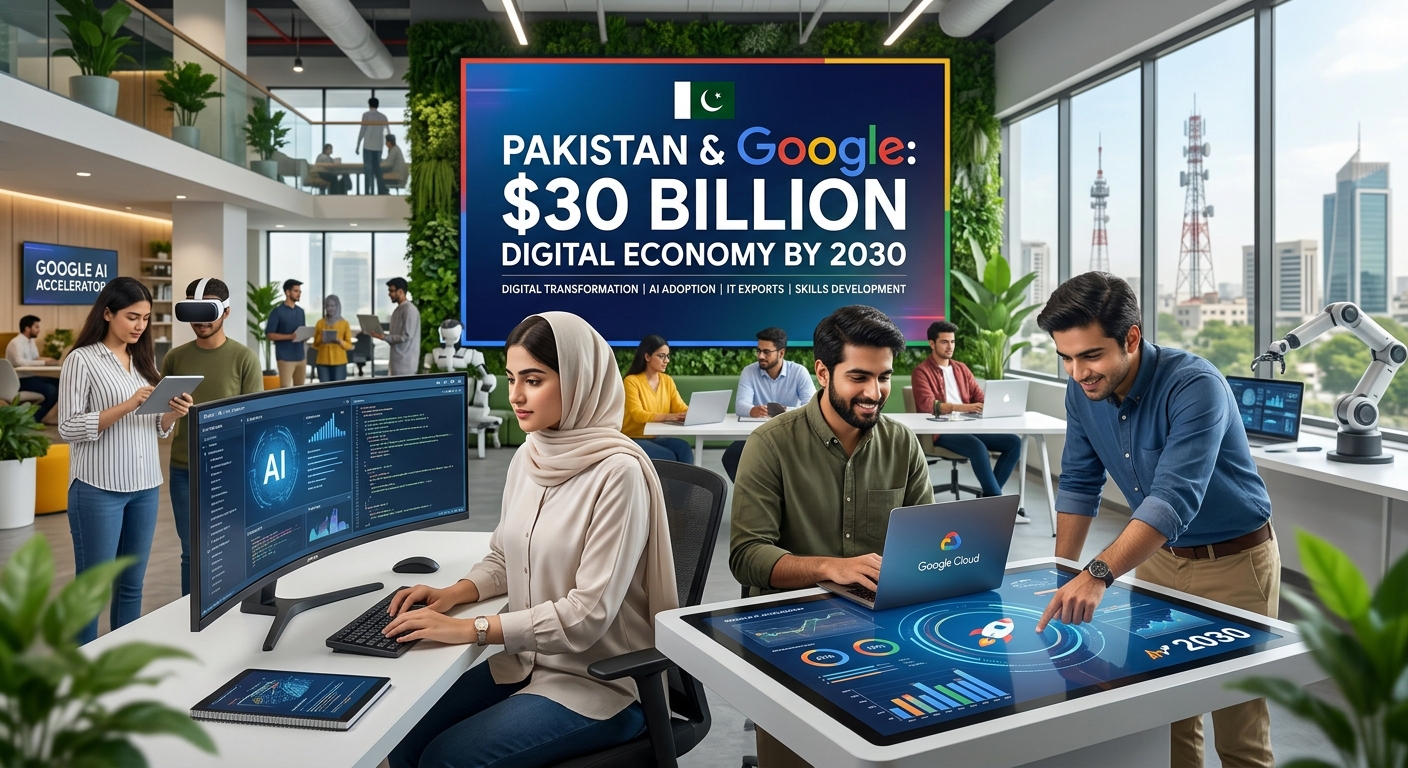
Pakistan is entering an important stage in its digital transformation as the country seeks to strengthen its technology sector, expand digital skills, increase IT exports, and create new opportunities for its young population. In a significant development, the Government of Pakistan and Google signed a landmark Memorandum of Understanding (MoU) on August 21, 2026, to promote digital transformation, artificial intelligence, innovation, and technology-driven economic growth. The partnership is connected with an ambitious national target of taking Pakistan’s IT exports and overall digital economy to $30 billion by 2030
The agreement is particularly important because Pakistan has a large young population that can become a major source of digital talent. The partnership focuses on developing market-ready skills, increasing access to artificial intelligence tools, supporting students and young professionals, strengthening local technology businesses, and exploring the use of AI in government and agriculture.
The development also comes shortly after Google established its presence in Pakistan. On August 18, the Prime Minister met a Google delegation in Islamabad, while on August 19 the foundation plaque for Google’s Pakistan office was unveiled. The government described Google's growing presence as an important part of Pakistan's digital transformation journey.
Pakistan’s $30 Billion Digital Economy Ambition
The $30 billion target represents an effort to make technology and digital services a more significant part of Pakistan’s economic future. The government wants to increase IT exports, strengthen the digital ecosystem, improve the skills of its workforce, and make Pakistani technology companies more competitive internationally.
The MoU with Google is designed to support this broader vision. It includes cooperation in digital skills, artificial intelligence, government services, agriculture, digital payments, app development, gaming, and international market access. A joint task force involving the government, Google, and relevant industry stakeholders will also work on identifying barriers and opportunities for IT export growth.
For Pakistan, increasing digital exports could create new sources of foreign exchange while providing employment opportunities for young people. Unlike many traditional industries, digital businesses can potentially reach customers in international markets without requiring large physical infrastructure.
This creates an opportunity for Pakistani software developers, designers, freelancers, entrepreneurs, researchers, and technology companies to participate more actively in the global economy.
Google’s Partnership with Pakistan
The partnership between Pakistan and Google is focused on developing a stronger digital ecosystem rather than being limited to one specific technology project.
The agreement covers several areas that are important for Pakistan’s future. These include digital skills development, AI adoption, IT exports, digital payments, mobile applications, gaming, agriculture, government digitization, and support for small and medium-sized businesses.
The government believes that modern technology can help Pakistan improve productivity and create new economic opportunities. Prime Minister Shehbaz Sharif has emphasized the importance of Pakistan’s young population and the need to provide young people with modern tools and technological skills.
Google, meanwhile, has indicated that the partnership can help unlock Pakistan’s digital potential by expanding access to skills, AI tools, and sector-specific technologies.
This cooperation therefore has the potential to connect Pakistan’s growing pool of young talent with international technology trends and markets.
150,000 Google Career Certificates for Pakistani Youth
One of the most notable elements of the agreement is the planned expansion of Google’s Career Certificates program in Pakistan. Google intends to provide 150,000 Career Certificates in 2026, with the possibility of expanding the initiative in future years. These certificates are intended to help young people develop market-oriented skills for high-growth fields.
This initiative could be particularly valuable for Pakistani youth because the global employment market is changing rapidly. Traditional academic qualifications remain important, but employers increasingly look for practical digital skills.
Training in areas such as technology, data, project management, digital marketing, cybersecurity, and other high-demand fields can help young people become better prepared for modern employment opportunities.
For students and young professionals, skill development can also create opportunities beyond the local job market. Digital skills can allow talented individuals to work with international companies, clients, and organizations.
However, certificates alone will not solve Pakistan’s employment challenges. Their real value will depend on the quality of training, practical experience, access to technology, mentorship, and the availability of opportunities where young people can apply their skills.
Free Access to Advanced AI Tools for Students
Artificial intelligence is one of the fastest-growing areas of technology, and Pakistani students are also being given an opportunity to benefit from it.
Under the MoU, Pakistan and Google agreed to explore providing students with advanced AI tools, including one-year free access to Google AI Plus and Gemini Notebook, to support academic and research activities.
This development could have a major impact on students if AI tools are used responsibly. Students can use modern technology to support research, understand difficult concepts, organize information, improve productivity, and explore new areas of learning.
At the same time, students need to understand that AI should support education rather than replace genuine learning. Critical thinking, originality, problem-solving, and independent understanding will remain essential.
The availability of advanced AI tools can also encourage students to experiment with new ideas. A student interested in computer science, for example, may use AI as a learning assistant while developing programming skills. Another student may explore research, data analysis, or entrepreneurship.
In this way, access to AI can help create a generation that is not simply consuming technology but learning how to build and innovate with it.
Google AI Centre of Excellence in Islamabad
Another important component of the agreement is the establishment of a dedicated Google AI Centre of Excellence in Islamabad.
The centre is intended to train Pakistani youth and human resources according to international technology-market standards.
Such an institution could become an important part of Pakistan’s AI ecosystem. Artificial intelligence is being introduced into industries around the world, and countries with skilled AI professionals are likely to have a stronger position in the future digital economy.
The centre could help develop specialized skills, encourage research, and create connections between young Pakistani talent and international technology standards.
For Pakistan, the long-term objective should be to create a strong domestic technology workforce capable of developing solutions for both local and international markets.
Artificial Intelligence in Government Services
The partnership also extends beyond education and private-sector technology.
Under the Prime Minister’s Federal Board of Revenue transformation plan, Google will support the use of AI to modernize public service delivery, streamline government operations, and accelerate digital transformation within the FBR.
The use of technology in government can potentially improve efficiency and make services easier to access. Digital systems can help organizations process information more efficiently, identify patterns, and make better use of available data.
For Pakistan, improving government systems is particularly important because digital transformation can reduce unnecessary paperwork and make certain processes faster and more accessible.
However, the successful use of AI in government will require strong data protection, transparency, cybersecurity, skilled professionals, and responsible decision-making. Technology should improve public services while maintaining trust and protecting citizens’ information.
AI and the Future of Pakistani Agriculture
Agriculture remains an important part of Pakistan’s economy, and the new partnership also looks at using AI in this sector.
The agreement includes cooperation on AI applications for crop monitoring, yield forecasting, and sustainable farming practices.
This could be especially valuable because farmers face numerous challenges, including changing weather patterns, water management issues, crop diseases, and the need to improve productivity.
AI-based technologies can potentially help analyze agricultural information and support better decision-making. Digital tools can also provide farmers and agricultural organizations with useful information about crops and production.
The long-term goal should be to make technology accessible not only to large agricultural businesses but also to smaller farmers. If digital solutions remain limited to major organizations, their national impact will be restricted.
Technology should therefore be developed with affordability, accessibility, and practical usefulness in mind.
Supporting Small and Medium Enterprises
Small and medium enterprises, commonly known as SMEs, are another important part of Pakistan’s economic landscape.
The Pakistan-Google partnership includes the use of digital platforms to help SMEs expand their presence in international markets.
Digital platforms can give small businesses opportunities to reach customers beyond their local communities. A Pakistani business that once depended mainly on local customers can potentially use digital tools to market its products and services to international buyers.
This can create opportunities for entrepreneurs in areas such as handicrafts, clothing, software, design, digital services, education, and other sectors.
However, businesses also need digital literacy, reliable internet access, secure payment systems, effective logistics, and knowledge of international markets.
A strong digital economy therefore requires more than internet access. It requires an entire ecosystem that allows businesses to operate successfully.
Development of Apps and Gaming Industry
The agreement also includes cooperation to support local app developers and gaming studios.
Pakistan has a large young population that spends considerable time using smartphones, computers, and online platforms. This creates a potential market for locally developed applications and digital entertainment.
Supporting app developers and gaming studios could encourage young programmers, designers, artists, writers, and entrepreneurs to build products for local and international audiences.
The gaming industry can also create opportunities for people with different skills. Game development is not limited to programming; it can involve graphic design, animation, sound, storytelling, marketing, project management, and business development.
If Pakistan develops a strong ecosystem for digital creativity, young people could participate in a rapidly growing global industry.
Strengthening Digital Payments
Digital payments are another area included in the partnership.
Pakistan and Google are exploring ways to strengthen the country’s digital payments ecosystem and expand digital trade.
A stronger digital payment system can make online commerce more convenient and support businesses that want to operate digitally.
For a growing digital economy, secure and accessible payment infrastructure is essential. Entrepreneurs need reliable ways to receive payments, while customers need trustworthy methods to purchase products and services.
The expansion of digital payments could also support financial inclusion by making certain services easier to access.
Nevertheless, cybersecurity and consumer protection will be increasingly important as more financial activity moves online.
Pakistan’s IT Exports and Global Competition
Pakistan already has a growing technology workforce, including software developers, freelancers, IT companies, and digital entrepreneurs. The challenge is to transform this talent into a stronger and more organized export industry.
The joint task force established under the agreement is expected to examine barriers and opportunities related to IT export growth. Its areas of focus include global market access, human-resource development, and an investment framework for hardware manufacturing and services.
For Pakistan to compete internationally, it will need more than a large number of skilled individuals. It will need strong companies, reliable infrastructure, investment, research, innovation, and a business environment that encourages technology-based enterprises.
The country also needs to focus on quality. Competing in the global digital economy requires professionals and companies that can deliver reliable, innovative, and internationally competitive products and services.
Opportunities for Pakistani Youth
Perhaps the biggest potential beneficiaries of this digital transformation are Pakistan’s young people.
The country has millions of young citizens who are interested in technology and digital careers. With appropriate education and training, this population can become an important economic asset.
Young Pakistanis can explore careers in:
Artificial intelligence
Software development
Data science
Cybersecurity
Digital marketing
Cloud computing
Mobile app development
Game development
Graphic design
E-commerce
Digital entrepreneurship
Research and innovation
The Google partnership could provide additional opportunities for training and exposure to modern technologies.
But young people also have a responsibility. Technology is changing rapidly, so students should develop a habit of continuous learning. A skill learned today may need to be updated tomorrow.
The future digital workforce will belong to people who are willing to keep learning.
Challenges on the Road to $30 Billion
Although the $30 billion vision is ambitious, achieving it will require sustained effort.
Pakistan faces challenges including infrastructure gaps, unequal access to quality education, limited research capacity, cybersecurity concerns, skill shortages, and difficulties faced by businesses entering international markets.
Another important issue is the digital divide. Not every young person has equal access to high-speed internet, modern computers, quality education, or advanced training.
If Pakistan wants digital transformation to benefit the whole country, opportunities must reach young people in smaller cities and underserved communities as well as major urban centres.
The government, technology companies, educational institutions, and private businesses will all have to work together.
The Importance of Digital Education
Digital transformation cannot succeed without education.
Schools, colleges, and universities should prepare students for an economy in which technology will be part of almost every profession.
Computer education should go beyond basic software skills. Students should develop problem-solving abilities, computational thinking, digital literacy, communication skills, and awareness of emerging technologies.
Universities can also strengthen links with technology companies so that students receive practical exposure to real-world projects.
The goal should be to create graduates who are capable of applying their knowledge rather than simply memorizing information for examinations.
Artificial Intelligence and Responsible Innovation
AI offers enormous possibilities, but responsible use is essential.
As Pakistan expands AI adoption, it will need policies and practices that address privacy, security, accuracy, transparency, and ethical use.
Students should learn how to verify information generated by AI. Businesses should protect customer data. Government institutions should ensure that automated systems are used responsibly.
AI should be viewed as a tool that can increase human capabilities rather than as a replacement for human judgment in every situation.
Responsible innovation will be critical if Pakistan wants its digital transformation to earn public trust.
What This Means for Pakistan’s Future
The partnership with Google represents more than a technology agreement. It reflects a broader shift in how Pakistan can approach economic development.
For decades, economic growth has been strongly associated with traditional sectors. While agriculture, manufacturing, trade, and other industries remain essential, the digital economy offers an additional pathway for growth.
A successful digital transformation could help Pakistan create new jobs, increase exports, improve public services, support businesses, strengthen education, and develop new industries.
The key will be implementation.
Announcements and targets are important, but their real value will be measured by the opportunities that eventually reach ordinary citizens. If young people gain practical skills, businesses gain access to global markets, students gain meaningful educational opportunities, and technology improves public services, the partnership could have a lasting impact.
Conclusion
Pakistan’s agreement with Google marks an important development in the country’s digital transformation journey. Signed on August 21, 2026, the MoU focuses on digital skills, artificial intelligence, IT exports, innovation, education, agriculture, government services, digital payments, apps, gaming, and international market access. The broader ambition is to help Pakistan reach a $30 billion IT export and digital economy target by 2030.
The planned 150,000 Google Career Certificates, proposed access to advanced AI tools for students, and the establishment of a Google AI Centre of Excellence in Islamabad could provide valuable opportunities for Pakistan’s young population. At the same time, AI applications in government and agriculture and digital platforms for SMEs could extend the impact of the partnership beyond the technology sector.
Pakistan has a significant opportunity to turn its young population into a powerful digital workforce. However, achieving the $30 billion vision will require consistent investment, quality education, reliable infrastructure, responsible AI adoption, strong cybersecurity, private-sector participation, and access to opportunities across the country.
The partnership with Google is therefore best viewed as a starting point rather than an endpoint. The real success will come from how effectively Pakistan converts digital skills into businesses, ideas into products, talent into exports, and technology into better opportunities for its citizens.
If Pakistan can build an environment where young people are educated, skilled, innovative, and connected to global markets, its digital economy could become an increasingly important part of national development.
Pakistan’s digital future will ultimately depend not only on technology itself, but on the people who learn to use, create, and innovate with it.
FAQs
1. What is Pakistan’s $30 billion digital economy vision?
It is Pakistan’s goal to expand IT exports and the digital economy to $30 billion by 2030.
2. What is the purpose of Pakistan’s partnership with Google?
The partnership aims to promote AI, digital skills, innovation, IT exports, and digital transformation.
3. How will Pakistani youth benefit from the partnership?
Youth will gain access to digital training, AI tools, career certificates, and new technology opportunities.
4. How can AI support Pakistan’s economy?
AI can improve education, agriculture, government services, businesses, and technological innovation.
5. Why is the digital economy important for Pakistan?
It can create jobs, increase exports, support businesses, and connect Pakistani talent with global markets.