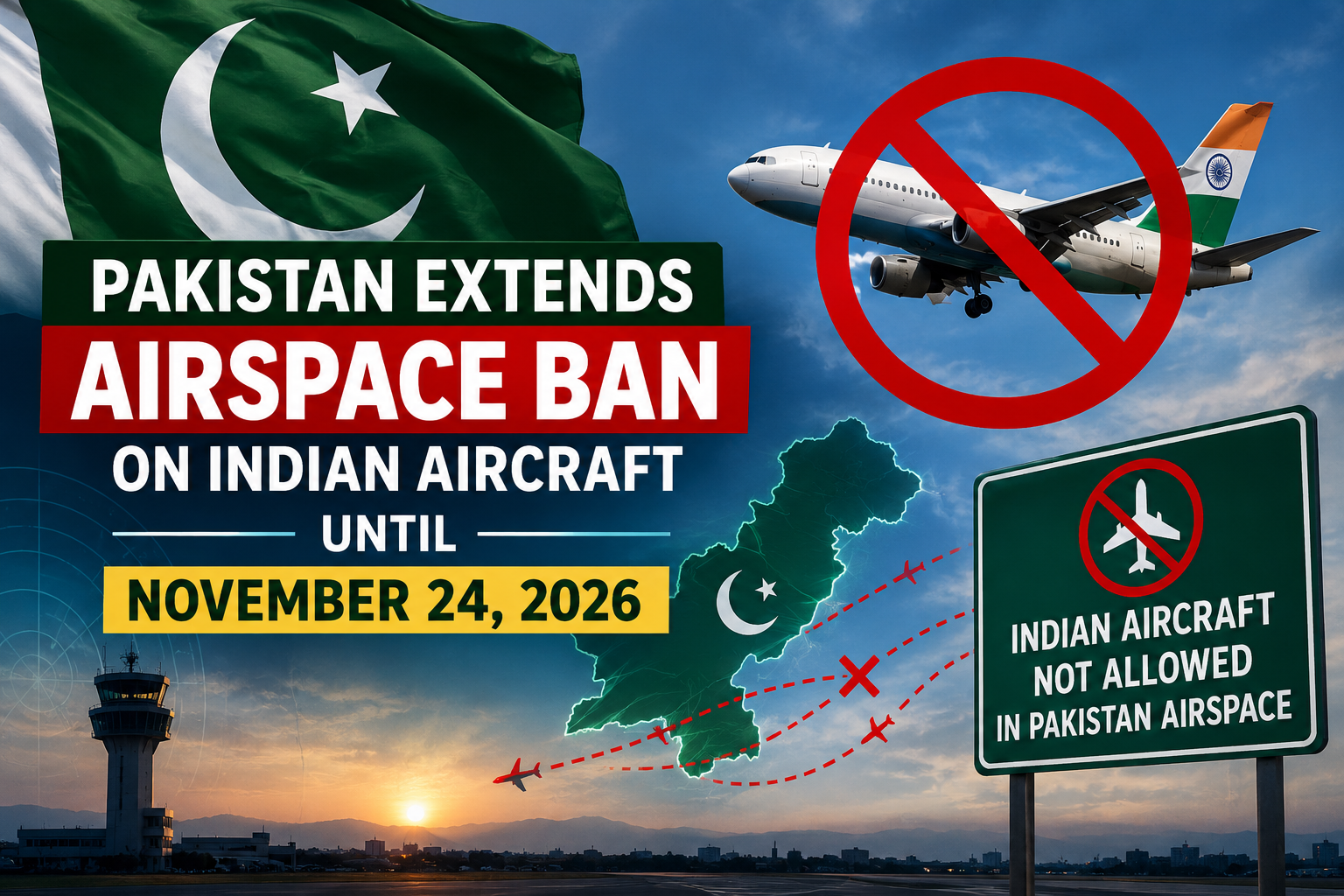
Pakistan's decision to extend its airspace restrictions on Indian aircraft has brought renewed attention to aviation, regional relations, and the economic consequences of prolonged tensions between the two neighbouring countries. According to reports published in October 2026, Pakistan extended the restriction on Indian aircraft until November 24, 2026.
The decision affects an important aspect of regional aviation because Pakistan's geographical location connects several international flight routes. Restrictions on the use of national airspace can require airlines to adjust their routes, flight schedules, fuel planning, and operating costs.
Pakistan and India have experienced longstanding political and security disagreements, and restrictions on airspace have formed part of the wider tensions between them. Such measures can influence not only the airlines directly affected but also passengers, airports, and businesses connected to international travel.
The extension has therefore renewed questions about the future of aviation links between the two countries, the impact on commercial airlines, and the possibility of restoring normal arrangements if bilateral relations improve.
This article examines the reported extension, its background, the implications for aviation and passengers, the economic considerations, and the potential role of diplomacy in resolving the dispute.
1. What Does the Latest Airspace Extension Mean?
The latest extension means that Indian-registered aircraft and aircraft owned, operated, or leased by Indian airlines and operators remain prohibited from using Pakistani airspace. The restriction also covers military flights. The Pakistan Airports Authority (PAA) issued a fresh Notice to Airmen, commonly known as a NOTAM, extending the measure until 4:59 a.m. on November 24, 2026.
A NOTAM is an official aviation notice that communicates information relevant to the safety, planning, and operation of flights. Airlines, pilots, dispatch teams, and other aviation professionals use such notices to understand restrictions and plan operations accordingly.
Pakistan's airspace is divided into two Flight Information Regions (FIRs): Karachi and Lahore. The latest restriction applies to both regions, making it relevant to aircraft planning routes through different parts of Pakistan's airspace.
The extension does not mean that every international flight operating in the region is prohibited. Rather, it applies to the categories of Indian aircraft and operators specified in the official notice. Other airlines must continue to follow applicable aviation rules, flight permissions, and any separate restrictions affecting their routes.
The measure is another extension of a restriction that has remained in place since April 2025. Its continuation reflects the unresolved political and security disagreements between Pakistan and India.
For aviation companies, the important issue is predictability. Airlines need to know which routes are available so they can prepare schedules, calculate fuel requirements, assign aircraft, and provide accurate information to passengers.
2. Background: Why Did Pakistan Introduce the Restriction?
Pakistan initially imposed the airspace restriction on Indian aircraft in April 2025, following a sharp deterioration in bilateral relations after the deadly Pahalgam attack in Indian-administered Kashmir. India accused Pakistan of involvement, while Pakistan denied the allegation and called for a neutral investigation.
The dispute was followed by a series of retaliatory measures and heightened military tensions between the two nuclear-armed neighbours. India also closed its airspace to Pakistani aircraft later in April 2025, creating reciprocal restrictions that affected aviation operations on both sides.
Airspace restrictions can serve as political or security measures, but they also have practical consequences for civilian aviation. When an airline loses access to a direct route, it may have to fly around the restricted area, potentially increasing journey time and fuel consumption.
Since the initial decision, Pakistan has repeatedly extended its restriction rather than allowing it to expire. The latest notice continues that policy for another month, until November 24, 2026.
The dispute illustrates how political disagreements can remain influential long after the event that triggered them. Restoring normal aviation arrangements may require broader progress in bilateral relations, alongside decisions by the relevant authorities.
It is important to distinguish the reasons governments give for their decisions from independently established facts about the underlying dispute. The airspace restriction is confirmed by official notices and reporting, while allegations surrounding the original attack remain contested by the two countries.
3. How the Ban Affects Indian Airlines
Indian airlines that previously used Pakistani airspace on certain international journeys must plan alternative routes when those flights cross restricted areas.
The effect varies depending on the origin, destination, aircraft, weather, available air corridors, and air traffic control requirements. Some flights may be affected more significantly than others, particularly services travelling westward from northern India towards Europe and other international destinations.
Alternative routing can increase the distance an aircraft travels. A longer journey may require additional fuel, adjustments to crew schedules, and changes to the airline's operating plan.
Airlines must also consider the combined effect of these changes across their networks. A delay on one flight can affect the aircraft's next scheduled service, while longer operating times can complicate crew rotations and aircraft availability.
According to reporting by Financial Express on October 18, the continuing restriction is one of the factors affecting Indian airline operations, alongside fuel costs and other operational challenges.However, the restriction should not be treated as the sole explanation for every difficulty experienced by Indian airlines. Their performance also depends on maintenance requirements, passenger demand, fleet availability, ticket prices, competition, and conditions in other regions.
For airlines, careful scheduling and route planning are essential to managing these pressures. Companies must balance operating costs against passenger demand while maintaining appropriate safety standards.
The extension means that affected airlines will need to continue accounting for the restriction in their schedules until the stated expiry date, unless the authorities announce a further change.
4. The Economic Cost of Longer Flight Routes
Aviation is a cost-sensitive industry in which relatively small changes in flight duration can have significant effects when repeated across many services.
Fuel is one of the largest operating expenses for many airlines. When a flight takes longer because it must avoid restricted airspace, the airline may consume more fuel and incur additional costs.
Longer routes can also increase crew expenses and aircraft utilisation time. Aircraft that spend more hours completing one journey may have less time available for other scheduled services.
The financial impact depends on the route and the airline's operations. It would be misleading to assign one fixed cost to every flight because the additional distance, aircraft type, passenger load, and fuel requirements differ.
Some costs may be absorbed by the airline, while others may influence ticket prices, schedules, or the number of services offered. The outcome depends on competition, demand, and the company's ability to manage its expenses.
The wider economic impact can extend to tourism, business travel, cargo operations, and international connections. When journeys become more complicated, travellers and businesses may need to adjust their plans.
Nevertheless, the overall financial consequences should be assessed using airline-specific data rather than assuming that every carrier experiences the same level of disruption.
For Pakistan, the restriction also forms part of a wider diplomatic dispute with India. Its economic implications are therefore connected to political and security considerations, not simply to the commercial interests of airlines.
5. What It Means for Passengers
Passengers are not necessarily prohibited from travelling between India and international destinations because of Pakistan's restriction. Instead, the direct impact depends on the airline, route, and flight schedule.
Some travellers may experience longer journeys if their flights must use alternative routes. Others may notice changes to departure times, connections, or available services, depending on how airlines adjust their operations.
Longer flight times can be particularly important for passengers connecting between international flights. A change in one part of an itinerary may affect the time available to transfer to another service.
Passengers should therefore rely on current information provided by their airline or booking provider when planning a journey. Published schedules may change, and individual flights can be affected by factors unrelated to the airspace restriction.
Travellers should also avoid assuming that every airline follows the same route. Flight paths vary according to operational requirements, air traffic control arrangements, weather, and permissions.
For people booking international travel, the most useful approach is to check the total journey time, connection arrangements, and any notifications issued by the carrier.
The restriction is primarily an aviation and diplomatic measure. Its practical effect on an individual passenger depends on the particular itinerary rather than simply on the nationality of the traveller.
6. Pakistan's Aviation Sector and Regional Connectivity
Pakistan occupies a geographically significant position between South Asia, Central Asia, the Middle East, and routes connecting to Europe. Its airspace is therefore part of a wider regional network used by commercial aviation.
Airspace access can influence how airlines organise journeys between distant destinations. When a corridor is unavailable, carriers may need to use alternative routes that are longer or operationally more complicated.
For Pakistan, aviation is connected to international trade, tourism, business travel, and the movement of overseas Pakistanis. Stable and predictable aviation arrangements can support these activities.
However, Pakistan's restriction on Indian aircraft does not automatically mean that all international aviation through Pakistani airspace is disrupted. The scope of the latest notice is defined by the categories of aircraft and operators it covers.
Airlines operating under different permissions and routes must comply with the relevant rules and notices. Aviation authorities also have to maintain safe and orderly air traffic management.
Regional connectivity depends on several factors, including political relations, infrastructure, airline networks, airport capacity, and international regulations. Airspace restrictions are one part of this broader system.
Improved relations between neighbouring countries could create opportunities for more predictable aviation arrangements in the future. Until then, airlines must plan according to the restrictions currently in force.
7. Why Pakistan's Airspace Is Divided into Two Flight Information Regions
Pakistan's airspace is organised into the Karachi and Lahore Flight Information Regions, commonly abbreviated as FIRs. These regions form part of the system used to organise air traffic services and communicate aviation information. The latest restriction applies to both regions.
A Flight Information Region is a designated area in which specified flight information and alerting services are provided. It helps establish the geographical framework within which aviation authorities coordinate relevant services.
The division does not mean that the two regions operate independently of national aviation rules. Rather, it provides an organised structure for managing aircraft movements and communicating relevant information to pilots and operators.
When an airspace restriction is issued, its geographical coverage and the categories of aircraft affected must be clearly specified. Airlines use this information when planning routes and ensuring compliance with applicable requirements.
For passengers, these technical arrangements are usually invisible. They nevertheless play an important role in keeping international air travel organised and helping airlines operate within the rules.
The current restriction demonstrates why accurate aviation notices matter. A clear notice allows affected operators to identify the limits of permitted operations and make the necessary adjustments.
8. Pakistan-India Relations Remain a Major Factor
The repeated extension of the airspace restriction reflects the wider difficulties in Pakistan-India relations. The two countries have longstanding disagreements involving security, political disputes, and developments in Kashmir.
The Pahalgam attack in 2025 intensified these tensions and was followed by reciprocal measures affecting diplomatic relations and aviation. Pakistan denied India's allegations concerning the attack, and the dispute contributed to a broader deterioration in relations.
Airspace restrictions can remain in place when governments consider that the circumstances leading to them have not sufficiently changed. Their continuation can therefore depend on wider political and security developments.
However, the latest extension alone does not establish what either government will decide in the future. The measure could be extended again, modified, or allowed to expire, depending on subsequent official decisions.
Diplomatic relations are influenced by many factors, and aviation arrangements are only one part of the wider relationship. Progress on communication, security concerns, and other bilateral issues could affect future decisions.
For both countries, maintaining clear communication is important to preventing misunderstandings and managing disagreements. Even where substantial political differences remain, practical dialogue can help reduce uncertainty in areas such as transportation and regional connectivity.
9. Could the Restriction Be Extended Again?
The restriction is scheduled to remain in effect until 4:59 a.m. on November 24, 2026, according to the latest notice reported by Pakistani media.Whether it will be extended again depends on decisions by the relevant authorities and the circumstances prevailing at that time.
Previous extensions show that the restriction has been renewed repeatedly since April 2025. This history indicates that airlines cannot assume normal access will automatically resume when the current period ends.
At the same time, previous extensions do not prove that another extension is inevitable. Any future decision would need to be confirmed through an official notice or a reliable report based on the relevant announcement.
Airlines therefore need to monitor updates and maintain contingency plans. They may have to revise flight plans, adjust schedules, or communicate changes to passengers if the restrictions continue or change.
Passengers should avoid making travel decisions based on speculation about the next extension. The most reliable information will come from official aviation notices and direct communications from airlines.
The key date for the current restriction is November 24, 2026. Any change to that deadline should be treated as confirmed only when the responsible authority announces it.
10. The Importance of Aviation Safety and International Rules
Aviation safety requires clear rules, reliable communication, and careful planning. Airlines must comply with the applicable restrictions and ensure that their flight plans account for the airspace available to them.
When a restriction is issued, flight operators need to understand its scope, duration, and any conditions that apply. Failure to account for an applicable restriction could create serious operational and regulatory problems.
Alternative routes must also be planned with consideration for fuel requirements, weather, air traffic control, aircraft performance, and other operational factors.
International aviation relies on coordination between states and relevant aviation bodies. Although national authorities regulate access to their airspace, safe international operations also depend on consistent communication and compliance with applicable aviation standards.
Political disagreements can complicate these arrangements, but operational clarity remains essential. Clear notices allow airlines to make decisions based on established information rather than assumptions.
The current Pakistan-India restriction illustrates how governments' decisions can affect civilian aviation even when the immediate issue is diplomatic rather than technical.
For the aviation industry, the priority is to ensure that any changes in access to airspace are communicated clearly and reflected in flight planning. Safety must remain central regardless of the political circumstances surrounding a restriction.
11. What Could Improved Relations Mean for Aviation?
If Pakistan and India make progress towards improved relations, aviation could become one area in which practical benefits eventually emerge.
A change in restrictions could provide affected airlines with additional routing options. Depending on the routes involved, this might reduce flight duration, improve scheduling flexibility, and lower some operating costs.
However, improved diplomatic relations would not automatically remove an existing aviation restriction. Any change would still require the appropriate decisions and official notices from the relevant authorities.
Airlines would need time to review new arrangements, update flight planning systems, revise schedules where appropriate, and inform passengers of any changes.
Aviation cooperation can also contribute to broader economic activity by supporting tourism, business travel, and international connections. More predictable arrangements can help companies plan their operations with greater confidence.
The potential benefits should not be overstated. Actual savings would vary by route and airline, and other costs could continue to affect operations.
Nevertheless, predictable aviation arrangements are valuable for airlines and passengers alike. They allow operators to plan more efficiently and make international travel easier to organise.
For Pakistan and India, any progress in this area would form part of a much wider process of managing political differences and rebuilding confidence.
12. What Happens Next?
For now, the confirmed development is the extension of Pakistan's airspace restriction on Indian aircraft until November 24, 2026. The measure continues a policy introduced in April 2025 amid heightened tensions between the two countries.
The next developments will depend on official decisions, the state of bilateral relations, and any changes announced by aviation authorities.
Airlines affected by the restriction will need to continue using permitted routes and adjusting their operations where necessary. Passengers should follow the latest information supplied by their carriers, particularly when travelling on international itineraries that could be affected by route changes.
Observers will also be watching for any diplomatic developments that could influence the future of the restriction. However, predictions about a possible reopening should not be confused with confirmed policy.
The November 24 deadline provides a clear reference point for the current notice, but it does not guarantee that the restriction will end on that date.
The situation remains an example of how political tensions can influence commercial aviation and international connectivity. Its future impact will depend on decisions that have yet to be announced.
Conclusion
Pakistan's extension of its airspace ban on Indian aircraft until November 24, 2026, is another development in the continuing tensions between the two neighbouring countries. The restriction covers Indian-registered aircraft, aircraft owned, operated, or leased by Indian airlines and operators, and military flights. It applies to Pakistan's Karachi and Lahore Flight Information Regions.
The extension has implications for airline route planning, operating costs, flight schedules, and some international journeys. The extent of the impact varies according to the route and airline, so individual consequences should be assessed using reliable operational information.
The wider issue remains diplomatic. The restrictions emerged after the deterioration in relations following the 2025 Pahalgam attack and have been renewed several times since then.
For now, airlines must follow the current rules, passengers should rely on confirmed travel information, and future changes should be assessed through official announcements.
Predictable aviation arrangements would benefit commercial operators and travellers, but any progress will depend on decisions by the relevant authorities and developments in Pakistan-India relations.
FAQs
1. Until when has Pakistan extended its airspace ban on Indian aircraft?
The restriction has been extended until 4:59 a.m. on November 24, 2026, according to the latest reported aviation notice.
2. Which aircraft are covered by the restriction?
It covers Indian-registered aircraft, aircraft owned, operated, or leased by Indian airlines and operators, and military flights.
3. Why did Pakistan impose the airspace ban?
Pakistan introduced the restriction in April 2025 amid escalating tensions following the Pahalgam attack. India accused Pakistan of involvement, while Pakistan denied the allegation.
4. How does the ban affect Indian airlines?
Affected airlines must use alternative routes where necessary, potentially increasing flight times, fuel consumption, and operating costs.
5. Will the airspace ban end on November 24, 2026?
Not necessarily. November 24 is the current expiry deadline. Any further extension or change would need to be confirmed through an official announcement.