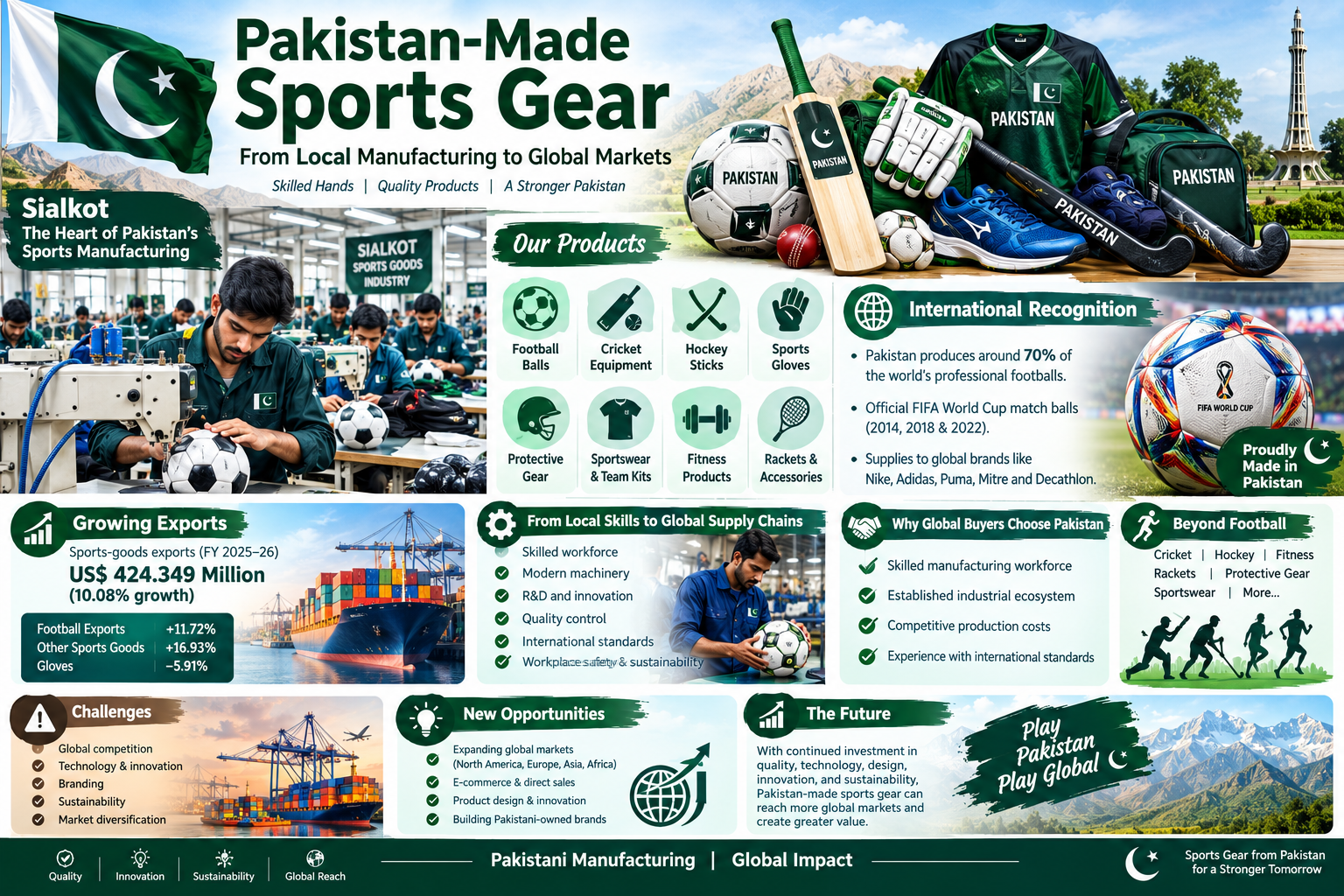
Pakistan has a long history of producing sports goods for both local players and international markets. From cricket bats and footballs to hockey equipment, gloves, protective gear, sports uniforms, and fitness products, Pakistani manufacturers have developed a strong presence in the sports goods industry. The country's skilled workers, manufacturing experience, leather industry, textile sector, and growing sports culture have helped local sports gear become an important part of Pakistan's manufacturing sector.
Sports are popular across Pakistan, especially cricket, football, hockey, badminton, volleyball, athletics, and different forms of fitness. This creates demand for sports equipment inside the country. At the same time, Pakistani manufacturers also produce sports goods for customers and businesses in other countries.
Sialkot is especially well known for sports goods manufacturing. The city has developed a large industrial network that includes manufacturers, skilled workers, suppliers, exporters, designers, and supporting businesses. Its sports goods sector has become an important example of how traditional craftsmanship can develop into an international manufacturing industry.
History of Sports Goods Manufacturing in Pakistan
The development of sports goods manufacturing in Pakistan has taken place over many decades. Local craftsmen initially produced equipment for nearby markets. With increasing demand, businesses gradually improved their production methods and began supplying larger markets.
Sialkot played a major role in this development. Local manufacturers gained experience in producing footballs, gloves, protective equipment, cricket products, and other sports goods. Over time, production expanded from small workshops to organized factories and export-oriented businesses.
The industry benefited from skilled workers who learned specialized techniques through years of experience. Many skills were passed from one generation to another, creating a strong knowledge base within manufacturing communities.
As international demand increased, manufacturers also started paying more attention to quality control, product design, packaging, international standards, and customer requirements.
Why Sialkot Is Important for Sports Gear
Sialkot is often associated with Pakistan's sports goods industry because of its strong manufacturing ecosystem. The city contains businesses involved in different stages of production.
A sports product may require raw materials from one supplier, stitching or molding from another unit, finishing from another facility, and packaging before it is ready for shipment. This network allows manufacturers to work efficiently.
The availability of experienced workers is another important advantage. Sports equipment often requires precision. A small difference in stitching, shape, weight, or material can affect the performance of a product.
Sialkot's manufacturing culture has therefore developed around specialized skills and attention to detail.
Cricket Gear Made in Pakistan
Cricket is one of the most popular sports in Pakistan, and cricket equipment represents an important part of the country's sports goods market.
Pakistani manufacturers produce or supply different cricket-related products, including:
Cricket bats
Cricket balls
Batting gloves
Wicketkeeping gloves
Pads
Helmets
Protective equipment
Cricket clothing
Training equipment
Sports bags
Accessories
Cricket equipment requires careful manufacturing because players depend on the performance and durability of their gear.
A cricket bat, for example, needs suitable wood, proper shaping, balancing, finishing, and grip. Gloves and protective equipment require suitable materials, careful stitching, and appropriate construction.
Local manufacturers serve different levels of players, from beginners and school teams to clubs and professional-level users.
Football Manufacturing in Pakistan
Football is another major part of Pakistan's sports manufacturing industry. Pakistani manufacturers have produced footballs for domestic use and international markets.
Football manufacturing can involve several stages. These may include material preparation, panel cutting, printing, stitching or bonding, shaping, inflation testing, finishing, and quality inspection.
Modern football production also requires attention to consistency. Manufacturers need to ensure that products meet required specifications for size, shape, weight, durability, and performance.
The football industry has helped Pakistani manufacturers build international business relationships and develop experience in producing sports products according to different customer requirements.
Hockey Equipment
Hockey has an important place in Pakistan's sporting history. Although cricket receives more public attention today, hockey remains an important sport and part of the country's sporting heritage.
Manufacturers can produce different hockey-related products such as sticks, balls, clothing, bags, gloves, and protective equipment.
Producing hockey equipment requires understanding the needs of players. Equipment should be designed to support control, movement, comfort, and safe participation.
The local market also provides opportunities for manufacturers to produce affordable hockey products for schools, clubs, and training centers.
Sports Gloves and Protective Equipment
Pakistan has also developed expertise in producing gloves and protective sports equipment.
Sports gloves may be used in cricket, football, cycling, boxing, fitness, and other activities. Different sports require different materials, padding, grip patterns, and designs.
Protective equipment is particularly important because it should provide suitable protection while allowing athletes to move comfortably.
Manufacturers therefore need to consider both performance and safety when designing such products.
Role of the Leather Industry
Pakistan has a significant leather manufacturing sector, and leather can be used in different sports products.
Leather and leather-related materials may be used for gloves, footwear, balls, protective equipment, and other products.
The availability of leather-processing knowledge can support sports goods manufacturers. However, modern markets increasingly require businesses to consider material quality, environmental practices, traceability, and responsible production.
Manufacturers that understand changing customer expectations can develop products suitable for different markets.
Role of the Textile Industry
Textiles are another important part of Pakistan's sports goods industry.
Sports clothing requires fabrics that provide comfort and allow movement. Depending on the sport, manufacturers may use lightweight, breathable, stretchable, or moisture-managing materials.
Pakistan's textile industry provides a foundation for producing:
Sports shirts
Football kits
Cricket uniforms
Training clothes
Track suits
Shorts
Athletic wear
Team uniforms
The combination of textile manufacturing and sportswear production creates opportunities for local companies to develop complete sports clothing solutions.
From Traditional Craftsmanship to Modern Manufacturing
One of the most interesting developments in Pakistan's sports goods industry is the transition from traditional craftsmanship to modern manufacturing.
Traditional skills remain valuable, but modern customers also expect consistent quality and efficient production.
Manufacturers increasingly use improved machinery, computer-based design, testing equipment, better cutting systems, and organized quality-control processes.
Technology can reduce production errors and improve consistency. At the same time, skilled workers remain important because many sports products require careful inspection and specialized finishing.
The future of the industry is therefore likely to involve a combination of skilled human work and modern technology.
Quality Control in Sports Gear
Quality control is one of the most important parts of sports goods manufacturing.
A sports product should meet the specifications required for its intended use. Manufacturers may check dimensions, weight, material quality, stitching, strength, finishing, and durability.
For products used in competitive sports, quality requirements can be even more important.
Quality control helps manufacturers reduce defective products and build trust with customers.
For international businesses, maintaining consistent quality is especially important because buyers may order large quantities and expect every product to meet the same specifications.
Custom Sports Gear Manufacturing
Pakistan's sports goods industry also offers opportunities for customized products.
Schools, colleges, clubs, academies, companies, and sports teams may require uniforms featuring specific colors, logos, names, numbers, and designs.
Manufacturers can produce customized:
Cricket uniforms
Football kits
Tracksuits
Training shirts
Sports bags
Gloves
Team accessories
Customization allows businesses to serve smaller organizations as well as large buyers.
It also creates opportunities for local sportswear brands to build relationships with schools, academies, and sports clubs.
Sports Gear for Schools and Colleges
Schools and colleges create a consistent demand for sports equipment.
Educational institutions may need footballs, cricket bats, volleyballs, badminton equipment, uniforms, sports shoes, cones, nets, and training accessories.
Local manufacturers can provide products according to institutional budgets and requirements.
Affordable locally produced equipment can also help schools organize sports activities without depending entirely on expensive imported products.
Supporting Local Sports
The availability of locally manufactured sports gear can support participation in sports.
When equipment is accessible at different price levels, more students and beginners may be able to participate in sports activities.
Sports equipment is especially important for schools, community clubs, academies, and local tournaments.
Local manufacturing can also make replacement and customization easier because businesses may be able to produce products according to local requirements.
Pakistani Sports Brands
Pakistan has several businesses involved in sportswear and sports equipment. Some focus on domestic consumers, while others mainly manufacture for international buyers.
A sports brand can build its identity through:
Product quality
Design
Customer service
Consistent sizing
Durability
Packaging
Online presence
Product innovation
Building a recognized brand can help Pakistani manufacturers move beyond contract manufacturing and sell products under their own names.
Export Opportunities
International markets provide major opportunities for Pakistani sports goods manufacturers.
Businesses can export sports products to different regions depending on customer demand, product category, quality requirements, and trade relationships.
Exporting can bring foreign income into the country and create employment opportunities in manufacturing, packaging, transportation, design, marketing, and related services.
However, international competition is strong. Pakistani companies must continue improving quality, design, delivery times, and customer communication.
Challenges Facing Pakistani Sports Gear Manufacturers
Although Pakistan has strong manufacturing experience, the industry also faces several challenges.
Rising Production Costs
Raw materials, electricity, transportation, labor, and other costs can affect manufacturing expenses.
Higher production costs may make it harder for local companies to compete on price in international markets.
International Competition
Manufacturers from different countries compete for sports goods contracts.
Companies therefore need to offer a combination of quality, price, reliability, and timely delivery.
Technology Requirements
Modern sports products can require advanced machinery and testing systems.
Businesses that invest in modern technology may be better positioned to meet changing customer requirements.
Brand Development
Manufacturing products for other companies can generate business, but building independent Pakistani brands can provide another route to growth.
Developing a strong brand requires marketing, product development, customer service, and long-term investment.
Environmental Expectations
International customers increasingly pay attention to environmental practices.
Manufacturers may need to reduce waste, improve energy efficiency, manage chemicals responsibly, and explore more sustainable materials.
Importance of Skilled Workers
Human skills remain an important part of sports goods manufacturing.
Workers may specialize in cutting, stitching, shaping, finishing, inspection, printing, packaging, or other stages of production.
Training new workers can help preserve traditional manufacturing knowledge while introducing modern production techniques.
Vocational training programs can also create opportunities for young people interested in manufacturing careers.
Women in Sports Goods Manufacturing
Women can also contribute to the sportswear and sports goods industry.
Depending on workplace policies and production systems, women may participate in areas such as stitching, quality checking, design, administration, packaging, marketing, and business management.
Providing appropriate training and safe working environments can expand employment opportunities and strengthen the manufacturing workforce.
Technology and the Future of Sports Gear
Technology is changing the sports industry around the world, and Pakistan's manufacturers can also benefit from these developments.
Digital design tools can help manufacturers develop new products. Online platforms can help businesses communicate with customers. Modern machinery can improve production consistency.
Data can also help companies understand customer preferences.
For example, a sportswear company can study which sizes, designs, colors, and products are most frequently purchased and use that information to plan future collections.
E-Commerce and Pakistani Sports Products
Online shopping has created another opportunity for Pakistani sports brands.
In the past, a local manufacturer mainly depended on physical stores, distributors, wholesalers, or international buyers.
Today, businesses can create online stores and reach customers in different cities and countries.
Social media can also help sports brands display new products, explain product features, share customer feedback, and communicate directly with buyers.
However, online businesses need reliable delivery, clear product information, secure payment options, and good customer service.
Opportunities for Small Businesses
The sports goods sector is not limited to large factories.
Small businesses can participate through customized uniforms, sports accessories, online stores, team merchandise, printing, embroidery, packaging, repair services, and distribution.
A small business can start with a specific niche and gradually expand its product range.
For example, a business might focus only on customized football kits before adding cricket uniforms, tracksuits, sports bags, and other products.
Research and Product Innovation
Innovation can help Pakistani manufacturers compete in changing markets.
Manufacturers can experiment with new materials, improved designs, lighter equipment, better protective features, and more comfortable sportswear.
Research can also help businesses understand what athletes need.
Instead of producing only traditional products, companies can study international trends and develop products for modern training methods.
Sustainable Sports Gear
Sustainability is becoming increasingly important in manufacturing.
Sports goods companies can explore ways to reduce waste and use resources more efficiently.
Possible approaches include:
Reducing material waste
Improving packaging
Recycling suitable materials
Using durable products
Improving energy efficiency
Managing production waste responsibly
Durable sports equipment can also reduce the need for frequent replacement.
Sustainability can therefore become both an environmental goal and a long-term business consideration.
The Role of Packaging
Packaging is sometimes overlooked, but it is important for sports goods.
Good packaging protects products during transportation and storage.
For export businesses, packaging must also be suitable for long-distance shipping.
Modern packaging can include product information, size details, care instructions, brand identity, and other useful information.
Building Trust in International Markets
International buyers need confidence that a manufacturer can deliver the required product consistently.
Trust can develop through:
Consistent quality
Clear communication
On-time delivery
Accurate product specifications
Professional documentation
Reliable customer support
A manufacturer that maintains these standards can develop long-term business relationships.
Pakistan's Sports Manufacturing Future
Pakistan has several advantages that can support the future development of its sports goods industry.
These include manufacturing experience, skilled workers, textile and leather industries, an established sports goods cluster in Sialkot, and a large domestic population interested in sports and fitness.
The future may involve greater use of technology, stronger local brands, more e-commerce, customized products, sustainable production, and higher-value sports equipment.
The industry can also benefit from better connections between manufacturers, designers, sports organizations, educational institutions, and athletes.
How Consumers Can Support Local Sports Gear
Pakistani consumers can contribute to the local sports industry by considering locally manufactured products when they meet their needs.
Buying local products can support manufacturers, retailers, workers, designers, and other businesses involved in the supply chain.
Consumers should still compare products based on quality, safety, comfort, durability, and suitability for their particular sport.
Supporting local manufacturing does not mean ignoring product quality. Instead, consumers can make informed choices while giving capable local businesses an opportunity to grow.
Sports Gear and Pakistan's Youth
Young people are an important part of the future sports market.
Schools, colleges, universities, sports academies, and community organizations can help young athletes develop their skills.
Affordable and suitable sports gear can make regular practice easier.
The sports goods industry can also create career opportunities beyond playing sports. Young people can work in design, manufacturing, marketing, coaching, sports management, e-commerce, photography, content creation, and business.
Export Growth and Global Recognition
Pakistan's sports goods sector has already demonstrated that local manufacturing can serve international markets.
The next stage can involve increasing product value and developing stronger Pakistani brands.
Instead of focusing only on manufacturing for foreign companies, businesses can also explore opportunities to develop their own designs, products, and international identities.
This can help create greater value within the country.
Conclusion
Pakistan-made sports gear represents an important part of the country's manufacturing and export potential. From the traditional skills of Sialkot to modern sportswear businesses and online brands, the industry has developed into a diverse sector serving both local and international markets.
Cricket, football, hockey, fitness, badminton, and other sports create demand for equipment and clothing. Skilled workers, textile and leather industries, manufacturing networks, and growing technology use provide a strong foundation for future development.
At the same time, Pakistani manufacturers face challenges such as international competition, production costs, technology requirements, environmental expectations, and the need for stronger brands.
By focusing on quality, innovation, modern production, sustainable practices, customization, digital marketing, and customer service, Pakistani sports goods businesses can continue developing their position in domestic and international markets.
The story of Pakistan-made sports gear is therefore not only about equipment. It is also about manufacturing skills, employment, entrepreneurship, exports, technology, and the potential of local businesses to connect with customers around the world.
rkets
FAQs
1. Why is Pakistan famous for sports goods?
Pakistan is known for its sports goods manufacturing, particularly through the established sports manufacturing industry in Sialkot.
2. What sports equipment is made in Pakistan?
Pakistan produces products such as footballs, cricket equipment, gloves, sports uniforms, protective gear, hockey equipment, and other sports accessories.
3. Why is Sialkot important for sports manufacturing?
Sialkot has a large network of skilled workers, manufacturers, suppliers, and exporters specializing in sports goods.
4. Can Pakistani sports gear be exported?
Yes. Pakistani manufacturers produce sports goods for international buyers and markets.
5. What is the future of sports goods manufacturing in Pakistan?
The industry has opportunities in technology, customization, e-commerce, sustainable production, product innovation, and development of Pakistani sports brands.




