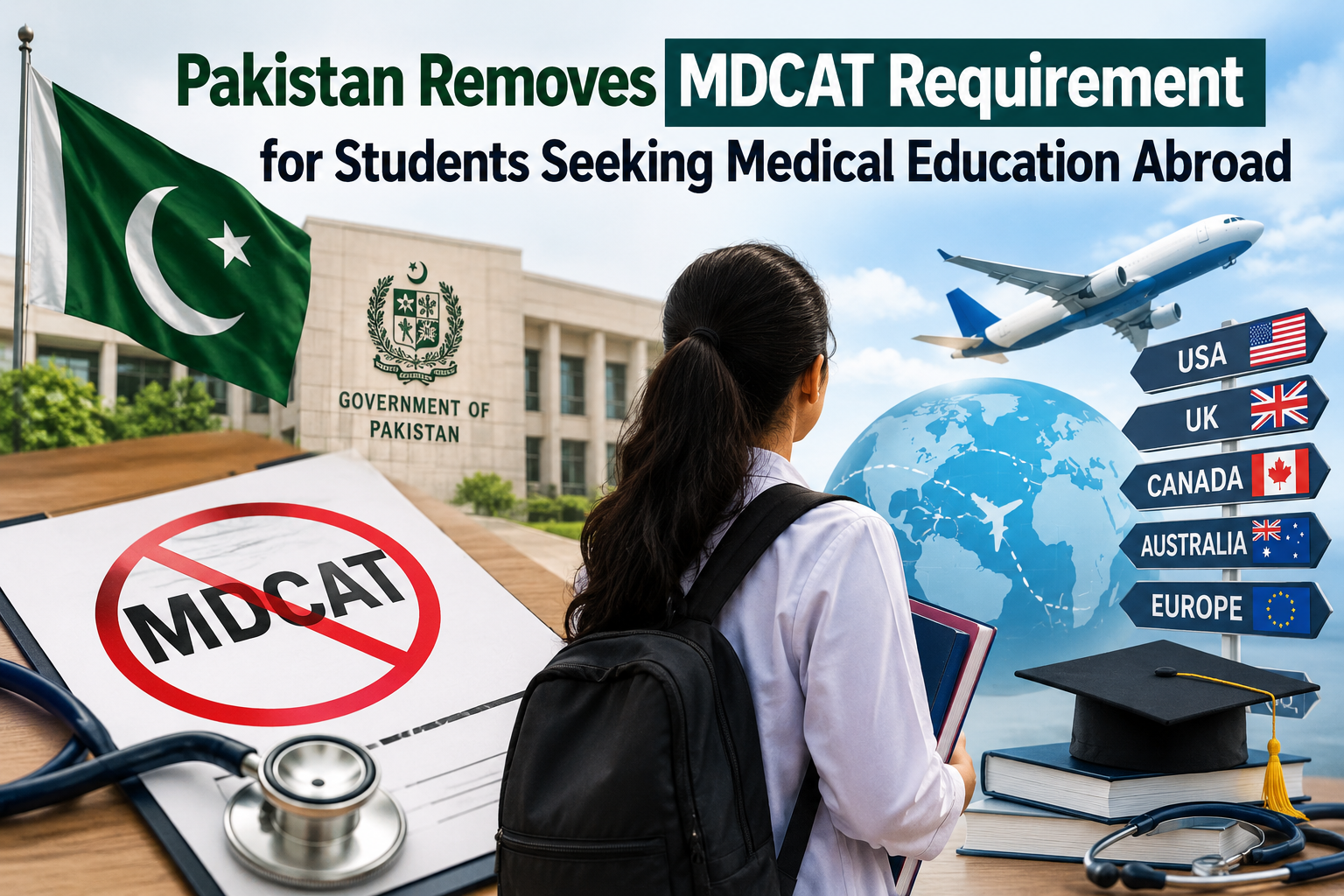
Pakistan has announced an important policy change for students who plan to pursue undergraduate medical or dental education abroad. The Pakistan Medical and Dental Council (PMDC) has removed the mandatory requirement for Pakistani students to pass the Medical and Dental College Admission Test (MDCAT) before seeking admission to foreign medical and dental institutions.
The decision was taken by the PMDC Council at its meeting on September 14, 2026, and was formally announced through a public notice on October 5. The change provides relief to Pakistani students who intend to study medicine or dentistry in other countries.
Previously, PMDC policy required Pakistani students who had completed their intermediate education in Pakistan to pass MDCAT as part of the eligibility requirements for admission to foreign medical and dental institutions. The earlier policy required at least 50 percent marks in MDCAT, along with other eligibility conditions.
The latest decision specifically removes the pre-admission MDCAT condition for students seeking admission abroad. It does not mean that all requirements for studying medicine overseas or eventually practising medicine in Pakistan have been removed.
What Has Changed?
The most important change is simple: Pakistani students seeking admission to undergraduate medical or dental institutions abroad are no longer required to have passed MDCAT as a prerequisite.
The PMDC announced the exemption through its official public notices. Its website lists the October 5 notice as the “Public Notice Regarding Exemption of MDCAT for seeking Admission in Foreign Institutions.”
This is a significant change because students previously had to satisfy the MDCAT requirement even when their intended medical education would take place outside Pakistan.
Under the new policy, that particular condition has been removed.
However, students still need to carefully consider other PMDC requirements, foreign university admission rules, recognition of qualifications and future registration requirements.
Why the Decision Matters for Pakistani Students
Medical education abroad is an important option for some Pakistani students who are unable to secure admission to local medical or dental colleges or who specifically wish to study in another country.
The MDCAT requirement had added another examination hurdle for such students.
Removing the requirement can make the initial application process more straightforward. Students can focus on meeting the admission criteria established by the foreign institution and the country where they intend to study.
The decision may also reduce uncertainty for families planning overseas medical education.
However, the exemption should not be interpreted as a guarantee of admission. Foreign universities will continue to have their own academic and admission requirements.
What Was the Previous Requirement?
The previous PMDC policy for Pakistani students seeking undergraduate medical or dental education abroad included several conditions.
A 2024 PMDC policy required students who completed intermediate education in Pakistan to have at least 60 percent marks in FSc Pre-Medical or an equivalent qualification. It also required such students to obtain at least 50 percent marks in MDCAT.
A PMDC notice issued in May 2026 similarly stated that students seeking admission to foreign undergraduate medical or dental institutions had to obtain at least 50 percent marks in MDCAT conducted in Pakistan or an equivalent examination from abroad under PMDC policy.
The October 2026 decision removes the MDCAT prerequisite.
This represents a clear change from the earlier framework.
PMDC Did Not Give a Detailed Reason
The PMDC’s public notice announcing the exemption did not provide a detailed explanation for why the council decided to remove the requirement.
According to reporting by Dawn, PMDC President Dr Rizwan Taj said that a parliamentary committee had recommended that Pakistani students intending to study abroad should not be compelled to clear MDCAT.
The issue had been discussed by the Senate Standing Committee on National Health Services.
The committee had questioned the legal basis for making MDCAT compulsory for students seeking admission to foreign medical institutions. It had also raised concerns about whether requiring MDCAT was an effective way to prevent Pakistani students from enrolling in low-quality foreign institutions.
Senate Committee Raised Questions
The debate surrounding the MDCAT requirement had been ongoing for several months.
Parliamentary discussions focused on whether the PMDC had sufficient legal authority to impose a blanket MDCAT condition on students who wanted to study outside Pakistan.
Committee members also questioned whether the examination requirement actually addressed the problem of students enrolling in substandard foreign medical colleges.
Instead of relying on MDCAT as a general restriction, the committee suggested that the PMDC should identify foreign medical institutions that do not meet the required standards and make that information publicly available.
This approach would give students and parents more information before making an important educational decision.
Recognition of Foreign Universities Remains Important
Removing the MDCAT requirement does not mean that students can choose any foreign medical or dental institution without checking its recognition status.
Recognition remains a major issue.
Students planning to study medicine abroad need to ensure that their chosen institution and qualification meet the relevant PMDC requirements if they intend to return to Pakistan and seek professional registration.
The earlier PMDC policy required students to verify that the institution appeared on the council’s relevant list and that the foreign medical qualification met specified recognition standards.
Therefore, students should not make decisions based solely on the removal of MDCAT.
The recognition of the institution and qualification remains highly important.
Studying Abroad and Practising in Pakistan Are Different
One of the most important points in the new policy is the distinction between admission to a foreign institution and permission to practise medicine in Pakistan.
The exemption concerns the requirement to pass MDCAT before admission abroad.
It does not automatically give a foreign medical graduate the right to practise medicine in Pakistan.
Foreign graduates must still satisfy the applicable requirements for professional registration.
According to Dawn, students who complete their medical education abroad and later want to practise in Pakistan will still have to meet the relevant registration requirements, including the examination required for foreign medical graduates.
This distinction is extremely important for students and parents.
National Registration Examination
Foreign medical graduates seeking registration in Pakistan may have to pass the National Registration Examination, depending on the applicable rules.
The examination is designed to assess the knowledge, clinical skills and professional competence of graduates of foreign medical institutions.
The PMDC has continued to list registration and examination services for medical and dental professionals on its official platform.
Therefore, the new MDCAT exemption should not be understood as an exemption from professional assessment after graduation.
What If a Student Wants to Return to Pakistan During Studies?
Another important situation concerns students who begin medical or dental education abroad and later want to transfer to Pakistan.
According to information reported by Dawn, students who seek to transfer to a Pakistani institution during their studies may have to meet National Examination Board assessment requirements.
This means students should think carefully before selecting a foreign institution.
Changing countries or transferring institutions during medical education can involve additional academic and regulatory requirements.
Students should therefore understand the rules before beginning their studies rather than assuming that the new MDCAT exemption covers every future situation.
Relief for Students Planning Overseas Education
For students who were planning to study medicine abroad, the decision can provide considerable relief.
Preparing for a competitive medical entrance examination requires significant time and effort. Students previously had to prepare for MDCAT while simultaneously meeting the academic requirements of foreign universities.
The removal of the requirement allows students to concentrate more directly on their foreign university applications.
For families, it may also simplify the initial planning process.
However, students should still research the academic requirements of the university they intend to attend.
Foreign Universities Have Their Own Requirements
The removal of Pakistan’s MDCAT requirement does not mean foreign universities have eliminated their own admission criteria.
Different countries and institutions can have different requirements for medical and dental applicants.
Some universities may require particular grades in science subjects, entrance examinations, interviews, language proficiency or other qualifications.
Therefore, Pakistani students still need to meet the requirements established by their chosen institution.
The PMDC decision simply removes the Pakistani council’s MDCAT prerequisite for seeking admission abroad.
Importance of Academic Preparation
Even without MDCAT, strong academic preparation remains important.
Medical education is demanding and requires a strong understanding of subjects such as biology, chemistry and other sciences.
Students planning to pursue medicine abroad should therefore not treat the exemption as a reason to reduce their academic effort.
Instead, they can use the additional flexibility to focus on the requirements of their selected university and prepare for the academic challenges of medical education.
A medical degree requires consistent study throughout the programme, so strong foundational knowledge remains valuable.
Parents Also Need to Check Recognition
Parents play an important role in overseas medical education decisions.
The cost of studying medicine abroad can be substantial, and choosing an institution is a major financial and educational decision.
Parents should therefore check whether the institution is properly recognised and whether its graduates can meet the professional registration requirements relevant to Pakistan.
The removal of MDCAT makes the admission pathway easier in one respect, but it does not remove the need for careful planning.
Concern About Substandard Institutions
One reason the MDCAT policy had attracted attention was the concern about Pakistani students enrolling in medical institutions that may not meet appropriate educational standards.
The Senate committee had recommended stronger regulation of foreign medical institutions and suggested that the PMDC prepare and publicly disclose a list of institutions that do not meet prescribed standards.
This issue remains important even after the MDCAT requirement has been removed.
Students should understand that easier admission does not necessarily mean better education.
The quality of the university, teaching hospital, clinical training, curriculum and recognition status can have a major effect on a medical graduate’s future.
Impact on Medical Education Abroad
The policy change could increase interest among Pakistani students considering medical and dental education overseas.
Students who previously viewed MDCAT as an additional barrier may now find overseas options more accessible at the application stage.
However, the long-term impact will depend on how the PMDC manages foreign medical education and professional registration.
The council will still have an important role in ensuring that Pakistani graduates of foreign institutions meet appropriate professional standards before receiving permission to practise in Pakistan.
Possible Benefits of the New Policy
The new policy can provide several potential benefits.
Easier Initial Application Process
Students no longer have to pass MDCAT simply to satisfy the PMDC prerequisite for seeking admission abroad.
More Flexibility
Students can focus on foreign university admission requirements rather than preparing for an additional Pakistani entrance examination.
Reduced Administrative Burden
Removing the blanket MDCAT condition can simplify the initial process for students and families.
Greater Choice
Students may have more flexibility when considering medical and dental institutions in other countries.
Clearer Separation of Admission and Registration
The policy distinguishes the process of getting admission abroad from the later process of professional registration in Pakistan.
Important Limitations
Despite the benefits, the new policy also has limitations.
First, removing MDCAT does not guarantee admission to a foreign university.
Second, it does not guarantee professional registration in Pakistan after graduation.
Third, students still need to consider recognition requirements.
Fourth, students who later want to transfer to Pakistan may face additional assessment requirements.
Finally, the cost of overseas medical education remains an important consideration for families.
What Students Should Understand
The simplest way to understand the new policy is this:
MDCAT is no longer a mandatory PMDC prerequisite for Pakistani students seeking admission to foreign undergraduate medical and dental institutions.
But:
Other academic, institutional recognition and professional registration requirements still matter.
This distinction can prevent confusion.
Students should not assume that the exemption means all PMDC regulations have disappeared.
Effect on Students Who Want to Practise in Pakistan
Many Pakistani students who study medicine abroad eventually hope to return home and work in Pakistan.
For these students, professional registration remains a major consideration.
A foreign medical degree alone does not automatically mean that a graduate can begin practising in Pakistan.
Graduates must comply with the applicable PMDC requirements and examinations.
According to Dawn, foreign graduates seeking to practise in Pakistan are still required to appear in the relevant registration examination.
This means students should consider their long-term career plans before selecting a university abroad.
The Importance of Checking Official Information
Medical education regulations can change over time.
The latest MDCAT exemption itself demonstrates how quickly policy can change.
Therefore, students and parents should rely on current official PMDC notices and applicable university information when making decisions.
The PMDC website currently lists the October 5, 2026 public notice concerning the exemption of MDCAT for students seeking admission to foreign institutions.
Students should check the latest rules rather than relying on older social-media posts or outdated admission guides.
A Significant Policy Shift
The removal of MDCAT as a prerequisite for foreign medical and dental admission is an important policy shift in Pakistan’s medical education system.
For years, students planning to study medicine abroad had to consider MDCAT as part of their eligibility pathway.
The new decision changes that requirement.
At the same time, the government and PMDC still face the challenge of protecting students from low-quality foreign medical institutions.
A balanced regulatory system can allow students greater freedom while ensuring that foreign medical qualifications meet acceptable standards.
Conclusion
Pakistan’s decision to remove the mandatory MDCAT requirement for students seeking admission to foreign medical and dental institutions is a major development for aspiring medical students.
The PMDC announced the exemption on October 5, 2026, following a council decision taken on September 14. The change removes the previous requirement for Pakistani students to pass MDCAT before seeking admission to undergraduate medical and dental institutions abroad.
The policy provides greater flexibility for students who want to pursue medical education overseas. It also follows months of discussion over whether MDCAT was an appropriate requirement for admission to foreign institutions.
However, students should understand that the exemption is limited. It does not remove foreign university admission requirements, PMDC recognition requirements or professional registration requirements in Pakistan.
For students who eventually want to return and practise in Pakistan, examinations and registration rules for foreign graduates remain important.
The latest policy therefore offers students an easier route at the admission stage, but careful planning remains essential for the entire medical education journey.
Ultimately, the success of the policy will depend on whether Pakistan can combine greater educational flexibility with strong regulation of foreign medical institutions. For students and parents, the most important lesson is to look beyond admission and consider the full journey from university selection to professional registration.
FAQs
1. Is MDCAT still required for Pakistani students seeking admission abroad?
No. PMDC has removed the mandatory MDCAT prerequisite for Pakistani students seeking admission to foreign undergraduate medical and dental institutions.
2. When did PMDC announce the exemption?
PMDC announced the exemption through a public notice dated October 5, 2026. The council decision was taken at its September 14 meeting.
3. Does the exemption guarantee admission to a foreign medical university?
No. Students still have to meet the admission requirements of the foreign university and comply with applicable PMDC rules.
4. Can foreign medical graduates practise in Pakistan without an examination?
No. The MDCAT exemption does not automatically provide professional registration in Pakistan. Foreign graduates must meet the applicable PMDC registration requirements.
5. Is checking the recognition of a foreign medical university still important?
Yes. Students should carefully verify the recognition and regulatory status of the institution and qualification before enrolling, particularly if they plan to return to Pakistan and practise.




