Introduction
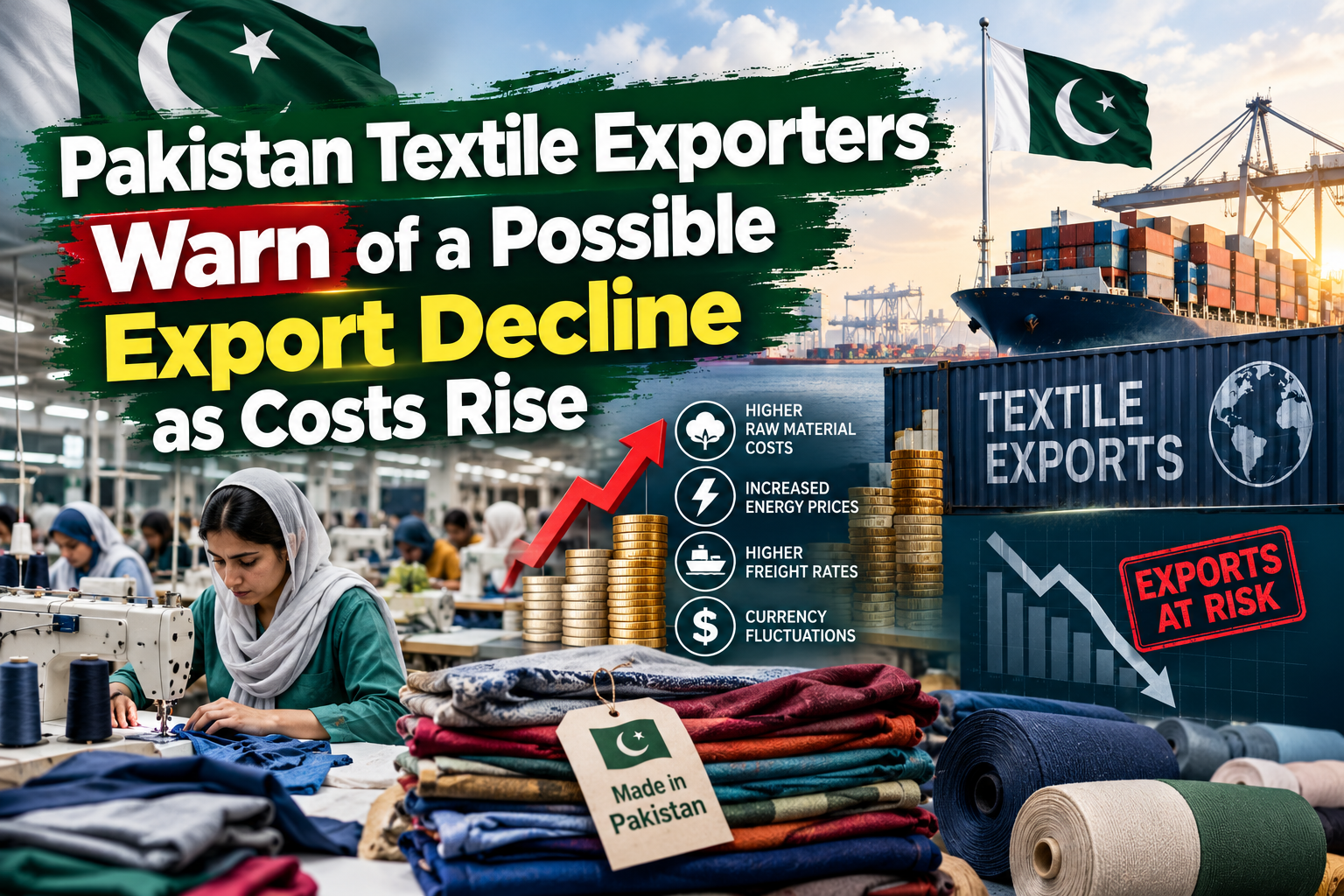
Pakistan’s textile industry is facing growing uncertainty as exporters warn that overseas shipments could decline during the October–December 2026 quarter. Weak demand in Western markets, higher shipping costs, rising production expenses, and disruptions to regional trade are creating serious challenges for manufacturers and exporters.
The warning comes despite a positive start to the current financial year. Pakistan’s textile and clothing exports increased by 5.26% during July–September 2026, reaching approximately $5.026 billion compared with $4.775 billion during the same period last year. However, industry representatives say maintaining this growth will be difficult if the costs of production and international transportation continue to rise.
The Pakistan Textile Exporters Association (PTEA) has urged the government to introduce supportive measures, clear outstanding refunds, and implement the announced export financing rate. The association believes that timely action could help Pakistani businesses maintain their competitiveness and protect the country’s share of international markets.
The situation is important for Pakistan because textiles are a major source of export earnings, manufacturing activity, and employment. Any prolonged slowdown could affect businesses throughout the textile supply chain, from cotton production to finished clothing.
Why Pakistan’s Textile Exporters Are Raising Concerns
Pakistan’s textile exporters operate in a highly competitive international market. They supply cotton yarn, fabrics, knitwear, towels, bedwear, and ready-made garments to buyers across different regions. These products support the country’s foreign-exchange earnings and provide work for people in manufacturing, transportation, processing, packaging, and related industries.
However, exporters are now facing several pressures simultaneously. According to the Pakistan Textile Exporters Association, weaker demand in Western markets, increased sea freight charges, and higher production costs have made it more difficult for Pakistani companies to compete internationally.
The concern is not limited to one product or one type of business. A factory producing yarn may experience lower orders from a weaving unit, while a garment manufacturer may struggle with expensive fabric, electricity, transportation, and delivery arrangements.
When several stages of the supply chain experience pressure at the same time, the effects can spread throughout the industry.
Exporters are therefore asking policymakers to address the problems before a temporary slowdown becomes a longer-term challenge.
Textile Exports Grew in the First Quarter of FY2026–27
Although industry representatives have warned about the coming quarter, official figures show that Pakistan’s textile exports increased during the first three months of fiscal year 2026–27.
Textile and clothing exports reached $5.026 billion between July and September 2026, compared with $4.775 billion during the corresponding period of the previous financial year. This represented year-on-year growth of 5.26%.
The increase indicates that Pakistani exporters continued to generate higher export earnings despite a difficult business environment. However, the overall figure does not mean that every textile category performed equally well or that the industry’s cost pressures have disappeared.
Some product categories recorded stronger growth than others. Ready-made garments performed particularly well, while cotton yarn and towels also contributed to the increase.
At the same time, rising input costs and logistical difficulties continued to affect exporters’ competitiveness. The industry’s challenge is to turn the first quarter’s growth into sustainable progress rather than allowing higher expenses to weaken future performance.
The warning about October–December should therefore be understood as a forecast from industry representatives, not confirmation that a decline has already occurred throughout the quarter.
Ready-Made Garments Support Export Growth
Ready-made garments were among the stronger performers in Pakistan’s textile export sector during the first quarter of FY2026–27.
Exports of ready-made garments increased by 15.69% in value to approximately $1.223 billion during July–September 2026, compared with around $1.057 billion in the same period a year earlier. Their exported quantity also increased, indicating that the growth was not limited to higher reported prices.
This performance highlights the importance of finished products in Pakistan’s export strategy. Instead of relying exclusively on raw cotton or intermediate materials, the country can generate additional economic value by producing garments that are ready for consumers.
Finished clothing requires several stages of activity, including fabric preparation, cutting, stitching, finishing, quality inspection, and packaging. These processes support manufacturing employment and allow businesses to develop relationships with international retailers and clothing brands.
Nevertheless, garment manufacturers remain exposed to higher energy bills, transportation costs, imported machinery and materials, and changing buyer demand. Strong first-quarter figures do not automatically guarantee continued growth.
To sustain progress, exporters need predictable operating costs, dependable shipping arrangements, access to financing, and the ability to meet international quality standards.
Cotton Yarn and Other Textile Products
Cotton yarn also contributed to the improvement in textile exports. According to the reported trade figures, cotton yarn exports increased by 24.47% to approximately $227.1 million during the first quarter of FY2026–27. Towel exports rose by around 10% to $291.56 million, while knitwear exports increased by 4.14% to approximately $1.483 billions.
These figures show that the textile industry contains several different business segments, each with its own market conditions and cost structure.
Cotton yarn is an important input for weaving and knitting. When yarn manufacturers face financial pressure, the effects can reach fabric producers and clothing businesses. Similarly, difficulties experienced by garment exporters can reduce demand for materials supplied by other domestic companies.
Knitwear remains a significant export category, but growth in its export value does not necessarily mean that all operational indicators are improving. Changes in quantities, production costs, product mix, and international prices can affect how businesses perform.
The industry therefore needs to assess both export earnings and the underlying factors that influence profitability.
Rising Freight Charges Put Pressure on Exporters
One of the main concerns raised by textile exporters is the increase in sea freight charges.
The Pakistan Textile Exporters Association has reported that freight costs have risen by approximately 1.5 to 2.5 times, placing additional pressure on businesses that already operate with limited profit margins.
International shipping is essential for Pakistan’s textile industry because most overseas customers require goods to be delivered according to agreed schedules. Exporters must arrange transportation from factories to ports, complete documentation, coordinate shipping, and ensure that products reach buyers in suitable condition.
When freight charges rise sharply, exporters have several difficult choices. They may absorb the additional expense, negotiate with customers, revise prices, or reconsider whether certain orders remain financially viable.
Absorbing higher costs reduces profit. Increasing prices can make products less competitive against suppliers in countries with lower production or transportation expenses. Delays may also create problems for retailers that need seasonal clothing and household textile products to arrive on time.
Smaller exporters can be particularly vulnerable because they may have less bargaining power with shipping companies and fewer financial resources to absorb unexpected expenses.
Reducing logistical uncertainty and improving access to competitive shipping arrangements could therefore help Pakistani exporters protect their international business relationships.
Weak Demand in Western Markets
Demand from Western markets is another important factor behind the industry’s concerns.
Textile exporters rely on customers in overseas markets to purchase clothing, household textiles, fabrics, and other products. When consumers face high living costs, they may reduce discretionary spending, while retailers may become more cautious about placing new orders.
This can affect suppliers in countries such as Pakistan, where many manufacturers depend on international customers for a substantial share of their business.
The Pakistan Textile Exporters Association has attributed part of the pressure on exporters to inflation in Western markets and weaker demand from international buyers.
When demand weakens, retailers may delay purchasing decisions, negotiate lower prices, or reduce order volumes. Manufacturers may then have difficulty planning production and managing their inventories.
Factories generally need to arrange raw materials, labour, electricity, and transportation before completing export orders. If a buyer reduces an order after production planning has begun, the manufacturer may be left with unused capacity or materials that cannot easily be sold elsewhere.
Pakistani exporters can respond by strengthening customer relationships, improving product quality, exploring new markets, and developing products that meet changing consumer preferences.
However, entering new markets takes time and investment. Businesses also need reliable information about regulations, product standards, payment arrangements, and customer demand.
Higher Production Costs Affect Competitiveness
Production costs are another major challenge for Pakistan’s textile manufacturers.
Textile production involves electricity, fuel, machinery, raw materials, labour, water, maintenance, packaging, and transportation. An increase in several of these expenses can significantly affect a factory’s total operating costs.
Exporters compete with suppliers from different countries, and buyers often compare prices, quality, delivery schedules, and reliability before placing orders. If Pakistani businesses face higher costs than their competitors, they may find it difficult to offer attractive prices without reducing their margins.
Energy costs are particularly important because textile manufacturing uses electricity and other energy sources across spinning, weaving, knitting, dyeing, processing, and finishing.
The association has called for changes to industrial energy arrangements, including removing cross-subsidies that it says increase the burden on exporters.
Any policy response must balance industrial competitiveness with the wider financial requirements of the energy sector. At the same time, businesses need sufficient predictability to prepare budgets, accept long-term orders, and invest in production facilities.
Improving energy efficiency, modernising machinery, reducing waste, and adopting better production management can also help manufacturers control costs over time.
Exporters Seek a 6–8% Duty Drawback Scheme
The Pakistan Textile Exporters Association has asked the government to provide temporary support through the Duty Drawback of Local Taxes and Levies scheme at a rate of 6–8%. It has also called for the clearance of outstanding refunds to ease financial pressure across the textile supply chain.
A duty drawback arrangement generally allows eligible exporters to receive refunds or rebates on certain domestic taxes and duties associated with exported products, subject to the rules of the relevant scheme.
Exporters argue that such support could help offset part of the cost disadvantage they face when competing in international markets.
Refund delays can also affect cash flow. A company may have to pay wages, purchase materials, cover electricity expenses, and arrange shipments while waiting for money owed to it. Businesses with limited working capital may struggle to finance new orders under these conditions.
Faster processing of valid claims could make it easier for companies to manage their finances and maintain production.
However, the effectiveness of any relief programme would depend on its design, eligibility rules, implementation speed, and financial sustainability. Policymakers would need to ensure that support reaches genuine exporting businesses and produces measurable benefits for export activity.
Export Finance Rate Remains an Important Issue
Access to affordable financing is another issue highlighted by textile exporters.
Businesses often require working capital before they receive payment from overseas buyers. They may need to purchase cotton, yarn, dyes, fabric, packaging, and other materials well before the final products are shipped.
Export finance can help companies cover these expenses and fulfil orders without placing excessive pressure on their cash reserves.
The Pakistan Textile Exporters Association has said that a 4.5% financing rate announced for the Export Finance Scheme in the FY2026–27 Finance Bill had not yet been implemented at the time of its October 12 statement.
For exporters, the difference between an announced policy and its practical implementation can be significant. Businesses need clarity about eligibility, lending conditions, and the actual financing cost before making decisions about production and new orders.
If financing remains expensive, companies may postpone investments, reduce production, or become more cautious about accepting large orders.
A predictable export finance framework could help businesses plan their working capital requirements and maintain production during periods of weaker demand.
Regional Trade Disruptions Create Additional Challenges
Pakistan’s textile exporters also face uncertainty from regional trade disruptions.
Recent reporting has identified the suspension of trade with Afghanistan since October 2025 and reduced exports to parts of the Middle East, including the United Arab Emirates, as factors affecting trade performance.
Regional markets matter because they can provide additional customers for Pakistani manufacturers and traders. When trade routes become difficult to use or demand in a particular market weakens, exporters may need to redirect goods to alternative destinations.
That process is not always straightforward. Buyers in different markets may require different product specifications, packaging, documentation, certifications, or delivery arrangements.
Companies may also need to establish new commercial relationships before they can replace lost orders.
Trade disruptions can affect more than the final delivery of a product. They may change transport costs, lengthen delivery times, create uncertainty about payment, and complicate production planning.
Improved trade facilitation, clearer procedures, and the development of alternative markets could help exporters reduce their dependence on a limited number of routes or customers.
Effects on Workers and Small Businesses
The textile industry’s performance matters not only to exporters but also to workers and smaller businesses.
Textile production depends on a wide network of activities. Cotton growers supply raw material, ginning facilities prepare cotton, spinning mills produce yarn, weaving and knitting units make fabric, processing facilities finish materials, and garment factories manufacture products for domestic and international customers.
Transportation providers, packaging companies, maintenance workers, and other service businesses also depend on activity across the supply chain.
If export orders decline for an extended period, factories may reduce shifts, delay expansion plans, or cut back on purchases from suppliers. Smaller businesses that depend on a few large customers may face particular difficulties.
Workers can also be affected when factories reduce operating hours or delay recruitment. The extent of these effects would depend on the size and duration of any slowdown, so a forecast of weaker exports should not be treated as proof that widespread job losses have already occurred.
Supporting a stable export environment can help businesses plan production and maintain employment. Skills development, modern manufacturing techniques, and improved productivity can also strengthen workers’ opportunities over the longer term.
Why Textile Exports Matter to Pakistan’s Economy
Textiles are one of Pakistan’s most important export industries. The sector generates foreign-exchange earnings and connects domestic manufacturing with international markets.
Export receipts help bring foreign currency into the country, while manufacturing activity supports jobs and demand for materials and services. A strong textile sector can also encourage investment in machinery, technology, logistics, and workforce training.
When textile exports grow sustainably, businesses may have greater confidence to expand capacity, improve quality, and develop new products. When exports weaken, manufacturers can become more cautious about investment and hiring.
The industry’s performance also matters because exporters must compete in a market where prices, quality, delivery reliability, and compliance requirements influence purchasing decisions.
Pakistan’s first-quarter export growth offers a positive starting point, but the warning from industry representatives shows that sustaining progress requires attention to operating costs, access to financing, trade conditions, and international demand.
The government and private sector therefore have a shared interest in improving the conditions under which exporters operate.
Steps That Could Help Strengthen the Textile Industry
Pakistan can pursue several practical measures to support the textile sector and improve its long-term competitiveness.
1. Improve the predictability of energy costs
Manufacturers need reliable information about electricity and fuel expenses to plan production and negotiate export orders. Transparent energy policies could help companies prepare budgets and assess investment opportunities more accurately.
2. Resolve outstanding refunds efficiently
A clear process for verifying and paying valid export-related refunds could help businesses manage cash flow. Timely processing would be particularly useful for companies that need working capital to fulfil new orders.
3. Clarify export financing arrangements
Exporters need transparent information about financing rates, eligibility, documentation, and implementation. Predictable access to working capital could make it easier to purchase materials and maintain production schedules.
4. Improve logistics and shipment reliability
Efficient port operations, dependable inland transportation, clear documentation procedures, and competitive shipping options could reduce delays and improve the reliability of deliveries.
5. Diversify export markets
Businesses can explore opportunities in additional countries rather than relying heavily on a limited number of customers. Market diversification requires research, product adaptation, and investment in commercial relationships, but it can reduce exposure to a downturn in one region.
6. Invest in technology and efficiency
Modern machinery, better production planning, energy-saving equipment, and waste reduction can improve productivity. These improvements may help businesses manage costs while maintaining product quality.
7. Move towards higher-value products
Pakistan can strengthen its position by developing finished garments and specialised textile products rather than depending entirely on lower-value materials. Higher-value manufacturing can create opportunities for design, branding, and product differentiation.
These measures would not eliminate every international challenge, but they could improve the industry’s ability to respond to changing market conditions.
The Role of Small and Medium-Sized Exporters
Small and medium-sized enterprises are an important part of the textile ecosystem. They may produce specialised garments, supply fabric to larger manufacturers, handle embroidery, provide stitching services, or manufacture products for particular customers.
Such businesses can be flexible and responsive to customer requirements, but they may have limited access to financing and fewer resources for international marketing.
Higher shipping charges and delayed payments can affect these companies more severely because they have less capacity to absorb unexpected costs.
Improving access to business information, export documentation support, digital marketing, quality certification, and working capital could help smaller exporters reach new customers.
Cooperation between manufacturers, trade associations, financial institutions, and government agencies may also help smaller firms understand changing market requirements.
At the same time, businesses should evaluate the profitability and risks of each order carefully. Winning an export contract is valuable only when a company can fulfil it to the required standard and at a financially sustainable cost.
The Importance of Product Quality and International Standards
Cost competitiveness is important, but price alone does not determine success in international textile markets.
Buyers also look for consistent quality, dependable delivery, product safety, and compliance with applicable requirements. Companies that fail to meet specifications can face rejected shipments, payment disputes, or damage to their commercial relationships.
Pakistani manufacturers can strengthen their position by improving quality-control systems, maintaining accurate production records, and investing in staff training.
They can also work towards meeting relevant buyer requirements concerning materials, manufacturing processes, and product traceability.
A reputation for reliability can help an exporter retain customers even when market conditions become difficult. Long-term relationships may also give businesses better visibility into future orders and changing consumer preferences.
For this reason, short-term financial support should ideally be accompanied by efforts to improve productivity, quality, and innovation.
What to Watch During October–December 2026
The October–December quarter will be important for assessing whether Pakistan’s textile export growth can continue.
Several indicators will help observers understand how the industry is performing:
Monthly textile export figures: These will show whether shipments and export earnings are increasing or weakening.
Order volumes from overseas buyers: New orders and cancellations can provide early signals about future production.
Freight costs and delivery times: Changes in shipping conditions can affect both margins and customer satisfaction.
Energy and input expenses: These influence the cost of manufacturing and the prices exporters can offer.
Refund and financing arrangements: Their implementation can affect the working capital available to businesses.
Performance across product categories: Garments, knitwear, yarn, towels, and other products may follow different trends.
A single month of data will not necessarily establish the direction of the entire industry. Seasonal demand, shipment timing, international prices, and temporary disruptions can all influence monthly results.
The most useful assessment will consider several months of data alongside the reasons behind any changes.
It is also important to distinguish between export value and export volume. Export earnings may rise because of higher prices even if the quantity shipped does not increase at the same pace. Understanding both measures can provide a clearer picture of the industry’s underlying performance.
Outlook for Pakistan’s Textile Export Sector
Pakistan’s textile industry enters the October–December period with mixed signals. Export earnings increased during the first quarter of FY2026–27, but industry representatives have warned that weaker overseas demand and higher costs could threaten the next quarter.
The 5.26% increase in first-quarter textile and clothing exports demonstrates that opportunities remain available for Pakistani manufacturers. Stronger performance in ready-made garments and several other categories offers a foundation on which the industry can build.
However, the outlook will depend on whether exporters can maintain competitive prices, secure new orders, manage freight expenses, and obtain the financing needed to fulfil contracts.
Government measures may help ease immediate financial pressures, but lasting progress will also require investment, productivity improvements, reliable logistics, and access to diversified markets.
For businesses, the coming months will be a test of resilience and planning. For policymakers, they will provide an opportunity to address long-standing concerns about the cost and predictability of doing business in Pakistan.
The central issue is not simply whether textile exports rise or fall in one quarter. It is whether Pakistan can create conditions that allow its manufacturers to compete consistently in international markets, retain customers, support employment, and increase the value of the goods they export.
If the industry receives effective support while continuing to improve efficiency and quality, it may be better positioned to protect its market share and pursue sustainable growth.
Conclusion
Pakistan’s textile exporters have warned of a possible decline in shipments during October–December 2026 because of weak Western demand, rising freight charges, and higher production costs. The warning comes after textile and clothing exports rose to $5.026 billion in the first quarter of the financial year.
The difference between recent growth and the industry’s concerns highlights the uncertainty facing exporters. A positive start does not guarantee that the same performance will continue if business costs increase and international orders weaken.
The Pakistan Textile Exporters Association has called for temporary tax-related support, clearance of outstanding refunds, and implementation of the announced export financing rate. These requests reflect the importance of cash flow and operating costs for companies working in competitive international markets.
Ultimately, Pakistan’s textile sector will need both immediate support and long-term improvements. Better energy efficiency, modern production systems, reliable logistics, stronger market access, and consistent product quality can help exporters remain competitive.
The coming quarter will provide important evidence about whether the industry can maintain its recent growth or whether the challenges identified by exporters will lead to weaker performance.
FAQs
1. Why are Pakistan’s textile exporters warning about a possible decline?
Exporters have cited weaker demand in Western markets, higher sea freight charges, and rising production costs as major concerns for the October–December 2026 quarter.
2. How much did Pakistan’s textile exports increase in the first quarter of FY2026–27?
Textile and clothing exports increased by 5.26% to approximately $5.026 billion during July–September 2026, compared with $4.775 billion in the same period a year earlier.
3. What support are textile exporters requesting from the government?
The Pakistan Textile Exporters Association has requested 6–8% support under the Duty Drawback of Local Taxes and Levies scheme, clearance of outstanding refunds, and implementation of the announced 4.5% Export Finance Scheme rate.
4. How do higher shipping costs affect textile businesses?
Higher freight charges increase the cost of delivering products overseas, reduce profit margins, and can make Pakistani goods less competitive against products from other exporting countries.
5. What could help Pakistan strengthen its textile exports?
More predictable energy costs, affordable export financing, timely refunds, improved logistics, investment in modern machinery, better product quality, and access to additional international markets could support the industry’s long-term competitiveness.