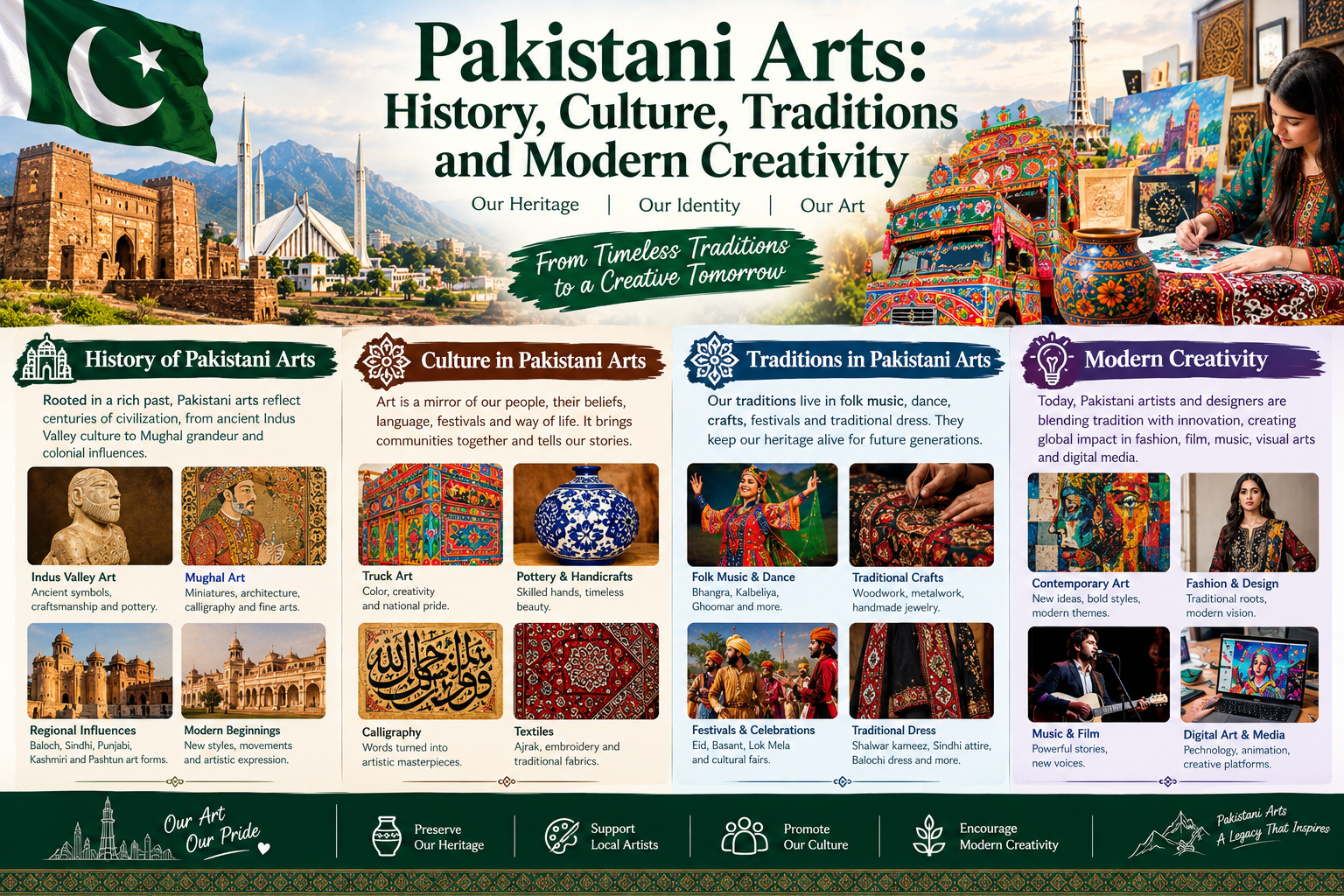
Pakistani arts represent the country's rich cultural history, regional diversity, traditional skills, and modern creative expression. From ancient pottery and decorative crafts to calligraphy, painting, embroidery, truck art, sculpture, architecture, and contemporary visual arts, Pakistan has a wide artistic heritage.
The arts of Pakistan have developed through centuries of cultural exchange. Different civilizations, communities, languages, religions, and regional traditions have contributed to the country's artistic identity. Ancient archaeological sites provide evidence of early craftsmanship, while Islamic art introduced important traditions of geometric patterns, calligraphy, architecture, and decorative design.
Today, Pakistani artists continue to combine traditional ideas with modern techniques. Paintings, digital art, textile designs, photography, sculpture, installations, and other creative forms are increasingly becoming part of Pakistan's contemporary art scene.
Pakistani arts are therefore not limited to museums or historical objects. They can be seen in homes, clothing, architecture, public spaces, handicrafts, festivals, galleries, educational institutions, and everyday cultural life.
History of Pakistani Arts
The history of art in the region that is now Pakistan goes back thousands of years.
Archaeological discoveries from ancient civilizations provide evidence of pottery, jewelry, sculpture, seals, decorative objects, and other forms of craftsmanship.
One of the most important examples is the Indus Valley Civilization. Ancient settlements such as Mohenjo-daro and Harappa produced objects that demonstrate the technical and artistic skills of their communities.
Over later centuries, the region experienced cultural influences from different societies and empires. These influences affected architecture, painting, decorative arts, textiles, metalwork, and other creative traditions.
The arrival and development of Islamic culture also had a major influence on art. Calligraphy, geometric decoration, floral patterns, mosque architecture, tile work, and manuscript traditions became important parts of artistic expression.
Indus Valley Artistic Heritage
The Indus Valley Civilization is an important part of the history of art in Pakistan.
Archaeological sites have produced pottery, terracotta objects, seals, ornaments, sculptures, and other artifacts.
The famous small sculptures and decorated objects demonstrate the craftsmanship of ancient communities.
Pottery was particularly important because it was used for practical purposes while also featuring decorative patterns and shapes.
Ancient seals are another important example. Many contain animal figures, symbols, and inscriptions.
These archaeological discoveries provide information about the creativity, technology, and daily life of ancient societies.
Islamic Influence on Pakistani Art
Islamic traditions have strongly influenced the development of art in the region.
Islamic art often uses calligraphy, geometric patterns, floral designs, symmetry, and architectural decoration.
In Pakistan, these elements can be seen in mosques, shrines, historic buildings, manuscripts, tiles, woodwork, and other artistic forms.
Arabic and Persian calligraphy traditions also influenced local artistic practices.
Over time, artists combined Islamic artistic ideas with regional styles, creating distinctive forms of Pakistani cultural art.
Pakistani Calligraphy
Calligraphy is one of the most important traditional art forms in Pakistan.
It involves creating artistic forms through carefully designed writing.
Arabic and Urdu calligraphy are particularly significant in Pakistani culture. Calligraphic artwork can be found in religious buildings, homes, educational institutions, galleries, and public spaces.
Different scripts and styles can be used depending on the artistic tradition and purpose.
Modern Pakistani calligraphers also experiment with colors, backgrounds, abstract compositions, and contemporary materials.
Pakistani Painting
Painting is another major part of Pakistani arts.
Pakistani painters have worked in traditional, modern, abstract, figurative, landscape, miniature, and contemporary styles.
The country's painting traditions have been influenced by local culture as well as international artistic movements.
Some artists focus on landscapes and cultural scenes, while others explore social themes, identity, history, and abstract ideas.
Art institutions and galleries in major Pakistani cities provide platforms for painters to display their work.
Miniature Painting
Miniature painting has an important place in South Asian and Pakistani art history.
The tradition developed through historical manuscript and court painting practices.
Miniature paintings often contain detailed figures, architecture, landscapes, decorative borders, and carefully applied colors.
Pakistani artists have continued this tradition while also experimenting with contemporary subjects.
Modern miniature artists may combine traditional techniques with new themes and materials.
Truck Art in Pakistan
Truck art is one of Pakistan's most recognizable forms of popular visual art.
Pakistani trucks and buses are often decorated with bright colors, detailed patterns, flowers, landscapes, portraits, poetry, calligraphy, and symbolic images.
Truck art developed as part of the country's transportation culture and became an important form of public artistic expression.
The artwork can vary between regions and individual artists.
Today, truck-art-inspired designs appear not only on vehicles but also on clothing, furniture, bags, accessories, home decorations, and commercial products.
Folk Art of Pakistan
Pakistan has many forms of folk art connected with local communities and regional traditions.
Folk art can include:
Embroidery
Pottery
Weaving
Wood carving
Basketry
Metalwork
Decorative painting
Textile decoration
Jewelry making
These traditions are often passed from one generation to another.
Folk art also provides a connection between artistic expression and everyday life.
Regional Diversity in Pakistani Arts
Pakistan contains several major cultural regions, each with distinctive artistic traditions.
Punjab, Sindh, Balochistan, Khyber Pakhtunkhwa, Gilgit-Baltistan, and other areas have their own crafts, patterns, materials, and artistic practices.
Climate, local resources, history, clothing, languages, and cultural traditions all contribute to regional differences.
This diversity makes Pakistani art particularly varied.
Punjabi Arts and Crafts
Punjab has a rich tradition of decorative crafts and textile arts.
Punjabi embroidery, pottery, weaving, woodwork, and decorative designs are important parts of the region's artistic heritage.
Phulkari embroidery is particularly associated with Punjab. It uses colorful threadwork to create decorative patterns on fabric.
Punjabi folk traditions also include artistic expressions connected with festivals, music, storytelling, and traditional clothing.
Sindhi Arts and Crafts
Sindh is well known for its distinctive textile and craft traditions.
Sindhi embroidery often features colorful threadwork and detailed patterns.
Ajrak is another important cultural textile associated with Sindh. Its geometric patterns and traditional printing techniques have made it an important symbol of Sindhi cultural heritage.
Sindhi pottery, ralli quilts, woodwork, and decorative crafts also contribute to the region's artistic identity.
Balochi Arts and Crafts
Balochistan has a distinctive artistic heritage influenced by local culture and geography.
Balochi embroidery is particularly well known for detailed patterns and colorful decorative work.
Traditional clothing may contain extensive embroidery.
Balochistan also has traditions of carpet making, pottery, jewelry, and other crafts.
These artistic traditions often reflect local cultural identity and community history.
Khyber Pakhtunkhwa Arts
Khyber Pakhtunkhwa has a long tradition of woodwork, embroidery, carpets, metalwork, and decorative crafts.
Wood carving is particularly important in some areas.
Traditional architectural decoration can also include detailed wooden elements.
Local crafts often reflect the region's cultural history and traditional lifestyles.
Gilgit-Baltistan Arts
Gilgit-Baltistan has its own distinctive cultural and artistic traditions.
Local communities produce textiles, embroidery, woodwork, jewelry, and other handicrafts.
The region's mountainous environment and cultural diversity influence artistic designs and materials.
Traditional clothing and decorative objects are important parts of local cultural expression.
Pakistani Textile Art
Textiles are among the most important forms of Pakistani artistic production.
Pakistan has strong traditions of weaving, embroidery, block printing, dyeing, quilting, and decorative fabric work.
Different regions use different patterns and techniques.
Textile art is connected to clothing, home decoration, cultural ceremonies, and traditional crafts.
Modern designers also use traditional Pakistani patterns in contemporary fashion.
Embroidery in Pakistan
Embroidery is practiced across many parts of Pakistan.
Different communities use different stitches, colors, patterns, and techniques.
Embroidery can be found on:
Dresses
Shawls
Dupattas
Bags
Cushions
Bed covers
Decorative textiles
Traditional embroidery is often created by hand, while modern production may also use machines.
Pakistani Pottery
Pottery has a long history in the region.
Traditional Pakistani pottery can be both practical and decorative.
Clay pots, dishes, vases, decorative objects, and other products are produced in different areas.
Some pottery traditions use painted designs, carved patterns, or glazed surfaces.
Modern ceramic artists have also developed new forms that combine traditional techniques with contemporary design.
Blue Pottery
Blue pottery is a well-known decorative craft associated particularly with Multan.
It is recognized for its distinctive blue and white decorative patterns.
Traditional motifs may include flowers, geometric forms, and other decorative elements.
Blue pottery products can include plates, bowls, vases, tiles, and decorative pieces.
The craft demonstrates the relationship between traditional skills and local cultural identity.
Wood Carving
Wood carving is another important craft tradition in Pakistan.
Skilled artisans create decorative patterns in doors, furniture, panels, boxes, and architectural elements.
Different regions have different carving traditions.
Wood carving requires patience and technical skill because patterns are often created manually.
Modern furniture designers sometimes incorporate traditional carving into contemporary products.
Metalwork
Traditional metalwork includes decorative and practical objects made from materials such as brass, copper, and other metals.
Artisans may create trays, pots, lamps, decorative objects, jewelry, and household products.
Some pieces feature engraved patterns and detailed designs.
Metal crafts continue to be produced in several parts of Pakistan.
Pakistani Jewelry as Art
Jewelry can also be considered an important form of decorative art.
Traditional jewelry designs vary between regions and communities.
Materials may include metals, beads, stones, and other decorative elements.
Traditional jewelry can reflect cultural identity and may be associated with weddings, festivals, and regional clothing.
Modern Pakistani jewelry designers often combine traditional motifs with contemporary designs.
Pakistani Architecture as an Art Form
Architecture is another important part of Pakistan's artistic heritage.
Historic mosques, forts, tombs, palaces, gardens, and other buildings demonstrate the artistic traditions of different periods.
Architectural decoration can include:
Calligraphy
Tile work
Geometric patterns
Carved wood
Stone decoration
Dome designs
Arches
Floral motifs
Modern architecture also contributes to Pakistan's evolving artistic landscape.
Public Art in Pakistan
Public spaces can provide opportunities for artistic expression.
Murals, sculptures, painted walls, installations, and decorative projects can be found in some Pakistani cities.
Public art can make cultural themes more visible and can transform ordinary spaces into areas of creative expression.
Some projects also focus on environmental awareness, history, education, or community identity.
Contemporary Pakistani Art
Contemporary Pakistani art includes a wide range of styles and subjects.
Artists may work with:
Painting
Sculpture
Photography
Video
Digital art
Installation
Mixed media
Performance-based practices
Contemporary artists may explore themes such as identity, history, culture, cities, technology, environment, and social change.
Digital Art in Pakistan
Technology has created new opportunities for Pakistani artists.
Digital drawing software, graphic design applications, photography tools, animation programs, and other technologies allow artists to experiment with new forms.
Digital art can be shared through websites and social media, giving artists opportunities to reach audiences beyond traditional galleries.
Some artists combine digital methods with traditional painting or calligraphy.
Pakistani Art Galleries
Art galleries provide spaces where artists can display their work and connect with audiences.
Major cities such as Lahore, Karachi, and Islamabad have established art communities and galleries.
Universities and cultural institutions also organize exhibitions, workshops, lectures, and other artistic events.
These platforms can help emerging artists gain experience and introduce audiences to different forms of Pakistani art.
Art Education in Pakistan
Art education plays an important role in developing future artists.
Schools, colleges, universities, art academies, and private institutions offer opportunities to learn drawing, painting, design, sculpture, photography, and other creative disciplines.
Art education can also help students develop observation, creativity, communication, and technical skills.
Pakistani Arts and Tourism
Arts and crafts contribute to Pakistan's tourism industry.
Visitors may purchase traditional handicrafts as cultural souvenirs.
Places known for crafts and artistic traditions can attract tourists interested in cultural heritage.
Craft markets, museums, historic buildings, galleries, and cultural festivals can all contribute to cultural tourism.
Pakistani Arts in International Markets
Pakistani crafts and artistic designs can reach international audiences through exhibitions, online platforms, fashion, cultural events, and exports.
Traditional textiles, handicrafts, pottery, furniture, jewelry, and decorative products can appeal to international buyers interested in handmade cultural products.
International exposure can also create opportunities for Pakistani artists and artisans.
Importance of Preserving Traditional Arts
Traditional arts are an important part of cultural heritage.
Many techniques depend on skills passed from experienced artisans to younger generations.
Preservation can involve:
Teaching traditional techniques
Supporting artisans
Documenting crafts
Organizing exhibitions
Promoting cultural festivals
Creating educational programs
Encouraging responsible commercial opportunities
Preserving traditional art does not mean preventing innovation. Traditional techniques can also be adapted for modern audiences.
Modern Creativity and Traditional Art
One of the most interesting developments in Pakistani art is the combination of old and new ideas.
Artists and designers may use traditional patterns in modern products.
For example, traditional embroidery can appear in contemporary fashion, truck-art designs can be used in modern interior decoration, and calligraphy can be combined with abstract artwork.
This interaction allows cultural traditions to remain relevant while artistic practices continue to evolve.
Challenges Facing Pakistani Artists and Artisans
Artists and artisans can face several challenges.
These may include limited access to funding, expensive materials, lack of exhibition opportunities, changing consumer preferences, and difficulties reaching international markets.
Traditional crafts can also face challenges when younger generations move toward other professions.
Greater awareness, education, fair market opportunities, and cultural support can help traditional arts remain active.
Future of Pakistani Arts
The future of Pakistani arts will likely include both traditional craftsmanship and modern technology.
Traditional crafts can continue through education, cultural preservation, and responsible commercial development.
At the same time, digital art, photography, graphic design, animation, and other modern forms can expand the creative sector.
Social media and online platforms can also help artists reach audiences within Pakistan and abroad.
The combination of cultural heritage and modern creativity can provide new opportunities for Pakistani artists.
Conclusion
Pakistani arts represent centuries of history, cultural exchange, regional traditions, craftsmanship, and modern creativity. From the archaeological heritage of the Indus Valley Civilization to Islamic calligraphy, miniature painting, truck art, embroidery, pottery, wood carving, textile art, and contemporary digital work, Pakistan has a diverse artistic landscape.
Regional traditions from Punjab, Sindh, Balochistan, Khyber Pakhtunkhwa, and Gilgit-Baltistan add further variety to the country's cultural heritage.
At the same time, modern Pakistani artists are using new technologies and contemporary ideas to create fresh forms of artistic expression. Traditional and modern art can therefore exist together, with each contributing to Pakistan's evolving cultural identity.
Supporting artists, artisans, galleries, educational institutions, museums, and cultural organizations can help preserve important traditions while creating opportunities for new creative work. Pakistani arts remain an important part of the country's history and continue to develop with changing generations, technologies, and cultural experiences.
FAQs
1. What are Pakistani arts?
Pakistani arts include painting, calligraphy, pottery, embroidery, truck art, textiles, wood carving, metalwork, architecture, sculpture, and contemporary creative forms.
2. What is the most famous traditional art in Pakistan?
Pakistan has many well-known art traditions, including truck art, calligraphy, miniature painting, embroidery, pottery, and regional textile crafts.
3. Which regions of Pakistan are known for traditional arts?
Punjab, Sindh, Balochistan, Khyber Pakhtunkhwa, and Gilgit-Baltistan all have distinctive artistic and craft traditions.
4. What is the importance of Pakistani art?
Pakistani art preserves cultural history, supports traditional craftsmanship, expresses regional identity, and provides opportunities for modern creative expression.
5. How is modern technology changing Pakistani art?
Digital tools, social media, online galleries, photography, graphic design, and other technologies are giving Pakistani artists new ways to create and share their work.




