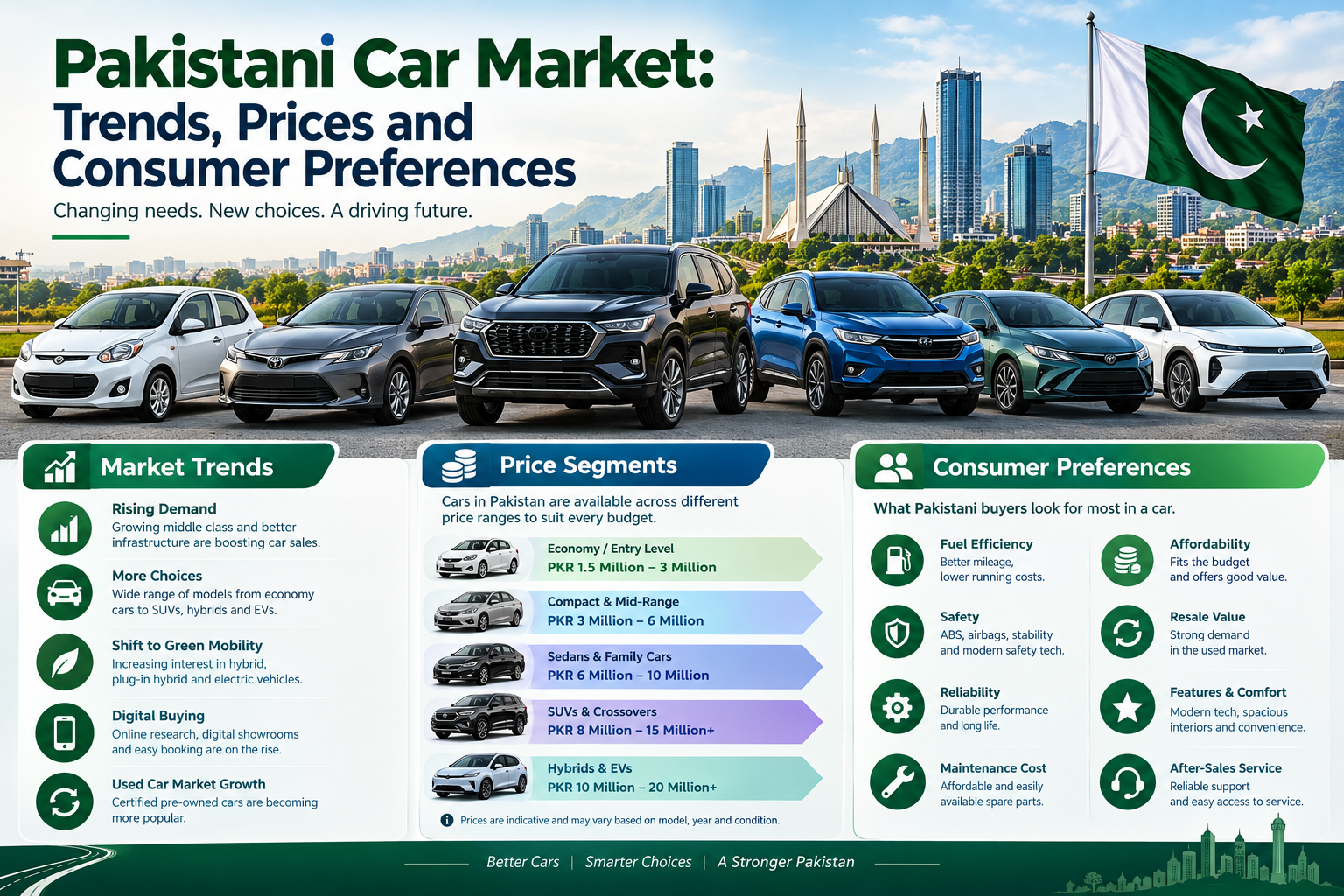
Pakistan’s car market is an important part of the country’s transportation and manufacturing sector. Cars are used by millions of people for commuting, family travel, education, business, tourism, and daily activities. Over time, the Pakistani automotive market has changed because of new technologies, changing consumer preferences, fuel prices, economic conditions, financing options, and the introduction of new vehicle brands and models.
The car market includes locally assembled vehicles, imported cars, used vehicles, hybrid models, electric vehicles, SUVs, crossovers, sedans, and hatchbacks. Different consumers have different priorities. Some buyers focus on affordability and fuel economy, while others are more interested in comfort, safety, technology, performance, or vehicle size.
Understanding the Pakistani car market can help buyers make more informed decisions. Instead of considering only the purchase price, consumers can also examine maintenance costs, fuel consumption, resale value, spare-parts availability, financing, safety features, and after-sales service.
Overview of the Pakistani Car Market
Pakistan has developed an automotive industry involving vehicle assembly, manufacturing, dealerships, parts suppliers, workshops, importers, and other supporting businesses.
The market has historically included several established international automobile brands with local assembly or distribution operations. Alongside established companies, newer brands have also entered the market, increasing the number of options available to consumers.
The Pakistani market is strongly influenced by economic conditions. Changes in currency values, taxes, import regulations, production costs, fuel prices, and financing rates can affect vehicle prices and consumer demand.
As a result, the price and availability of vehicles can change over time.
Major Factors Affecting Car Prices in Pakistan
Car prices are influenced by several factors rather than one single element.
Manufacturing Costs
The cost of producing or assembling a vehicle directly affects its price. Components, labor, electricity, transportation, machinery, and other production expenses can influence manufacturing costs.
If production costs increase, manufacturers may adjust vehicle prices.
Imported Components
Many vehicles assembled in Pakistan use components that are sourced internationally.
Changes in exchange rates and international supply costs can therefore influence the local price of vehicles and spare parts.
Taxes and Government Policies
Government policies can have an important effect on the automotive industry.
Import duties, sales taxes, regulatory policies, localization requirements, and other measures can influence vehicle prices, production, and imports.
Policies may also affect which types of vehicles manufacturers and consumers choose.
Currency Exchange Rates
Exchange-rate movements can influence vehicles and components that depend on imported materials.
When imported components become more expensive in local currency, production costs can increase.
Consumer Preferences in Pakistan
Pakistani consumers consider several factors when choosing a car.
Fuel Economy
Fuel consumption is one of the most important concerns for many drivers.
A fuel-efficient vehicle can reduce everyday running expenses. This is particularly relevant for people who use their cars for commuting over long distances.
Consumers often compare engine sizes, transmission systems, vehicle weight, and real-world fuel consumption before purchasing.
Price
The purchase price remains an important factor.
Many buyers compare multiple models before deciding which vehicle fits their budget. However, the cheapest vehicle is not necessarily the least expensive to own because maintenance, fuel, insurance, repairs, and depreciation can also contribute to total ownership costs.
Resale Value
Resale demand is another consideration in Pakistan.
Some models have active used-car markets, making them easier to sell after several years. Buyers may therefore consider expected resale value when purchasing a new vehicle.
Resale value can depend on model popularity, condition, mileage, maintenance history, spare-parts availability, and overall market demand.
Maintenance Costs
A vehicle may be attractive at the time of purchase but become expensive if replacement parts and repairs are difficult to obtain.
Consumers often prefer cars with established service networks and readily available parts.
Comfort
Comfort has become increasingly important as people spend significant amounts of time in their vehicles.
Air conditioning, comfortable seats, sufficient legroom, cabin space, sound insulation, infotainment systems, and convenient storage can influence purchasing decisions.
Hatchbacks in Pakistan
Hatchbacks have traditionally been associated with practical urban transportation.
Their compact dimensions can make them useful in crowded cities where parking and traffic are common problems.
Hatchbacks can also appeal to first-time buyers, students, small families, and people looking for economical transportation.
Their smaller engines and lighter construction can contribute to reasonable fuel consumption, although actual economy depends on the particular model and driving conditions.
Sedans in Pakistan
Sedans remain an important category in Pakistan.
They are commonly used by families, professionals, businesses, and people who want a combination of passenger comfort and luggage space.
Sedans can be suitable for both city driving and highway travel. Different models offer different engine capacities, equipment levels, and price points.
Consumers often compare sedans according to fuel economy, cabin space, safety equipment, reliability, and resale demand.
SUVs and Crossovers
SUVs and crossovers have gained greater attention in Pakistan.
Their larger cabins, elevated seating positions, and modern designs appeal to many consumers.
Some SUVs are designed for larger families and long-distance travel, while compact crossovers are aimed at urban users who want SUV-style features without choosing a very large vehicle.
However, larger vehicles can involve higher purchase prices and potentially greater running costs.
Hybrid Cars
Hybrid technology has become an important part of the Pakistani automobile market.
A hybrid vehicle combines an internal-combustion engine with an electric motor and battery system.
Hybrid cars can be particularly attractive to consumers who prioritize fuel efficiency. Their operating characteristics can be useful in traffic conditions where frequent stopping and starting occur.
However, hybrid buyers should consider battery condition, replacement costs, specialist service requirements, and the availability of trained technicians.
Electric Vehicles in Pakistan
Electric vehicles represent another developing area of the Pakistani automotive market.
EVs use electric motors and rechargeable batteries instead of conventional petrol or diesel engines.
The development of electric mobility depends on several factors, including charging infrastructure, battery technology, electricity availability, vehicle prices, consumer awareness, and government policy.
For potential EV buyers, charging access is an important practical consideration.
Growth of Automotive Technology
Modern cars increasingly include advanced technology.
Depending on the vehicle, features may include:
Touchscreen infotainment
Bluetooth connectivity
Smartphone integration
Rear-view cameras
Parking sensors
Digital instrument clusters
Keyless entry
Push-button start
Cruise control
Driver-assistance systems
Multiple airbags
Electronic stability systems
Technology can improve convenience and safety, but buyers should also consider repair and replacement costs.
Importance of Safety
Vehicle safety has become a more important purchasing consideration.
Consumers can compare vehicles according to features such as airbags, anti-lock braking systems, electronic stability control, traction control, parking sensors, cameras, and other driver-assistance technologies.
Safety equipment can vary between different variants of the same model. Therefore, buyers should check the specifications of the exact variant they are considering.
Used-Car Market in Pakistan
The used-car market is an important part of the automotive sector.
Used vehicles provide an alternative for buyers who cannot or do not want to purchase a new car.
The price of a used car depends on several factors, including:
Model year
Mileage
Overall condition
Accident history
Maintenance history
Number of previous owners
Registration location
Demand for the model
Availability of spare parts
A professional inspection can help identify mechanical or structural problems before purchase.
Online Car Buying and Selling
Digital platforms have changed the way Pakistani consumers search for vehicles.
People can now compare models, view photographs, check specifications, communicate with sellers, and research market prices online.
Online marketplaces have made it easier for buyers and sellers to reach larger audiences.
However, consumers should remain careful when dealing with online listings. Vehicle documents, ownership, condition, and payment arrangements should be verified before completing a transaction.
Role of Car Dealerships
Dealerships provide an important connection between manufacturers and consumers.
They may offer vehicle sales, financing arrangements, servicing, spare parts, warranties, and customer support.
The quality and availability of after-sales service can influence consumer decisions, particularly for buyers who plan to keep a car for several years.
Car Financing Trends
Vehicle financing allows eligible buyers to purchase cars through scheduled payments.
Banks and financial institutions may provide different financing plans depending on their policies and the customer's eligibility.
Before choosing financing, consumers should understand:
Down payment
Monthly installment
Financing duration
Applicable charges
Insurance requirements
Total amount payable
Early settlement conditions
Comparing the complete cost of financing is more useful than looking only at the monthly installment.
Impact of Fuel Prices
Fuel prices can have a significant influence on consumer preferences.
When fuel becomes more expensive, consumers may pay greater attention to vehicles with better fuel efficiency.
This can increase interest in smaller engines, hybrid vehicles, public transportation, and other fuel-saving alternatives.
For people who drive long distances every day, fuel economy can make a substantial difference to monthly transportation expenses.
Importance of Spare Parts
Spare-parts availability is a major consideration in Pakistan.
Vehicles with widely available parts can be easier to maintain. Parts availability can also influence repair times and costs.
Before buying a vehicle, consumers can research the prices and availability of common replacement items such as filters, brake components, tires, batteries, lights, and suspension parts.
Local Manufacturing and Employment
The automotive industry supports more than vehicle assembly alone.
It involves parts suppliers, dealerships, transport companies, mechanics, workshops, logistics providers, engineers, technicians, and other businesses.
Local production can contribute to industrial activity and employment.
A stronger local parts industry can also support the broader manufacturing ecosystem.
Automotive Industry and Economic Conditions
The Pakistani car market is closely connected to the wider economy.
Economic growth can increase consumer purchasing power, while inflation and higher financing costs can make vehicle purchases more difficult for some households.
Currency movements can also affect imported components and vehicles.
As economic conditions change, manufacturers and consumers may adjust their purchasing and production decisions.
Changing Consumer Expectations
Pakistani consumers are becoming increasingly interested in features beyond basic transportation.
Many buyers now compare:
Fuel efficiency
Safety
Technology
Comfort
Interior quality
Exterior design
Warranty
Service network
Resale value
Environmental impact
This means manufacturers face greater pressure to provide competitive combinations of price, features, and reliability.
Role of Social Media and Online Reviews
Social media has become an important source of automotive information.
Consumers can watch vehicle reviews, compare features, discuss ownership experiences, and learn about maintenance issues through online communities.
However, online opinions can vary considerably. A review may reflect an individual owner's experience rather than the experience of every driver.
Consumers should therefore compare information from several reliable sources before making a major purchase.
Car Ownership in Pakistani Cities
Car ownership patterns differ between urban and rural areas.
In large cities, cars are commonly used for commuting, school runs, shopping, business, and family activities.
Traffic congestion and limited parking can influence the type of vehicle people choose.
In smaller cities and rural areas, road conditions and longer travel distances can influence vehicle requirements differently.
Environmental Considerations
Environmental awareness is gradually becoming part of automotive discussions.
Traditional petrol and diesel vehicles produce emissions, while hybrid and electric technologies provide alternative approaches to transportation.
Electric vehicles can reduce tailpipe emissions because they do not produce exhaust emissions while driving.
However, the overall environmental impact of vehicles also depends on factors such as electricity generation, battery production, manufacturing, and vehicle lifespan.
Future Trends in Pakistan’s Car Market
Several trends are likely to remain important in Pakistan’s automotive sector.
More Technology
Cars are becoming increasingly connected and digital. Infotainment systems, cameras, sensors, and driver-assistance features are becoming more common.
Interest in Fuel Efficiency
Fuel-efficient vehicles are likely to remain attractive because operating costs are important to many consumers.
Growth of Hybrid Technology
Hybrid vehicles can continue to attract buyers looking for improved fuel economy without depending entirely on charging infrastructure.
Electric Mobility
Electric vehicles may become more visible as charging networks, vehicle options, and consumer awareness develop.
Greater Consumer Research
Online information allows buyers to research specifications, prices, reviews, and ownership experiences before visiting dealerships.
Tips for Pakistani Car Buyers
A careful purchasing process can help consumers avoid unnecessary expenses.
First, establish a realistic budget. Include the purchase price as well as registration, insurance, fuel, maintenance, and possible financing costs.
Second, compare several vehicles instead of focusing on one model.
Third, check the safety features of the exact variant.
Fourth, research spare-parts and service availability.
Fifth, take a test drive to evaluate comfort, visibility, braking, steering, and general driving characteristics.
For used vehicles, arrange a professional inspection and verify ownership documents.
Conclusion
The Pakistani car market continues to evolve as consumer preferences, technology, economic conditions, and vehicle choices change. Hatchbacks, sedans, SUVs, hybrids, and electric vehicles each serve different requirements.
Price remains an important factor, but modern consumers increasingly consider fuel economy, safety, maintenance costs, technology, comfort, resale value, and after-sales service.
The future of Pakistan’s automotive sector will depend on several factors, including economic conditions, local manufacturing, government policies, technology, consumer demand, and the development of electric-vehicle infrastructure.
For buyers, understanding the complete cost of ownership and comparing vehicles carefully can be more valuable than focusing only on the initial purchase price. With better information and careful planning, consumers can choose vehicles that suit their transportation needs and financial circumstances.
FAQs
1. What factors affect car prices in Pakistan?
Car prices can be affected by manufacturing costs, imported components, exchange rates, taxes, government policies, production costs, and market demand.
2. Why is fuel economy important for Pakistani car buyers?
Fuel economy can influence the everyday running cost of a vehicle, especially for people who drive long distances or use their cars frequently.
3. Are SUVs popular in Pakistan?
SUVs and crossovers have become increasingly visible in Pakistan because of their larger cabins, elevated driving positions, and practical features.
4. What should I consider when buying a used car?
Buyers should check the vehicle's condition, mileage, accident history, maintenance record, documents, ownership status, and spare-parts availability.
5. What is the future of electric cars in Pakistan?
Electric vehicles are a developing part of Pakistan's automotive market. Their wider adoption will depend on factors such as vehicle prices, charging infrastructure, battery technology, electricity availability, and consumer demand.