Introduction
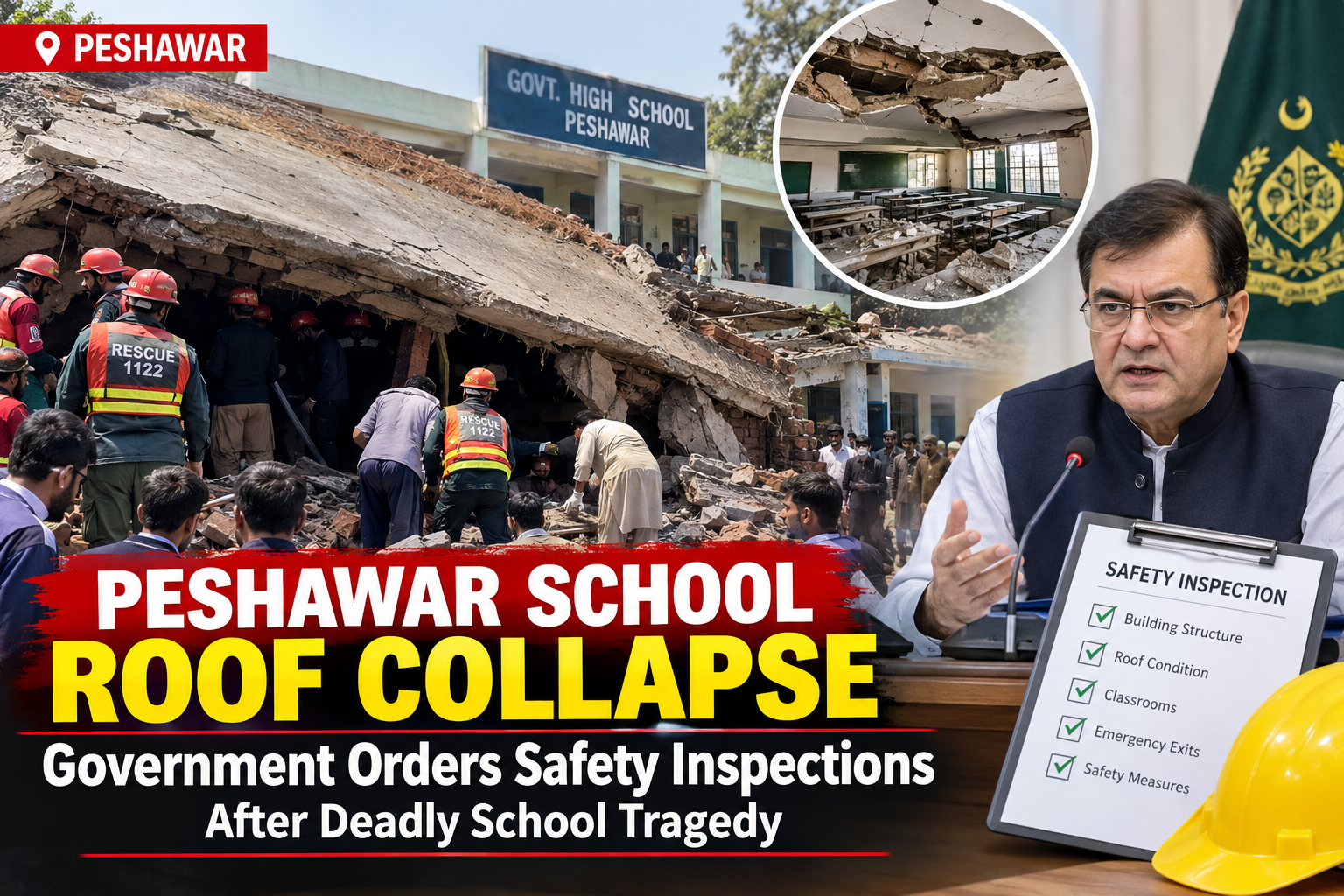
The safety of children in educational institutions has become a major concern in Pakistan following the tragic collapse of a school roof in Peshawar on October 15, 2026. The incident at Al-Khair Education Center in the Dir Colony area claimed the lives of dozens of children and a female teacher, leaving families devastated and raising serious questions about the condition of school buildings, construction standards, and the effectiveness of regulatory authorities.
In response to the tragedy, the Khyber Pakhtunkhwa government ordered inspections of school buildings and called for stronger enforcement of safety standards. Authorities also initiated an investigation into the incident to determine the circumstances that led to the collapse and establish accountability.
The tragedy has renewed a nationwide discussion about whether schools across Pakistan are providing children with safe learning environments. While education is essential for the country's social and economic development, the protection of students must remain an equally important responsibility.
The incident highlights the need for comprehensive building inspections, professional engineering assessments, transparent registration procedures, and effective monitoring of educational institutions. It also raises an important question: how can Pakistan prevent similar tragedies and ensure that every child can attend school without unnecessary risks?
What Happened at the Peshawar School?
On Thursday, October 15, 2026, a devastating roof collapse occurred at Al-Khair Education Center in Peshawar's Dir Colony area. Children were attending classes when the building structure failed, causing parts of the roof and classrooms to collapse.
According to reports published on October 16, the incident resulted in the deaths of 34 children and a female teacher. More than 50 people were reported injured in initial accounts, although casualty figures and medical updates may vary as official information develops.
Emergency responders, police personnel, medical teams, and local residents participated in the rescue operation. Children were transported to nearby hospitals, while rescue workers searched the damaged structure for people who might still be trapped.
The tragedy deeply affected families and the surrounding community. Parents who had sent their children to school expecting an ordinary day of learning instead faced an unimaginable emergency.
The incident also attracted national attention because it raised questions about the condition of the building and whether appropriate safety measures had been followed before the school opened to students.
Authorities began investigating the collapse, while the school owner was arrested as part of the initial legal proceedings. The arrest does not by itself establish criminal responsibility; that must be determined through a fair investigation and the applicable legal process.
The investigation is important not only for determining responsibility in this particular case but also for identifying weaknesses in the wider system responsible for supervising educational buildings.
Government Orders School Safety Inspections
Following the tragedy, the Khyber Pakhtunkhwa government ordered safety inspections of school buildings. The objective is to identify structural weaknesses, assess potential risks, and determine which buildings require repairs or further technical examination.
The provincial administration has also emphasized the importance of investigating the incident and taking action against those found responsible under the law.
According to reporting published on October 16, the provincial education department directed technical teams to inspect government school buildings across the province. The teams are expected to assess roofs, ceilings, walls, foundations, beams, staircases, and other important structural components.
The inspection process is intended to classify buildings according to their condition. Buildings may be considered safe, in need of repairs or improvements, or potentially unsafe and requiring urgent assessment.
This approach can help authorities prioritize resources. A school with minor maintenance issues may require routine repairs, while a building with serious structural weaknesses may need immediate restrictions on its use.
The government has also directed that dangerous conditions should be reported without waiting for the completion of the entire inspection exercise.
These measures are important, but their effectiveness will depend on implementation. Inspections must be conducted by qualified professionals, findings must be documented accurately, and identified hazards must be addressed promptly.
A safety inspection should not become a routine administrative formality. Its purpose must be to establish whether a building can safely accommodate students, teachers, and other staff members.
Why School Building Safety Matters
Schools are among the most important institutions in any society. They provide children with education, social development, and opportunities for a better future.
However, these benefits can only be achieved when educational institutions provide safe and suitable environments.
Children spend several hours a day inside classrooms, corridors, laboratories, libraries, playgrounds, and other school facilities. During this time, they depend on school administrations and relevant authorities to maintain buildings and protect them from avoidable hazards.
A structurally unsafe school can expose students and employees to serious risks. Weak roofs, damaged walls, deteriorating foundations, overcrowded rooms, and poorly maintained staircases may create dangerous conditions.
The consequences can be especially serious during emergencies because young children may have difficulty recognizing danger or leaving a building without assistance.
School safety must therefore be treated as a fundamental responsibility rather than an optional improvement.
Parents should be able to trust that their children are attending institutions where basic building standards are followed. Teachers should also be able to perform their duties without worrying about preventable structural hazards.
The Peshawar tragedy has reinforced the importance of this responsibility and the need for practical measures that protect students throughout Pakistan.
The Importance of Professional Structural Inspections
One of the central lessons from the Peshawar incident is that school buildings need proper technical assessments.
A building may appear normal from the outside while having weaknesses that are not easily visible to an ordinary observer. Determining whether a roof, beam, column, or foundation can safely carry its intended load requires appropriate technical knowledge.
For this reason, school safety inspections should involve qualified civil and structural engineers or other appropriately authorized building professionals.
Inspectors should examine the condition of major structural elements, signs of deterioration, previous repairs, water damage, and any alterations that could affect the building's stability.
They should also check whether construction corresponds with approved building plans and applicable safety requirements.
Where a building has been modified or additional floors have been constructed, the assessment should establish whether those changes were properly approved and whether the structure can support the additional loads.
A professional inspection should produce a written report identifying the building's condition, the evidence supporting the assessment, the repairs required, and the urgency of those repairs.
Where serious danger is identified, authorities should take precautionary action according to the relevant laws and technical advice.
Regular inspections are also important because a building's condition can change over time. Rain, moisture, aging materials, poor maintenance, and unauthorized construction may gradually weaken parts of a structure.
A one-time inspection cannot replace an ongoing safety management system.
Water Leakage and Weather-Related Risks
Water leakage is one of the issues that can affect the durability of a building.
When rainwater repeatedly enters a roof or wall, it may contribute to the deterioration of construction materials. Depending on the structure and the source of the moisture, prolonged exposure can damage plaster, promote corrosion in reinforcement, weaken certain materials, and create other maintenance problems.
Reports following the Peshawar tragedy included concerns about leakage and the effect of recent rainfall on the building. The precise technical cause of the collapse, however, must be established through the official investigation rather than assumed from preliminary statements.
School administrations should have clear procedures for reporting leaks and other visible signs of damage.
A leaking roof should not simply be covered with fresh paint or treated as a minor inconvenience without checking the underlying cause. Where the problem may affect structural safety, a qualified professional should assess it.
Maintenance records should document when a problem was reported, what action was taken, who performed the work, and whether the repair was inspected afterward.
Seasonal inspections before and during periods of heavy rainfall can also help schools identify maintenance problems early.
Weather-related risks cannot always be eliminated, but proper construction, regular maintenance, and timely professional assessments can reduce preventable dangers.
Questions About Private School Regulation
The Peshawar incident has also brought attention to the regulation of private educational institutions.
Private schools play a significant role in Pakistan's education system. They provide educational opportunities to many families and operate under different financial arrangements, teaching models, and administrative structures.
However, registration alone does not necessarily establish that a building is structurally safe.
A school may meet certain administrative requirements while still needing a separate technical assessment of its premises.
A report published by Dawn on October 17 highlighted concerns about the ability of the Khyber Pakhtunkhwa Private Schools Regulatory Authority to technically assess building safety and enforce certain requirements. The report also discussed the responsibilities of other agencies involved in building approval and control.
This raises an important administrative issue: the responsibilities of different departments must be clearly defined.
Education regulators understand school administration and educational requirements, while building-control authorities and qualified engineers have the expertise needed to assess structural safety.
These bodies should work together rather than leaving gaps in responsibility.
School registration and renewal procedures should include the relevant safety documentation required by law. Authorities should also establish clear mechanisms for verifying the authenticity and validity of those documents.
If a school fails to meet essential safety requirements, the responsible authority must have a lawful and effective process for requiring corrective action.
Where an immediate danger exists, the response should prioritize the protection of students and staff.
Strong regulation does not mean creating unnecessary difficulties for responsible school operators. It means establishing consistent standards that every institution must meet.
Challenges Facing Low-Cost Private Schools
Affordability is an important consideration in Pakistan's education sector.
Many families choose lower-cost private schools because they want their children to receive an education close to home or because nearby public schools do not meet their particular needs.
Some low-cost schools operate with limited financial resources. Their budgets may need to cover teachers' salaries, rent, electricity, classroom materials, maintenance, and other operating expenses.
However, limited resources cannot justify exposing children to unsafe buildings.
The solution should combine clear safety requirements with practical implementation support.
Authorities can help responsible school operators understand the requirements for building inspections, approved construction, emergency planning, and maintenance.
Where improvements are needed, schools should receive clear technical findings and realistic corrective requirements, provided that any immediate danger is addressed without delay.
Financial support mechanisms, where feasible and properly governed, could help eligible institutions undertake essential safety improvements. Such assistance should never replace accountability or weaken minimum standards.
Schools must also avoid overcrowding classrooms beyond their safe capacity. More students in a limited space can make ordinary movement difficult and complicate evacuation during an emergency.
The aim should be to make safe education accessible to every child, regardless of family income.
The Role of Parents and Local Communities
Parents are important partners in school safety.
Families often notice everyday problems before they become formal administrative issues. These may include leaking ceilings, cracks, damaged staircases, exposed electrical wiring, blocked exits, or rooms that appear overcrowded.
A clear complaint system can help parents report concerns to school administrations and relevant authorities.
Schools should acknowledge complaints, assess them appropriately, and communicate what action is being taken.
Where a concern appears to involve serious structural danger, it should be referred promptly to the competent technical authority.
Parents should not be expected to perform engineering assessments themselves. Their role is to raise concerns and seek a responsible response, while qualified professionals determine the technical condition of a building.
Community awareness can also encourage a culture in which safety concerns are taken seriously rather than dismissed as unnecessary criticism.
At the same time, public communication should remain responsible. Unverified allegations about particular schools or individuals can create confusion and unfairly damage reputations.
Reports of dangerous conditions should be investigated through appropriate channels, with evidence and due process guiding the response.
Responsibilities of School Administrations
School owners, principals, and management teams have a direct responsibility to maintain safe learning environments within the scope of their legal duties.
They should ensure that their premises are maintained, that necessary inspections are completed, and that known hazards receive appropriate attention.
A school safety management plan should cover routine maintenance, the reporting of defects, emergency procedures, staff responsibilities, and the safe use of classrooms and other facilities.
Building records should include approved plans, applicable permissions, inspection certificates, maintenance reports, and documentation of significant repairs.
When construction work is required, school administrations should use appropriately qualified professionals and follow the applicable approval process.
They should not add floors, modify load-bearing elements, or make other significant structural changes without the required technical assessment and authorization.
Classroom capacity must also be managed responsibly. Administrators should ensure that students can move through corridors and exits without unnecessary obstructions.
Emergency drills and clear communication procedures can help staff respond more effectively to incidents such as fires, earthquakes, or other emergencies.
However, emergency planning is not a substitute for structural safety. A building must be suitable for occupation before evacuation procedures can be considered an adequate safeguard.
What Government Inspections Should Include
For school safety inspections to produce meaningful results, authorities need a consistent and transparent process.
First, inspectors should establish an accurate record of the schools and buildings that fall within the scope of the exercise.
Second, qualified technical personnel should examine structural components and record any defects. The assessment should consider the building's design, condition, use, and history of modifications where this information is available.
Third, schools should be assigned a safety classification based on documented findings and the applicable standards.
Buildings that meet the requirements can be recorded as compliant, subject to any necessary conditions or future inspection schedules.
Buildings requiring repairs should receive specific recommendations, deadlines, and a process for verifying that the work has been completed satisfactorily.
Buildings presenting an immediate threat should be referred for urgent action under the applicable laws. Authorities should not allow continued use to depend solely on an operator's assurance that repairs will be made later.
Fourth, the inspection process should include follow-up visits where necessary. A report identifying a problem has limited value if no one verifies whether the problem was corrected.
Finally, records should be maintained in a system that allows relevant authorities to track inspection dates, outstanding defects, certificates, and enforcement actions.
A transparent system can help prevent schools from repeatedly avoiding requirements or relying on outdated documentation.
Improving Coordination Between Government Departments
School safety involves more than one public institution.
Education departments oversee educational administration, school registration authorities regulate institutions within their mandates, and building-control agencies deal with construction approvals and related requirements.
Local administrations may also have responsibilities involving inspections, public safety, and enforcement.
When these duties are unclear, an institution may pass through one administrative process without receiving the technical assessment needed for another.
Better coordination can help close these gaps.
The government should define which authority is responsible for each stage, from initial building approval to structural inspection, school registration, renewal, and enforcement.
Departments should also establish clear procedures for sharing information.
For example, an education regulator should be able to verify the relevant building-safety documentation with the competent technical authority instead of relying exclusively on an administrative checklist.
Similarly, building-control agencies should have a process for notifying education officials when a school building is found to present a serious risk.
Coordination should also include clear reporting deadlines and accountability for delays.
The purpose is not simply to create additional committees or paperwork. It is to ensure that every necessary safety task has an identified responsible authority and that failures are addressed.
The Need for Accountability and a Fair Investigation
A thorough investigation is essential after a tragedy of this scale.
Investigators must establish what happened, which structural or administrative factors contributed to the collapse, and whether any legal requirements were violated.
This process may involve reviewing building plans, construction records, inspection documents, maintenance history, witness statements, and technical assessments.
Investigators should distinguish between confirmed evidence and preliminary explanations.
For example, rainfall may be relevant to an investigation, but the presence of rain alone does not establish the complete cause of a structural failure. Engineers and investigators must examine the available evidence to determine the relationship between the building's condition and the collapse.
The investigation should also consider whether warning signs were reported, how those reports were handled, and whether the relevant authorities performed their assigned duties.
If negligence or violations are established, appropriate legal action should follow.
At the same time, allegations must be tested through a fair process. Accountability requires reliable evidence, lawful procedures, and clear findings rather than speculation or public pressure alone.
The findings should lead to practical recommendations that address the causes identified by the investigation.
Without this follow-through, a tragedy may generate temporary attention without producing lasting improvements.
Supporting the Affected Families
Beyond the technical and administrative issues, the Peshawar tragedy has created enormous emotional and practical difficulties for affected families.
Parents and relatives who have lost children need compassion, privacy, and respectful treatment. Families whose children were injured may also face medical expenses, disruption to daily life, and continuing uncertainty about recovery.
Authorities should ensure that injured students receive appropriate medical care and that affected families can access the assistance made available to them.
Any compensation announced by the government should be administered through a transparent process, with clear eligibility requirements and timely communication.
Families should not have to navigate confusing administrative procedures while coping with grief.
Schools, community organizations, and public institutions can also help by providing practical support and respecting the wishes of those affected.
Media coverage should avoid sensationalism and protect the dignity of grieving families and children.
The purpose of reporting such a tragedy should be to inform the public, establish the facts, and encourage meaningful improvements—not to exploit private suffering.
A Nationwide Approach to School Safety
Although the incident occurred in Peshawar, the questions it raises are relevant to educational institutions across Pakistan.
Different provinces and territories have their own administrative arrangements, building regulations, and education policies. Nevertheless, the basic principle is the same: schools must provide premises that are suitable for their intended use and maintained according to applicable safety standards.
A nationwide approach could encourage consistent minimum expectations for building inspections, maintenance records, emergency planning, and the verification of safety certificates.
Provincial authorities would still need to implement requirements through their own legal and administrative systems.
Particular attention should be given to older buildings, structures that have undergone significant modifications, and schools where overcrowding or visible deterioration raises concerns.
Public institutions also need proper maintenance budgets and reliable systems for reporting defects.
School safety should not be treated as a concern limited to private institutions. Every educational building, whether publicly or privately operated, requires appropriate oversight.
Regular monitoring can help identify problems before they become emergencies.
The most useful policy will be one that combines technical expertise, clear responsibilities, adequate resources, and enforceable standards.
How Technology Can Improve Monitoring
Technology can support a more effective school safety system.
Authorities could maintain a digital register containing each school's location, building details, relevant safety certificates, inspection dates, and outstanding maintenance requirements.
Such a register would help officials identify institutions that need inspections or whose certificates require renewal.
Digital records could also make it easier to track whether a school has completed required repairs.
A complaint-management system could allow parents and staff to submit safety concerns and receive a reference number for follow-up. Reports involving potential immediate danger would need a clear escalation process.
Photographs and inspection documents may support recordkeeping, but they should not replace professional engineering assessments.
Likewise, automated reminders and digital dashboards are useful only when trained staff review the information and take appropriate action.
Technology cannot guarantee safety on its own. Its value comes from helping responsible authorities organize information, identify delays, and verify that required actions have been completed.
Building a Long-Term Culture of Prevention
One of the most important lessons from the Peshawar school tragedy is that safety must be continuous.
A school cannot rely on a single inspection, an old certificate, or an informal assurance that its building is in good condition.
Prevention requires regular maintenance, appropriate construction practices, qualified assessments, and a willingness to act when problems are identified.
School leaders should encourage staff to report defects without fear of being ignored or blamed for raising concerns.
Parents should have access to clear channels for communicating safety issues.
Authorities should conduct inspections according to risk and legal requirements, document their findings, and verify corrective work.
Construction and renovation projects should follow approved plans and applicable technical standards.
These steps may require time, money, and administrative effort, but the cost of prevention must be considered alongside the consequences of failing to address known risks.
A strong safety culture is created when every responsible party understands their duties and when those duties are consistently enforced.
Conclusion
The Peshawar school roof collapse of October 15, 2026, was a devastating tragedy that has raised serious concerns about school building safety, regulatory oversight, and the protection of children in Pakistan.
The government's decision to order school safety inspections is an important response, but inspections alone will not be enough. Their success will depend on qualified technical assessments, transparent reporting, prompt repairs, effective enforcement, and coordination among the authorities responsible for education and construction.
The incident also highlights the importance of listening to safety concerns, maintaining accurate building records, preventing overcrowding, and ensuring that school administrations meet their responsibilities.
The investigation must establish the facts and identify any failures that contributed to the collapse. Its findings should inform practical reforms that reduce the risk of similar incidents.
Most importantly, the tragedy should lead to lasting improvements rather than temporary attention. Children attend school to learn, develop their abilities, and prepare for the future. They deserve educational environments in which their safety is treated as a fundamental responsibility.
Protecting students requires cooperation among government departments, school administrations, technical professionals, parents, and local communities. By strengthening oversight and taking preventive action seriously, Pakistan can work toward safer schools and greater confidence in its education system.
No educational goal should come at the expense of children's safety.
FAQs
1. What happened in the Peshawar school roof collapse?
On October 15, 2026, a roof collapsed at Al-Khair Education Center in Peshawar's Dir Colony area, killing dozens of children and a female teacher and injuring many others.
2. Why did the government order school safety inspections?
The inspections were ordered following the tragedy to identify unsafe buildings, assess structural weaknesses, and help authorities take corrective action where necessary.
3. What do school building safety inspections examine?
Professional inspections may examine roofs, ceilings, walls, foundations, beams, staircases, signs of deterioration, and compliance with applicable building requirements.
4. Who is responsible for ensuring school building safety?
Responsibility depends on the applicable laws and administrative arrangements. School management, education regulators, building-control authorities, and qualified technical professionals all have roles in maintaining and verifying safety.
5. How can Pakistan prevent similar school tragedies?
Pakistan can reduce risks through regular professional inspections, proper maintenance, approved construction, clear regulatory responsibilities, timely repairs, effective enforcement, and transparent investigations into safety failures.




