Introduction
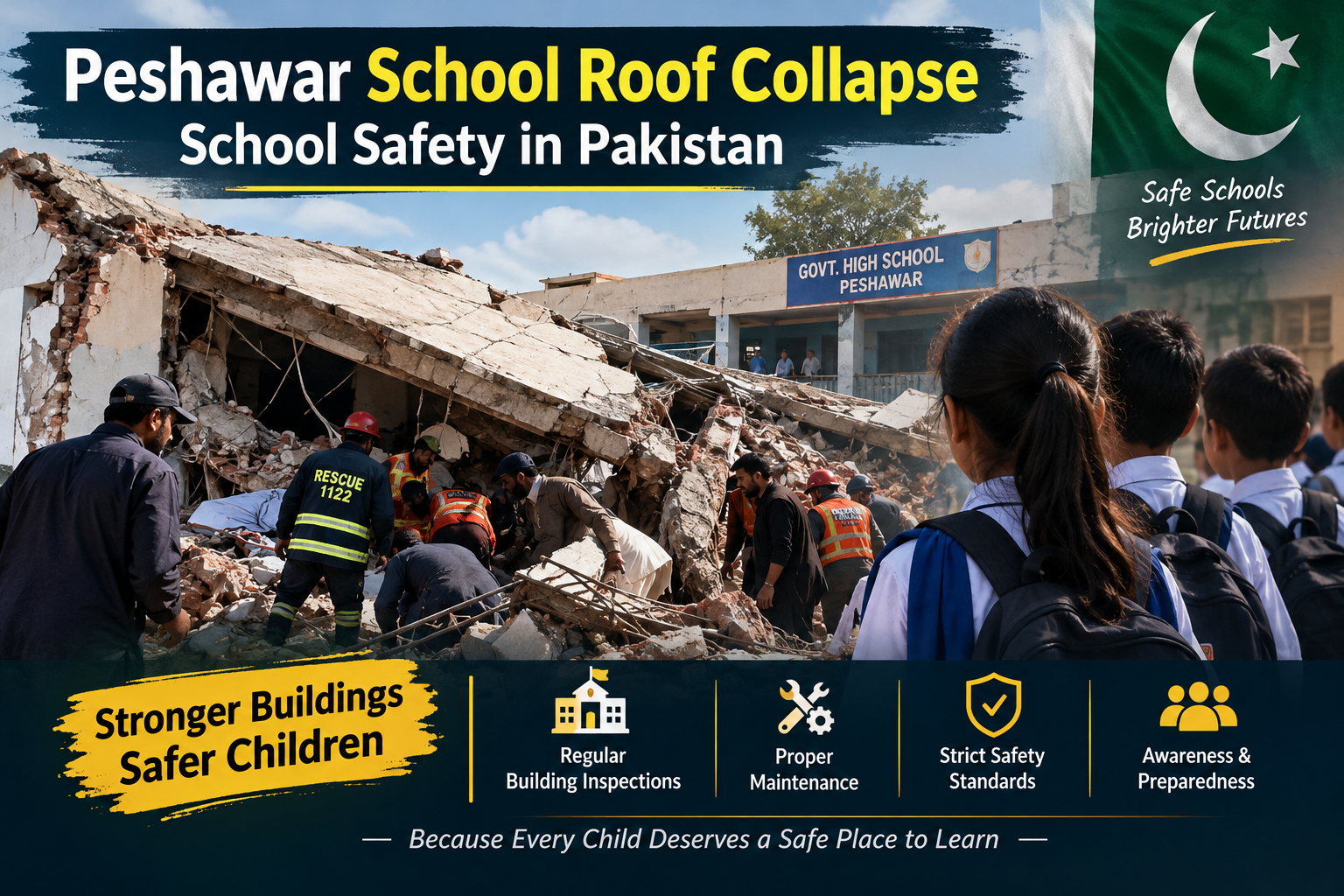
A reported school roof collapse in Peshawar on October 15, 2026, has brought renewed attention to the safety of educational buildings in Pakistan. The incident, which reportedly occurred at Al-Khair School in the Afridi Abad area, resulted in the deaths of students and a teacher, while other people sustained injuries. The tragedy has raised serious questions about building construction, structural inspections, school management responsibilities and the effectiveness of safety regulations.
Schools are among the most important institutions in any society. They provide children with education, opportunities for personal development and a foundation for their future careers. Parents trust schools to provide an environment where their children can learn and grow safely. When an educational building collapses, that trust is deeply shaken, and the incident becomes a matter of wider public concern.
The Peshawar incident highlights the importance of ensuring that every school building is structurally sound, regularly inspected and properly maintained. It also demonstrates why government departments, school owners, construction professionals and local authorities must work together to protect students and teachers.
Although investigations are necessary to establish the exact circumstances of the collapse, the incident has already renewed an important national discussion: how can Pakistan make educational institutions safer for everyone?
What Happened at the School in Peshawar?
According to reports published on October 15, a roof collapsed at Al-Khair School in the Afridi Abad locality of Peshawar while students were attending morning classes. The incident caused serious damage to the building and trapped people beneath the debris.
Rescue personnel and local residents responded to the emergency. Injured individuals were taken to nearby hospitals for treatment, while authorities worked to determine the extent of the damage and identify those affected.
Published reports placed the death toll at at least 29 people, including 28 students and one female teacher. The situation also prompted concerns about the building's structural condition and the circumstances that led to the collapse.
Authorities began investigating the incident to determine what happened and whether any safety requirements had been ignored. Initial reports raised questions about the strength of the structure and the load placed on the roof, but the precise technical cause must be established through a proper investigation.
Determining the cause is essential because the same problems could potentially exist in other buildings. If construction defects, unauthorised alterations, poor maintenance or failures in inspection contributed to the incident, identifying them would help authorities take appropriate preventive measures.
The investigation should therefore examine the building's construction history, approvals, inspection records and any changes made to the structure.
A Devastating Loss for Families and the Community
The loss of children is among the most painful events a community can experience. Students attend school to gain knowledge, develop friendships and prepare for a better future. Their families make significant sacrifices to support their education and hope to see them achieve their ambitions.
A school tragedy affects far more than the physical building. Parents and relatives face profound grief, classmates lose friends, teachers lose students, and the wider community struggles to understand what happened.
The death of a teacher also reminds society that educators deserve safe working environments. Teachers dedicate their time and abilities to helping young people learn, and their safety should be treated as an essential responsibility.
Following such an incident, affected families need compassionate assistance, accurate information and appropriate support. Injured people require timely medical care, while families should receive clear communication from the authorities responsible for the response.
Public discussion must also respect the dignity and privacy of victims. Unverified claims and distressing images can increase the suffering of families without contributing to a better understanding of the incident.
The most constructive response is to focus on verified information, support for those affected and meaningful measures that can help prevent similar tragedies.
Why School Building Safety Is Essential
A safe physical environment is a basic requirement for effective education. Students cannot fully benefit from teaching and learning if their classrooms present avoidable risks.
School buildings must accommodate children, teachers, administrative staff and visitors. Their design should account for the number of people using the premises, the intended purpose of each room and the movement of occupants throughout the day.
Important features include structurally sound roofs, secure walls, suitable staircases, safe corridors, adequate exits and properly maintained facilities. These features must meet the applicable building standards and be assessed by qualified professionals.
A building originally designed for residential use may not automatically be suitable for a school. Educational institutions can have different occupancy patterns and safety requirements. Converting a property into a school should therefore involve the necessary professional assessments and regulatory approvals.
The age of a building alone does not determine whether it is safe. An older structure may remain suitable if it has been properly maintained and meets applicable requirements, while a newer building may still contain construction defects.
For this reason, regular inspections are essential regardless of whether a school operates in a public or private building.
Construction Quality and Structural Weaknesses
Construction quality is an important factor in the long-term safety of educational buildings. Structures must be designed and constructed according to applicable engineering standards and the conditions under which they will be used.
Several factors can affect a building's structural performance. These include the quality of construction materials, engineering design, foundation conditions, workmanship and the distribution of loads.
Changes made after construction can also create problems if they are not properly assessed. Adding floors, installing heavy equipment or placing additional materials on a roof may alter the loads that the structure must support.
School owners should never assume that a building can safely accommodate modifications simply because it has remained standing for years. Any significant alteration should receive the necessary professional assessment and approvals.
Maintenance is equally important. Water penetration, corrosion, deteriorating materials and other defects may require investigation and repair. However, visible signs should not be interpreted without appropriate expertise because only qualified professionals can determine the nature and seriousness of a structural problem.
The Peshawar incident highlights the importance of examining these issues carefully rather than drawing conclusions before the investigation is complete.
The Importance of Regular School Inspections
Regular inspections can help authorities identify structural problems before they become serious hazards. A well-organised inspection programme should cover both the physical condition of buildings and compliance with relevant safety requirements.
Inspections should be conducted by appropriately qualified professionals. Depending on the building and the nature of the concerns, assessments may involve structural engineers, building-control officials and other specialists.
An effective inspection system should include several important steps.
First, authorities need an accurate record of registered educational institutions and the buildings they occupy. This record should include relevant information about building approvals, construction history and previous inspections.
Second, inspections should take place according to a defined schedule, with additional assessments when credible safety concerns arise.
Third, findings should be documented clearly. If an inspection identifies a problem, the responsible institution should receive appropriate instructions about the required corrective action.
Finally, authorities should verify that necessary repairs have been completed. Identifying a defect is not enough if the problem remains unresolved.
Where a serious risk is identified, appropriate restrictions or temporary closure may be necessary until the building is assessed and made safe.
These measures can help turn inspections into a practical safety system rather than a routine administrative exercise.
Government Responsibility and Public Accountability
Government departments have an important role in protecting students and ensuring that educational institutions comply with applicable regulations.
Depending on the jurisdiction and the type of school, responsibilities may involve education departments, municipal authorities, building-control agencies and other regulatory bodies.
These organisations need clear procedures for approving school buildings, conducting inspections and responding to reported hazards. Their responsibilities should be coordinated so that important safety concerns do not fall between departments.
Following the Peshawar incident, a transparent investigation is necessary to establish the facts. Authorities should examine whether the building had the required approvals, whether relevant standards were followed and whether previous warnings or inspection findings existed.
If evidence establishes negligence or violations, appropriate legal action should follow. Any individual or organisation found responsible should be dealt with according to the law and the evidence.
Accountability should also extend to weaknesses in administrative systems. If inspection procedures were inadequate or known problems were not addressed, authorities should identify those shortcomings and implement corrective measures.
Public confidence is strengthened when investigations are conducted fairly, findings are communicated clearly and reforms are implemented consistently.
Safety Challenges in Private Schools
Private schools provide education to millions of children in Pakistan and contribute significantly to the country's education system. However, private institutions vary widely in their facilities, financial resources and management arrangements.
Some operate purpose-built campuses with extensive facilities, while others occupy smaller rented premises. This variation makes consistent enforcement of safety requirements particularly important.
School owners must ensure that their premises are suitable for educational use and meet the applicable legal requirements. They should obtain the necessary approvals, arrange professional inspections and maintain records of repairs and maintenance.
Where a school operates in a rented building, the responsibilities of the landlord and school administration should be clearly established. Rental arrangements should not result in confusion about who must address structural defects or arrange necessary repairs.
Limited financial resources may make improvements difficult for some institutions, but serious safety risks cannot simply be ignored. Where assistance or additional time is appropriate under the law, authorities should ensure that students are still protected during the process.
Regulators should apply safety requirements consistently across different institutions. The objective should be to ensure that children receive protection regardless of their family's income or the type of school they attend.
Public Schools Must Also Be Assessed
The need for safer educational buildings applies equally to government schools.
Public schools serve communities across Pakistan, including urban neighbourhoods, small towns and rural areas. Their buildings differ in age, design, maintenance history and available resources.
Some institutions may require routine maintenance, while others may need more extensive professional assessments. Decisions should be based on reliable inspections and documented conditions rather than assumptions about a school's location or ownership.
Provincial education departments and relevant local authorities should maintain accurate records of school infrastructure. These records can help identify buildings that require urgent attention and support more effective planning.
Education budgets should account for infrastructure maintenance alongside teachers' salaries, textbooks, learning materials and other essential expenses. Safe classrooms, secure roofs, suitable sanitation and accessible exits are important components of a functioning educational system.
Long-term maintenance plans can also help public authorities manage costs more effectively. Preventive repairs may address developing problems before they require more extensive work.
Transparent procurement and appropriate engineering supervision are important to ensure that money allocated for school construction and repairs is used responsibly.
How Poor Maintenance Can Create Risks
Every building requires maintenance throughout its useful life. Even a structure that was originally designed and constructed properly can deteriorate if defects are ignored or repairs are delayed.
Roof leaks, water penetration, corrosion, damaged materials and unauthorised alterations may affect a building's condition. These problems do not all indicate an immediate structural danger, but they should be assessed appropriately.
School administrators should establish clear procedures for reporting maintenance concerns. Teachers, support staff and maintenance workers should know how to report defects and who is responsible for responding.
Reports should be recorded and followed up. Where a concern requires technical expertise, a qualified professional should assess it and recommend suitable action.
Schools should maintain documentation covering inspections, repairs, building modifications and relevant approvals. This information can help administrators and regulators understand the building's history and make better decisions.
Preventive maintenance is a central part of responsible school management. Waiting until a problem becomes an emergency can place students and staff at unnecessary risk.
Emergency Preparedness in Schools
Although strong construction and regular maintenance are essential, schools should also prepare for emergencies.
Every institution should have an emergency plan appropriate to its building and the needs of its students. Staff should understand their responsibilities and know how to contact emergency services.
Evacuation routes should be clearly identified and kept free from obstructions. Emergency exits must remain accessible, and staff should know how students will be accounted for after an evacuation.
Schools should maintain up-to-date emergency contact information for parents and guardians. Procedures should also explain how verified information will be communicated during an incident.
Age-appropriate drills can help students understand emergency instructions without causing unnecessary fear. Staff should receive appropriate training and know how to assist younger children and students who may need additional support.
Emergency planning cannot eliminate every risk, but it can improve coordination and reduce confusion when something unexpected happens.
Importantly, an emergency plan must complement structural safety rather than serve as a substitute for it. The primary objective should always be to prevent avoidable hazards.
The Role of Parents and Local Communities
Parents naturally want reassurance that their children attend safe schools. They can contribute to a stronger safety culture by asking school administrations about building approvals, inspection arrangements and emergency procedures.
Parent-teacher meetings can provide opportunities to discuss maintenance concerns and request clarification about safety policies.
Schools should establish clear channels for receiving complaints and responding to reasonable questions. Parents should be able to report concerns without being dismissed or discouraged.
Community members may also help by reporting potentially unsafe conditions to the appropriate authorities. However, structural assessments should be left to qualified professionals.
It is equally important to avoid spreading rumours or making unverified accusations while an investigation is underway. Public concern is valuable when it encourages transparency and preventive action, but speculation can undermine a fair investigation.
Cooperation among parents, teachers, administrators and authorities can help identify problems earlier and strengthen confidence in educational institutions.
Protecting Children Must Remain the Priority
Children depend on adults to provide safe learning environments. They generally cannot assess the structural condition of a building or determine whether a classroom meets safety requirements.
That responsibility belongs to school owners, administrators, qualified professionals and the relevant authorities.
Safety arrangements should consider students of different ages and abilities. Younger children may need additional assistance during emergencies, while students with disabilities may require accessible evacuation arrangements.
School buildings should provide appropriate space, safe routes between classrooms and facilities that meet applicable standards.
Teachers should understand emergency procedures, while administrators should ensure that safety responsibilities are clearly assigned.
A strong safety culture requires continuous attention. It cannot depend only on inspections conducted after a serious incident or on temporary measures introduced when public attention increases.
Every educational institution should treat the protection of students as an ongoing responsibility.
The Economic Impact of Unsafe Educational Buildings
A school building collapse can create substantial economic consequences in addition to its human cost.
Families may face medical expenses, transport costs and disruption to their daily lives. Schools may need to suspend classes, relocate students or arrange repairs and alternative facilities.
When a local school closes, students may have to travel farther to continue their education. This can create additional difficulties for families with limited financial resources.
Public authorities may also need to allocate emergency funds for rescue operations, medical assistance, investigations and infrastructure assessments.
Preventive inspections and maintenance require investment, but they can help identify problems before they lead to more expensive emergencies.
Government departments and school owners should therefore consider safety expenditure an essential part of education planning rather than an optional cost.
Transparent budgets, appropriate engineering supervision and documented repair work can help ensure that resources are used effectively.
Long-term infrastructure planning can also support better decisions by identifying schools that need urgent improvements and allocating resources according to verified risk assessments.
How Technology Can Improve School Safety
Technology can help authorities manage school infrastructure more effectively.
Digital records can store information about building approvals, inspection dates, maintenance activities and outstanding safety concerns. Such systems can make it easier to identify institutions that have missed inspections or require follow-up assessments.
Authorities could also use structured reporting systems to track whether recommended repairs have been completed.
Risk-based inspection schedules may help regulators prioritise buildings according to their condition, occupancy and other relevant factors. However, technology should support qualified professional judgment rather than replace physical assessments.
Photographs, inspection reports and maintenance records can provide useful documentation of a building's condition over time.
Larger institutions may benefit from specialist monitoring systems where engineers determine that they are appropriate. For most schools, the essential priorities remain sound construction, regular inspections, proper maintenance and effective enforcement.
Technology is most valuable when it makes safety information more reliable, responsibilities clearer and corrective action easier to monitor.
The Need for Stronger Building Regulations
Building regulations can help protect people who use schools and other public facilities, but their effectiveness depends on consistent implementation.
Educational buildings should be assessed according to the applicable construction codes, occupancy requirements and safety standards. Authorities must ensure that approvals reflect the actual use of each premises.
Significant building alterations should receive the necessary technical assessments and approvals before work proceeds.
Coordination among education departments, municipal authorities, building-control agencies and emergency services can help prevent gaps in oversight.
A strong regulatory framework should establish clear responsibilities, credible inspection procedures and appropriate consequences for violations.
Regulators also need sufficient technical expertise, staffing and resources to carry out inspections effectively.
The Peshawar tragedy provides an opportunity to examine whether existing systems are working as intended and whether additional safeguards are necessary.
Any reform should be based on reliable evidence and implemented in a way that produces measurable improvements in student safety.
What Should Happen After the Peshawar Tragedy?
The immediate priorities are to support affected families, ensure appropriate medical treatment for injured people and complete a thorough investigation.
Authorities should communicate verified findings clearly and explain what actions will follow. Families deserve respectful treatment and accurate information about the investigation.
A broader assessment of educational buildings may then help identify other institutions requiring urgent attention. Schools with serious structural concerns should receive appropriate restrictions or corrective measures until qualified professionals determine that they are safe for use.
The review should also examine whether existing inspection arrangements, building approvals and maintenance procedures were effective.
If the investigation identifies failures, authorities should explain how those failures will be addressed. Corrective action may involve improvements to inspection systems, clearer responsibilities, stronger enforcement or additional resources for infrastructure maintenance.
Progress should be monitored through defined targets and regular reporting. Announcing reforms is not enough; authorities must demonstrate that the measures are being implemented.
The long-term goal should be to reduce avoidable risks throughout the education system, rather than limiting action to the building involved in the incident.
Conclusion
The reported school roof collapse in Peshawar on October 15, 2026, has raised serious concerns about the safety of educational buildings in Pakistan. The reported loss of students and a teacher makes the incident a matter of profound public concern and highlights the responsibility of all relevant institutions to protect children.
A transparent investigation is necessary to establish the precise cause of the collapse and determine whether safety requirements were violated. At the same time, the incident reinforces the importance of regular structural inspections, responsible construction, preventive maintenance and effective enforcement of building regulations.
Government departments, private school owners, construction professionals, teachers, parents and local communities all have a role in promoting safer educational environments.
Pakistan's education system needs not only qualified teachers and effective learning materials but also secure buildings where students can attend classes with confidence.
The most meaningful response to this tragedy will be measured by the improvements made after the immediate emergency has passed. Consistent inspections, adequate maintenance budgets, transparent investigations and practical reforms can help protect students in the years ahead.
Every child deserves the opportunity to learn in a safe environment. Protecting that opportunity must remain a fundamental responsibility of every educational institution and public authority.
Frequently Asked Questions (FAQs)
1. What happened in Peshawar on October 15, 2026?
Reports stated that a roof collapsed at Al-Khair School in the Afridi Abad area of Peshawar during morning classes, resulting in fatalities and injuries.
2. How many people reportedly died in the Peshawar school collapse?
Reports published on October 15 stated that at least 29 people died, including 28 students and one female teacher. The official findings should be consulted for final confirmation.
3. What caused the school roof to collapse?
The exact cause requires a technical investigation. Construction quality, structural condition, roof loading and maintenance are among the issues that may need examination.
4. Why are regular school building inspections important?
Inspections help identify structural defects, maintenance requirements and potential hazards so that appropriate action can be taken before problems become more serious.
5. How can Pakistan improve school building safety?
Pakistan can strengthen enforcement of building regulations, conduct professional inspections, improve maintenance practices, maintain accurate school infrastructure records and ensure that serious safety concerns receive prompt attention.




