Introduction
Pakistan’s railway network remains an important part of the country’s public transportation system, connecting major cities, commercial centres and communities across different provinces. Thousands of passengers depend on passenger trains for work, education, family visits and long-distance travel. When a serious railway accident occurs, its consequences extend beyond the railway line, affecting families, transport schedules and public confidence in the safety of rail travel.
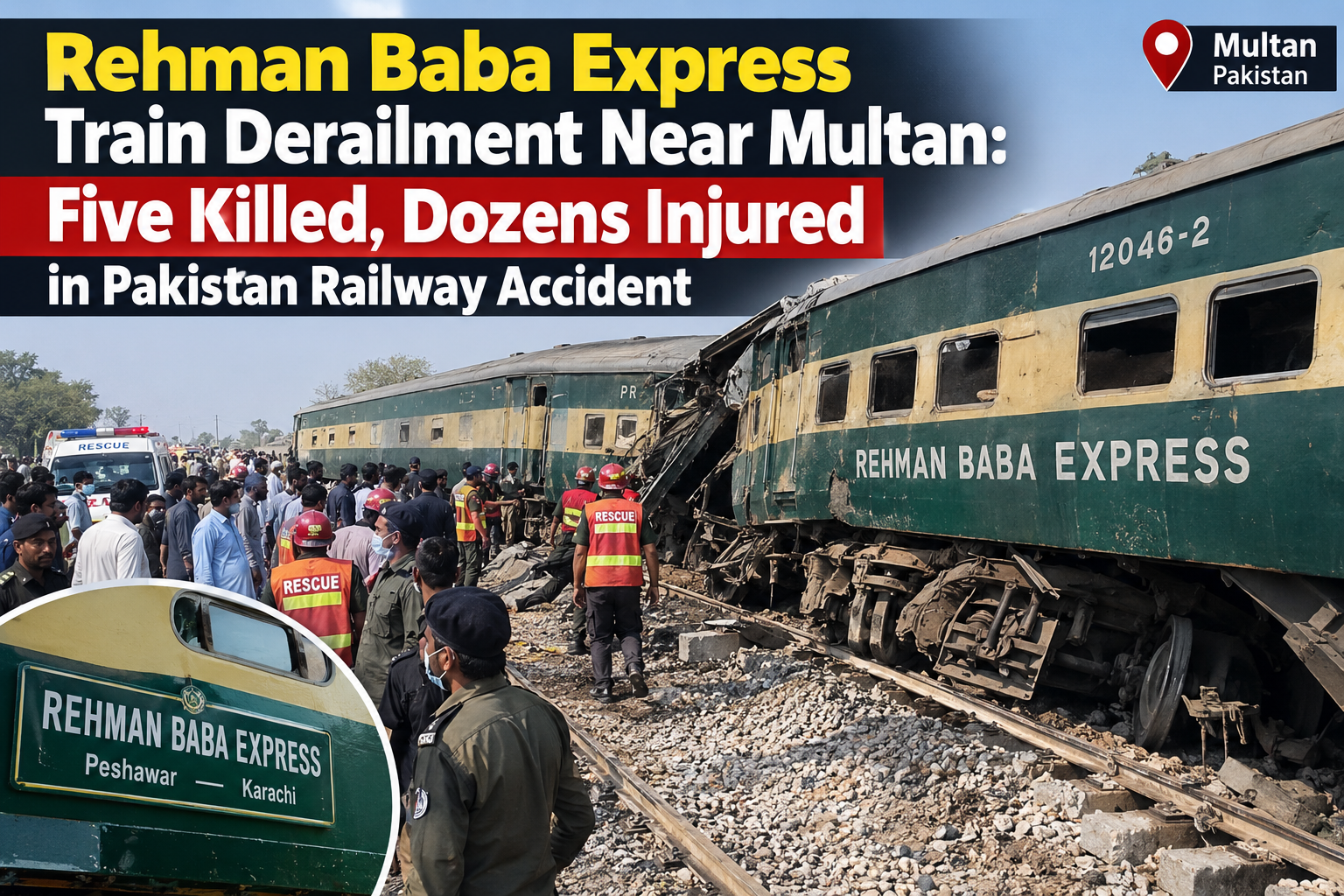
The Rehman Baba Express derailment near Multan brought these concerns into focus. The accident occurred in the Sher Shah railway station area early on Tuesday, October 13, 2026. Fourteen coaches went off the tracks, emergency responders rushed to the scene, and injured passengers were transported for medical treatment. The incident also disrupted train operations through Multan, one of southern Punjab’s important transport hubs
Authorities subsequently began examining the technical circumstances of the derailment. An initial investigation report pointed to a component beneath a passenger coach becoming caught in the railway crossing mechanism. Officials also announced assistance for victims and an inquiry into the incident.
The accident has renewed attention on railway maintenance, inspection procedures, track infrastructure and the importance of transparent investigations into transport disasters.
What Happened in the Rehman Baba Express Train Accident?
The Rehman Baba Express was travelling from Karachi towards Peshawar when it derailed near Sher Shah Railway Station in Multan district on October 13. The accident occurred at approximately 5:15 a.m., according to reports published by Pakistani news organisations.
The train was passing through the railway station area when its coaches left the tracks. Reports described the derailment of all 14 passenger coaches, although the precise extent of damage varied between individual coaches. The incident prompted an emergency response involving railway personnel, rescue workers, police and local administrative authorities.
According to Dawn, five passengers were killed and 49 injured. Early reports published during the rescue operation contained different casualty figures, illustrating how information can change as officials identify victims, treat injured passengers and verify reports from the scene. The later report provided the updated figures cited in this article.
The derailment caused disruption on both railway lines in the affected area. Railway personnel had to remove stranded coaches and inspect the infrastructure before normal operations could resume.
For passengers aboard the train, the immediate priorities were safety, evacuation, medical attention and arrangements to continue their journeys. For authorities, the incident created two urgent responsibilities: responding to the emergency and determining why the train had derailed.
Casualties and Medical Assistance
The loss of five lives made the accident a serious tragedy for the affected families and the wider railway community. The injured passengers required different levels of medical assistance, depending on their conditions.
Rescue 1122 officials reported that 49 passengers had been injured. According to the October 14 report in Dawn, 22 injured passengers received first aid at the scene, while another 27 were transported to hospital for further treatment. Railway officials later said that most injured passengers had been discharged, while seven remained in hospital at the time of the report.
Medical teams and emergency responders played a central role in the response. In railway accidents, injured passengers may require immediate assessment before being moved, particularly when coaches have shifted or overturned and access to passengers is restricted.
Hospitals also need to coordinate with rescue personnel to receive patients, assess injuries and provide treatment. Clear communication between emergency services, railway officials and medical facilities helps prevent confusion during a large incident.
The reported figures represent the information available in the cited reports, rather than a guarantee that every passenger's medical status remained unchanged afterwards.
The accident also highlighted the importance of communicating verified information to relatives. Families seeking information about passengers need accurate updates about hospital transfers, injuries and the arrangements made by the railway administration.
Rescue Operations at the Accident Site
Following the derailment, emergency responders and railway personnel began efforts to reach passengers and move people away from unsafe areas. The operation required coordination because multiple coaches had left the tracks, while railway infrastructure in the affected section had also sustained damage.
Rescue workers prioritised locating affected passengers, helping injured people reach medical assistance and clearing the immediate area. The response involved the local administration and other personnel supporting the railway authorities. Federal Minister for Railways Muhammad Hanif Abbasi subsequently visited the area and reviewed the response, according to the Associated Press of Pakistan.
Removing derailed railway coaches is a complex operation. Heavy equipment and trained personnel may be required to move damaged vehicles safely. Officials must also consider the condition of the rails, points, crossing mechanisms and nearby infrastructure before allowing trains to pass through an affected section.
An effective response therefore involves more than evacuating passengers. It includes protecting the site, preserving evidence needed for an investigation, assessing structural damage and coordinating alternative transport where necessary.
The Multan incident demonstrated the importance of having emergency procedures that can be activated quickly. Railway operators, rescue agencies and district administrations must be prepared to work together when an accident affects a busy route.
Preliminary Investigation: What Caused the Derailment?
One of the most important developments following the accident was the release of preliminary findings about the possible cause.
According to Dawn, an initial railway investigation report attributed the derailment to a technical problem involving a passenger coach, specifically the second coach behind the locomotive. The report described a component beneath the coach becoming caught in the nose of a railway crossing, contributing to the derailment.
The initial report identified the component as part of the coach's truss-bar hanger assembly. According to the report, the component struck the crossing mechanism and became lodged there, after which the coach was pulled and a wheel climbed onto the rail head.
These findings provide a possible technical explanation for how the incident began. However, preliminary findings are not the same as a complete final investigation. Investigators still need to establish the sequence of events, examine the relevant components and determine whether other mechanical or infrastructure factors contributed.
The train driver told Dawn that the train had been travelling at approximately 100 kilometres per hour and that the signals were clear as it passed through the station area. He reported feeling a sudden push, applying the brakes and then discovering that the passenger coaches had derailed.
The driver's account forms part of the available reporting, but it does not independently establish the complete cause. Investigators must compare witness statements with physical evidence, technical records and the condition of the railway equipment.
A comprehensive inquiry can help determine whether the failure resulted from a damaged component, inadequate inspection, a maintenance issue, a problem with the crossing mechanism or a combination of factors.
It is essential that any conclusions about negligence or individual responsibility be based on verified evidence rather than speculation.
Why Railway Maintenance Matters
Railway safety depends on several interconnected systems. A train can operate safely only when its rolling stock, wheels, brakes, suspension components, tracks, signalling equipment and crossing mechanisms function as intended.
A problem involving one component may affect the performance of other parts of the system. For this reason, routine inspections and preventive maintenance are essential to identifying faults before they lead to accidents.
The preliminary findings in the Rehman Baba Express case place particular attention on the condition of the affected coach and the railway crossing. The final investigation should examine the relevant component, the maintenance history of the coach and any inspection records associated with the track and crossing.
Maintenance programmes are most effective when they are systematic rather than reactive. Inspections should follow established procedures, reported defects should be documented, and repairs should be completed and checked before equipment returns to service.
Railway operators also need dependable systems for recording maintenance work. Accurate records help investigators determine whether a component had previously been identified as defective, whether the required repair was completed and whether safety checks were properly documented.
Where technical problems are discovered, the response should address both the immediate defect and any wider issue that might affect other trains or railway sections.
The accident should therefore be viewed as an opportunity to examine the effectiveness of existing safety procedures. Its precise lessons will depend on the findings of the official investigation.
Train Services Disrupted Around Multan
The derailment disrupted railway traffic through Multan, requiring authorities to manage affected services while clearing the coaches and assessing damage to the tracks.
Multan is an important railway junction in Punjab, and interruptions in this area can affect passengers travelling between different parts of the country. When a section of track becomes unavailable, trains may be delayed, diverted or temporarily held at stations until railway personnel establish a safe route.
According to the Associated Press of Pakistan, the accident blocked the up and down tracks in the affected area. Railway authorities subsequently worked to remove the stranded coaches and restore operations.
The disruption created difficulties for passengers who had planned to reach their destinations according to the original timetable. Those travelling for work, medical appointments, education or family commitments may have needed to change their plans.
Railway authorities arranged a replacement train for passengers who wished to continue their journeys. The replacement service was reported to be carrying more than 500 passengers. Buses were also arranged in coordination with the Multan district administration for passengers who preferred to continue by road.
These arrangements were important because passengers should not be left without clear information about alternative travel options after a major disruption.
A coordinated response requires railway officials to communicate expected delays, explain alternative arrangements and provide assistance to people who may have difficulty arranging transport independently.
Restoration of Railway Operations
Restoring railway operations after a derailment requires careful inspection. Before a track can be reopened, personnel must assess whether the rails, sleepers, crossing equipment and associated infrastructure remain safe for use.
According to APP's October 13 report, the down track was restored for train operations after the coaches stranded on it had been removed. The up track had sustained partial damage and required further repair work. Railway authorities said trains travelling in both directions would continue to use the down track until the up track was fully restored.
This arrangement allowed railway traffic to resume while repairs continued. However, using one track for traffic in both directions requires careful coordination and appropriate operating controls.
The restoration process also demonstrates why the removal of coaches does not automatically mean that a railway line is ready for unrestricted service. Engineers and other qualified personnel must evaluate the condition of the infrastructure and confirm that operational requirements have been met.
Passengers should follow official railway announcements when checking whether a route has reopened, whether a train has been delayed or whether alternative arrangements remain in place.
For railway operators, a key objective is to balance the need to restore services with the requirement to protect passengers and railway workers.
Government Response and Official Investigation
Federal Minister for Railways Muhammad Hanif Abbasi expressed grief over the loss of life and directed authorities to provide medical assistance to injured passengers. He also said that compensation would be provided to affected passengers and the families of those who died, in accordance with the applicable Pakistan Railways insurance policy.
The minister ordered the Federal Government Inspector of Railways to investigate the accident. He stated that the circumstances would be examined and that action would be taken against anyone found responsible under the law.
The investigation is important because it can establish the technical sequence of events and identify measures needed to reduce the risk of similar incidents.
A credible inquiry should examine physical evidence from the scene, relevant components, maintenance documentation, inspection records and accounts from railway personnel. It should also consider whether existing procedures were followed and whether improvements are necessary.
Public accountability does not mean assigning blame before the evidence is complete. Instead, it requires a transparent process, clearly explained findings and appropriate action based on the investigation's conclusions.
The government and railway administration also face the practical challenge of implementing any recommendations that emerge from the inquiry. An investigation has limited value if identified safety problems are not corrected or if similar risks elsewhere remain unaddressed.
Compensation and Support for Affected Families
Financial compensation cannot reverse the loss of a family member or remove the difficulties faced by an injured passenger. However, timely assistance can help families manage some of the immediate costs associated with a serious accident.
Railways Minister Hanif Abbasi announced that financial assistance would be provided to the victims under the applicable railway insurance policy. Railway officials also indicated that compensation would be paid to families of deceased passengers and injured people in accordance with policy provisions.
For affected families, a clear claims process is essential. They need to understand which documents are required, where claims should be submitted and how they can obtain information about the status of their applications.
The administration should communicate these requirements in accessible language and provide a point of contact for families who need help.
Injured passengers may also require continued medical care after their initial hospital treatment. Support arrangements should account for the fact that recovery does not always end when a patient is discharged.
The needs of each affected person may differ. Some may require additional medical appointments, while others may need assistance with transport or arrangements for returning home.
A responsive compensation and support process should therefore combine financial assistance with accurate information, practical guidance and respectful treatment of affected families.
Pakistan Railways and the Challenge of Passenger Safety
The Rehman Baba Express accident has raised wider questions about railway safety in Pakistan. The country relies on rail transport to connect distant cities, support passenger mobility and move goods across long distances.
However, safe railway operations require continuous investment in infrastructure, rolling stock, maintenance systems and staff training. When maintenance is delayed or equipment deteriorates, railway operators face additional challenges in keeping services dependable.
Dawn noted that the latest derailment came amid concerns about railway maintenance and other recent incidents. Its reporting also referred to earlier comments from the Pakistan Railways chief executive about maintenance problems.
These concerns make it important to assess safety across the network rather than concentrating only on the location where an accident occurred.
Railway infrastructure includes more than visible tracks. It also encompasses crossing mechanisms, signalling systems, bridges, drainage, communications equipment and the mechanical components of passenger coaches.
Each part requires suitable inspection and maintenance. If one element fails, it may affect the safety of an entire train movement.
A long-term improvement programme should prioritise high-risk locations, address documented defects and establish clear standards for inspecting equipment. It should also ensure that maintenance teams have the training, tools and resources needed to perform their duties effectively.
Investment decisions should be guided by technical assessments and safety requirements. The objective should be to prevent accidents, reduce service disruptions and protect passengers and railway employees.
The Importance of Preventive Inspections
Preventive inspections are intended to identify problems before equipment fails during operation. In railway systems, this includes examining coach components, wheel assemblies, brakes and other mechanical parts, as well as checking the condition of track infrastructure.
The preliminary findings concerning the Rehman Baba Express make the inspection of under-coach components and crossing equipment particularly relevant. Investigators should establish how the reported component became caught in the crossing and whether the existing inspection procedures were sufficient to identify any defect beforehand.
Inspection systems need clear documentation. When a defect is identified, the railway administration should record the finding, determine whether the equipment can safely remain in service and confirm that any required repair has been completed.
Regular reviews of maintenance records can help identify repeated failures or components that require additional attention.
Staff training is equally important. Personnel responsible for inspecting and maintaining railway equipment need to understand the relevant safety standards and be able to recognise signs of deterioration.
Where appropriate, modern monitoring technologies may help detect changes in equipment condition. However, technology should support rather than replace sound maintenance procedures, qualified personnel and independent safety oversight.
Ultimately, preventive maintenance must be treated as a core operational responsibility, not simply as an expense to be considered after a failure.
Lessons for Future Railway Safety
Every serious railway accident provides an opportunity to examine whether existing safety measures are adequate. The lessons from the Rehman Baba Express derailment will become clearer as the official investigation progresses.
Several areas deserve attention.
First, technical investigations should be thorough. The initial findings identify a possible mechanical explanation, but investigators should establish the complete chain of events. Their conclusions should distinguish confirmed evidence from assumptions and explain any recommendations arising from the inquiry.
Second, maintenance records should be reliable. Railway authorities need accurate documentation of inspections, repairs and reported defects. This helps establish whether equipment was maintained according to the required standards.
Third, infrastructure must receive regular attention. Tracks, crossings and other railway components need inspection and repair based on their condition and operational requirements. Defects that could affect safe train movements should be addressed promptly.
Fourth, emergency response plans should be reviewed. Rescue agencies, hospitals, railway staff and local administrations need clear responsibilities and communication procedures. Regular exercises can help organisations prepare for major incidents.
Fifth, passenger communication should improve. During an emergency, passengers need timely information about rescue arrangements, medical assistance, delays and alternative transport. Clear announcements can reduce confusion and help families obtain reliable updates.
These measures cannot guarantee that every accident will be prevented, but they can strengthen the systems designed to identify hazards, respond to emergencies and reduce avoidable risks.
Why Transparent Reporting Matters
Public trust depends partly on how authorities respond after a major transport accident. Passengers and families need to know what happened, what investigators have established and what steps will follow.
Transparent reporting should include the investigation's findings, the evidence supporting its conclusions and any corrective measures that authorities intend to implement. Where technical questions remain unresolved, officials should explain that further work is required rather than present preliminary information as conclusive.
Accurate reporting is also important for journalists and online publishers. Early accounts of an accident may contain conflicting casualty figures because rescue operations and identification procedures are still under way. Later reports may provide updated information from hospitals and railway officials.
In this case, early reports on October 13 contained varying casualty figures, while Dawn reported five deaths and 49 injuries in its October 14 update. Responsible reporting should use the latest verified figures available and make the publication date clear.
Journalists should avoid presenting unverified allegations as established facts. They should also respect the privacy of affected families and avoid publishing distressing material that does not serve a clear public-interest purpose.
For readers, comparing reliable reports and paying attention to publication dates can help distinguish initial information from subsequent updates.
Impact on Passengers and Public Confidence
Railways are often chosen because they provide a practical way to travel between distant cities. Passengers expect railway operators to maintain equipment, communicate delays and take reasonable precautions to protect everyone on board.
A serious accident can undermine confidence in these services, particularly when it raises questions about maintenance or inspection practices. Restoring confidence requires more than statements of regret. It requires evidence that the causes have been investigated and that necessary improvements are being implemented.
Passengers can benefit from reliable service updates, accessible complaint procedures and clear information about assistance available after disruptions. Railway authorities, meanwhile, need systems for recording passenger concerns and responding to recurring operational problems.
The experience of people affected by the Multan derailment should inform efforts to improve passenger care. This includes the way injured passengers receive assistance, how families obtain information and how alternative travel arrangements are communicated.
Public confidence is strengthened when railway services demonstrate that safety, accountability and passenger welfare are practical priorities.
Conclusion
The derailment of the Rehman Baba Express near Sher Shah Railway Station in Multan district on October 13, 2026, was a serious railway accident that claimed five lives and injured 49 people, according to updated reporting published on October 14. The incident disrupted rail services, required emergency rescue operations and prompted an official investigation.
Preliminary findings pointed towards a mechanical problem involving a component beneath a passenger coach and the railway crossing mechanism. Authorities ordered a further inquiry, arranged assistance for passengers and began restoring the affected railway infrastructure.
The most important task now is to establish the full cause of the accident and ensure that the findings lead to meaningful action. Proper maintenance, thorough inspections, reliable infrastructure, well-coordinated emergency services and transparent investigations are all essential to safer railway operations.
For Pakistan Railways, the incident is a reminder that passenger safety must remain central to daily operations and long-term planning. For the families affected by the tragedy, timely support and clear communication remain vital.
The lasting measure of the response will not simply be how quickly services return to normal, but whether the investigation produces practical improvements that help prevent similar accidents in the future.
FAQs
1. When did the Rehman Baba Express train accident occur?
The accident occurred early on October 13, 2026, near Sher Shah Railway Station in Multan district, Punjab, Pakistan.
2. How many people were killed or injured in the accident?
According to Dawn's October 14 report, five passengers died and 49 were injured.
3. What caused the Rehman Baba Express derailment?
The preliminary investigation identified a component beneath the second passenger coach becoming caught in a railway crossing mechanism. A complete investigation was ordered to establish the circumstances.
4. What action did Pakistan Railways take after the accident?
Authorities launched rescue operations, arranged medical assistance and alternative transport for passengers, began repairing railway infrastructure and ordered an official investigation.
5. What does the accident mean for railway safety in Pakistan?
The incident highlights the importance of preventive maintenance, regular inspections, reliable railway infrastructure and transparent investigations to reduce the risk of future accidents.




