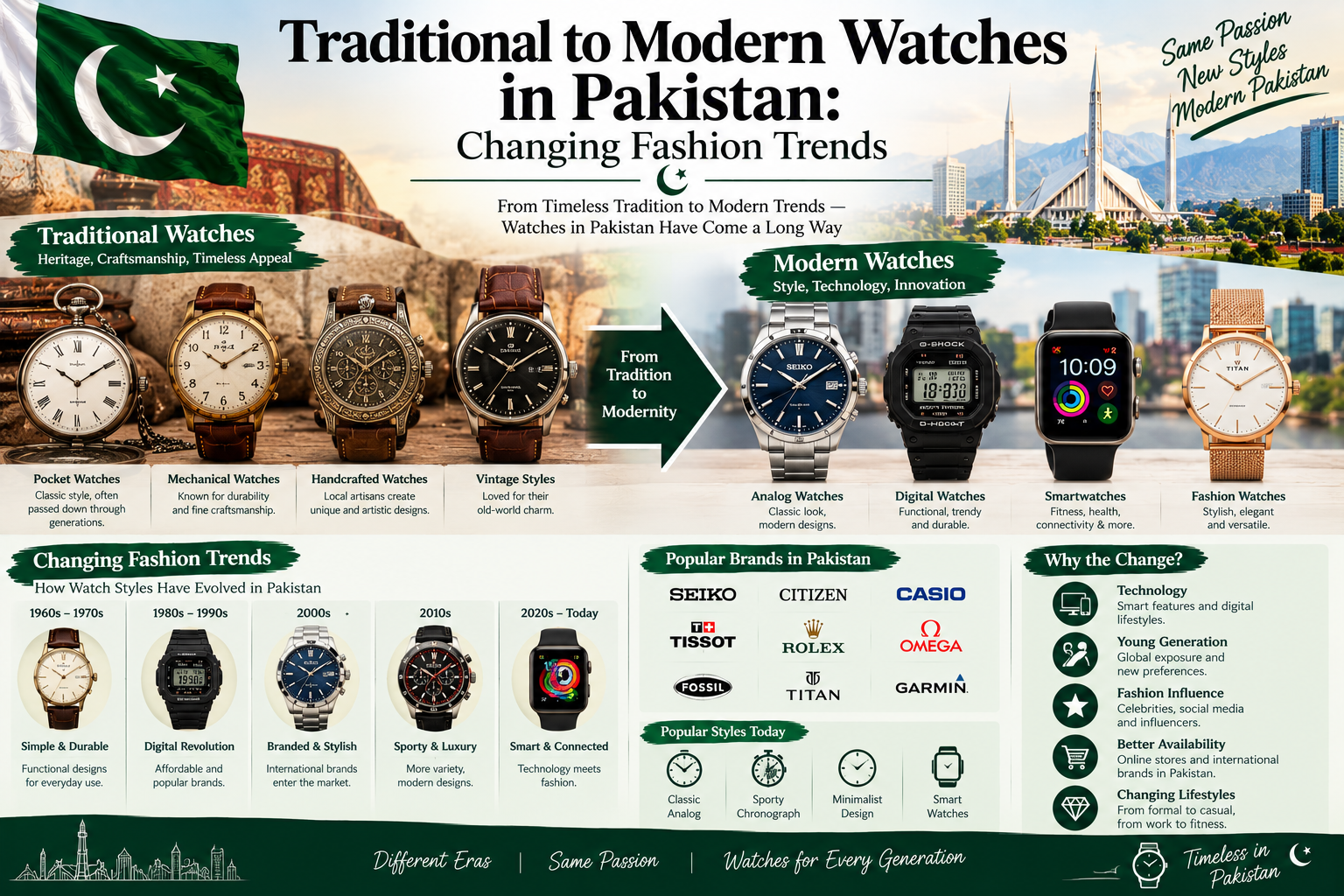
Watches have been an important part of everyday life and fashion in Pakistan for many years. From simple traditional timepieces to modern smart watches, the watch market has changed significantly with developments in technology, fashion, shopping habits, and consumer preferences.
In earlier times, a watch was mainly purchased for one simple purpose: checking the time. Traditional analog watches with mechanical or quartz movements were common choices for men and women. Over time, watches became more closely connected with fashion and personal style. Today, consumers can choose from classic watches, digital watches, sports watches, chronographs, luxury watches, and smart watches.
Pakistan has a diverse culture, and this diversity is also reflected in watch preferences. Traditional clothing such as shalwar kameez, kurta, waistcoats, and formal wear can be paired with different watch styles. At the same time, younger consumers are increasingly familiar with digital technology and wearable devices.
Online shopping has also changed the way people discover and purchase watches. Customers can now compare different designs, features, brands, and prices without visiting multiple physical stores.
This article explores the journey from traditional to modern watches in Pakistan and explains how fashion, technology, lifestyle, and shopping trends have influenced the local watch market.
The Traditional Role of Watches in Pakistan
For many years, watches were primarily practical accessories.
A traditional analog watch generally had a circular dial, hour and minute hands, and sometimes a second hand. Some models also included a date display.
Mechanical watches were once particularly important because they provided timekeeping through a mechanical movement. Later, quartz watches became widely available and offered another practical option.
In Pakistan, watches were often considered useful personal accessories for students, workers, professionals, and travelers.
A watch could be worn every day without being viewed only as a fashion item.
Watches as Fashion Accessories
Over time, the role of watches expanded.
People began selecting watches based not only on timekeeping but also on design, color, strap material, size, and occasion.
A formal watch could be worn with professional clothing, while sports watches could be paired with casual clothing.
This development helped create a wider watch market in Pakistan.
Today, consumers can select watches according to their individual preferences and daily routines.
Traditional Analog Watches
Traditional analog watches remain relevant in Pakistan.
Their simple design makes them suitable for people who prefer familiar timekeeping without complicated digital functions.
Analog watches are available with:
Leather straps
Stainless-steel bracelets
Fabric straps
Simple dials
Date displays
Chronograph features
Quartz movements
Mechanical movements
Classic analog watches can be used for offices, colleges, family events, weddings, and everyday activities.
Mechanical Watches
Mechanical watches represent one of the traditional forms of watchmaking.
Instead of relying on a battery-powered quartz system, mechanical watches use a system of gears, springs, and other components.
Automatic watches are mechanical watches that can use movement from the wearer to help power the mechanism.
Mechanical watches continue to attract consumers who appreciate traditional craftsmanship and watchmaking.
Quartz Watches
Quartz technology changed the watch industry by providing a practical electronic method of keeping time.
Quartz watches became popular because they can be convenient for everyday use and are available in many designs and price ranges.
In Pakistan, quartz watches remain common among consumers looking for simple and reliable everyday timepieces.
Digital Watches Enter the Market
Digital watches introduced a different way of displaying time.
Instead of traditional hands, digital watches display numbers on a screen.
Many digital models also offer features such as:
Alarm
Stopwatch
Timer
Calendar
Backlight
Multiple time zones
These features made digital watches useful for students, sports enthusiasts, travelers, and people interested in practical functionality.
The Rise of Sports Watches
Sports watches introduced more functionality into everyday timepieces.
They are often designed with durable cases, digital displays, timers, alarms, and activity-related features.
Some models are designed for outdoor activities and may offer water resistance.
In Pakistan, sports watches are used by people with different lifestyles, including students and people interested in outdoor activities.
Chronograph Watches
Chronograph watches combine regular timekeeping with stopwatch functions.
Their additional sub-dials often give them a more detailed appearance.
Chronograph watches can be found in both affordable and premium categories.
Some consumers choose them primarily for their appearance, while others value their stopwatch functionality.
The Influence of Fashion Trends
Fashion has played an important role in changing watch preferences.
As international fashion trends became easier to access through television, magazines, websites, and social media, Pakistani consumers became familiar with a wider variety of watch designs.
Minimalist watches, vintage-inspired models, large digital displays, metal bracelets, colorful straps, and smart watches have all become part of the modern watch market.
However, traditional designs have not disappeared.
Instead, traditional and modern styles now exist alongside each other.
Watches with Pakistani Traditional Clothing
Traditional Pakistani clothing remains an important part of local fashion.
Men commonly wear shalwar kameez, kurta pajama, waistcoats, and sherwanis, while women wear a variety of traditional and contemporary outfits.
A classic watch can work well with traditional clothing.
For formal events, some people prefer watches with leather or metal straps. For everyday traditional clothing, simpler watches can be practical.
The choice depends on the occasion and personal preference.
Watches and Formal Wear
Formal clothing often influences watch selection.
For business meetings, office environments, weddings, and formal events, many people choose simple watches with clean designs.
Leather straps and metal bracelets are common choices.
A watch does not need to be expensive to work with formal clothing. A well-maintained watch with a simple design can be suitable for many occasions.
Watches for Everyday Use
Everyday watches generally need to be practical and comfortable.
Consumers may look for:
Clear time display
Comfortable strap
Durable case
Reliable movement
Appropriate size
Long battery life
Easy maintenance
A simple quartz watch can be sufficient for someone who mainly needs basic timekeeping.
Others may prefer a smartwatch because of its additional digital features.
The Arrival of Smart Watches
Smart watches represent one of the biggest changes in the modern watch industry.
Instead of only displaying time, smart watches can connect with smartphones and provide digital features.
Depending on the model, a smart watch may offer:
Notifications
Calls
Messages
Alarms
Timers
Activity tracking
GPS
Sports modes
Music controls
Weather information
The exact features vary between manufacturers and models.
Smart Watches and Modern Lifestyle
The modern Pakistani lifestyle increasingly involves smartphones, online services, digital communication, and wearable technology.
Smart watches can complement this lifestyle by providing quick access to information.
For example, a person may see a notification on the watch without taking the phone out of a pocket or bag.
Students may use alarms and timers, professionals may use calendar notifications, and travelers may use GPS-related features.
Online Shopping and the Pakistani Watch Market
Online shopping has changed how consumers buy watches.
Previously, buyers often depended on local watch shops or shopping malls.
Today, customers can browse watches through online marketplaces and websites.
Online shopping allows consumers to compare:
Prices
Designs
Specifications
Customer reviews
Warranty information
Seller ratings
However, buyers should verify product details and seller reliability before placing an order.
Social Media and Watch Trends
Social media has become an important source of fashion inspiration.
People can see watches worn by celebrities, athletes, influencers, business professionals, and other public figures.
This exposure can introduce consumers to designs they may not have seen in local stores.
Short videos and product reviews can also explain watch features and demonstrate how different devices work.
As a result, social media has contributed to faster awareness of changing watch trends.
Changing Preferences Among Young Consumers
Young consumers are growing up with smartphones and digital technology.
As a result, many are familiar with smart watches and other wearable devices.
However, traditional watches remain relevant because they are simple, fashionable, and do not require frequent charging.
Some young consumers therefore choose traditional watches for fashion and smart watches for technology.
This creates a market where both categories can exist together.
Minimalist Watch Trends
Minimalist watches have become popular in many markets, including Pakistan.
These watches generally use simple dials, limited decorative elements, and straightforward designs.
Minimalist watches can work with casual and formal clothing.
Their simple appearance can also make them suitable for everyday use.
Vintage-Inspired Watches
Vintage-inspired watches use design elements associated with older watch styles.
They may feature classic dial layouts, traditional straps, or retro-inspired shapes.
Some consumers choose vintage-inspired watches because they offer a connection to traditional watch aesthetics while using modern movements.
Stainless-Steel Watch Trends
Stainless-steel watches continue to be widely available.
Metal bracelets can provide durability and a formal or modern appearance.
They are commonly found in office watches, casual watches, chronographs, and premium models.
Different finishes can create different visual effects, including polished and brushed surfaces.
Leather-Strap Trends
Leather straps remain associated with classic watch design.
Black and brown straps are particularly common.
Leather can be suitable for formal and office environments, although it requires appropriate care and protection from excessive moisture.
Color Trends in Watches
Watch designs are available in many colors.
Traditional choices such as black, silver, brown, and white remain common.
Modern designs may include blue, green, gold, grey, or other combinations.
Consumers can choose colors according to their clothing preferences and the occasions for which they plan to use the watch.
Watch Size Trends
Watch sizes have changed over time.
Different periods have seen preferences for smaller, medium-sized, and larger cases.
Today, consumers can find watches across a wide range of sizes.
The most practical choice depends on comfort, personal preference, and the watch's purpose.
A watch should be comfortable enough for regular use.
Smart Watch Displays and Modern Designs
Modern smart watches have introduced new possibilities for watch faces.
Users can sometimes change digital watch faces to display different information.
Some designs imitate traditional analog watches, while others use modern digital layouts.
This allows a single device to appear different depending on the user's preference.
Watches for Men in Pakistan
Men's watches in Pakistan include classic, sports, digital, chronograph, luxury, and smart designs.
Traditional watches remain common for office and formal wear.
Sports and digital watches are often selected for casual or active lifestyles.
Smart watches are increasingly used by people who want digital features.
The wide variety allows men to select watches according to their daily needs.
Watches for Women in Pakistan
Women's watches are also available in traditional and modern designs.
Common options include:
Classic analog watches
Metal bracelet watches
Leather-strap watches
Minimalist watches
Fashion watches
Smart watches
Design preferences can vary widely, so consumers have many options for casual, formal, professional, and everyday use.
Luxury Watches and Changing Consumer Interest
Luxury watches represent a specialized segment of the market.
Some consumers are interested in premium watches because of their craftsmanship, materials, movement technology, and brand history.
Luxury watches can be significantly more expensive than ordinary watches.
Because counterfeit products exist in many global markets, buyers should pay close attention to authenticity when purchasing expensive watches.
Affordable Watches in Pakistan
Affordable watches remain important because not every consumer wants to spend a large amount of money on a timepiece.
Basic analog, digital, sports, and smart watches are available across different price categories.
Buyers should compare quality and features rather than focusing only on the lowest price.
Factors Affecting Watch Prices
Several factors can influence the price of a watch in Pakistan.
These include:
Brand
Movement type
Materials
Features
Design
Manufacturing quality
Warranty
Import costs
Currency exchange rates
Retailer
Premium materials and advanced technology can increase costs.
Prices can also change because of economic and market conditions.
How to Choose Between Traditional and Smart Watches
The decision between a traditional watch and a smart watch depends mainly on the user's requirements.
A traditional watch may be suitable for someone who wants simple timekeeping, long battery life, and a classic accessory.
A smart watch may be more suitable for someone who wants notifications, activity tracking, communication features, and smartphone connectivity.
Some consumers may choose to own both types and use them for different situations.
Watch Maintenance
Proper maintenance can extend the useful life of a watch.
Traditional watches should be kept clean and protected from unnecessary impacts.
Leather straps should be protected from excessive moisture.
Smart watches should be charged using compatible equipment and kept updated with recommended software.
Users should always follow the manufacturer's care instructions.
Authenticity and Reliable Sellers
Authenticity is especially important when purchasing branded or expensive watches.
Consumers should consider:
Seller reputation
Warranty
Model number
Packaging
Documentation
Product specifications
Return policy
An unusually low price can require additional investigation.
Purchasing from established or authorized sellers can provide greater confidence, especially for premium watches.
Future of Watches in Pakistan
The Pakistani watch market is likely to continue combining traditional and modern products.
Traditional watches will remain relevant because of their simple operation and classic appearance.
Smart watches will continue to develop as wearable technology becomes more advanced.
Future products may offer better battery technology, improved connectivity, more accurate sensors, stronger materials, and additional digital features.
Online shopping will also continue to make a broader selection available to consumers across Pakistan.
Conclusion
The journey from traditional to modern watches in Pakistan reflects wider changes in fashion, technology, and everyday life. Traditional analog watches remain popular because of their simplicity and classic appearance, while digital, sports, chronograph, and smart watches provide additional features.
Fashion trends, social media, online shopping, and smartphone technology have expanded the choices available to Pakistani consumers. Today, a watch can serve as a simple timekeeping device, a fashion accessory, a sports tool, or a digital wearable device.
There is no single watch style suitable for everyone. The right choice depends on personal preference, lifestyle, budget, comfort, features, and intended use. Traditional and modern watches can both have a place in the Pakistani market, giving consumers many options as watch technology and fashion continue to evolve.
FAQs
1. Are traditional watches still popular in Pakistan?
Yes. Traditional analog, quartz, mechanical, and classic watches remain popular alongside modern digital and smart watches.
2. Why are smart watches becoming popular in Pakistan?
Smart watches provide additional features such as notifications, activity tracking, GPS, alarms, and smartphone connectivity.
3. What watch styles are suitable for traditional Pakistani clothing?
Classic analog watches, leather-strap watches, and metal-bracelet watches can all work with traditional clothing depending on the occasion.
4. How has online shopping changed the watch market?
Online shopping allows consumers to compare different designs, prices, features, reviews, and sellers more easily.
5. Which is better for everyday use, a traditional watch or smart watch?
Both can be suitable. A traditional watch offers simple timekeeping, while a smart watch provides additional digital functions. The choice depends on the user's needs.




