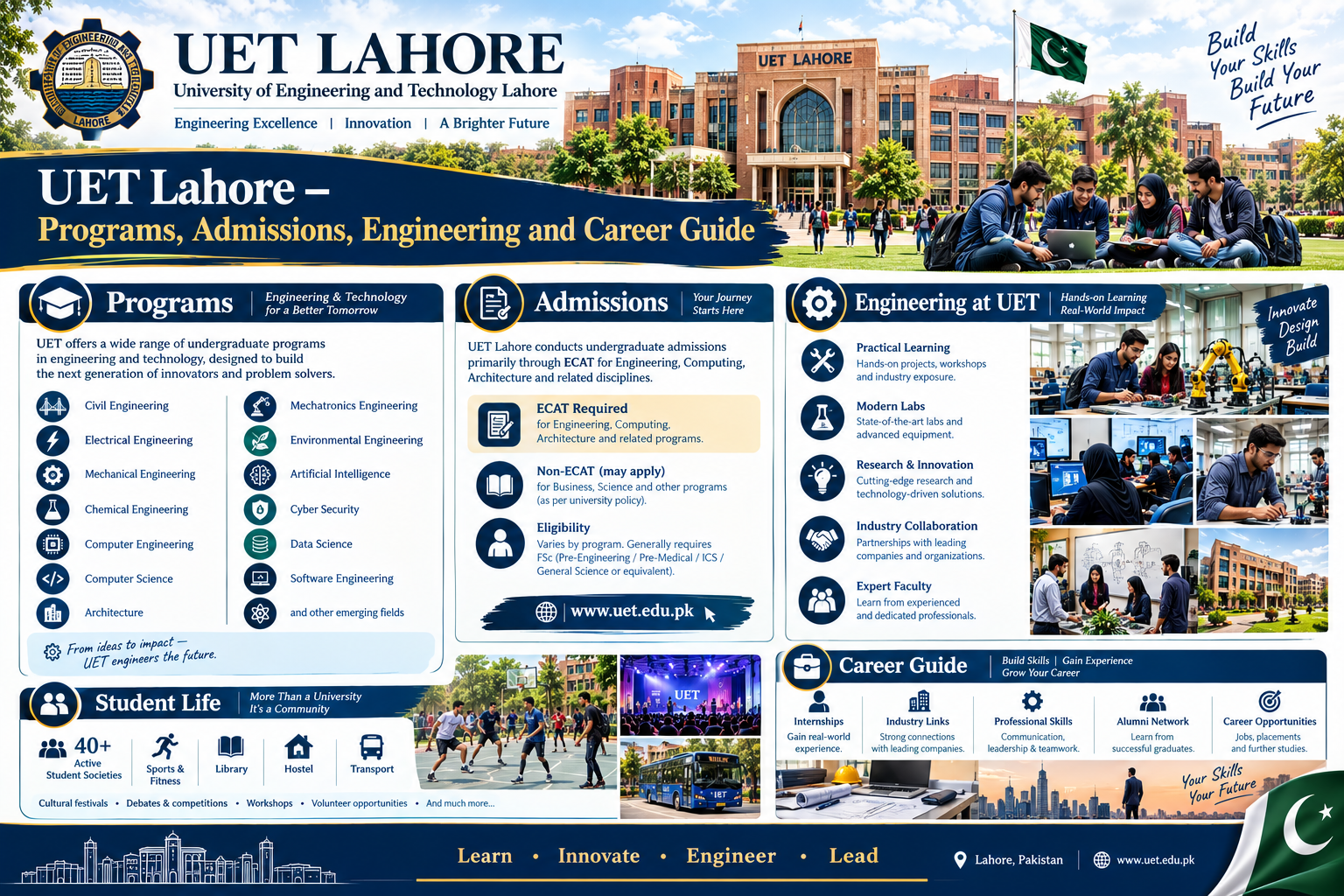
The University of Engineering and Technology, commonly known as UET Lahore, is one of Pakistan's most recognized institutions for engineering, technology, architecture, applied sciences, and related fields. Located in Lahore, Punjab, the university has played an important role in producing engineers, researchers, technologists, architects, and professionals who contribute to the country's industrial, technological, construction, energy, and infrastructure sectors.
Engineering education is particularly important for a developing country because engineers are involved in designing buildings, roads, bridges, electrical systems, computer networks, industrial processes, manufacturing systems, energy projects, communication technologies, and many other areas of modern life. UET Lahore has therefore developed an important position within Pakistan's higher education system.
The university provides an environment where students can study technical subjects while also developing practical, analytical, research, and professional skills. Its academic activities cover a broad range of disciplines, allowing students with different interests to choose fields connected with engineering, computing, architecture, technology, and applied sciences.
For students planning careers in engineering and technology, UET Lahore is an institution worth considering. Its long academic history, professional environment, laboratories, research activities, and connection with Pakistan's engineering sector make it an important university in the country.
History of UET Lahore
The University of Engineering and Technology Lahore has a long history in engineering education. Its origins can be traced to an engineering school established in the nineteenth century, which later developed into a college and eventually became a university.
Over time, the institution expanded its academic programs and facilities to meet the changing needs of Pakistan.
As technology developed, engineering education also changed. Traditional disciplines such as civil, mechanical, and electrical engineering were joined by newer fields involving computers, electronics, telecommunications, chemical processes, architecture, environmental systems, and other areas.
This long history has helped UET Lahore develop a strong identity in Pakistan's engineering education sector.
Location of UET Lahore
The main campus of UET Lahore is located on G. T. Road in Lahore.
Lahore is one of Pakistan's major educational and cultural centers. The city contains many universities, colleges, research institutions, technology companies, industries, and professional organizations.
The university's location provides students with opportunities to interact with a large academic and professional community.
UET Lahore also has other campuses and teaching facilities associated with its academic activities.
Academic Programs at UET Lahore
UET Lahore offers programs in numerous engineering and technology-related disciplines.
The exact programs and admission requirements can vary from one academic year to another, but the university has traditionally been associated with fields such as:
Civil Engineering
Electrical Engineering
Mechanical Engineering
Chemical Engineering
Computer Engineering
Computer Science
Environmental Engineering
Architectural Engineering
Architecture
Industrial Engineering
Transportation Engineering
Mechatronics and related technologies
These disciplines cover a wide range of professional opportunities.
Students should always check the latest university information before applying because programs, admission criteria, and policies may change.
Civil Engineering
Civil engineering is one of the oldest and most important engineering disciplines.
Civil engineers work on infrastructure such as buildings, roads, bridges, dams, water systems, transportation networks, and other structures.
Pakistan has a continuous need for civil engineers because cities are expanding and infrastructure requires planning, construction, maintenance, and modernization.
Students studying civil engineering learn subjects related to structures, materials, surveying, soil mechanics, fluid mechanics, transportation, construction, and environmental systems.
Practical training and laboratory work are important components of civil engineering education.
Electrical Engineering
Electrical engineering deals with electricity, electronics, power systems, control systems, communication, and related technologies.
Electricity is essential to almost every part of modern society.
Electrical engineers can work in power generation, transmission, distribution, electronics, automation, telecommunications, industrial systems, renewable energy, and other sectors.
The development of solar power, smart grids, electric vehicles, automation, and advanced electronic systems has created new areas of interest within electrical engineering.
Mechanical Engineering
Mechanical engineering focuses on machines, mechanical systems, energy, manufacturing, thermal systems, and industrial equipment.
Mechanical engineers can work in manufacturing plants, automotive companies, energy projects, industrial organizations, research institutions, and many other sectors.
Students learn about mechanics, thermodynamics, fluid mechanics, materials, machine design, manufacturing, and related subjects.
Mechanical engineering is closely connected with Pakistan's industrial development.
Chemical Engineering
Chemical engineering combines chemistry, physics, mathematics, and engineering principles to design and operate industrial processes.
Chemical engineers can work in industries such as chemicals, pharmaceuticals, food processing, energy, fertilizers, petroleum, polymers, and manufacturing.
Students study topics such as chemical processes, thermodynamics, fluid mechanics, reaction engineering, process control, and plant design.
This field can be particularly valuable for industries that depend on large-scale production processes.
Computer Engineering and Computer Science
Computing has become one of the fastest-growing areas of modern education.
Computer-related programs can prepare students for careers in software development, artificial intelligence, data science, networking, cybersecurity, embedded systems, cloud computing, and other technology fields.
Computer engineering combines aspects of hardware and software.
Computer science focuses more broadly on algorithms, programming, computation, software, data, artificial intelligence, and information systems.
Pakistan's technology industry continues to create opportunities for graduates with strong computing skills.
Mechatronics and Automation
Mechatronics combines mechanical engineering, electronics, computer systems, and control technologies.
Automation is becoming increasingly important in manufacturing and industrial processes.
Modern factories can use sensors, robotics, programmable systems, and automated equipment to improve efficiency.
Students interested in robotics and intelligent machines may find mechatronics particularly attractive.
Architecture and Design
UET Lahore is also associated with architecture and architectural engineering.
Architecture combines technical knowledge with design and creativity.
Architects work on buildings, urban spaces, housing projects, commercial structures, educational facilities, and other environments.
Architectural engineering connects building design with engineering systems.
Students in these fields need both creative and technical abilities.
Environmental Engineering
Environmental engineering addresses problems related to pollution, waste, water, air quality, environmental protection, and sustainable development.
Pakistan faces environmental challenges including urban pollution, water management problems, waste management issues, and climate-related risks.
Environmental engineers can contribute to developing systems that reduce pollution and improve resource management.
This field is becoming increasingly important as countries focus on sustainability and environmental protection.
Importance of Mathematics in Engineering
Mathematics is one of the foundations of engineering education.
Engineering students commonly study subjects such as calculus, algebra, differential equations, statistics, and numerical methods.
Mathematics allows engineers to model systems, calculate forces, analyze electrical circuits, design structures, study fluid movement, and solve technical problems.
Students interested in engineering should therefore build a strong mathematical foundation before entering university.
Importance of Physics
Physics is another major foundation for engineering.
Mechanical systems, electricity, energy, waves, forces, materials, and many other engineering concepts are connected with physics.
Students who understand physics can often find it easier to understand advanced engineering concepts.
Strong preparation in mathematics and physics can therefore help students transition successfully into engineering education.
Laboratories and Practical Learning
Engineering cannot be learned effectively through textbooks alone.
Students need opportunities to perform experiments, operate equipment, analyze data, and apply theoretical concepts.
Laboratories provide this practical environment.
Different engineering disciplines require different types of laboratories.
For example, civil engineering students may work with construction materials and structural testing, while electrical engineering students may work with circuits and electrical systems.
Practical experience helps students understand how theoretical concepts work in real situations.
Research at UET Lahore
Research is an important part of a modern university.
UET Lahore is involved in research across engineering, technology, applied sciences, architecture, energy, environment, computing, and other areas.
Research allows faculty members and students to investigate problems and develop new solutions.
Engineering research can have direct practical applications.
A research project may focus on energy efficiency, renewable energy, smart transportation, water treatment, construction materials, artificial intelligence, robotics, telecommunications, or industrial automation.
Renewable Energy Research
Energy is an important issue for Pakistan.
The country needs reliable, affordable, and sustainable energy systems.
Engineering research can contribute to solar power, wind energy, energy storage, smart grids, energy efficiency, and other technologies.
Pakistan receives significant sunlight in many regions, creating opportunities for solar energy.
Engineers can help design systems that use renewable energy efficiently.
Artificial Intelligence and Emerging Technology
Artificial intelligence is transforming many industries.
Engineering universities increasingly need to prepare students for technologies such as AI, machine learning, robotics, automation, data science, and intelligent systems.
AI can be applied to manufacturing, transportation, healthcare, agriculture, energy, finance, and education.
Students who combine engineering knowledge with programming and data skills can explore a wide range of modern careers.
Industry Connection
Engineering education becomes more useful when students understand how industries operate.
Universities can support this through internships, industrial visits, research partnerships, professional seminars, and practical projects.
Industry exposure allows students to understand workplace expectations.
It also helps them recognize the difference between academic problems and real-world engineering challenges.
Internships and Practical Experience
Internships can be valuable for university students.
During an internship, students may observe professional engineers, participate in projects, learn workplace procedures, and improve communication skills.
An internship can also help students decide what type of career they want after graduation.
Students should take practical experience seriously because employers often value graduates who can apply knowledge rather than simply describe theories.
Student Projects
Engineering students often complete design and development projects during their degrees.
A project may involve developing a software application, designing a mechanical system, building an electronic device, creating an energy solution, or developing a structural model.
Such projects encourage teamwork and problem-solving.
Students learn how to identify a problem, research possible solutions, design a system, test it, analyze results, and present their findings.
Student Life at UET Lahore
University life is more than attending lectures.
Students can participate in societies, competitions, seminars, workshops, sports, technical events, cultural activities, and other extracurricular programs.
Engineering students may join technical societies related to their academic fields.
These activities can help students develop communication, leadership, teamwork, presentation, and organizational skills.
Technical Competitions
Technical competitions can encourage students to apply their classroom knowledge.
Examples can include programming contests, robotics competitions, engineering design challenges, business competitions, research presentations, and innovation events.
Such activities allow students to experiment with ideas outside normal classroom assignments.
They can also encourage creativity and innovation.
Entrepreneurship at UET
Engineering graduates do not necessarily have to work only for traditional companies.
Some graduates may create startups or develop technology-based businesses.
Entrepreneurship can combine technical knowledge with business skills.
A student who develops a useful software platform, engineering product, energy solution, or industrial technology may eventually turn the idea into a business.
For students interested in becoming entrepreneurs, engineering education can provide valuable technical foundations.
Admissions to UET Lahore
Admission requirements vary according to the program and academic year.
Students applying to engineering programs generally need the relevant academic qualifications and may have to meet specific subject and test requirements.
Because admission policies can change, applicants should check the latest requirements before applying.
Students should also pay attention to application deadlines and required documents.
Early preparation can reduce stress during the admission process.
Entrance and Merit Considerations
Engineering admissions can be competitive.
Academic performance can play an important role in determining admission.
Students should therefore focus on their mathematics, physics, chemistry, computer science, or other relevant subjects depending on the chosen program.
Preparation should begin well before the application period.
Students should also understand how merit is calculated for their particular admission category.
Scholarships and Financial Assistance
University education can create financial challenges for some families.
Scholarships and financial assistance can make higher education more accessible.
Students should explore available scholarships, fee-support programs, and other financial assistance opportunities.
Eligibility conditions may differ according to academic performance, financial need, program, and other factors.
Since policies can change, students should consult the latest official information when preparing an application.
Career Opportunities After UET
UET graduates can enter many professional fields.
Civil engineers can work in construction, infrastructure, transportation, consulting, urban development, and government organizations.
Electrical engineers can work in power, electronics, telecommunications, automation, and industrial systems.
Mechanical engineers can work in manufacturing, energy, automotive, maintenance, and design.
Computer-related graduates can work in software, AI, cybersecurity, data science, cloud computing, and technology companies.
Chemical engineers can work in manufacturing, energy, pharmaceuticals, chemicals, and process industries.
Architecture graduates can work in design firms, construction companies, planning organizations, and independent practices.
Government Career Opportunities
Engineering graduates can also pursue government careers.
Government departments require engineers for infrastructure, energy, transportation, water management, public works, telecommunications, and other projects.
Engineers may work in public-sector organizations, development authorities, municipal organizations, and other institutions.
Government careers can offer opportunities to contribute directly to national infrastructure and development.
Private Sector Careers
The private sector is another major employer of engineers.
Construction companies, manufacturing organizations, software companies, telecommunications firms, energy companies, banks, technology startups, consultancies, and industrial organizations employ graduates from different engineering disciplines.
The exact opportunities depend on the graduate's degree, skills, experience, and specialization.
Freelancing and Remote Work
Technology has also created opportunities for engineering and computing graduates to work remotely.
Programming, web development, software engineering, graphic design, data analysis, technical writing, and other digital services can be performed online.
Students interested in freelancing should develop practical skills in addition to their university education.
A degree can provide theoretical knowledge, while projects and practical work can help demonstrate professional ability.
Importance of Soft Skills
Technical knowledge alone is not always enough for career success.
Engineers also need communication, teamwork, leadership, problem-solving, time management, and presentation skills.
An engineer may need to explain a technical project to a manager who does not have the same technical background.
Good communication can therefore be extremely valuable.
Students should develop these skills throughout university.
Women in Engineering
Women can play an important role in engineering and technology.
Engineering careers offer opportunities in civil engineering, computing, electrical systems, architecture, environmental engineering, research, management, and many other fields.
Encouraging more women to enter technical professions can expand Pakistan's skilled workforce.
Universities provide an important environment where female students can develop technical and professional confidence.
Engineering and Pakistan's Development
Pakistan requires engineers for almost every major area of development.
Roads, bridges, water systems, electricity networks, factories, communication systems, housing, transportation, software infrastructure, energy projects, and environmental systems all require technical expertise.
Engineering universities therefore contribute directly to national development by preparing skilled professionals.
Role in Infrastructure Development
Infrastructure is the physical foundation of a modern economy.
Efficient transportation networks help businesses move goods.
Reliable electricity supports industries.
Good water and sanitation systems protect public health.
Safe buildings and bridges protect communities.
Engineers contribute to designing, constructing, operating, and maintaining these systems.
Engineering and Climate Change
Climate change is creating new engineering challenges.
Pakistan is vulnerable to floods, extreme heat, water stress, and other environmental risks.
Engineers can contribute to climate-resilient infrastructure, water management, renewable energy, efficient buildings, disaster-resistant structures, and sustainable transportation.
Environmental and civil engineering research can therefore become increasingly important.
Future of Engineering Education
Engineering is changing rapidly.
Traditional engineering knowledge remains important, but modern engineers also need digital skills.
Artificial intelligence, automation, robotics, cloud computing, advanced materials, renewable energy, and data science are changing professional requirements.
Future engineering students may increasingly work across multiple disciplines.
For example, a civil engineer may use digital modeling and data analysis, while a mechanical engineer may work with robotics and AI.
Why UET Lahore Remains Important
UET Lahore has a long history of engineering education in Pakistan.
Its wide academic scope, technical environment, research activities, laboratories, professional programs, and connection with engineering industries make it an important institution for students interested in technical careers.
The university also reflects the changing nature of engineering.
While traditional disciplines remain important, new technologies are creating additional opportunities.
How Students Can Prepare for UET
Students who want to study at UET should start preparing early.
A strong foundation in mathematics and science can make university-level engineering easier.
Students should practice problem-solving instead of relying only on memorization.
They should also develop basic computer skills because technology is now part of almost every engineering discipline.
Reading technical material in English can also be useful because many engineering textbooks and professional resources are written in English.
Conclusion
The University of Engineering and Technology Lahore is one of Pakistan's leading institutions for engineering, technology, architecture, computing, and applied sciences.
With its long history and broad academic environment, UET Lahore has contributed to the development of engineers and technical professionals who work across Pakistan and internationally.
The university offers opportunities in traditional engineering disciplines such as civil, electrical, mechanical, and chemical engineering, while also supporting modern areas related to computing, automation, environmental systems, architecture, and emerging technologies.
Its laboratories, research activities, technical projects, student societies, and professional connections can help students develop both academic and practical skills.
For students planning careers in engineering and technology, UET Lahore can be an important option. However, choosing a university should always depend on the student's academic interests, career goals, financial situation, preferred field, and admission eligibility.
Engineering is a challenging but rewarding field. Students who combine technical knowledge with creativity, communication, discipline, and problem-solving skills can contribute to Pakistan's future development.
As the country continues to expand its infrastructure, technology sector, energy systems, manufacturing capacity, and digital economy, the need for capable engineers and technologists will remain significant.
UET Lahore's continuing role in engineering education, research, innovation, and professional development makes it an important part of Pakistan's higher education landscape.
Meta Title: UET Lahore – Programs, Admissions, Engineering and Career Guide
Meta Description: Explore UET Lahore, one of Pakistan’s leading engineering universities, including programs, admissions, research, student life and career opportunities.
Keywords: UET Lahore, engineering universities in Pakistan, UET Lahore programs
Short Summary: UET Lahore is a leading Pakistani university known for engineering, technology, architecture, computing, research, and professional education.
FAQs
1. What is UET Lahore?
UET Lahore, or the University of Engineering and Technology Lahore, is a major Pakistani university specializing in engineering, technology, architecture, computing, and applied sciences.
2. What programs is UET Lahore known for?
UET Lahore is known for fields including civil, electrical, mechanical, chemical, computer, environmental, architectural, and other engineering and technology-related disciplines.
3. Where is UET Lahore located?
The main campus of UET Lahore is located on G. T. Road in Lahore, Punjab.
4. Is UET Lahore good for engineering students?
UET Lahore has a long history of engineering education, technical programs, laboratories, research activities, and professional development opportunities, making it an important option for engineering students in Pakistan.
5. What careers can UET graduates pursue?
Graduates can pursue careers in engineering, technology, construction, manufacturing, energy, computing, telecommunications, architecture, research, government organizations, private companies, and entrepreneurship.




