Introduction
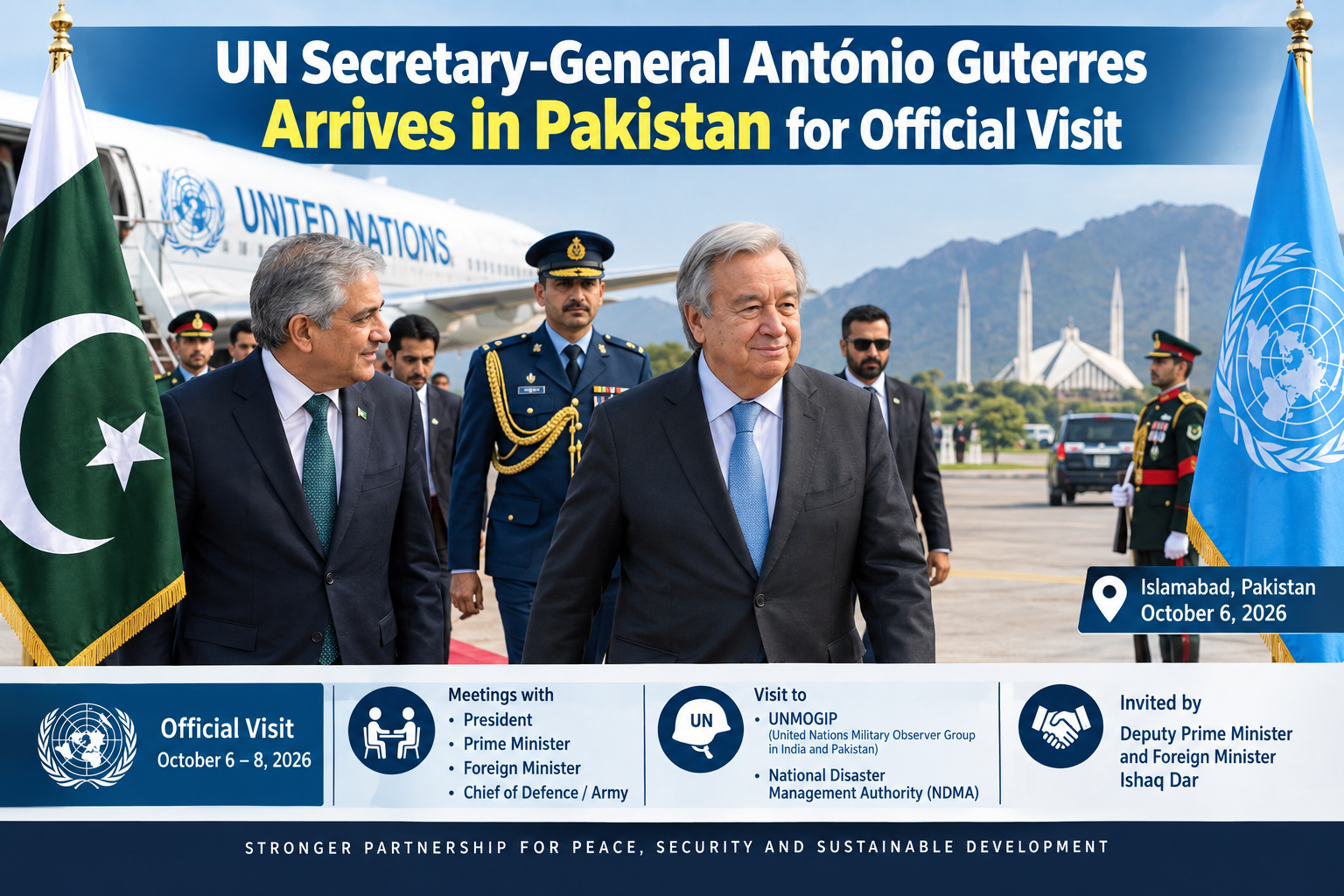
United Nations Secretary-General António Guterres arrived in Islamabad on October 6, 2026, for an official visit to Pakistan. The visit, scheduled from October 6 to October 8, comes at an important time for Pakistan as the country continues to engage with the international community on regional peace, security, climate resilience, disaster preparedness, and multilateral cooperation. The visit was arranged at the invitation of Pakistan’s Deputy Prime Minister and Foreign Minister, Senator Mohammad Ishaq Dar.
Guterres was received upon arrival by Acting Foreign Secretary Ambassador Nabeel Munir. During his stay, the UN chief is expected to meet Pakistan’s senior leadership, including President Asif Ali Zardari, Prime Minister Shehbaz Sharif, Deputy Prime Minister and Foreign Minister Ishaq Dar, and Chief of Defence Forces and Chief of Army Staff Field Marshal Asim Munir.
The visit is significant because it provides an opportunity for Pakistan and the United Nations to discuss regional and international developments and strengthen cooperation on issues that affect both Pakistan and the wider international community.
Guterres Begins His Pakistan Visit
António Guterres arrived in Islamabad early on Tuesday, beginning his scheduled three-day visit. According to Pakistan’s Foreign Office, the visit will focus on Pakistan’s longstanding cooperation with the United Nations and the country’s support for multilateralism and the principles of the UN Charter.
The UN Secretary-General’s arrival has attracted considerable attention because of the wide range of issues expected to be discussed during his meetings with Pakistani officials. These include international peace and security, regional developments, disaster preparedness, early-warning systems, and Pakistan’s role in multilateral diplomacy.
The visit also comes near the end of Guterres’s tenure as UN Secretary-General. His current term is scheduled to conclude at the end of 2026, making the Pakistan visit an important part of his final engagements as head of the United Nations.
Meetings With Pakistan’s Leadership
One of the major components of the visit will be meetings between Guterres and Pakistan’s top leadership.
The UN Secretary-General is scheduled to meet President Asif Ali Zardari and Prime Minister Shehbaz Sharif. He will also meet Deputy Prime Minister and Foreign Minister Ishaq Dar and Field Marshal Asim Munir, the Chief of Defence Forces and Chief of Army Staff.
These meetings are expected to provide an opportunity to exchange views on major regional and international developments. Pakistan has traditionally emphasized the importance of diplomacy, dialogue, peaceful conflict resolution, and multilateral institutions in addressing international challenges.
The discussions may also provide an opportunity for Pakistan to explain its perspectives on regional security and international cooperation.
Focus on Multilateralism
Multilateralism is expected to be one of the central themes of the visit.
Pakistan has repeatedly expressed support for a strong United Nations system and international cooperation. The Foreign Office has described the visit as an opportunity to reiterate Pakistan’s longstanding cooperation with the UN and its commitment to the purposes and principles of the UN Charter.
Multilateralism means countries working together through international institutions and diplomatic frameworks to address shared challenges. For Pakistan, cooperation through the United Nations remains important in areas such as peacekeeping, climate change, humanitarian assistance, development, and international security.
Guterres has also consistently promoted international cooperation during his tenure. His visit therefore provides an opportunity for Pakistan and the UN leadership to discuss how international institutions can respond to emerging global challenges.
Regional Peace and Security
Regional peace and security are another important area expected to receive attention during the visit.
Pakistan is located in a strategically important region surrounded by countries and areas facing complex political and security challenges. Islamabad has consistently emphasized peaceful dialogue and diplomatic engagement as important tools for resolving disputes.
According to Pakistan’s Foreign Office, the visit will allow the two sides to exchange views on regional and international developments.
The discussions may therefore cover developments affecting South Asia and other regions where Pakistan has diplomatic interests. The UN’s role in maintaining international peace and supporting diplomatic solutions is likely to remain an important part of the conversation.
Visit to UNMOGIP Headquarters
During his stay in Islamabad, Guterres is scheduled to visit the headquarters of the United Nations Military Observer Group in India and Pakistan, commonly known as UNMOGIP.
UNMOGIP has a long history in the region and represents an important part of the United Nations’ presence in connection with regional peace and security.
The Secretary-General’s visit to the organization’s headquarters highlights the continued importance of UN activities in the region. It also gives Guterres an opportunity to meet personnel involved in the UN’s work in Pakistan and understand their ongoing responsibilities.
For Pakistan, the visit also draws attention to the country’s continued engagement with UN peace and security mechanisms.
Focus on Disaster Preparedness
Another major part of Guterres’s visit will be disaster preparedness.
The UN Secretary-General is scheduled to attend a briefing at the National Disaster Management Authority, or NDMA, in Pakistan. The briefing will provide an opportunity to highlight Pakistan’s efforts to strengthen disaster preparedness and early-warning systems.
Disaster preparedness is particularly important for Pakistan because the country has experienced major floods, heatwaves, droughts, earthquakes, and other climate-related challenges.
The devastating floods of 2022 demonstrated the scale of the country’s vulnerability to extreme weather events. Guterres visited Pakistan after those floods and drew international attention to the humanitarian and climate challenges faced by the country.
His current visit provides an opportunity to review progress made since then and discuss ways to improve preparedness for future disasters.
Importance of Early-Warning Systems
Early-warning systems can play a major role in protecting communities from natural disasters.
When governments and communities receive timely information about floods, storms, extreme temperatures, or other hazards, they can take steps to protect lives, property, infrastructure, and essential services.
Pakistan has been working to improve disaster preparedness and early-warning capabilities. According to the Foreign Office, progress in disaster preparedness and early warning will be highlighted during Guterres’s visit.
International cooperation can support these efforts by providing technical knowledge, financing, training, and access to global disaster-management networks.
Pakistan’s Relationship With the United Nations
Pakistan has maintained a longstanding relationship with the United Nations.
The country has participated in UN peacekeeping missions for decades and has contributed personnel to international peacekeeping efforts. Pakistan also engages with the UN on development, climate change, humanitarian assistance, international security, and other global issues.
The current visit reflects this continuing relationship.
The Foreign Office has stated that the visit demonstrates Pakistan’s support for multilateralism with the United Nations at its core. It also reflects Pakistan’s commitment to the purposes and principles of the UN Charter.
For Pakistan, maintaining strong relationships with international organizations remains important for advancing diplomatic, economic, environmental, and security interests.
Climate Change and Pakistan
Climate change is another issue closely connected to Pakistan’s international diplomacy.
Pakistan is highly vulnerable to the effects of climate change despite contributing a relatively small share of global greenhouse-gas emissions. Extreme weather events can have serious consequences for agriculture, infrastructure, water supplies, public services, and local communities.
The 2022 floods were a major example of these vulnerabilities. The disaster affected millions of people and generated international concern.
The UN has repeatedly emphasized the need for greater climate action and support for vulnerable countries. Guterres has been an outspoken advocate for stronger climate policies and greater international cooperation on climate finance.
His visit therefore provides another opportunity for Pakistan to highlight its climate-related challenges and its efforts to strengthen resilience.
Humanitarian Cooperation
The United Nations plays an important role in humanitarian assistance around the world, including Pakistan.
Humanitarian cooperation can become particularly important after floods, earthquakes, conflicts, disease outbreaks, and other emergencies.
Pakistan’s experience with major natural disasters has demonstrated the importance of cooperation between government agencies, international organizations, humanitarian groups, and local communities.
The presence of the UN Secretary-General in Pakistan can help draw international attention to the country’s humanitarian needs and disaster-management priorities.
Pakistan’s Role in International Diplomacy
Pakistan has also sought to strengthen its diplomatic role at international forums.
As a member of the international community, Pakistan participates in discussions concerning peace, security, development, climate change, counterterrorism, and humanitarian affairs.
The meeting between Guterres and Pakistani leaders provides an opportunity for Islamabad to present its views directly to the UN leadership.
Pakistan can use such engagements to emphasize the importance of dialogue, international law, peaceful dispute resolution, and cooperation between nations.
Why the Visit Matters for Pakistan
The visit is important for several reasons.
First, it reinforces Pakistan’s diplomatic relationship with the United Nations. A visit by the UN Secretary-General provides a high-level platform for discussions between Islamabad and the world body.
Second, it allows Pakistan to highlight its progress in disaster preparedness and early-warning systems.
Third, it creates an opportunity to discuss regional and international security issues with the UN leadership.
Fourth, it provides Pakistan with an opportunity to emphasize the importance of multilateralism at a time when many international challenges require cooperation between countries.
Finally, the visit highlights Pakistan’s continuing role in UN-related peace and security activities.
Guterres’s Previous Connection With Pakistan
António Guterres has visited Pakistan before. According to the United Nations, his previous visit included travel to areas affected by the devastating floods in 2022.
His earlier engagement with Pakistan gave him direct exposure to the humanitarian consequences of extreme weather and climate-related disasters.
His return to Pakistan in 2026 therefore carries additional significance. It provides an opportunity to assess how the country has strengthened its disaster-management capacity since the 2022 floods.
The UN has continued to emphasize the importance of climate resilience, disaster preparedness, and international support for vulnerable countries.
Broader International Context
The visit takes place during a period of significant international challenges.
Countries around the world continue to face political tensions, armed conflicts, humanitarian emergencies, economic uncertainty, climate risks, and concerns about international security.
The United Nations remains one of the main international institutions where countries can discuss these issues.
For Pakistan, engagement with the UN allows Islamabad to participate in global discussions while highlighting its own national and regional concerns.
Guterres’s meetings with Pakistan’s leadership are therefore expected to go beyond bilateral matters and include broader international developments.
Strengthening Pakistan-UN Cooperation
The visit can also contribute to stronger cooperation between Pakistan and the United Nations in the future.
Areas such as climate resilience, disaster management, sustainable development, peacekeeping, humanitarian assistance, and international diplomacy offer opportunities for continued cooperation.
Pakistan can benefit from international partnerships that provide technical expertise, financial assistance, training, and institutional support.
At the same time, Pakistan’s contributions to UN peacekeeping and international diplomacy remain important elements of its relationship with the organization.
Conclusion
UN Secretary-General António Guterres’s official visit to Pakistan from October 6 to October 8, 2026, is an important diplomatic development. His arrival in Islamabad has created an opportunity for high-level discussions between Pakistan’s leadership and the United Nations on regional developments, international peace and security, multilateralism, and disaster preparedness.
During his visit, Guterres is scheduled to meet President Asif Ali Zardari, Prime Minister Shehbaz Sharif, Deputy Prime Minister Ishaq Dar, and Field Marshal Asim Munir. He will also visit UNMOGIP headquarters and attend a briefing at the National Disaster Management Authority.
For Pakistan, the visit is an opportunity to strengthen its relationship with the United Nations, highlight its role in international diplomacy, and showcase progress in disaster preparedness and early-warning systems.
More broadly, the visit demonstrates the continuing importance of international cooperation at a time when countries face challenges that cannot easily be addressed individually. Pakistan’s engagement with the UN remains an important part of its foreign policy, and Guterres’s visit provides another platform for strengthening that relationship.
sm and disaster preparedness.
FAQs
1. When did António Guterres arrive in Pakistan?
António Guterres arrived in Islamabad on October 6, 2026, for an official visit.
2. How long will Guterres stay in Pakistan?
His official visit is scheduled from October 6 to October 8, 2026.
3. Who will Guterres meet in Pakistan?
He is scheduled to meet President Asif Ali Zardari, Prime Minister Shehbaz Sharif, Deputy Prime Minister Ishaq Dar, and Field Marshal Asim Munir.
4. What is the main focus of his visit?
The visit focuses on Pakistan-UN cooperation, regional and international developments, peace and security, multilateralism, and disaster preparedness.
5. Will Guterres visit any UN or disaster-management facilities?
Yes. He is scheduled to visit UNMOGIP headquarters and attend a briefing at Pakistan’s National Disaster Management Authority.




