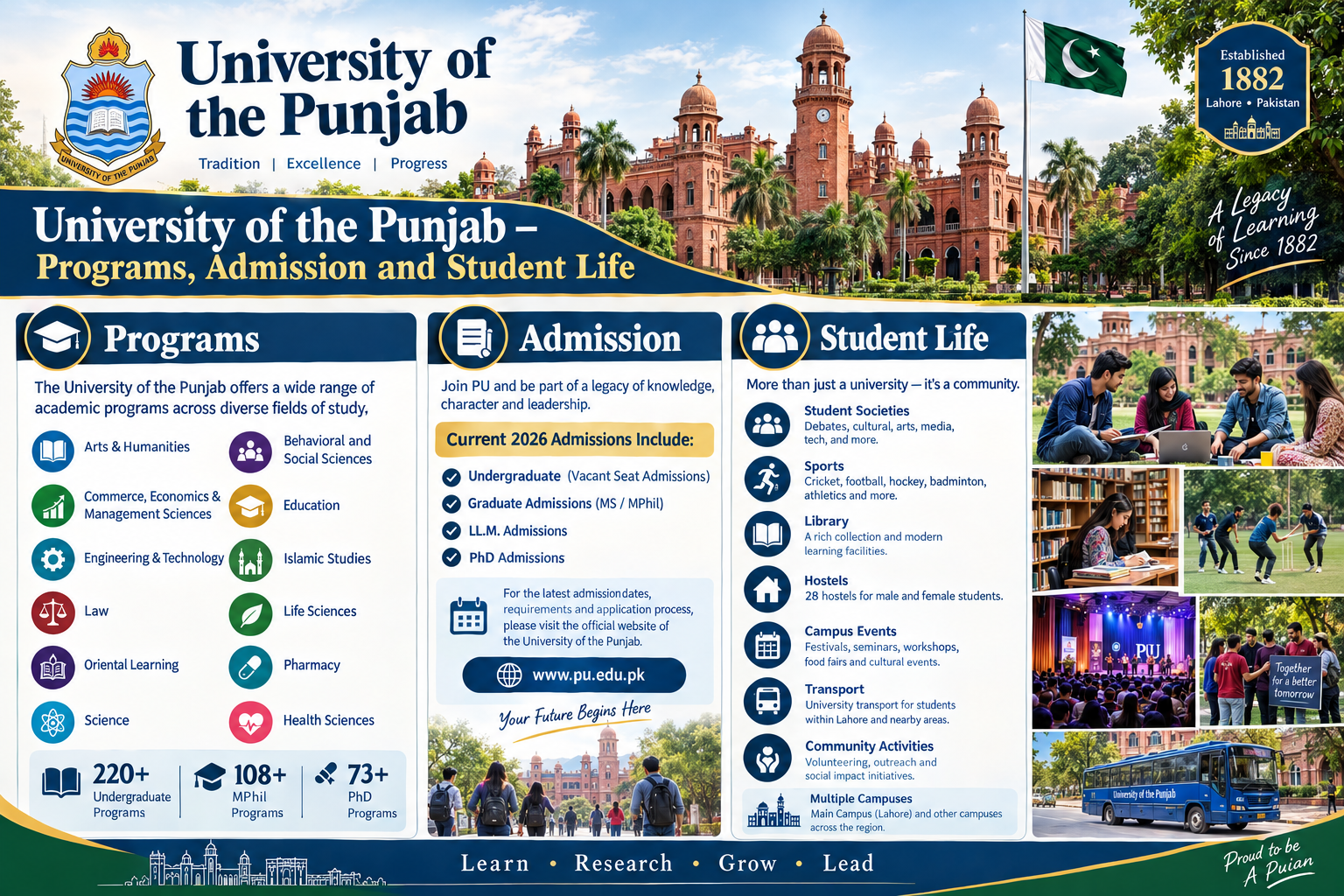
The University of the Punjab, commonly known as Punjab University or PU, is one of Pakistan's oldest and most important universities. Located in Lahore, the university has played a major role in the development of higher education, research, culture, science, law, humanities, social sciences, and professional education in Pakistan.
Founded in 1882, the University of the Punjab has a long academic history. It has educated generations of students who have gone on to contribute to Pakistan in government, education, science, business, law, medicine, literature, journalism, politics, technology, and many other fields.
The university is particularly important because of its broad range of academic programs. Unlike institutions that specialize mainly in one or two areas, Punjab University offers education across numerous disciplines. Students can study subjects ranging from natural sciences and engineering to business, law, languages, social sciences, arts, education, pharmacy, and information technology.
For Pakistani students searching for an established public-sector university, Punjab University remains an important option. Its long history, large academic community, extensive departments, research activities, libraries, campuses, and relatively accessible public-sector education model make it a significant part of Pakistan's higher education system.
History of the University of the Punjab
The University of the Punjab was established in 1882 during the British colonial period. It became the first major university established in the Punjab region.
The university was created to provide higher education opportunities and develop academic institutions in the region.
Over more than a century, the institution experienced significant changes.
The university's role expanded as the educational needs of the region developed. New faculties, departments, institutes, research centers, and professional programs were introduced over time.
After the creation of Pakistan in 1947, Punjab University became an important institution in the country's new higher education system.
It continued to expand its academic activities and became an important center for teaching and research.
Today, its historical significance remains one of its strongest characteristics.
Location of Punjab University
The University of the Punjab is located in Lahore, the capital of Punjab.
Lahore is one of Pakistan's largest cities and is widely known for its educational institutions, historical landmarks, cultural activities, businesses, and professional opportunities.
Punjab University's major campus is the Quaid-e-Azam Campus, commonly associated with the New Campus area.
The university also has the Allama Iqbal Campus, traditionally known as the Old Campus, in central Lahore.
Its presence across different parts of Lahore gives students access to a large urban environment.
The city also provides opportunities for internships, professional networking, cultural activities, research connections, and employment.
Academic Structure
Punjab University has a very broad academic structure.
Its faculties, departments, institutes, and centers cover a wide range of disciplines.
These include:
Arts and humanities
Social sciences
Natural sciences
Engineering and technology
Business and commerce
Law
Education
Pharmacy
Information technology
Languages
Islamic studies
Communication studies
Economics
Geography
Political science
Psychology
Sociology
Mathematics
Physics
Chemistry
Biological sciences
This diversity allows students from different academic backgrounds to find degree programs relevant to their interests.
Faculty of Arts and Humanities
Arts and humanities have a long history at Punjab University.
Students can study languages, literature, history, philosophy, Islamic studies, and other humanities-related subjects.
Humanities education is important because it helps students understand culture, history, language, ideas, and human society.
Pakistan has a rich literary and cultural history, and universities play an important role in preserving and studying this heritage.
Students who study humanities can pursue careers in education, research, writing, publishing, media, cultural organizations, civil services, and other sectors.
Social Sciences at Punjab University
Social sciences are another important part of Punjab University's academic system.
Subjects such as political science, sociology, psychology, economics, international relations, social work, and related fields help students understand society and institutions.
These subjects can be particularly useful for students interested in government, public policy, research, development organizations, education, journalism, and international affairs.
Social science research can also contribute to understanding Pakistan's economic and social challenges.
Faculty of Science
Punjab University has a strong tradition in natural sciences.
Students can study subjects such as physics, chemistry, mathematics, statistics, zoology, botany, environmental sciences, and other scientific disciplines.
Science education provides the foundation for research and technological development.
For example, mathematics supports computer science, engineering, economics, and data science.
Physics contributes to engineering, energy research, electronics, and modern technology.
Chemistry plays a role in pharmaceuticals, agriculture, manufacturing, environmental science, and many industries.
Biological sciences are important for healthcare, agriculture, biotechnology, and environmental research.
Engineering and Technology
Punjab University also provides opportunities in engineering and technology-related disciplines.
Modern economies require engineers and technology professionals to develop infrastructure, software, industrial systems, energy solutions, and new products.
Engineering education combines mathematics, science, technical knowledge, and practical problem-solving.
Students interested in engineering should carefully review the university's current programs and admission requirements because the availability and structure of programs can change.
Information Technology and Computer Science
Information technology has become one of the most important areas of modern education.
Punjab University provides programs and academic opportunities related to computing and information technology.
The demand for computer professionals has grown rapidly in Pakistan because businesses, banks, schools, government institutions, hospitals, and other organizations increasingly depend on digital systems.
Students interested in software development, databases, artificial intelligence, networking, data analysis, cybersecurity, and digital services can build useful foundations through computing education.
However, technology students should understand that university education is only the beginning.
Continuous learning is necessary because technologies change rapidly.
Business and Commerce
Business and commerce are also important academic fields at Punjab University.
Students can study areas such as accounting, finance, management, marketing, commerce, and economics.
These programs can prepare students for careers in banking, corporate organizations, accounting firms, government institutions, consulting, entrepreneurship, and business management.
Pakistan's economy depends on professionals who understand financial systems, markets, organizations, trade, and business operations.
Business education can therefore provide students with a wide range of career possibilities.
Law Education at Punjab University
Law has traditionally been an important field at Punjab University.
The university has educated many students who have entered legal practice, government service, academia, corporate organizations, and public policy.
Law students develop knowledge of legal systems, constitutional principles, civil and criminal law, legal research, and legal reasoning.
A legal education can lead to several career paths.
Graduates may become practicing lawyers, legal consultants, corporate legal professionals, researchers, teachers, or government officials, depending on their qualifications and career choices.
Students interested in law should carefully check current professional and regulatory requirements before selecting a program.
Pharmacy Education
Pharmacy is another important professional field.
Pharmacists play an important role in healthcare by understanding medicines, pharmaceutical products, drug safety, manufacturing, quality control, and related areas.
Pakistan's pharmaceutical industry also requires qualified professionals.
Students interested in pharmacy can explore academic programs that combine chemistry, biology, pharmacology, pharmaceutical sciences, and practical training.
Education and Teacher Training
Education is essential for Pakistan's long-term development.
Punjab University provides opportunities related to education and teacher training.
Teachers have a major influence on future generations.
Professional education programs can help teachers develop skills in teaching methods, educational psychology, curriculum development, assessment, classroom management, and educational leadership.
Improving the quality of teachers can have a direct impact on schools and students.
Research at Punjab University
Research is one of the important functions of a major university.
Punjab University has numerous departments and research centers working across different disciplines.
Research can address problems related to science, technology, economics, education, health, environment, culture, language, society, and public policy.
For Pakistan, local research is especially important because many challenges require solutions suited to the country's specific circumstances.
Research can also contribute to international academic knowledge.
Students interested in postgraduate education can benefit from learning research methods and participating in academic projects.
Importance of Libraries
Libraries are an essential part of university education.
Punjab University has library resources that support students and researchers.
A strong library allows students to access textbooks, academic journals, research papers, reference materials, historical documents, and other resources.
University students should not depend entirely on lecture notes.
Developing the habit of reading books and academic sources can improve understanding and critical thinking.
Research skills also become increasingly important at higher academic levels.
Student Life at Punjab University
University life is about more than attending lectures.
Punjab University provides students with opportunities to participate in societies, sports, cultural events, academic activities, seminars, debates, and other programs.
Student societies can help students meet people with similar interests.
For example, students interested in literature can participate in literary activities.
Students interested in debating can develop public-speaking skills.
Students interested in technology can participate in technical activities.
Students interested in social service can join volunteer initiatives.
These experiences can help students develop confidence and communication skills.
Sports at Punjab University
Sports are an important part of student life.
University sports can include activities such as cricket, football, hockey, athletics, badminton, basketball, volleyball, and other games.
Sports can teach discipline and teamwork.
They also provide students with an opportunity to take a break from academic work.
Participation in sports can help students develop leadership and cooperation skills that may later be useful in professional life.
Campus Diversity
Punjab University has a large and diverse student population.
Students come from different cities, districts, social backgrounds, and educational systems.
This diversity can be an important part of the university experience.
Students learn to communicate with people who may have different perspectives and experiences.
Such interaction can improve social skills and broaden students' understanding of Pakistan.
Admission to Punjab University
Admission requirements at Punjab University depend on the program.
Different degree programs can have different eligibility criteria, merit requirements, entrance tests, interviews, or other conditions.
Students should therefore identify the specific department and degree they want before applying.
Applicants should always consult the university's latest official admission information because deadlines, eligibility criteria, fees, merit lists, and admission procedures can change.
Students should prepare their academic documents carefully and keep track of important deadlines.
Merit and Competition
Popular programs at Punjab University can be highly competitive.
The number of applicants can be significantly higher than the available seats in certain programs.
Students should therefore focus on maintaining strong academic results.
Admission merit can depend on the specific program and applicable admission rules.
Students should not assume that admission requirements for one department are the same as those for another.
Affordability and Public-Sector Education
One reason many Pakistani students consider Punjab University is its public-sector status.
Public universities can provide comparatively accessible higher education opportunities for students from different economic backgrounds.
However, students still need to consider tuition fees, transportation, accommodation, books, technology, and other expenses.
Students who live outside Lahore may need to consider hostel or private accommodation costs.
Financial planning should therefore be part of the university decision.
Scholarships and Financial Assistance
Punjab University provides various scholarship and financial-support opportunities according to applicable policies.
Scholarships can help students continue their education when financial circumstances create difficulties.
Students should check the latest information about available scholarships, eligibility requirements, application procedures, and deadlines.
Financial assistance can be especially important for talented students from lower-income families.
Career Opportunities After Graduation
Punjab University graduates can pursue careers in a wide range of sectors.
Science graduates may enter research, education, laboratories, industry, environmental organizations, and related fields.
Business graduates can work in banking, finance, marketing, accounting, management, and entrepreneurship.
Law graduates can pursue legal practice and related careers.
Computer science graduates can enter software development, IT services, data analysis, cybersecurity, and technology.
Social science graduates can work in government, NGOs, research organizations, media, education, and corporate organizations.
Humanities graduates can pursue teaching, writing, research, publishing, cultural work, media, and public service.
The large number of academic disciplines gives graduates many possible directions.
Importance of Internships
Students should consider gaining practical experience before graduation.
Internships allow students to understand how professional organizations operate.
For example, a business student can experience corporate work.
A computer science student can work on software projects.
A media student can gain experience in journalism or communications.
A law student can gain exposure to legal offices and professional environments, subject to applicable rules.
Practical experience can make academic knowledge more meaningful.
Alumni of Punjab University
Punjab University has a large alumni community.
Its graduates have contributed to Pakistan in politics, government, education, science, literature, law, business, journalism, medicine, public service, and many other areas.
The university's long history means that generations of professionals have passed through its classrooms.
An established alumni network can provide opportunities for professional connections and mentorship.
However, students should remember that their own effort and skills remain central to career development.
Punjab University and Pakistani Culture
Punjab University has also contributed to Pakistan's intellectual and cultural life.
Its departments of languages, literature, history, Islamic studies, arts, and social sciences have supported academic research into Pakistan's culture and heritage.
Universities have an important responsibility to preserve historical knowledge while also preparing students for the future.
This balance between tradition and modern education is particularly important in Pakistan.
Role in National Development
Pakistan requires skilled graduates across many sectors.
The country needs scientists to conduct research.
Engineers are needed for infrastructure and industry.
Teachers are required to educate children.
Lawyers contribute to the legal system.
Economists help analyze financial and development issues.
Computer professionals support digital transformation.
Social scientists help understand social problems.
Punjab University contributes to this national need by educating students in a wide variety of fields.
Digital Education and Modern Learning
Modern university education is increasingly supported by digital technology.
Students now have access to online academic resources, digital libraries, learning platforms, research databases, and virtual communication tools.
Digital skills can improve academic performance and prepare students for modern careers.
Students at Punjab University can benefit from learning how to use reliable online resources, academic databases, presentation tools, research software, and collaboration platforms.
However, students should also learn how to distinguish reliable academic information from inaccurate online content.
Importance of English Skills
English remains important in Pakistani higher education.
Many textbooks, research papers, academic journals, professional documents, and international resources are written in English.
Students who improve their English reading and writing skills can access a much wider range of educational resources.
This does not mean students need perfect English before entering university.
Instead, they can gradually improve their vocabulary, grammar, writing, speaking, and academic communication.
Skills Students Should Develop
A university degree is important, but students should also develop practical skills.
Communication skills are essential.
Critical thinking helps students analyze information.
Problem-solving helps them deal with real-world challenges.
Teamwork is important because many professional projects involve groups.
Digital literacy is increasingly necessary.
Time management helps students balance classes, assignments, exams, activities, and personal responsibilities.
These skills can make graduates more prepared for employment.
Challenges Students May Face
Studying at a large public university can also involve challenges.
Large student populations may mean that students need to become more independent.
Academic workloads can be demanding.
Students may have to manage multiple courses and assignments.
Those living away from home may need to adapt to hostel life.
Transportation can also be a concern for students commuting from different parts of Lahore.
Students can overcome many of these challenges by planning ahead and developing good study habits.
How to Succeed at Punjab University
Students can make their university experience more successful by attending classes regularly, completing assignments on time, reading beyond textbooks, asking questions, and participating in useful activities.
They should also build positive relationships with teachers and classmates.
Students should look for internships, research projects, competitions, and volunteer opportunities.
Career planning should begin early rather than waiting until graduation.
Students should also develop skills outside their degree.
For example, a science student can learn communication and data analysis.
A business student can learn digital marketing or basic programming.
A humanities student can develop research and digital communication skills.
These combinations can make graduates more versatile.
Why Punjab University Remains Important
The University of the Punjab has survived and developed across more than a century of major historical change.
Its longevity is one of its most important characteristics.
The university has educated generations of Pakistanis and continues to provide opportunities to students from different regions and backgrounds.
Its broad academic structure makes it different from specialized universities.
Students can study traditional disciplines while also exploring modern fields.
Its public-sector character also makes it an important part of Pakistan's accessible higher education system.
Future of Punjab University
The future of Punjab University will depend on its ability to respond to changing educational and professional needs.
Technology is transforming higher education.
Artificial intelligence, data science, digital learning, biotechnology, renewable energy, climate research, and other emerging fields are becoming increasingly important.
Universities need to update curricula, expand research, develop laboratories, improve digital resources, and strengthen connections with industry.
Punjab University has a large academic base that can support this transformation.
The university can also contribute to Pakistan's future by encouraging entrepreneurship and interdisciplinary research.
Conclusion
The University of the Punjab is one of the most historically significant universities in Pakistan.
Founded in 1882, it has played an important role in the development of higher education in the region and has educated generations of students.
Its wide range of academic programs allows students to pursue careers in science, technology, business, law, education, social sciences, humanities, pharmacy, information technology, and many other fields.
Punjab University's large academic community, research activities, libraries, student societies, sports opportunities, and public-sector education model make it an important choice for Pakistani students.
However, choosing a university should always be a personal decision based on academic interests, career goals, finances, location, and the quality of the specific program.
Students who choose Punjab University should make full use of the opportunities available to them.
They should focus on their studies while also developing communication, digital, research, teamwork, and professional skills.
They should seek internships and practical experience and remain open to new areas of learning.
Pakistan's future depends on educated and skilled young people. Universities have a major responsibility in preparing those young people for national and global challenges.
With its long history and broad academic structure, the University of the Punjab continues to hold an important position in Pakistan's educational landscape.
For students looking for a well-established public university in Lahore, Punjab University remains a significant institution to consider.
FAQs
1. When was the University of the Punjab established?
The University of the Punjab was established in 1882 and is one of the oldest major universities in Pakistan.
2. Where is Punjab University located?
The university is based in Lahore, Punjab, with major campuses including the Quaid-e-Azam Campus and Allama Iqbal Campus.
3. What subjects can students study at Punjab University?
Students can study a wide range of subjects, including science, engineering, information technology, business, law, pharmacy, education, humanities and social sciences.
4. Is Punjab University a public university?
Yes. The University of the Punjab is a public-sector university in Pakistan.
5. Does Punjab University offer scholarships?
Yes. The university offers various scholarship and financial-support opportunities according to applicable eligibility criteria and policies.