Introduction
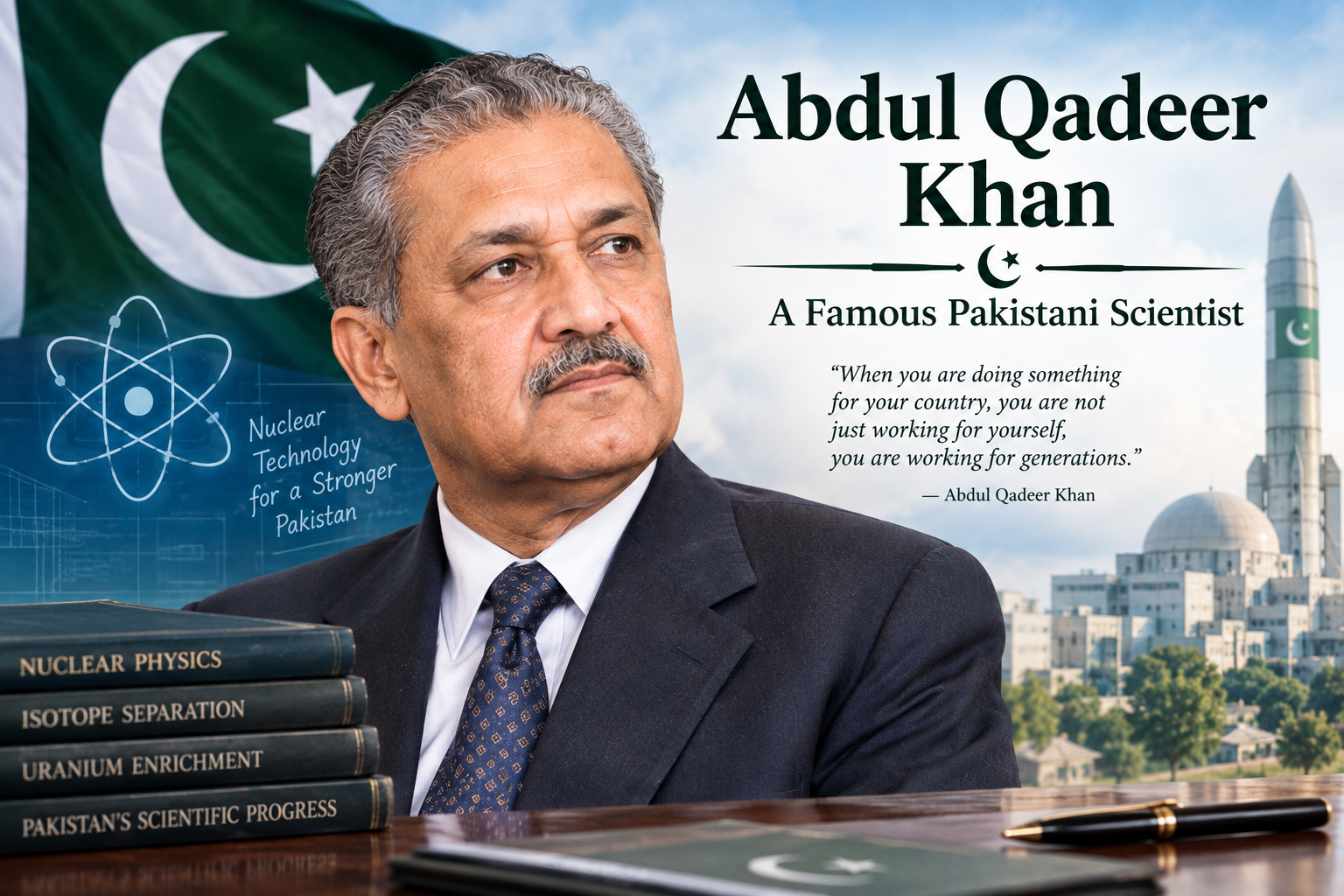
Abdul Qadeer Khan was a well-known Pakistani scientist who became one of the most recognized names in Pakistan's scientific history. He was closely associated with Pakistan's nuclear programme and became internationally known for his scientific and engineering work.
He was born in Bhopal, India, in 1936. After the partition of the subcontinent in 1947, he moved to Pakistan with his family. He later studied science and engineering and developed a career in metallurgy and scientific research.
Abdul Qadeer Khan is remembered in Pakistan for his contribution to the country's nuclear development. He also became involved in education and social welfare activities later in his life.
His life included both major achievements and serious international controversy. In the early 2000s, he became the subject of an international nuclear-proliferation investigation and publicly accepted responsibility for unauthorized proliferation activities. These events became an important part of his historical record.
Therefore, studying Abdul Qadeer Khan's life requires looking at both his scientific contribution and the controversies surrounding his career.
Early Life
Abdul Qadeer Khan was born in Bhopal in 1936. His family moved to Pakistan after the partition of British India in 1947.
After arriving in Pakistan, he continued his education and developed an interest in science.
The early years of his life were important because education later became the foundation of his scientific career.
He grew up during a period when Pakistan was a newly created country. The country needed trained scientists, engineers, teachers, doctors, and other professionals to build its institutions.
Khan became one of the scientists whose professional career was later connected with Pakistan's scientific and technological development.
Education in Pakistan
Abdul Qadeer Khan studied at the University of Karachi and completed a science degree in 1960. After that, he continued his education abroad.
His studies eventually focused on metallurgical engineering.
Metallurgy is the branch of engineering and science concerned with metals, their properties, processing, and uses.
This field provided Khan with a strong technical background.
His education also exposed him to advanced scientific research outside Pakistan.
Higher Education in Europe
After completing his studies in Pakistan, Khan continued his education in Europe.
He studied in Germany, the Netherlands, and Belgium. He became associated with universities including the Technical University of Berlin and the Catholic University of Leuven.
His European education helped him develop advanced knowledge in metallurgy and engineering.
Studying abroad also gave him experience of international scientific institutions.
This part of his life shows the value of higher education and international academic experience.
Students who want to become scientists often need strong foundations in mathematics, physics, chemistry, engineering, and research methods.
Khan's academic journey demonstrates how education can take a student from a local university to international research environments.
Metallurgical Engineering
Metallurgical engineering was an important part of Khan's scientific background.
Metallurgy has many peaceful applications. It is used in industries such as construction, transportation, manufacturing, energy, and engineering.
Scientists and engineers working in this field study how materials behave and how their properties can be improved for different purposes.
Khan's training in metallurgy became relevant to his later scientific work.
His technical education helped him develop a career that eventually connected him with major scientific projects.
Scientific Career in Europe
Before returning to Pakistan, Khan worked in Europe.
He became associated with a Dutch engineering company and gained professional experience in a field related to advanced industrial research.
His work in Europe gave him exposure to international engineering practices and scientific technologies.
His professional experience became important when he later returned to Pakistan.
This part of his career also demonstrates the role of international experience in developing scientific skills.
Return to Pakistan
Khan returned to Pakistan in the 1970s.
His return took place during an important period in Pakistan's scientific and political history.
Following India's 1974 nuclear test, Pakistan increased its efforts to develop its own nuclear capabilities.
Khan joined Pakistan's nuclear programme and became closely associated with uranium enrichment research and development.
Because nuclear technology is a sensitive subject, the technical methods involved are not the focus of this article.
Instead, his historical role can be understood through his scientific leadership, organizational work, and contribution to Pakistan's nuclear programme.
Khan Research Laboratories
One of the most important institutions associated with Abdul Qadeer Khan was Khan Research Laboratories (KRL).
The organization was established in 1976, and Khan served as its chief scientist and director for many years.
KRL became an important scientific and research institution in Pakistan.
The organization brought together scientists, engineers, technicians, and other professionals.
Scientific institutions require teamwork. A major research programme cannot normally depend on one individual alone.
Khan worked with many other Pakistani scientists and engineers during his career.
Scientific Leadership
Scientific leadership involves more than personal knowledge.
A scientific leader must work with teams, organize research, solve difficult problems, and help develop institutions.
Khan became an important scientific leader at KRL.
His work involved managing scientific and engineering teams and supporting Pakistan's broader nuclear programme.
His career therefore included both scientific and organizational responsibilities.
Pakistan's Nuclear Development
Pakistan's nuclear development involved many scientists, engineers, government officials, and institutions.
Abdul Qadeer Khan became one of the most publicly recognized figures associated with this history.
It is important to remember that Pakistan's nuclear programme was not the work of one individual alone.
Other scientists and institutions also played important roles. Recent historical discussion has highlighted the contributions of scientists such as Munir Ahmad Khan, Riazuddin, Fayyazuddin, and others.
This broader view helps provide a more complete understanding of Pakistan's scientific history.
1998 Nuclear Tests
Pakistan conducted nuclear tests in May 1998 after India conducted its own tests earlier that month.
The tests became a major historical event in Pakistan.
Abdul Qadeer Khan was one of the scientists publicly associated with Pakistan's nuclear programme.
His name became even more well known across Pakistan after the 1998 tests.
The event had major political, security, and international consequences.
Because nuclear weapons are dangerous and highly regulated, the scientific details of their construction are not appropriate for this article. The important historical point is that Khan became a major public figure connected with Pakistan's nuclear development.
Recognition in Pakistan
Abdul Qadeer Khan received important national awards for his services.
He was awarded the Hilal-i-Imtiaz in 1989 and later received the Nishan-i-Imtiaz. He received the Nishan-i-Imtiaz again in 1999.
These awards reflected the recognition he received from the Pakistani state for his scientific contributions.
He became a highly recognizable public personality.
For many Pakistanis, his name became closely associated with national scientific achievement.
Scientific Publications
Khan also wrote and contributed to scientific publications.
His published work included subjects connected with metallurgy and engineering.
One of his early books was related to physical metallurgy, while later publications covered metallurgical thermodynamics and kinetics.
Scientific writing is an important part of a researcher's career.
Scientists use research papers and books to share knowledge with other researchers and students.
Writing also allows scientific ideas to remain available for future generations.
Interest in Education
Education became an important part of Khan's activities beyond scientific research.
He supported educational institutions and encouraged students to study science.
According to reporting after his death, he and his wife were involved in education and social welfare projects, including institutions in different parts of Pakistan.
This side of his life is important because scientific progress depends on education.
A country needs schools, colleges, universities, teachers, laboratories, and research opportunities to develop a strong scientific community.
Social Welfare Work
Abdul Qadeer Khan was also associated with social welfare activities.
Reports after his death described his involvement in education and welfare institutions across Pakistan.
Social welfare can include supporting schools, educational institutions, community projects, and people who need assistance.
These activities showed another side of his public life.
Although he was mainly known for science, he also became involved in projects outside his scientific career.
Interest in Students
Khan had an interest in educational opportunities for young people.
Students are important for the future of science.
Every scientist eventually depends on the next generation to continue research and education.
Providing students with opportunities to study can help a country develop its scientific and technological capacity.
This is particularly important for developing countries where resources for advanced education may be limited.
Science and National Development
Scientists can play an important role in national development.
Science supports many fields, including medicine, agriculture, communication, engineering, environmental research, and technology.
A country with strong scientific institutions can develop new technologies and train skilled professionals.
Abdul Qadeer Khan's career became part of Pakistan's broader effort to develop advanced scientific capabilities.
His story therefore provides an opportunity to understand the importance of science and education in national development.
Public Recognition
Abdul Qadeer Khan became a highly recognizable public figure.
His name was frequently discussed in Pakistani media.
People knew him not only as a scientist but also as a public personality.
His public recognition increased after the 1998 nuclear tests.
However, his public image later became more complicated because of the international proliferation controversy.
International Controversy
One of the most important and controversial parts of Abdul Qadeer Khan's life was the international nuclear-proliferation investigation.
In the early 2000s, allegations emerged that nuclear technology and related information had been transferred to other countries.
In February 2004, Khan publicly accepted responsibility for proliferation activities and sought clemency from the Pakistani government. Contemporary reporting stated that he accepted responsibility for activities conducted while he was at the helm of KRL.
This became a major international controversy.
It affected his reputation outside Pakistan and became an important part of discussions about nuclear proliferation.
House Detention
Following the 2004 events, Khan was placed under house detention.
He remained under restrictions for several years.
In 2009, a court ended his formal house arrest, although security restrictions continued to affect his movements.
The legal and political developments surrounding his case became an important part of his later life.
This period demonstrated how scientific careers can sometimes become connected with international security and political issues.
A Complex Historical Figure
Abdul Qadeer Khan's life cannot be understood through one achievement alone.
He was a scientist and engineer, a scientific administrator, an education supporter, and a controversial public figure.
His contribution to Pakistan's scientific development is widely discussed.
At the same time, his involvement in the proliferation controversy is an established part of his public record.
A balanced study of his life should include both sides.
Importance of Scientific Ethics
The controversy surrounding Khan's career also raises broader questions about scientific ethics.
Scientists work with knowledge that can have both peaceful and harmful applications.
Modern science requires researchers to understand their responsibilities.
Scientific knowledge can be used for medicine, energy, agriculture, and industry, but some technologies can also create serious risks.
For this reason, scientists and institutions need strong ethical standards and responsible systems.
Students studying science can learn from history by understanding that scientific knowledge comes with responsibility.
Science and Responsibility
A scientist's responsibility does not end with research.
Researchers should consider how their work may affect society.
This is especially important when scientific knowledge relates to technologies with serious security or safety implications.
Abdul Qadeer Khan's career became part of this wider discussion.
His story shows that scientific achievement and scientific responsibility are closely connected.
Contribution to Education
Despite the controversies surrounding his career, Khan's connection with education remained part of his public life.
Educational institutions associated with his name were established in different parts of Pakistan.
Supporting education can create long-term benefits because students become teachers, professionals, researchers, and community leaders.
Science education is particularly important for countries seeking technological development.
Abdul Qadeer Khan and Young People
Young students can learn several general lessons from his life.
The first lesson is the importance of education.
Khan studied in Pakistan and abroad and developed advanced technical knowledge.
The second lesson is the value of specialization.
He developed expertise in metallurgy and engineering.
The third lesson is the importance of research.
Scientific progress requires people who are willing to study difficult problems.
The fourth lesson is responsibility.
Scientific knowledge must be handled carefully and ethically.
Importance of Research
Research is the foundation of scientific progress.
Scientists ask questions, study evidence, test ideas, and communicate their findings.
A country that invests in research can develop knowledge and train future scientists.
Abdul Qadeer Khan's career shows how research institutions can become important parts of national scientific development.
Khan Research Laboratories became one of the most recognizable scientific institutions associated with Pakistan's nuclear programme.
Importance of Teamwork
Scientific achievements are rarely the result of one person working alone.
Large research projects require teams.
Scientists, engineers, technicians, administrators, and other professionals can all contribute.
Pakistan's nuclear programme involved many individuals and institutions.
While Abdul Qadeer Khan became its most publicly recognized scientific figures, other scientists also played important roles.
This is an important lesson for students: success in science often depends on cooperation.
International Education
Khan's education in Europe was an important part of his scientific development.
International education can expose students to different academic systems, research methods, laboratories, and scientific communities.
Today, many Pakistani students study abroad and later bring knowledge and experience back to Pakistan.
Khan's educational journey is one historical example of this process.
Later Years
In his later years, Abdul Qadeer Khan remained a well-known public figure in Pakistan.
He wrote about science and education and continued to take an interest in national issues.
He also became involved in educational and welfare activities.
Even after leaving active scientific leadership, his name remained closely connected with Pakistan's scientific history.
Death
Abdul Qadeer Khan died in Islamabad on 10 October 2021, at the age of 85. He was given a state funeral at Faisal Mosque and was later buried at the H-8 graveyard in Islamabad.
His death received widespread attention in Pakistan.
Government officials, politicians, scientists, and members of the public expressed condolences.
His passing marked the end of the life of one of Pakistan's most internationally recognized scientists.
Legacy
Abdul Qadeer Khan left a complicated but important legacy.
In Pakistan, he is strongly associated with the country's nuclear development and scientific history.
He is also remembered for his educational and welfare activities.
Internationally, his name is connected with the nuclear-proliferation controversy of the early 2000s.
His legacy therefore includes scientific achievements, institution building, education, public recognition, and controversy.
Importance of His Life for Students
Students can study Abdul Qadeer Khan's life to understand several important ideas.
Education can create opportunities.
Scientific research can contribute to national development.
International experience can expand knowledge.
Teamwork is essential for major scientific projects.
Most importantly, scientific knowledge must be accompanied by responsibility.
These lessons are useful for students regardless of the scientific field they choose.
Science in Modern Pakistan
Pakistan continues to need scientists and researchers in many fields.
Young people can contribute to areas such as computer science, artificial intelligence, medicine, agriculture, environmental science, physics, chemistry, engineering, and biotechnology.
The country needs universities and research institutions that provide students with modern education.
The story of scientists such as Abdul Qadeer Khan can encourage students to take science seriously.
At the same time, students should understand that scientific success involves both knowledge and ethical responsibility.
Conclusion
Abdul Qadeer Khan was one of the most recognized scientists in Pakistan's history.
Born in Bhopal in 1936, he moved to Pakistan after partition and developed his scientific career through education in Pakistan and Europe.
His field was metallurgical engineering, and his professional experience later became connected with Pakistan's nuclear programme.
He became closely associated with Khan Research Laboratories and was an important scientific figure during Pakistan's nuclear development.
He received major national awards and became a well-known public figure.
His life also included serious international controversy. In 2004, he publicly accepted responsibility for nuclear-proliferation activities, and the resulting events remained an important part of his historical record.
Beyond science, he supported educational and welfare activities and remained interested in the development of students and institutions.
He died in Islamabad on 10 October 2021.
Abdul Qadeer Khan's life provides a complex example of the relationship between science, national development, education, international politics, and scientific responsibility.
For students, his story offers an important lesson: scientific knowledge is powerful, and it should always be combined with education, responsibility, ethics, and careful judgment.
FAQs
1. Who was Abdul Qadeer Khan?
Abdul Qadeer Khan was a Pakistani scientist and metallurgical engineer who became closely associated with Pakistan's nuclear programme.
2. Where was Abdul Qadeer Khan born?
He was born in Bhopal, India, in 1936 and moved to Pakistan after the 1947 partition.
3. What was Abdul Qadeer Khan's field?
His academic and professional background was in science, metallurgy, and engineering.
4. When did Abdul Qadeer Khan die?
He died in Islamabad on 10 October 2021, at the age of 85.
5. What is Abdul Qadeer Khan remembered for?
He is primarily remembered for his association with Pakistan's nuclear programme, as well as his educational and welfare activities and the international proliferation controversy connected with his career.




