Introduction
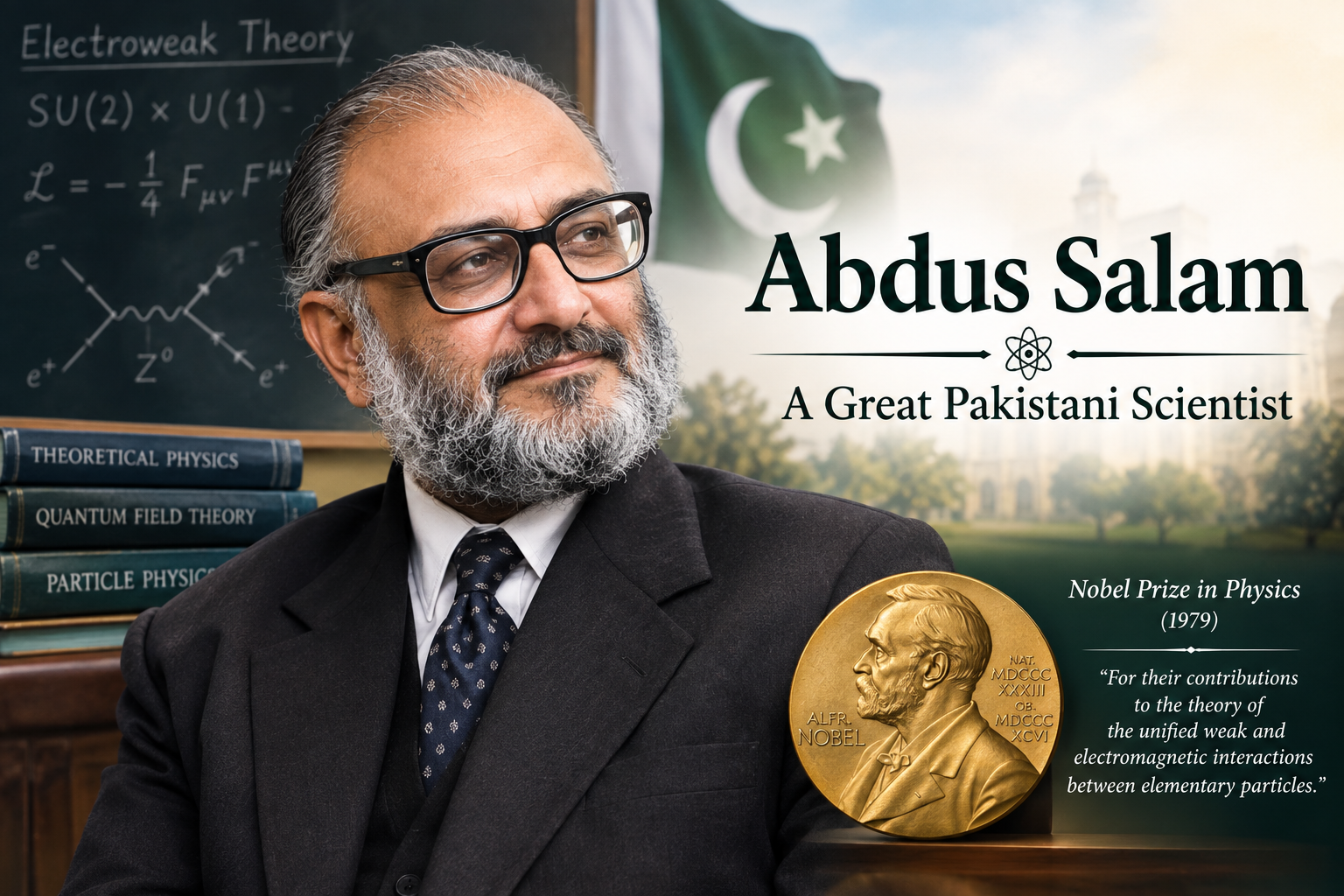
Abdus Salam was one of the most famous scientists from Pakistan. He was a brilliant physicist whose work made an important contribution to modern science. He became the first Pakistani and the first Muslim scientist to receive a Nobel Prize in a scientific field.
Abdus Salam was born on 29 January 1926 in Jhang, Punjab, which was then part of British India. From a young age, he showed an exceptional interest in learning and mathematics. His teachers and family recognized his abilities, and he worked very hard in his studies.
His main field was theoretical physics. He worked on some of the most important questions in modern physics, especially the relationship between electromagnetic forces and the weak nuclear force. His scientific work later became part of what is known as the electroweak theory.
In 1979, Abdus Salam shared the Nobel Prize in Physics with Sheldon Glashow and Steven Weinberg. The Nobel Prize recognized their work concerning the unified theory of the weak and electromagnetic interaction between elementary particles.
His story is not only about a Nobel Prize. It is also about education, hard work, scientific curiosity, international cooperation, and his efforts to encourage young people from developing countries to study science.
Early Life
Abdus Salam was born in Jhang on 29 January 1926. His father, Muhammad Hussain, worked in the education department and belonged to a family that valued learning.
Salam grew up in an environment where education was highly respected. As a student, he quickly became known for his strong ability in mathematics.
He was a very hardworking student. His early academic achievements showed that he had an unusual talent for understanding difficult mathematical ideas.
At a young age, he developed a strong interest in numbers and scientific questions. Mathematics later became an important foundation for his work in theoretical physics.
His early life is an example of how education can help a talented student develop his abilities.
Education
Education played a central role in Abdus Salam's life.
He studied at Government College University Lahore, where he completed his studies in mathematics and physics. His academic performance was outstanding.
After completing his education in Pakistan, he went to the University of Cambridge in the United Kingdom. There, he continued his studies in mathematics and physics.
At Cambridge, he received advanced training in theoretical physics.
His education gave him the opportunity to study modern scientific theories and work with other talented researchers.
The combination of strong mathematical skills and deep interest in physics helped him become a leading theoretical physicist.
Interest in Physics
Physics tries to explain how the natural world works.
Scientists study everything from very small particles to huge stars and galaxies.
Abdus Salam was particularly interested in the fundamental laws that control matter and energy.
Instead of working mainly in laboratories, he worked with mathematical theories and ideas. This type of physics is called theoretical physics.
Theoretical physicists use mathematics to develop models that can explain observations and predict new results.
Salam's work involved some of the most difficult questions in particle physics.
Theoretical Physics
Theoretical physics was the main field of Abdus Salam's scientific career.
He studied elementary particles and the forces that act between them.
Scientists know that nature contains different fundamental forces. Two of these are the electromagnetic force and the weak nuclear force.
Electromagnetism is responsible for many familiar phenomena, including electricity, magnetism, and light.
The weak nuclear force plays an important role in processes involving radioactive decay and particle interactions.
For many years, scientists studied these forces separately.
Salam's work helped show that the electromagnetic force and weak nuclear force could be understood as different aspects of a more unified theory.
Electroweak Theory
One of Abdus Salam's greatest scientific contributions was his work on the electroweak theory.
Salam independently developed important parts of this theory alongside other scientists, especially Sheldon Glashow and Steven Weinberg.
The theory showed that electromagnetic and weak interactions are closely connected.
At very high energies, these interactions can be described within a unified framework.
This was a major development in particle physics.
The theory also helped scientists understand why some particles have mass while others behave differently.
Later experiments provided important evidence supporting the theory.
Nobel Prize
In 1979, Abdus Salam received the Nobel Prize in Physics.
He shared the prize with Sheldon Glashow and Steven Weinberg.
The Nobel Prize recognized their contributions to the theory of the unified weak and electromagnetic interaction between elementary particles.
This was a historic achievement.
Salam became the first Pakistani Nobel laureate and the first Muslim Nobel laureate in science.
His achievement brought international attention to Pakistan and demonstrated that scientists from developing countries could make major contributions to modern science.
Importance of the Nobel Prize
The Nobel Prize was important not only for Abdus Salam but also for Pakistan.
At a time when many people from developing countries faced limited opportunities in advanced scientific research, Salam showed what could be achieved through education and determination.
His success inspired many students in Pakistan and other Muslim-majority countries.
He became a symbol of scientific achievement and academic excellence.
His Nobel Prize also helped bring greater international attention to the importance of scientific education in developing countries.
Scientific Research
Salam published many scientific papers during his career.
His research covered theoretical physics, particle physics, quantum theory, and other areas of modern science.
Scientific research requires careful thinking and mathematical understanding.
Researchers often spend years studying one difficult problem before reaching a useful result.
Salam's career demonstrates the importance of patience in scientific work.
His ideas became part of the development of modern particle physics.
Work at Universities
Abdus Salam worked at several major universities and research institutions.
He became a professor at Imperial College London, where he worked for many years.
Imperial College provided him with an important environment for research and teaching.
He also supervised and encouraged students from different parts of the world.
Teaching was an important part of his scientific life.
He believed that talented young people needed opportunities to learn and conduct research.
Teacher and Mentor
Abdus Salam was not only a researcher. He was also a teacher and mentor.
He believed that young scientists could make important contributions if they received proper education and opportunities.
As a professor, he worked with students and researchers from many countries.
He encouraged them to ask questions, study deeply, and take part in international scientific research.
His approach showed that science grows when knowledge is shared.
International Scientific Cooperation
Science is an international activity.
Scientists from different countries often work together to solve difficult problems.
Abdus Salam strongly supported international scientific cooperation.
He believed that developing countries should have greater access to scientific knowledge, laboratories, research opportunities, and international networks.
His own career demonstrated the benefits of international cooperation.
He studied in Pakistan and the United Kingdom and worked with scientists from many countries.
International Centre for Theoretical Physics
One of Salam's most important contributions outside his research was the creation of the International Centre for Theoretical Physics (ICTP) in Trieste, Italy.
The centre was established in 1964 with support from UNESCO and the International Atomic Energy Agency.
Salam played a major role in developing the centre.
His goal was to provide scientists from developing countries with opportunities to study, conduct research, and communicate with scientists from around the world.
The centre became an important international institution for theoretical physics and related sciences.
Supporting Developing Countries
Salam understood the difficulties faced by scientists in developing countries.
Many talented students do not have access to advanced laboratories, research libraries, scholarships, or international scientific networks.
He wanted to reduce these barriers.
Through the ICTP and his other activities, he supported scientific education and international research opportunities.
His efforts helped create connections between scientists from developing countries and the wider scientific community.
Science and Development
Abdus Salam believed that science was important for the development of nations.
Modern countries depend on science and technology in areas such as medicine, agriculture, energy, communications, engineering, and industry.
Without strong scientific education, developing countries can face difficulties in building modern economies.
Salam therefore encouraged countries to invest in universities, research institutions, and young scientists.
His message remains relevant because science continues to play an important role in economic and technological development.
Importance of Mathematics
Mathematics was an important part of Abdus Salam's scientific thinking.
Theoretical physics depends heavily on mathematics.
Mathematical equations allow scientists to describe physical systems and develop predictions.
Salam's early talent in mathematics helped him understand advanced physics.
His life shows students that mathematics is not only a school subject. It can also be a powerful tool for understanding nature.
Students who are interested in physics can benefit from developing strong mathematical skills.
Interest in Young Scientists
Salam had a strong interest in young researchers.
He believed that talented students from countries with fewer scientific resources should receive opportunities to develop their skills.
He encouraged young scientists to travel, study, attend scientific meetings, and work with international researchers.
This approach helped many researchers build international connections.
His work demonstrated that supporting students can have benefits far beyond one person's career.
Scientific Excellence
Abdus Salam's career is an example of scientific excellence.
He achieved international recognition because of the quality and importance of his research.
However, his success was not achieved overnight.
It developed through years of education, research, teaching, writing, and collaboration.
His story teaches students that major achievements usually require long-term effort.
A Role Model for Students
Students can learn many useful lessons from Abdus Salam.
The first lesson is hard work.
Talent is important, but talent needs regular effort.
The second lesson is curiosity.
Scientists ask questions about how and why things happen.
The third lesson is education.
Strong education can open opportunities.
The fourth lesson is patience.
Scientific discoveries often require years of research.
The fifth lesson is sharing knowledge.
Salam worked to provide scientific opportunities to people from different countries.
Contribution to Pakistan
Abdus Salam remained connected with Pakistan throughout his life.
He was interested in the development of science and technology in his country.
He encouraged Pakistan to develop strong scientific institutions and provide opportunities for talented students.
His achievements demonstrated that Pakistan could produce scientists capable of making internationally important contributions.
His Nobel Prize remains one of the most important achievements in Pakistan's scientific history.
Nuclear Science and Pakistan
Salam's name is sometimes discussed in connection with Pakistan's broader scientific development.
He served as a scientific adviser to the Government of Pakistan for several years.
During this period, he was involved in discussions about science and technology.
His role demonstrated his interest in strengthening scientific research in Pakistan.
However, his greatest internationally recognized scientific achievement remained his work in theoretical particle physics.
Science Education
Salam believed that scientific education should be available to talented students.
A country cannot develop a strong scientific system without educated researchers and teachers.
Schools provide the foundation, while universities and research institutions provide advanced training.
Scholarships and international collaboration can provide additional opportunities.
Salam worked throughout his career to expand such opportunities for scientists from developing countries.
Global Recognition
Although Abdus Salam was from Pakistan, his scientific work had a global impact.
His research was studied by physicists around the world.
His Nobel Prize placed him among the most recognized scientists of the twentieth century.
The institutions he helped develop also created opportunities for researchers from many countries.
His legacy therefore extends beyond one country.
Personal Qualities
Abdus Salam is remembered for his dedication to science and education.
He had a strong work ethic and deep intellectual curiosity.
He believed that scientific knowledge should benefit humanity.
He also believed that talented people should have opportunities regardless of where they were born.
These ideas influenced his work as a scientist, teacher, and institution builder.
Later Life
Abdus Salam continued his scientific and educational work for many years.
Even after receiving the Nobel Prize, he remained active in research and international scientific activities.
He continued to support young scientists and developing countries.
His later years were affected by health problems, but his scientific legacy continued to grow.
He died on 21 November 1996 in Oxford, United Kingdom, at the age of 70.
His death was widely remembered by the international scientific community.
Legacy
Abdus Salam left a powerful scientific legacy.
His work became part of the Standard Model of particle physics.
The electroweak theory helped scientists understand the relationship between two fundamental interactions.
The International Centre for Theoretical Physics also remains an important part of his legacy.
His influence can therefore be seen in both scientific research and scientific education.
Abdus Salam and the Future of Science
Salam's ideas about science remain relevant today.
Modern challenges such as climate change, energy needs, disease, artificial intelligence, space exploration, and advanced technology require scientific knowledge.
Developing countries need strong educational systems to participate in these areas.
Salam's emphasis on international cooperation can also be important.
Scientific problems often cross national borders, so researchers need to share knowledge and work together.
Inspiration for Pakistan
For Pakistan, Abdus Salam remains an important example of scientific achievement.
His life demonstrates that Pakistani students can succeed in highly competitive international fields.
His story can encourage students to study mathematics, physics, chemistry, computer science, engineering, and other scientific subjects.
Young people do not need to limit their ambitions because of their background.
With education, determination, and opportunities, talented students can contribute to global knowledge.
Conclusion
Abdus Salam was one of the greatest scientists associated with Pakistan.
Born in Jhang in 1926, he developed an early interest in mathematics and science. His academic journey took him from Pakistan to the University of Cambridge, where he developed his expertise in theoretical physics.
His most famous scientific contribution was his work on the electroweak theory, which helped unite the description of electromagnetic and weak interactions.
In 1979, he received the Nobel Prize in Physics together with Sheldon Glashow and Steven Weinberg. This made him the first Pakistani Nobel laureate and the first Muslim scientist to receive a Nobel Prize in a scientific field.
His contribution was not limited to physics. He worked to improve scientific opportunities for researchers from developing countries and played a major role in establishing the International Centre for Theoretical Physics in Trieste.
His life teaches the importance of education, hard work, curiosity, research, international cooperation, and support for young scientists.
Abdus Salam died in 1996, but his scientific ideas and educational vision continue to influence people around the world.
His story remains an important part of Pakistan's scientific history and an inspiration for students who dream of contributing to science.
FAQs
1. Who was Abdus Salam?
Abdus Salam was a Pakistani theoretical physicist who received the Nobel Prize in Physics in 1979.
2. What did Abdus Salam win the Nobel Prize for?
He shared the 1979 Nobel Prize in Physics for important work on the unified theory of the weak and electromagnetic interactions.
3. Where was Abdus Salam born?
Abdus Salam was born in Jhang, Punjab, in 1926.
4. What was Abdus Salam's main field?
His main field was theoretical physics, especially particle physics.
5. Why is Abdus Salam important for Pakistan?
He was Pakistan's first Nobel laureate and became an international example of Pakistani scientific achievement. He also worked to expand scientific opportunities for researchers from developing countries.