Introduction
Agriculture remains one of the most important sectors of Pakistan's economy. It provides food for millions of people, supports rural communities, supplies raw materials to industries, and contributes to employment, exports, and overall economic activity. From wheat, rice, sugarcane, cotton, and maize to fruits, vegetables, livestock, and fisheries, agriculture affects almost every part of daily life in Pakistan.
The sector is now receiving renewed attention as Pakistan works to strengthen food security, improve farm productivity, support farmers, modernize agricultural practices, and increase the value of agricultural exports. The need for reform has become increasingly important because farmers face several challenges, including changing weather patterns, water shortages, rising input costs, limited access to modern technology, storage problems, market inefficiencies, and difficulties in obtaining affordable financing.
Agriculture also has an important connection with Pakistan's industrial sector. Cotton supports the textile industry, sugarcane supports sugar production, wheat supports the flour and food industries, while fruits and vegetables provide raw materials for processing and export businesses. Improvements in agriculture can therefore create benefits throughout the wider economy.
Pakistan has significant agricultural potential because of its fertile land, diverse climate, irrigation networks, large rural population, and experience in farming. However, achieving this potential requires modernization.
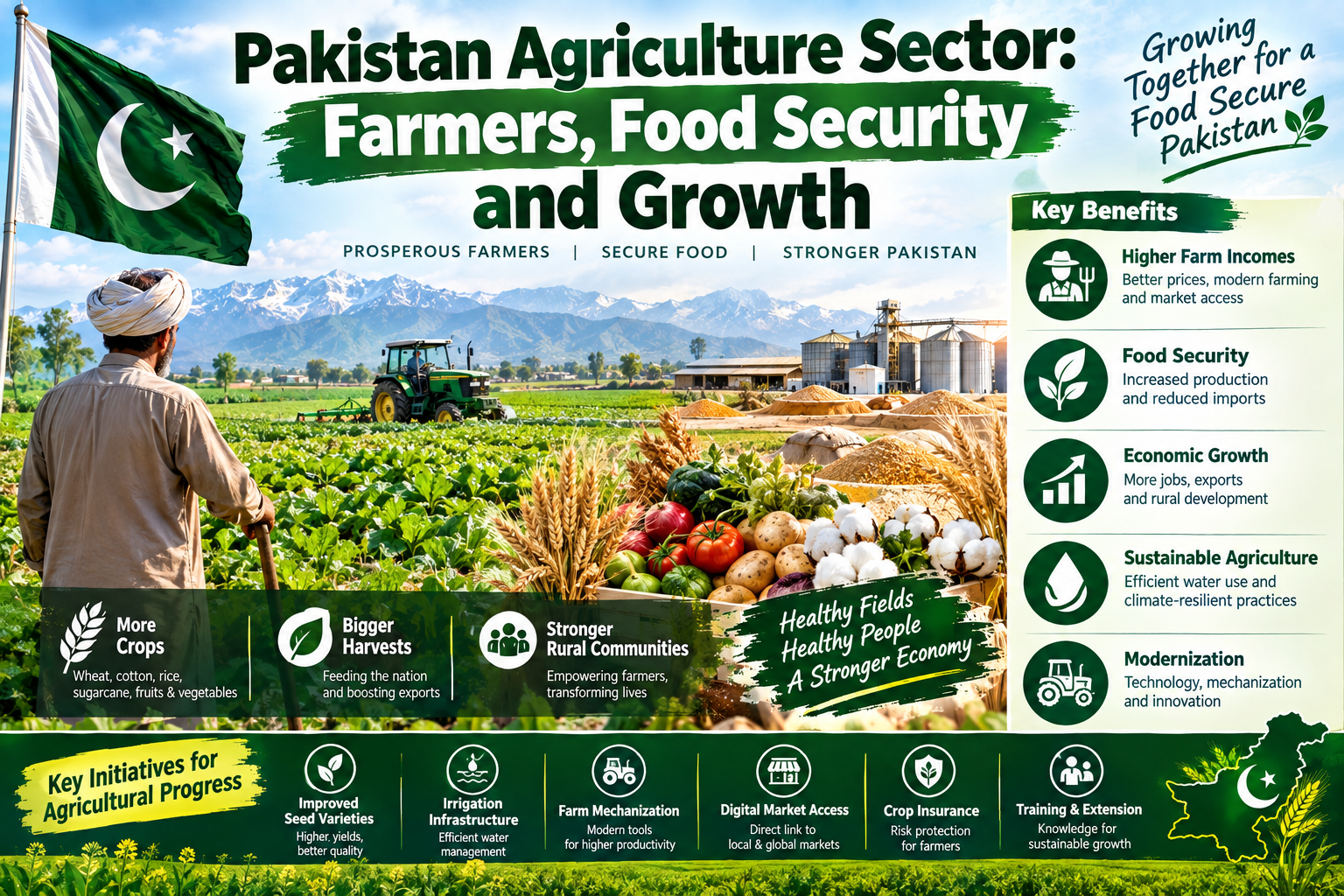
Farmers need access to better seeds, efficient irrigation systems, agricultural machinery, digital information, financial services, crop insurance, storage facilities, modern markets, and training.
Climate change has made these needs even more urgent. Rising temperatures, irregular rainfall, floods, droughts, heatwaves, and changing pest patterns can affect agricultural production. A modern agricultural strategy must therefore focus not only on increasing production but also on making farming more resilient.
The future of Pakistan's agriculture will depend on how successfully the country combines traditional farming knowledge with modern technology, better infrastructure, improved market systems, and sustainable resource management.
Importance of Agriculture to Pakistan
Agriculture is deeply connected with Pakistan's economy and society.
A large number of people depend directly or indirectly on agriculture for their livelihoods. Rural communities rely on farming, livestock, fisheries, agricultural transportation, food processing, and related businesses.
Agriculture also supplies raw materials to several major industries.
Cotton is essential for textiles. Sugarcane supports sugar mills. Wheat is central to the food system. Rice is an important export commodity. Fruits, vegetables, dairy products, and livestock support food-processing businesses.
This makes agricultural performance important for both domestic consumption and international trade.
When agricultural production improves, farmers can earn more, food supplies can become more stable, and rural economic activity can increase.
When production falls because of weather problems, disease, high costs, or water shortages, food prices and rural incomes can be affected.
Agriculture is therefore not simply a rural sector. It is an important part of Pakistan's overall economic system.
Food Security and Agriculture
Food security means that people have reliable access to sufficient, safe, and nutritious food.
Pakistan's growing population increases the need for a strong food-production system.
The country needs to produce enough food while also ensuring that food can be stored, transported, processed, and distributed efficiently.
Increasing agricultural production is one part of the solution.
Reducing post-harvest losses is another.
Large amounts of fruits and vegetables can lose value because of inadequate storage, transportation, packaging, and cold-chain facilities.
Better infrastructure can therefore improve food availability without requiring farmers to dramatically increase production.
Food security also depends on water availability, climate resilience, agricultural research, and stable markets.
Supporting Farmers
Farmers are at the centre of Pakistan's agricultural economy.
Small farmers in particular can face difficulties obtaining quality seeds, fertilizers, pesticides, machinery, loans, and market information.
Government policies that provide easier access to agricultural services can help improve productivity.
Farmer training is also important.
Farmers can benefit from knowledge about soil health, efficient irrigation, crop rotation, pest management, modern harvesting techniques, and climate-resilient farming.
Agricultural extension services can play an important role by connecting farmers with researchers and technical experts.
Digital platforms can also make information easier to access.
Farmers can receive weather updates, market information, crop-management advice, and information about agricultural programmes through mobile phones.
Rising Cost of Agricultural Inputs
One of the major challenges for farmers is the increasing cost of inputs.
Seeds, fertilizers, pesticides, diesel, electricity, machinery, labour, and transportation can all contribute to production costs.
When input prices rise faster than crop prices, farmers may struggle to maintain profitability.
High production costs can also discourage investment in modern farming technologies.
Policies that improve access to affordable inputs, efficient financing, and better technology can help farmers manage costs.
However, long-term agricultural competitiveness also requires improvements in productivity.
Producing more from the same amount of land and water can help reduce the cost per unit of output.
Modern Seeds and Crop Productivity
Seed quality has a significant impact on agricultural productivity.
Improved varieties can provide better yields, stronger resistance to certain diseases, and greater tolerance to environmental conditions.
Pakistan's agricultural research institutions can contribute by developing and promoting crop varieties suited to local conditions.
Farmers also need access to reliable seed markets.
Poor-quality or counterfeit seeds can reduce yields and increase financial losses.
Quality-control systems can help farmers make better choices.
Modern seed technology should also be combined with appropriate farming practices.
Even high-quality seeds may not perform well if farmers lack adequate water, nutrients, pest management, or technical knowledge.
Water Management
Water is one of the most important resources for Pakistani agriculture.
Much of the country's farming system depends on irrigation.
However, water availability is under pressure from population growth, climate change, inefficient irrigation practices, and competition among different users.
Improving water efficiency is therefore essential.
Traditional flood irrigation can result in significant water losses.
Modern methods such as drip irrigation, sprinkler systems, laser land leveling, and improved irrigation scheduling can help farmers use water more efficiently.
Technology can also help farmers determine when crops actually need water.
Better water management can increase productivity while conserving an increasingly valuable resource.
Climate Change and Agriculture
Climate change is one of the biggest long-term challenges facing Pakistani farmers.
Pakistan is vulnerable to floods, heatwaves, droughts, irregular rainfall, and other climate-related events.
Extreme weather can destroy crops, damage agricultural infrastructure, reduce livestock productivity, and disrupt supply chains.
Farmers need strategies that improve resilience.
These may include drought-resistant crop varieties, heat-tolerant seeds, improved water management, crop diversification, agroforestry, better drainage, and early-warning systems.
Climate-smart agriculture can help farmers adapt to changing conditions.
Agricultural research is particularly important because farmers need locally appropriate solutions.
Role of Technology in Agriculture
Technology can transform agriculture in Pakistan.
Modern agricultural machinery can reduce labour requirements and improve efficiency.
Drones can potentially help farmers monitor crops and identify areas affected by disease or water stress.
Satellite imagery can provide information about crop conditions.
Mobile applications can provide weather forecasts and market information.
Sensors can monitor soil moisture and other agricultural conditions.
Artificial intelligence can also contribute to crop monitoring, pest identification, yield prediction, and resource management.
The challenge is making these technologies accessible to ordinary farmers.
Technology will have the greatest impact when it is affordable, easy to use, and supported by training.
Digital Agriculture
Digital agriculture is becoming increasingly important.
Farmers can use mobile phones to access information about crop prices, weather conditions, agricultural techniques, and government programmes.
Digital marketplaces can potentially connect farmers more directly with buyers.
This can improve market transparency and reduce dependence on intermediaries in some situations.
Digital payment systems can also make agricultural transactions more efficient.
However, digital agriculture requires reliable internet access, digital literacy, and trustworthy platforms.
Training rural communities in digital skills can therefore support agricultural modernization.
Agricultural Machinery
Mechanization can improve agricultural productivity.
Tractors, planters, harvesters, threshers, irrigation equipment, and other machines can reduce manual labour and improve the timing of agricultural operations.
For small farmers, however, purchasing expensive machinery may not be practical.
Shared machinery services and agricultural equipment rental models can provide an alternative.
Farmer groups or private service providers can offer machinery to multiple farmers.
This can allow smaller farms to benefit from mechanization without requiring every farmer to purchase expensive equipment.
Livestock Development
Agriculture in Pakistan includes much more than crops.
Livestock is an important part of rural livelihoods.
Cattle, buffaloes, goats, sheep, poultry, and other animals provide milk, meat, eggs, leather, and income.
Improving livestock productivity can therefore strengthen rural economies.
Better animal health services, improved breeds, balanced feed, vaccination programmes, and modern dairy practices can increase productivity.
Milk collection and cold-chain systems can also reduce losses and improve product quality.
Pakistan has potential to increase the value of livestock products through modern processing and better quality standards.
Dairy Industry Opportunities
The dairy sector can provide opportunities for farmers and businesses.
Pakistan has a large livestock population and significant milk production.
However, productivity and quality can be affected by animal health, feeding practices, storage, transportation, and processing challenges.
Modern dairy farming can improve productivity through better animal nutrition, veterinary services, hygiene, and breeding practices.
Cold-chain infrastructure is particularly important because milk is highly perishable.
Better processing and packaging can also create opportunities for higher-value dairy products.
Fruits and Vegetables
Pakistan produces a wide variety of fruits and vegetables.
Mangoes, citrus fruits, dates, kinnow, potatoes, onions, tomatoes, and many other products contribute to domestic markets and exports.
However, post-harvest losses can reduce the economic value of these products.
Better harvesting techniques, packaging, refrigerated transportation, cold storage, and processing facilities can reduce waste.
Exporters also need to meet international standards for quality, safety, packaging, and traceability.
Improving these systems can help Pakistan increase agricultural exports.
Increasing Agricultural Exports
Agriculture can contribute significantly to Pakistan's export earnings.
Rice is already an important export product, while fruits, vegetables, seafood, meat, and other agricultural commodities also have international potential.
Pakistan can increase agricultural export value by moving beyond raw commodities.
Processing can create higher-value products.
For example, instead of exporting only fresh agricultural products, businesses can develop packaged, frozen, dried, canned, or processed foods.
This can create additional jobs and increase the value retained within Pakistan.
Export growth also requires strong quality-control systems.
International buyers expect consistent quality and food safety.
Rice Production and Exports
Rice is one of Pakistan's important agricultural commodities.
The country is known for varieties such as basmati rice.
Improving rice productivity, quality, processing, packaging, and marketing can strengthen Pakistan's position in international markets.
Farmers can also benefit from water-efficient rice cultivation methods.
Modern production techniques can help reduce water use while maintaining yields.
Better branding and certification can further improve the value of premium Pakistani rice.
Cotton and the Textile Industry
Cotton has special importance because Pakistan has a large textile industry.
The performance of the cotton crop affects spinning mills, textile factories, garment manufacturers, and exporters.
Cotton production can be affected by weather, pests, water availability, seed quality, and farming practices.
Reviving cotton productivity is therefore important for both agriculture and industry.
Research into disease-resistant and climate-resilient varieties can support cotton farmers.
Better pest management and improved farming practices can also improve yields.
A stronger cotton sector can help Pakistan's textile industry secure local raw materials.
Wheat and Food Security
Wheat is one of the most important staple crops in Pakistan.
It plays a central role in the country's food system.
Maintaining adequate wheat production is therefore important for food security.
Farmers need access to quality seed, fertilizers, water, technical advice, and reliable markets.
At the same time, policymakers need to manage wheat storage, procurement, transportation, and distribution efficiently.
Reducing post-harvest losses can also improve food availability.
Role of Agricultural Research
Agricultural research is essential for long-term progress.
Researchers can develop better seeds, study crop diseases, improve water-management techniques, and develop climate-resilient agricultural practices.
Research institutions should work closely with farmers.
Solutions developed in laboratories need to be practical and affordable in real farming conditions.
Universities can also collaborate with agricultural businesses to develop technology and train the next generation of agricultural professionals.
Agricultural Financing
Farmers often require financing to purchase seeds, fertilizer, machinery, livestock, irrigation equipment, and other inputs.
Access to suitable agricultural finance can therefore support productivity.
Digital banking can make financial services more accessible in rural areas.
Banks and financial institutions can also develop products designed around agricultural cycles.
For example, repayment schedules can be aligned with harvest periods.
Agricultural insurance can provide another layer of protection against major losses.
Crop Insurance
Farming involves significant risks.
A farmer can invest heavily in a crop and then lose much of the harvest because of floods, drought, pests, or disease.
Crop insurance can help reduce this financial risk.
Insurance programmes need to be affordable, transparent, and easy to access.
Technology can support agricultural insurance through satellite data and digital assessment systems.
Better insurance coverage can encourage farmers to invest in improved technologies because they have greater protection against extreme losses.
Improving Agricultural Markets
Market access is a major issue for farmers.
If farmers cannot reach buyers efficiently, they may receive lower prices for their products.
Better roads, storage facilities, digital marketplaces, agricultural markets, and transparent pricing systems can improve market access.
Farmer cooperatives can also help small producers negotiate collectively.
By combining their products, farmers may gain better access to transportation, storage, processing, and larger buyers.
Reducing Middlemen-Related Problems
Intermediaries can perform useful functions by connecting farmers with markets.
However, farmers may sometimes receive a small share of the final consumer price because of long and inefficient supply chains.
Modern market systems can improve transparency.
Digital platforms can provide farmers with information about prices in different markets.
Better storage can also reduce the pressure to sell immediately after harvesting.
When farmers have the ability to store products safely, they may have more flexibility in choosing when and where to sell.
Cold-Chain Development
Cold-chain infrastructure is particularly important for perishable agricultural products.
Refrigerated storage and transportation can preserve fruits, vegetables, dairy products, meat, and seafood.
Better cold chains can reduce food waste and improve export opportunities.
Investment in cold storage can also support rural businesses.
Processing companies can establish facilities near production areas, creating jobs and adding value locally.
Agricultural Processing and Value Addition
Value addition can transform Pakistan's agricultural economy.
Instead of selling raw products, businesses can process them into finished or semi-finished goods.
Examples include fruit juices, dried fruits, packaged vegetables, frozen foods, dairy products, flour, edible oils, processed rice, meat products, and other foods.
Processing creates additional employment and can increase export earnings.
Industrial zones can also provide locations for food-processing companies.
Role of CPEC in Agriculture
The China-Pakistan Economic Corridor is increasingly emphasizing agriculture under its next phase.
Agricultural cooperation can involve technology transfer, training, investment, processing, and market access.
Pakistan's CPEC Secretariat reported in 2026 that around 1,000 Pakistani agricultural experts were being sent to China for training in advanced agricultural technologies.
Such cooperation can help Pakistani professionals learn modern farming and agricultural-processing techniques.
The wider objective should be to convert knowledge and technology into practical benefits for farmers and agricultural businesses.
Youth and Agriculture
Young people can play an important role in the modernization of agriculture.
Agriculture is increasingly becoming a technology-based sector.
Young entrepreneurs can establish businesses in agricultural machinery, digital farming, food processing, logistics, e-commerce, agricultural finance, and farm-management services.
Agricultural education can also become more attractive when students see opportunities in modern agribusiness.
Pakistan needs young professionals who understand both agriculture and technology.
Women in Agriculture
Women contribute significantly to agricultural and livestock activities in rural Pakistan.
They may be involved in livestock care, dairy production, crop activities, food processing, and household-level agricultural work.
Improving women's access to training, finance, technology, markets, and business opportunities can strengthen rural economies.
Women-focused agricultural programmes can support entrepreneurship and household income.
Greater recognition of women's agricultural contributions can also improve policy design.
Sustainable Agriculture
Agricultural development must be sustainable.
Overuse of water, soil degradation, excessive chemical use, and poor land-management practices can reduce long-term productivity.
Farmers can benefit from soil testing, balanced fertilizer use, crop rotation, integrated pest management, and water-efficient irrigation.
Sustainable agriculture is not only about protecting the environment.
It is also about protecting the farmer's future productivity.
Healthy soils and efficient water systems can help farms remain productive for many years.
Improving Rural Infrastructure
Agricultural development depends on rural infrastructure.
Farm-to-market roads can reduce transportation costs.
Electricity can support irrigation, processing, and storage.
Internet access can provide market and weather information.
Schools and healthcare facilities can improve the quality of rural life.
Better rural infrastructure can also reduce migration pressure by creating stronger economic opportunities in villages and smaller towns.
Government's Role in Agricultural Reform
Government policy can influence almost every part of agriculture.
Authorities can support research, irrigation, extension services, rural infrastructure, agricultural finance, market regulation, food safety, and export development.
However, agricultural policy should focus on long-term productivity rather than only short-term support.
Farmers need predictable policies so they can plan investments.
Government programmes should also be transparent and accessible.
Digital systems can help improve the delivery of agricultural support and reduce administrative delays.
Future of Pakistan's Agriculture
Pakistan's agricultural future depends on modernization.
The country needs to move toward more efficient water use, better seeds, mechanization, digital agriculture, climate resilience, improved storage, value addition, and stronger export systems.
The objective should not simply be producing more crops.
Pakistan needs to produce better-quality agricultural products at competitive costs while protecting natural resources.
Agricultural technology can play a major role.
Research can provide new solutions.
Young entrepreneurs can introduce innovative business models.
Private investment can improve processing and storage.
Government policy can create an environment in which farmers and businesses can invest confidently.
Conclusion
Pakistan's agriculture sector remains a central pillar of the country's economy and food security. It provides food, employment, industrial raw materials, rural income, and export opportunities.
However, the sector faces major challenges, including rising input costs, water shortages, climate change, limited access to technology, post-harvest losses, inefficient markets, and inadequate storage and processing facilities.
Fresh attention to agriculture can help Pakistan address these challenges and build a stronger food system.
Farmers need better seeds, affordable financing, efficient irrigation, modern machinery, digital information, technical training, and reliable markets.
Technology can make agriculture more productive and efficient.
Solar-powered irrigation, smart farming tools, satellite monitoring, mobile applications, modern machinery, and digital marketplaces can all contribute to agricultural modernization.
Climate resilience must also become a central part of agricultural policy.
Pakistan needs crops and farming systems capable of dealing with heat, floods, droughts, and changing weather patterns.
Water efficiency is equally important because agricultural productivity depends heavily on irrigation.
Better storage, cold-chain systems, food processing, and packaging can reduce post-harvest losses and increase the value of agricultural production.
Pakistan can also increase agricultural exports by focusing on quality, processing, branding, and international standards.
The next generation of farmers and agricultural entrepreneurs will play an important role in this transformation.
With appropriate training and access to technology, young people can help connect traditional agriculture with the digital economy.
Women can also contribute significantly to rural economic development when they have better access to finance, training, markets, and technology.
CPEC and Pakistan-China cooperation can provide additional opportunities through agricultural training, technology transfer, investment, and business partnerships.
Ultimately, Pakistan's agricultural future depends on combining farmer support with long-term structural reforms.
A modern agricultural sector can strengthen food security, increase rural incomes, create employment, support industries, improve exports, and contribute to national economic growth.
By investing in farmers, technology, water efficiency, research, infrastructure, and value-added agriculture, Pakistan can turn its agricultural potential into a stronger and more sustainable economic advantage.
Frequently Asked Questions (FAQs)
1. Why is agriculture important for Pakistan?
Agriculture provides food, employment, rural income, industrial raw materials, and export opportunities, making it one of Pakistan's most important economic sectors.
2. What are the major challenges facing Pakistani farmers?
Farmers face rising input costs, water shortages, climate change, limited access to technology and finance, market problems, and post-harvest losses.
3. How can technology improve agriculture in Pakistan?
Technology can improve farming through smart irrigation, modern machinery, digital market information, satellite monitoring, weather forecasting, improved seeds, and data-based crop management.
4. How can Pakistan improve food security?
Pakistan can strengthen food security by increasing agricultural productivity, improving water management, reducing post-harvest losses, expanding storage facilities, supporting farmers, and improving food distribution systems.
5. Can agriculture increase Pakistan's exports?
Yes. Better-quality crops, improved processing, modern packaging, cold-chain infrastructure, value-added food products, and compliance with international standards can help Pakistan increase agricultural exports.




