Introduction
Pakistan's energy sector remains one of the most important foundations of the country's economic development. Electricity is essential for homes, schools, hospitals, businesses, factories, agriculture, transportation, and digital services. When electricity is reliable and affordable, businesses can operate more efficiently, industries can expand, and households can enjoy better living standards. When the power sector faces shortages, high costs, financial losses, or distribution problems, the effects can spread throughout the wider economy.
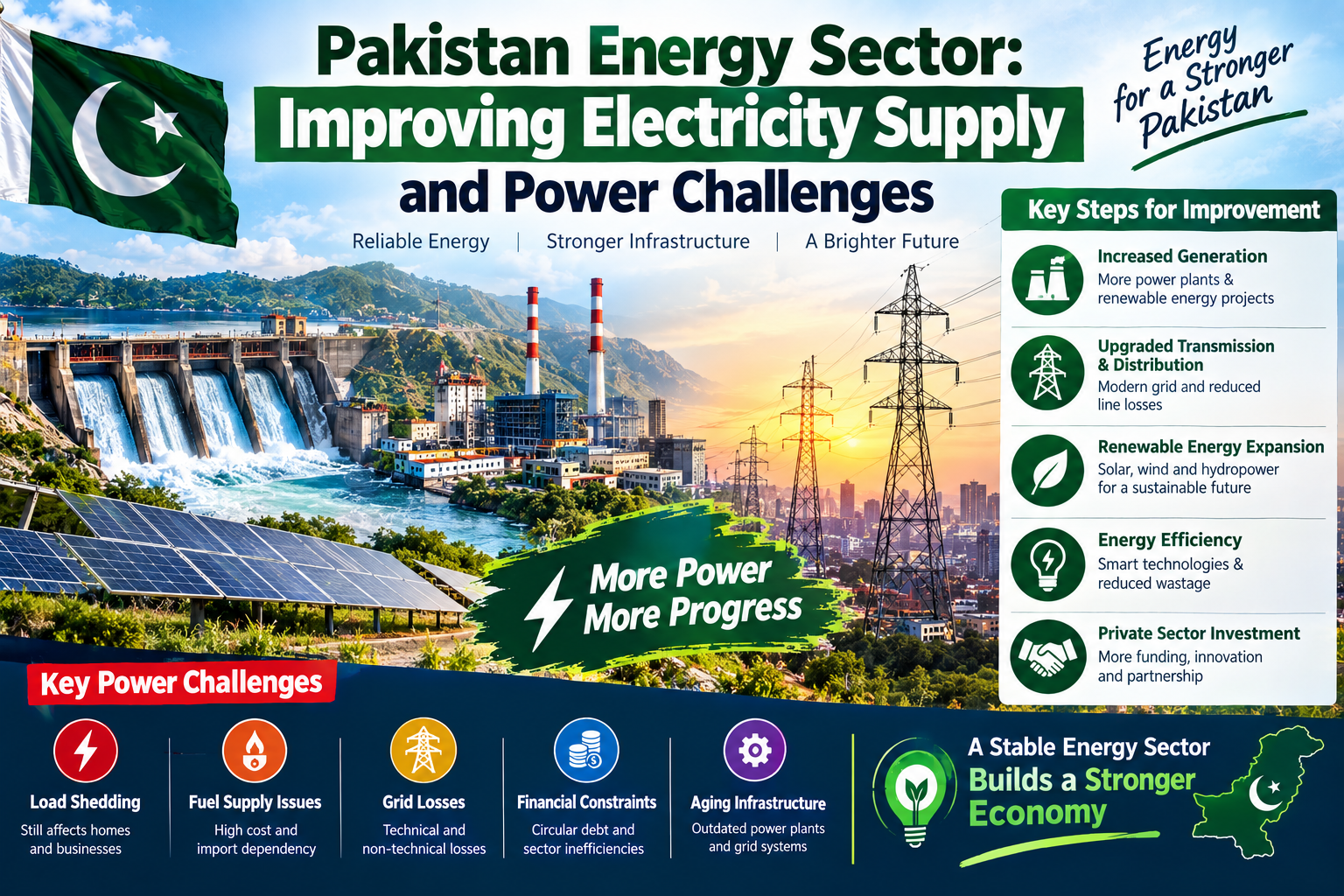
Pakistan has made significant investments in electricity generation and transmission infrastructure over the past decade. However, the country continues to face challenges related to electricity prices, circular debt, transmission constraints, distribution losses, fuel costs, and the financial health of power-sector institutions. These issues mean that increasing generation capacity alone is not enough. Pakistan also needs reforms that make the entire energy system more efficient, financially sustainable, and responsive to consumers.
The country's energy strategy is increasingly focused on improving the efficiency of the power sector, reducing losses, strengthening transmission and distribution networks, encouraging renewable energy, and improving the overall financial sustainability of electricity supply.
Renewable energy is also becoming more important. Solar, wind, and hydropower can help diversify the electricity mix and reduce dependence on imported fuels. At the same time, better grid management and transmission infrastructure are needed so that electricity generated in one part of the country can reach consumers in another.
The challenge for Pakistan is therefore not simply producing more electricity. The country needs an energy system that can provide reliable, affordable, sustainable, and financially manageable electricity.
Importance of Energy for Pakistan's Economy
Energy is closely connected with almost every part of Pakistan's economy.
Factories need electricity to operate machinery. Textile mills require power for spinning, weaving, dyeing, and processing. Food-processing companies depend on electricity for production and refrigeration. Small businesses need power for computers, equipment, lighting, and communication.
Agriculture also depends increasingly on electricity.
Farmers use electric pumps for irrigation, while agricultural processing facilities require electricity for cleaning, packaging, cooling, and storage. Reliable energy can therefore improve agricultural productivity and reduce losses.
The services sector is equally dependent on electricity.
Banks, hospitals, schools, restaurants, shopping centres, software companies, call centres, and telecommunications networks all need dependable power.
Pakistan's rapidly developing digital economy makes reliable electricity even more important. Data centres, internet networks, software businesses, freelancers, and technology companies cannot function effectively without stable power.
This means that improvements in the energy sector can have benefits far beyond the electricity industry itself.
Pakistan's Electricity Generation Capacity
Pakistan has expanded its electricity-generation capacity through investments in thermal power, hydropower, wind, solar, and other technologies.
Large infrastructure projects under initiatives such as CPEC have also contributed significant generation capacity. According to Pakistan's CPEC Secretariat, CPEC Phase I added nearly 8,000 MW to Pakistan's power-generation capacity.
These investments helped address the severe electricity shortages that affected Pakistan during earlier periods.
However, electricity generation capacity and actual electricity availability are not exactly the same thing.
A power plant may exist but not operate at full capacity because of fuel availability, financial constraints, technical problems, transmission limitations, or demand conditions.
Therefore, Pakistan's energy policy must consider the complete electricity system.
This includes generation, transmission, distribution, billing, collection, maintenance, and consumer demand.
The Challenge of High Electricity Costs
Electricity prices are one of the biggest concerns for Pakistani households and businesses.
When electricity becomes expensive, household budgets are affected. Families have less money available for food, education, transportation, and other necessities.
Businesses also face higher operating costs.
For manufacturers competing in international markets, expensive electricity can make Pakistani products less competitive.
High electricity costs can therefore affect exports, investment, industrial growth, and employment.
Several factors contribute to the cost of electricity, including fuel prices, exchange-rate movements, financing costs, power-purchase agreements, transmission and distribution losses, and inefficiencies within the sector.
Reducing electricity costs requires a comprehensive approach rather than a single solution.
Improving efficiency, increasing renewable generation, reducing losses, strengthening transmission systems, and addressing financial problems can all contribute to a healthier power sector.
Circular Debt Remains a Major Issue
One of Pakistan's most persistent energy-sector problems is circular debt.
Circular debt develops when financial obligations accumulate throughout the electricity supply chain.
For example, if electricity distribution companies do not recover enough revenue from consumers, they may struggle to pay suppliers and generators. Those suppliers can then face difficulty meeting their own financial obligations.
Over time, unpaid bills can accumulate across the system.
Circular debt creates financial pressure and can affect investment in the power sector.
It also makes it more difficult for the government to maintain a financially sustainable electricity system.
Reducing circular debt requires improvements in billing, collection, governance, energy efficiency, and the financial structure of the sector.
Reducing Electricity Distribution Losses
Electricity can be lost during transmission and distribution.
Some losses are technical, meaning they occur because of the physical characteristics and condition of electrical networks.
Other losses are linked to theft, inaccurate metering, illegal connections, or poor collection.
Reducing these losses is essential.
Modern electricity meters can improve billing accuracy.
Digital monitoring systems can help utilities identify unusual consumption patterns.
Better maintenance can reduce technical losses.
Stronger enforcement against electricity theft can improve revenue collection.
When losses decline, electricity companies can become financially stronger without simply increasing prices for consumers.
This is one reason distribution-sector reform is so important.
Improving Transmission Infrastructure
Pakistan needs a strong transmission network to move electricity efficiently from power plants to areas where it is needed.
Transmission constraints can prevent available electricity from reaching consumers.
This problem becomes particularly important as renewable energy expands.
Wind and solar resources are often concentrated in specific geographical areas. If large amounts of renewable electricity are generated in a location far from major demand centres, adequate transmission infrastructure is required to deliver that electricity to consumers.
Modernizing the national grid can therefore support both conventional and renewable energy.
A stronger transmission network can also improve reliability and reduce congestion.
Renewable Energy and Pakistan
Renewable energy has become increasingly important for Pakistan.
The country has significant potential for solar, wind, and hydropower.
Solar energy is particularly attractive because Pakistan receives abundant sunlight across much of the country.
The rapid adoption of rooftop solar has also changed the way many consumers think about electricity.
Businesses and households can use solar systems to generate part of their own electricity, reducing dependence on grid electricity during suitable periods.
Wind energy is another important resource.
Pakistan's Sindh province, particularly the Gharo-Jhimpir wind corridor, has significant wind potential.
Hydropower is also an established component of Pakistan's electricity system.
Renewable energy can help reduce dependence on imported fossil fuels and potentially improve energy security.
However, renewable energy also requires appropriate grid planning because solar and wind generation can vary according to weather conditions.
Battery storage, flexible generation, demand management, and modern grid systems can help integrate renewable energy more effectively.
Solar Energy and the Changing Power Market
Solar power is changing Pakistan's electricity landscape.
The availability of relatively affordable solar equipment has encouraged households, farms, businesses, and industries to consider solar systems.
Solar energy can provide several advantages.
It can reduce electricity bills for consumers who generate electricity for their own use.
It can also reduce demand on the national grid during sunny periods.
For agriculture, solar power can be useful for water pumping and other farm operations.
For businesses, solar systems can provide an alternative source of electricity and reduce exposure to fluctuations in grid electricity costs.
However, the rapid expansion of distributed solar also creates new challenges for electricity distribution companies.
Grid operators need to manage two-way electricity flows when consumers generate electricity and send surplus power into the grid.
This requires appropriate regulations, modern meters, reliable grid management, and a sustainable pricing structure.
Energy Efficiency Can Reduce Demand
Pakistan does not necessarily need to solve every energy problem by building more power plants.
Energy efficiency can also play a major role.
Efficient appliances use less electricity while providing similar services.
Energy-efficient buildings require less cooling and lighting.
Modern industrial machinery can reduce energy consumption per unit of production.
Efficient motors and pumps can reduce electricity use in factories and agriculture.
Public awareness can also encourage consumers to avoid unnecessary electricity consumption.
If Pakistan improves energy efficiency across households, businesses, government buildings, and industries, overall electricity demand can be managed more effectively.
This can reduce pressure on the power system and lower energy costs.
Energy and Industrial Development
Pakistan's industrial sector requires reliable and competitive energy.
Manufacturing businesses often operate expensive machinery that cannot simply be stopped and restarted repeatedly.
Unexpected electricity interruptions can damage production schedules, increase costs, and affect customer orders.
Reliable energy is particularly important for export industries.
Pakistan's textile, leather, sports goods, surgical instruments, food-processing, pharmaceutical, and engineering industries compete with producers from other countries.
If energy costs are significantly higher than those of competitors, Pakistani exporters may face difficulties in international markets.
Improving the energy sector can therefore support Pakistan's export ambitions.
Industrial zones and special economic zones also require dependable electricity.
Investors are more likely to establish factories when they can reasonably expect reliable infrastructure and predictable operating costs.
Energy and Agriculture
Agriculture is another major consumer of energy.
Electricity is used for irrigation pumps, tube wells, processing facilities, cold storage, and other agricultural activities.
Solar energy can provide farmers with an alternative electricity source for certain agricultural applications.
Reliable electricity can also support food-processing businesses.
Cold-storage facilities are particularly important because they can reduce post-harvest losses for fruits, vegetables, meat, dairy products, and other perishable goods.
Better energy infrastructure can therefore contribute to food security and agricultural exports.
Pakistan can also benefit from combining agricultural modernization with renewable energy.
Solar-powered irrigation, efficient pumps, and improved storage systems can reduce operating costs and improve productivity when appropriately planned.
Energy and Small Businesses
Small and medium-sized enterprises form an important part of Pakistan's economy.
Small shops, workshops, restaurants, tailoring businesses, salons, printing businesses, bakeries, and repair centres all require electricity.
When electricity is expensive or unreliable, small businesses can struggle to remain profitable.
Some businesses have to rely on backup power systems, which increase operating expenses.
Improving grid reliability can therefore help small businesses.
Affordable electricity can also encourage entrepreneurship because new businesses can operate with lower fixed costs.
Digital businesses and freelancers are another growing part of the economy.
They require computers, internet connections, and often long working hours.
Reliable electricity can support this emerging workforce.
Energy Security and Imported Fuel
Pakistan has historically relied significantly on imported fuels for part of its energy requirements.
When global fuel prices rise, the cost of electricity generation can increase.
Exchange-rate fluctuations can also affect the local cost of imported fuel.
This creates pressure on the country's external finances.
Developing domestic renewable resources can help reduce some of this dependence.
Hydropower, solar, and wind do not require imported fuel in the same way as conventional thermal generation.
However, Pakistan must continue to diversify its energy mix rather than depending excessively on a single source.
A balanced energy strategy can improve resilience against international price shocks.
Hydropower Development
Hydropower is an important component of Pakistan's energy strategy.
Pakistan has considerable hydropower potential because of its geography and river systems.
Hydropower can provide large-scale electricity generation and, depending on the project, can support grid stability.
Hydropower projects can also provide additional benefits related to water management.
However, large projects require significant investment and careful environmental and social planning.
Construction timelines can also be lengthy.
Pakistan therefore needs a balanced approach combining hydropower with other renewable and conventional energy sources.
Wind Power Potential
Wind energy offers another opportunity for diversification.
Pakistan's wind corridor in Sindh has already attracted several projects.
Wind power can provide electricity without consuming fossil fuels during generation.
However, wind generation varies with weather conditions.
This means that transmission capacity and grid flexibility are important.
As Pakistan adds more wind and solar power, the country will need better forecasting, storage options, grid management, and demand-response mechanisms.
Role of Private Investment
Private-sector investment can play an important role in improving Pakistan's energy system.
Private companies can bring capital, technology, management expertise, and innovation.
However, investors need clear and predictable policies.
Frequent changes in regulations can discourage long-term investment.
Transparent procurement and consistent energy policies can help build investor confidence.
The government also needs to ensure that investment arrangements are financially sustainable for consumers and the state.
A successful energy market requires a balance between attracting investment and protecting consumers.
Modernizing Electricity Distribution Companies
Pakistan's distribution companies are central to the power system because they deliver electricity to consumers.
Modernization can include:
Smart meters
Digital billing
Automated monitoring
Better customer-service systems
Improved outage management
Stronger theft detection
Network upgrades
Data-driven maintenance
Digital technology can make electricity distribution more efficient.
For example, smart meters can provide more accurate information about electricity consumption.
Utilities can use data to identify technical problems and unusual consumption patterns.
Customers can also receive better information about their electricity usage.
Modernization can therefore improve both service quality and financial performance.
Smart Grids and the Future of Electricity
The traditional electricity system was designed around large centralized power plants sending electricity to consumers.
The modern electricity system is becoming more complex.
Consumers can now generate electricity using rooftop solar.
Electric vehicles may become more common.
Battery storage can allow electricity to be stored and used later.
Digital devices can monitor energy consumption in real time.
These developments require smarter electricity grids.
A smart grid uses digital technology, sensors, automated controls, and data systems to manage electricity more efficiently.
Pakistan can gradually introduce smart-grid technologies as part of its long-term energy modernization strategy.
Energy Policy and Economic Reforms
Energy reforms cannot be separated from broader economic reforms.
Electricity companies need financially sustainable business models.
Government institutions need strong governance.
Contracts need to be managed responsibly.
Investment decisions need proper economic evaluation.
Consumers need fair and transparent billing.
Businesses need predictable energy policies.
These reforms require coordination among federal ministries, provincial authorities, regulators, distribution companies, generators, investors, and consumers.
Long-term consistency is particularly important.
Energy infrastructure is built over decades, so policies should not change unpredictably every few months.
Energy and Climate Change
Pakistan is highly vulnerable to climate change.
Extreme weather events can damage infrastructure and disrupt energy systems.
Floods can affect power plants, transmission lines, roads, and distribution networks.
Heatwaves can increase electricity demand because people use more cooling systems.
Changing water availability can also affect hydropower generation.
Climate-resilient energy infrastructure is therefore essential.
New power projects should consider climate risks during planning and design.
Renewable energy can also help Pakistan reduce dependence on fossil fuels and contribute to cleaner economic growth.
Role of Energy Conservation
Energy conservation can provide immediate benefits.
Consumers can reduce unnecessary electricity consumption by using efficient appliances, switching off unused equipment, improving building insulation, and managing cooling systems carefully.
Industries can conduct energy audits to identify inefficient processes.
Government buildings can adopt energy-saving measures.
Schools and universities can teach students about responsible energy use.
Although individual actions may appear small, millions of households and businesses can collectively make a significant difference.
Improving Consumer Awareness
Consumers need better information about electricity.
Many people do not fully understand how electricity tariffs, peak hours, fuel adjustments, taxes, and other charges affect their bills.
Better communication can improve public understanding.
Electricity companies can provide clearer bills and digital tools that allow customers to track consumption.
Consumers can then identify unusually high usage and take corrective action.
Greater transparency can also improve trust between utilities and consumers.
Role of Government
The government has a central role in energy-sector reform.
It can establish regulations, invest in infrastructure, encourage renewable energy, improve governance, and support consumer protection.
However, the government cannot solve every energy problem alone.
Private companies, consumers, banks, investors, engineers, universities, and technology firms all have important roles.
A successful energy transition requires cooperation across the economy.
Role of Technology
Technology can transform Pakistan's energy system.
Artificial intelligence and data analytics can help forecast electricity demand.
Digital monitoring can detect equipment problems.
Smart meters can improve billing.
Automated systems can manage electricity flows.
Solar and battery technologies can provide distributed power.
Mobile applications can help consumers monitor electricity consumption.
Technology can therefore improve both efficiency and transparency.
Pakistan's growing technology sector could also develop local solutions for energy management.
Opportunities for Pakistani Engineers and Professionals
Energy-sector modernization can create opportunities for engineers, technicians, software developers, data analysts, environmental experts, financial professionals, and project managers.
Universities can prepare students for these emerging fields.
Technical institutions can provide practical training in solar installation, electrical maintenance, automation, battery systems, and energy efficiency.
Developing local expertise can reduce dependence on foreign technical support and create new employment opportunities.
The Future of Pakistan's Energy Sector
Pakistan's future energy system is likely to become more diversified.
Solar, wind, hydropower, natural gas, nuclear energy, and other sources may all contribute depending on economic and technical conditions.
The most important objective will be maintaining a reliable and affordable electricity system while reducing financial and environmental risks.
The country also needs stronger transmission and distribution infrastructure.
Renewable energy expansion should be supported by grid modernization.
Energy efficiency should be promoted alongside generation expansion.
Financial reforms should address circular debt and distribution losses.
Investment should focus on projects that create long-term economic value.
Conclusion
Pakistan's energy sector is at an important stage of transformation. The country has expanded electricity-generation capacity considerably, but challenges involving affordability, distribution losses, circular debt, transmission constraints, imported fuel costs, and governance continue to affect the power system.
Solving these problems requires more than building additional power plants.
Pakistan needs a comprehensive energy strategy that combines reliable generation, modern transmission networks, efficient distribution companies, renewable energy, smart-grid technology, energy conservation, and financial reform.
Solar, wind, and hydropower can help diversify the electricity mix. Modern technology can improve grid management and billing. Better transmission infrastructure can ensure that available electricity reaches consumers. Energy efficiency can reduce unnecessary demand.
The energy sector is also closely connected with Pakistan's industrial and economic ambitions. Affordable and reliable electricity can help factories expand, businesses become more competitive, farmers improve productivity, and technology companies grow.
Small businesses and households can also benefit from a more stable electricity system.
At the same time, Pakistan must ensure that energy reforms remain financially sustainable. Electricity prices need to reflect the real cost of supplying power while protecting vulnerable consumers through appropriate policies.
Reducing theft and distribution losses can improve the financial health of electricity companies without relying entirely on higher tariffs.
Renewable energy can provide an important part of the long-term solution, but its expansion must be supported by modern grids, appropriate regulations, storage, and better demand management.
The future of Pakistan's energy sector will ultimately depend on effective implementation.
If the country can improve governance, reduce losses, modernize infrastructure, encourage investment, expand renewable energy, and promote efficiency, it can build a stronger energy system.
A reliable energy sector can become a foundation for industrial growth, employment, exports, technological development, and improved living standards.
Pakistan's economic future therefore depends partly on its ability to transform the power sector from a persistent challenge into a reliable engine of development.
Frequently Asked Questions (FAQs)
1. Why is the energy sector important for Pakistan?
The energy sector supports homes, industries, agriculture, businesses, hospitals, education, transportation, and technology. Reliable electricity is essential for economic growth.
2. What are Pakistan's main power-sector challenges?
Major challenges include high electricity costs, circular debt, transmission constraints, distribution losses, electricity theft, financial inefficiencies, and dependence on imported fuels.
3. Can renewable energy help Pakistan?
Yes. Solar, wind, and hydropower can diversify Pakistan's electricity mix, improve energy security, and reduce dependence on imported fossil fuels.
4. How can Pakistan reduce electricity losses?
Pakistan can reduce losses through better transmission infrastructure, modern distribution networks, smart meters, digital monitoring, improved billing, stronger maintenance, and measures against electricity theft.
5. How can better electricity supply support Pakistan's economy?
Reliable and affordable electricity can help industries increase production, businesses reduce operating costs, farmers improve agricultural activities, technology companies expand, and exporters become more competitive.




