Introduction
The China-Pakistan Economic Corridor (CPEC) remains an important part of Pakistan’s long-term economic development strategy. Since its launch, CPEC has focused on improving transport connectivity, energy infrastructure, industrial cooperation, Gwadar development, agriculture, technology, and social development. In 2026, the focus is increasingly shifting toward the next stage of cooperation, commonly described as CPEC 2.0, with greater attention to industrial investment, business-to-business cooperation, agriculture, technology, human-resource development, and exports.
CPEC is part of the wider economic relationship between Pakistan and China. Its importance for Pakistan goes beyond individual roads, power plants, or infrastructure projects. The broader objective is to create stronger economic connections, improve transportation, support industrial development, increase investment, and connect Pakistani businesses with regional and international markets.
The first phase of CPEC produced major infrastructure and energy projects. According to Pakistan’s CPEC Secretariat, Phase I involved approximately $25 billion in Chinese investment, added nearly 8,000 MW to Pakistan’s power-generation capacity, and included the development of the Thar coal project and a fibre-optic network.
The next phase is expected to focus more strongly on productive economic activity. Industrial cooperation, agriculture, minerals, technology, human-resource development, and business-to-business partnerships are among the areas being emphasized.
For Pakistan, the central challenge is now to ensure that infrastructure and investment translate into sustainable economic growth, employment, higher exports, technology transfer, and opportunities for local businesses.
What Is CPEC?
The China-Pakistan Economic Corridor is a framework for economic cooperation between Pakistan and China. It covers several sectors, including infrastructure, energy, industrial development, agriculture, science and information technology, Gwadar, and social development.
The official CPEC Secretariat describes CPEC as a regional connectivity framework intended to strengthen economic cooperation and connectivity between Pakistan, China, and the wider region.
The corridor is therefore much broader than a single road or railway project.
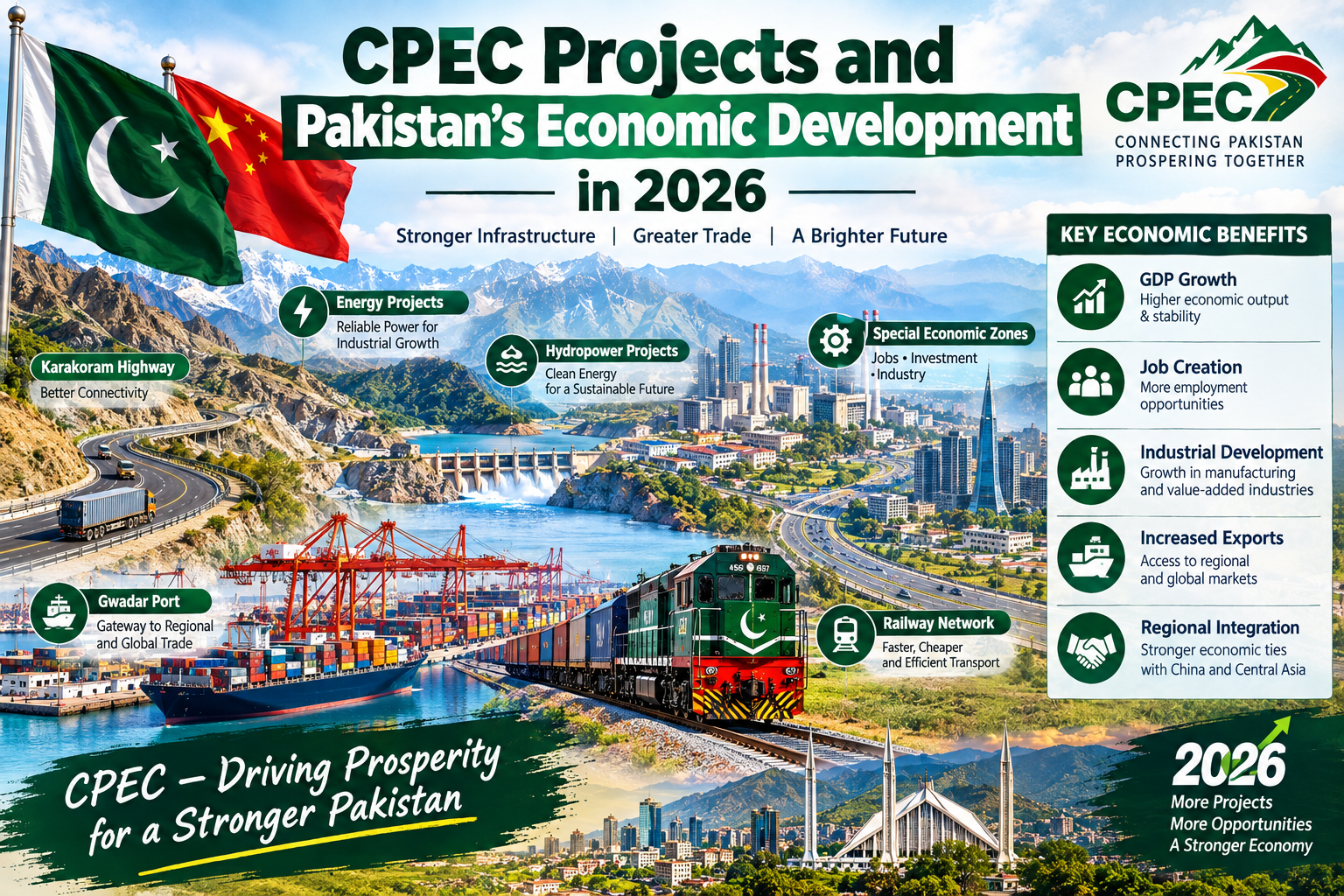
Its various components are designed to support economic activity by improving transportation, increasing energy availability, developing industrial zones, strengthening digital connectivity, and supporting communities.
The development of roads and transport networks can reduce travel times and make it easier to move goods between production centres, markets, ports, and borders.
Energy projects can support industrial and commercial activity by increasing electricity-generation capacity.
Special Economic Zones can provide spaces where businesses establish factories and other productive activities.
Agricultural and technological cooperation can improve skills and productivity.
Together, these components can contribute to a more connected and diversified economy.
CPEC Phase I and Its Achievements
The first phase of CPEC concentrated heavily on infrastructure and energy.
Several major transport projects have been completed. The official CPEC project portfolio lists the 120-kilometre Havelian-Thakot section of the Karakoram Highway, the 392-kilometre Multan-Sukkur motorway section, the 27-kilometre Lahore Orange Line Metro, and other connectivity projects among completed initiatives.
The energy portfolio has also been significant.
The CPEC Secretariat lists completed projects including the 1,320 MW Sahiwal coal-fired power plant, the 1,320 MW Port Qasim power project, the 1,320 MW China Hub project, the 660 MW Engro Thar project, wind farms, hydropower projects, and transmission infrastructure.
These projects were intended to address major infrastructure limitations and improve Pakistan’s ability to support economic activity.
The development of energy infrastructure was particularly important because electricity shortages had previously affected households and businesses.
However, infrastructure investment must ultimately be judged by its long-term economic impact. The benefits of power and transportation projects depend on whether they support productive businesses, employment, exports, and sustainable public finances.
This is why the transition toward CPEC 2.0 is important.
CPEC 2.0 and the Next Stage
The current phase of CPEC cooperation is increasingly focused on moving from infrastructure development toward broader economic cooperation.
At the 92nd CPEC Progress Review Meeting held on August 31, 2026, Pakistan’s Planning Ministry stated that CPEC Phase II would focus on industry, agriculture, minerals, technology, human-resource development, and business-to-business partnerships.
This represents an important change in emphasis.
Infrastructure remains necessary, but roads and power plants alone cannot guarantee economic transformation.
Pakistan needs factories, exporters, technology companies, agricultural businesses, skilled workers, and entrepreneurs who can use infrastructure to generate economic value.
Business-to-business cooperation can therefore become an important part of the next stage.
The government has also emphasized a Five Corridors framework for CPEC 2.0 involving innovation, livelihood, openness, green development, and growth.
The purpose of such a framework is to create a broader development approach rather than concentrating only on individual construction projects.
Industrial Development Through Special Economic Zones
Industrial cooperation is one of the most important opportunities associated with the next phase of CPEC.
Special Economic Zones, or SEZs, are designed to provide locations where businesses can establish manufacturing and industrial operations.
The official CPEC portfolio currently identifies several SEZ projects, including Rashakai Special Economic Zone, Allama Iqbal Industrial City, Dhabeji Special Economic Zone, and Bostan Special Economic Zone.
The basic idea behind these zones is to create an environment where businesses can access infrastructure and investment incentives.
Industrial zones can help Pakistan move toward higher-value manufacturing.
Instead of exporting only raw materials or semi-finished products, Pakistan can encourage businesses to process materials locally and produce finished goods.
This can create additional employment and potentially increase export earnings.
Industrial zones can also encourage the development of local supply chains.
For example, a large manufacturing company may need packaging companies, transport providers, maintenance services, suppliers, accountants, technology companies, and other businesses.
This can create indirect economic activity around major industrial investments.
Technology Transfer and Skills Development
One of the potential benefits of international investment is technology transfer.
Chinese companies operating in Pakistan can introduce modern machinery, production techniques, management practices, and technical knowledge.
For this benefit to become permanent, Pakistani workers and businesses need opportunities to acquire relevant skills.
Training and knowledge-sharing programmes can help Pakistani employees learn modern technologies and production methods.
Universities and technical institutions can also cooperate with industry to develop training programmes aligned with market requirements.
CPEC-related technical education initiatives are already part of the broader cooperation framework. The official project portfolio includes vocational and technical education projects, including initiatives in Gwadar.
Skills development is particularly important for young Pakistanis.
Infrastructure can create temporary construction jobs, but long-term economic development requires skilled employment in manufacturing, logistics, technology, agriculture, engineering, and business services.
Agriculture and CPEC 2.0
Agriculture is another major area of focus under the next phase of CPEC.
Pakistan has a large agricultural sector, but farmers face challenges involving productivity, water management, storage, technology, market access, and climate-related risks.
Modern agricultural technology can help address some of these problems.
At the 2026 CPEC progress review, Pakistan stated that around 1,000 Pakistani agricultural experts were being sent to China for training in advanced agricultural technologies, with the first group already having completed its training and returned to Pakistan.
Such cooperation can support knowledge transfer in areas such as modern farming techniques, agricultural machinery, food processing, storage, and productivity improvement.
Agricultural development can also support exports.
Pakistan already produces a range of agricultural commodities, but improving processing and packaging can help the country move toward higher-value food products.
Better cold-storage facilities can reduce post-harvest losses.
Improved logistics can help agricultural products reach markets more efficiently.
Technology can also provide farmers with better access to information about weather, markets, and production methods.
Minerals and Natural Resources
Mineral development has emerged as another area of interest under CPEC 2.0.
Pakistan has significant mineral resources, but extracting and processing these resources in an economically and environmentally responsible way requires investment, technology, infrastructure, and skilled workers.
Mineral development can generate export earnings and attract investment.
However, simply exporting raw minerals may limit the economic benefits.
A stronger strategy would encourage local processing where commercially viable.
Processing minerals inside Pakistan can create additional jobs, develop industrial capabilities, and increase the value of exports.
Mining projects also need strong environmental and community safeguards.
Local communities should benefit from economic activity through employment, infrastructure, skills development, and improved services.
Responsible resource development is essential for ensuring that mineral wealth contributes to long-term national development.
Transport Connectivity
Transportation is one of the most visible elements of CPEC.
Better roads and highways can improve connections between cities, industrial areas, agricultural regions, and ports.
The official CPEC transport portfolio includes completed, under-construction, and planned road projects. Among the projects listed in the pipeline are the upgrading and dualization of ML-1 and establishment of a dry port near Havelian, the Peshawar-D.I. Khan Motorway, and other road connections.
Improved transport can reduce travel times and make supply chains more efficient.
For exporters, efficient transportation is particularly important because delays can increase costs and reduce competitiveness.
For farmers, better roads can make it easier to transport crops and livestock to markets.
For industrial businesses, reliable transportation can improve access to raw materials and customers.
However, infrastructure needs regular maintenance.
Building a road is only the beginning. Long-term economic value depends on keeping infrastructure safe and functional.
Gwadar and Regional Connectivity
Gwadar has a prominent place in the CPEC framework.
The port and surrounding development are intended to support trade, logistics, economic activity, and regional connectivity.
Gwadar’s development includes infrastructure and social projects.
The official CPEC project portfolio lists initiatives such as the Gwadar hospital project, desalination facilities, vocational and technical projects, drinking-water equipment, and other social-development initiatives.
The development of Gwadar can potentially support logistics and trade if surrounding infrastructure and economic activity grow together.
A successful port requires more than a port facility.
It also needs roads, storage, customs services, businesses, skilled workers, utilities, and reliable connections to domestic and international markets.
Local residents also need to benefit from development.
Education, healthcare, employment, training, and business opportunities can help ensure that economic development produces broader social benefits.
Energy Development
Energy has been one of the largest components of CPEC.
Pakistan has historically faced energy shortages and high production costs, making electricity supply a major economic concern.
CPEC energy projects added substantial generation capacity. The official CPEC Secretariat states that Phase I added nearly 8,000 MW to Pakistan’s power-generation capacity.
The energy portfolio includes coal, hydropower, wind, and solar projects.
Energy availability can support factories, businesses, transportation systems, hospitals, schools, and households.
However, energy policy must also consider affordability and financial sustainability.
The electricity sector faces broader challenges involving distribution losses, collection, contracts, fuel prices, and circular debt.
Future energy investments therefore need to be evaluated carefully.
Renewable energy and efficient power systems can contribute to a more sustainable energy mix.
Pakistan can also benefit from better transmission infrastructure and improved management of electricity distribution.
Digital Connectivity
Modern economic corridors are no longer limited to roads and physical infrastructure.
Digital connectivity is increasingly important.
CPEC has included telecommunications-related projects, including a cross-border optical fibre cable between Khunjerab and Rawalpindi. The official transport and infrastructure portfolio lists this 820-kilometre optical-fibre project among completed initiatives.
Digital infrastructure can support businesses, education, government services, remote employment, and international trade.
Pakistan’s technology sector can benefit from improved connectivity by expanding software exports, freelancing, cloud services, digital marketing, and other online businesses.
Digital connectivity can also help smaller cities participate in the national economy.
A student in a remote area with reliable internet can access online educational resources.
A freelancer can work with an international customer.
A small business can market products beyond its local market.
This makes digital infrastructure an important part of modern economic development.
Employment Opportunities
CPEC projects can generate both direct and indirect employment.
Construction projects require engineers, technicians, drivers, workers, managers, and other professionals.
Industrial projects can create longer-term jobs in manufacturing, maintenance, logistics, administration, and management.
Agricultural modernization can generate employment in farming services, food processing, packaging, transportation, and technology.
The scale and quality of employment will depend on how successfully projects become integrated into the wider economy.
Training is therefore essential.
Pakistani workers should receive opportunities to acquire technical skills that remain valuable after individual projects are completed.
Vocational institutions can help prepare workers for manufacturing, construction, engineering, logistics, and energy-related occupations.
Young people can benefit particularly from apprenticeships and practical training.
Opportunities for Small and Medium Businesses
CPEC should not benefit only large corporations.
Small and medium-sized enterprises can play an important role in supplying goods and services to larger projects.
They can provide transportation, maintenance, construction materials, food services, packaging, software, professional services, and other inputs.
Connecting local businesses to larger supply chains can increase the domestic economic impact of investment.
However, small companies need access to finance, information, quality standards, and technical support.
Government agencies and large companies can help by providing transparent procurement opportunities and encouraging local suppliers where commercially appropriate.
Digital platforms can also help small businesses find customers and manage supply chains.
Increasing Pakistan’s Exports
One of the most important objectives of the next phase of CPEC is to support export-led growth.
Pakistan needs to increase foreign exchange earnings to strengthen its external financial position.
Industrial development can help by producing goods for international markets.
Agriculture can contribute through processed food and higher-value agricultural products.
Mineral development can create new export opportunities.
Technology can expand digital services exports.
The official CPEC Secretariat reported in August 2026 that Pakistan’s planning authorities had emphasized an ambition to increase national exports to $100 billion by 2035.
CPEC alone cannot achieve this target.
Pakistan will also need improvements in productivity, trade policy, energy reliability, education, logistics, taxation, and business regulation.
The corridor can provide infrastructure and investment opportunities, but Pakistani companies must become more competitive in global markets.
CPEC and Regional Trade
Pakistan’s geographical position gives CPEC potential regional significance.
Improved connectivity can create stronger links between Pakistan, China, Central Asia, and other regional markets.
Regional trade can support logistics, transportation, warehousing, manufacturing, and services.
However, regional connectivity depends on more than infrastructure.
Cross-border trade also requires efficient customs systems, predictable regulations, security, compatible standards, and reliable commercial relationships.
If these systems improve alongside physical infrastructure, Pakistan can strengthen its role as a regional trade and transit hub.
Human Development and Social Projects
Economic development is not only about roads, factories, and power plants.
Education, healthcare, clean water, vocational training, and other social services are also important.
The official CPEC project portfolio includes a range of social and livelihood initiatives, including educational facilities, medical projects, vocational training, agricultural cooperation, and disaster-preparedness activities.
These projects can contribute to human development when they are implemented effectively and maintained over time.
Human capital is particularly important because infrastructure cannot produce maximum economic benefits without skilled people.
Investment in education and healthcare can therefore complement physical investment.
Environmental Considerations
Large infrastructure and energy projects can have environmental impacts.
Pakistan is also highly vulnerable to climate-related risks, including floods, heatwaves, water stress, and changing agricultural conditions.
Future economic development should therefore incorporate environmental planning.
Renewable energy, efficient transport, responsible mining, water conservation, and climate-resilient infrastructure can help reduce environmental risks.
Projects should be assessed according to their long-term economic, social, and environmental effects.
Sustainable development can protect communities while improving the resilience of infrastructure.
Environmental considerations are particularly important for agriculture, water resources, mining, and energy projects.
Challenges Facing CPEC
Despite its potential, CPEC faces several challenges.
One challenge is timely project implementation.
Delays can increase costs and postpone economic benefits.
Another challenge is coordination.
CPEC involves federal ministries, provincial governments, public-sector organizations, regulators, businesses, and international partners. Effective coordination is therefore essential.
Security is another important consideration because large infrastructure projects require safe operating environments.
Financial sustainability also matters.
Projects need appropriate financing structures and realistic economic assessments.
Pakistan must ensure that investments contribute to productive economic activity and do not create unnecessary financial pressures.
Finally, local communities need to be included in development.
Economic projects are more sustainable when communities see clear benefits through employment, business opportunities, infrastructure, education, and public services.
Importance of Business-to-Business Cooperation
CPEC 2.0 places greater emphasis on business-to-business cooperation.
This approach can help shift economic activity from government-led infrastructure projects toward private-sector investment.
Pakistani and Chinese companies can explore partnerships in manufacturing, agriculture, technology, logistics, minerals, and other sectors.
Business partnerships can encourage technology transfer and access to international markets.
They can also create opportunities for Pakistani companies to join international supply chains.
For this model to succeed, Pakistan needs a competitive business environment.
Companies need clear regulations, efficient customs procedures, reliable energy, skilled workers, access to finance, and strong contract enforcement.
A successful private-sector ecosystem can make CPEC more economically sustainable over the long term.
Role of Youth in CPEC’s Future
Pakistan’s young population can become a major beneficiary of CPEC-related development.
Young people can find opportunities in engineering, information technology, manufacturing, logistics, agriculture, construction, tourism, and entrepreneurship.
Vocational education can prepare students for technical occupations.
Universities can develop professionals in engineering, business, computer science, economics, agriculture, and other relevant fields.
Entrepreneurship programmes can encourage young people to establish businesses that supply larger industries.
The key is to ensure that young people acquire skills aligned with actual economic opportunities.
Training should therefore be practical and connected to industry needs.
CPEC and Pakistan’s Long-Term Economic Strategy
CPEC should be considered as part of a wider national development strategy.
Pakistan needs to improve productivity, exports, education, energy security, governance, taxation, infrastructure, and investment.
CPEC can contribute to several of these areas, but it cannot replace domestic reforms.
For example, a new motorway can improve connectivity, but businesses still need predictable taxes and regulations.
An industrial zone can provide infrastructure, but companies still need skilled workers and access to markets.
A power plant can increase electricity supply, but the wider energy system must remain financially sustainable.
A port can support trade, but efficient customs and logistics are also necessary.
This means Pakistan’s domestic policies will determine how effectively it converts CPEC investment into long-term economic growth.
Future Prospects of CPEC
The future of CPEC increasingly depends on the transition from infrastructure-led development toward a broader economic partnership.
CPEC 2.0 is being positioned around industry, agriculture, technology, minerals, human development, and business cooperation.
This creates opportunities for Pakistan to build productive industries and increase exports.
The next stage can also support greater participation by private companies.
If Pakistani businesses become integrated into CPEC-related supply chains, the benefits could extend beyond large projects.
Technology and agriculture can further diversify the economic impact.
The success of this phase will depend on implementation, transparency, coordination, financial sustainability, security, and the ability to turn investment into productive economic activity.
Conclusion
CPEC remains an important component of Pakistan’s economic development strategy. Its first phase contributed major infrastructure and energy projects, while the next stage is increasingly focused on industrial cooperation, agriculture, minerals, technology, human-resource development, and business-to-business partnerships.
The completed transport network has improved connectivity in several parts of the country, while energy projects have added substantial generation capacity. Industrial zones provide opportunities for manufacturing and investment, and digital and social-development projects can support a broader transformation of the economy.
For Pakistan, the most important objective now is to ensure that CPEC produces sustainable economic benefits. Roads and power plants are valuable, but their greatest impact will come when they support factories, exporters, agricultural businesses, technology companies, entrepreneurs, and skilled workers.
CPEC 2.0 provides an opportunity to strengthen Pakistan’s productive capacity and deepen cooperation with China. Greater business-to-business investment can help Pakistani companies access technology, capital, expertise, and international markets.
Agriculture, minerals, technology, and manufacturing can all contribute to a more diversified economy. Training and education can help young Pakistanis take advantage of new employment opportunities.
At the same time, Pakistan must maintain strong standards for financial management, environmental protection, transparency, security, and community participation.
CPEC should therefore be viewed not simply as a collection of individual projects but as a long-term opportunity to strengthen Pakistan’s economic foundations.
If infrastructure investment is combined with domestic reforms, industrial growth, export development, skills training, technological innovation, and private-sector participation, CPEC can contribute significantly to Pakistan’s future economic growth.
The ultimate success of CPEC will be measured not only by kilometres of roads or megawatts of electricity but by the number of sustainable businesses created, jobs generated, exports increased, skills developed, and communities benefiting from economic progress.
Frequently Asked Questions (FAQs)
1. What is the main purpose of CPEC?
CPEC is a broad economic cooperation framework between Pakistan and China covering infrastructure, energy, industry, agriculture, technology, Gwadar development, and regional connectivity.
2. What is CPEC 2.0?
CPEC 2.0 refers to the next stage of Pakistan-China economic cooperation, with greater emphasis on industry, agriculture, minerals, technology, human-resource development, and business-to-business partnerships.
3. How can CPEC help Pakistan’s economy?
CPEC can support Pakistan through improved connectivity, energy infrastructure, industrial investment, employment, technology transfer, agricultural development, and opportunities to increase exports.
4. What role can young Pakistanis play in CPEC?
Young Pakistanis can benefit from opportunities in engineering, technology, manufacturing, agriculture, logistics, construction, entrepreneurship, and other sectors by developing relevant technical and professional skills.
5. Can CPEC increase Pakistan’s exports?
CPEC can contribute to export growth by supporting industrial development, improving transport infrastructure, encouraging business partnerships, developing agriculture and minerals, and strengthening connections with regional and international markets.