Introduction
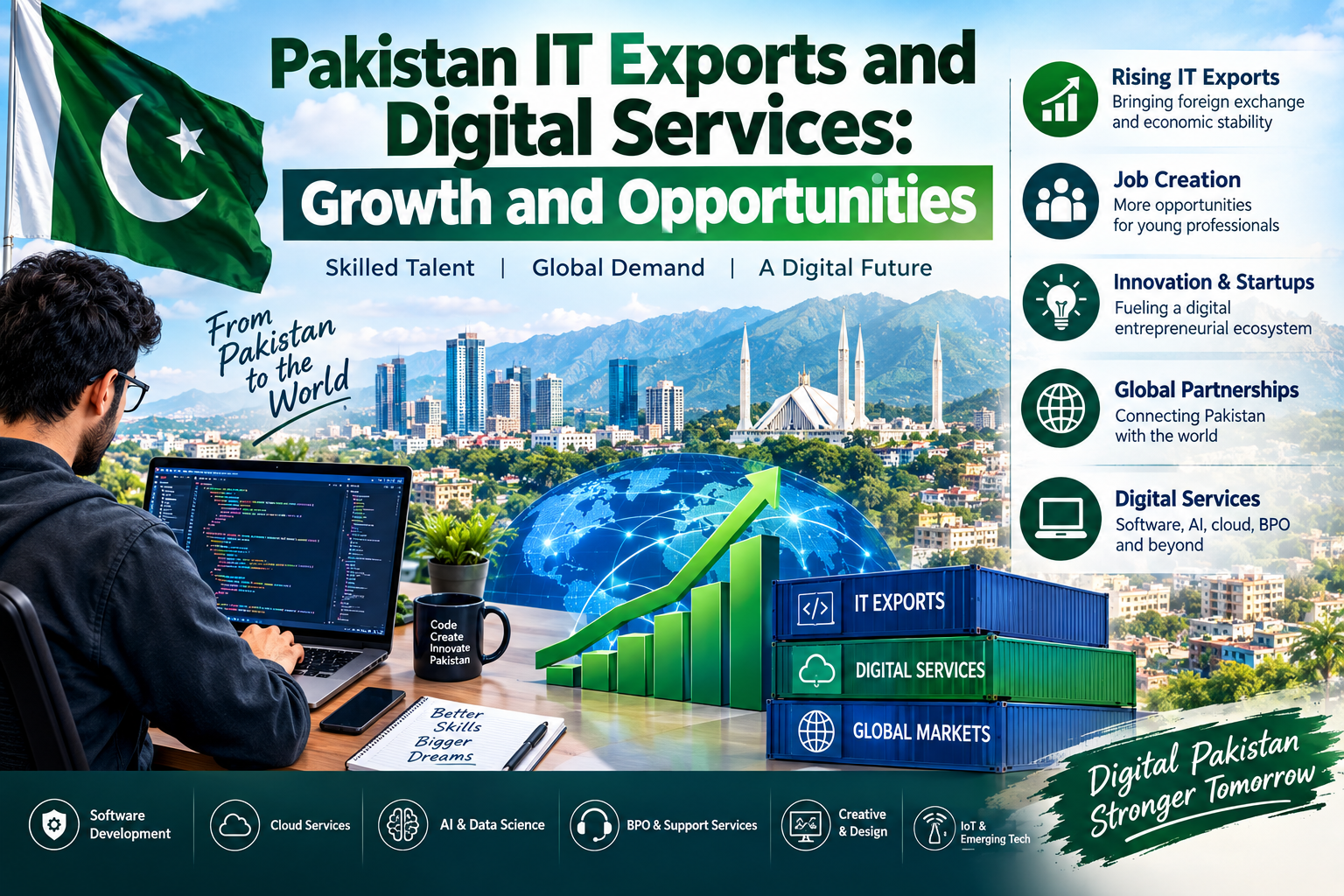
Pakistan’s information technology industry is becoming an increasingly important part of the national economy. As businesses around the world move toward digital services, Pakistan is seeking to strengthen its position in the international technology market and increase the amount of foreign exchange generated through information technology exports.
The growth of IT exports can provide Pakistan with an opportunity to diversify its economy beyond traditional sectors. The country has historically depended heavily on industries such as textiles, agriculture, manufacturing, and other physical goods for exports. Digital services offer another path because software, online business services, consulting, design, and other technology-based products can be delivered to international customers without the transportation costs associated with physical goods.
Pakistan has a large young population and a growing community of software developers, freelancers, digital entrepreneurs, engineers, and technology professionals. These human resources can become an important competitive advantage if they receive high-quality education, practical training, reliable digital infrastructure, and access to international markets.
The expansion of IT exports is also closely connected with the development of digital services inside Pakistan. Online payments, e-commerce, digital banking, cloud computing, artificial intelligence, cybersecurity, and digital government services are changing how individuals, businesses, and institutions operate.
However, increasing IT exports requires more than simply encouraging people to work online. Pakistan must address challenges involving skills, internet connectivity, cybersecurity, taxation, investment, business regulations, international payments, and professional standards.
A coordinated strategy involving the government, private companies, universities, financial institutions, technology professionals, and international partners can help Pakistan build a stronger and more competitive digital economy.
Why IT Exports Matter for Pakistan
IT exports are important because they can generate foreign exchange without requiring the country to export large quantities of physical goods.
When a Pakistani software company develops an application for a foreign customer or a freelancer provides digital marketing services to an international client, the payment received from abroad represents an export of services.
This model has several advantages.
First, digital services can reach customers in almost any country with an internet connection.
Second, technology companies can grow without requiring the same level of physical infrastructure as traditional manufacturing businesses.
Third, digital businesses can create employment for highly educated young people.
Fourth, technology exports can encourage investment in education and professional training.
Finally, a stronger technology industry can support innovation throughout the wider economy.
Pakistan can therefore use IT exports as one component of a broader strategy for improving its external financial position.
Pakistan’s Growing Digital Workforce
Pakistan has a large population of young people who are increasingly interested in digital careers.
Many young Pakistanis are learning programming, graphic design, video editing, digital marketing, website development, data analysis, and other online skills.
Freelancing has become particularly attractive because it allows professionals to work with clients from different countries.
However, the global freelancing market is highly competitive.
Simply learning a basic digital skill is not always enough to build a sustainable career. International clients often expect high-quality work, professional communication, reliable delivery, strong portfolios, and knowledge of modern tools.
Pakistan can increase the value of its digital workforce by moving toward advanced skills.
Instead of focusing mainly on low-cost services, technology professionals can develop expertise in software engineering, cloud computing, artificial intelligence, cybersecurity, data science, enterprise software, and specialized consulting.
Higher-value skills can increase earnings per worker and strengthen Pakistan’s reputation in international markets.
Government Support for IT Exports
Government policies play an important role in creating an environment where technology businesses can grow.
A supportive policy framework can make it easier for companies to register, receive investment, access banking services, hire skilled employees, export digital services, and receive international payments.
Government agencies can also support technology companies through training initiatives, export promotion, technology parks, startup programmes, and international trade events.
Digital policies should remain predictable so that businesses can make long-term decisions.
Technology companies often invest heavily in employees and infrastructure. Frequent policy changes can increase uncertainty and discourage investment.
A stable regulatory environment can encourage both local entrepreneurs and international companies to establish operations in Pakistan.
Government support should also focus on reducing unnecessary administrative barriers.
If a technology entrepreneur spends too much time dealing with complicated procedures, fewer resources remain available for product development and international business expansion.
Importance of Reliable Internet Connectivity
Internet connectivity is the foundation of the digital economy.
A freelancer cannot reliably serve an international client if their internet connection frequently stops working. A software company cannot maintain international operations without dependable communication systems. Online education also becomes difficult when students do not have stable access to the internet.
For this reason, Pakistan’s IT export strategy needs strong digital infrastructure.
Internet access should be reliable, affordable, and available across different parts of the country.
Major cities already contain significant technology activity, but smaller cities and rural communities also have talented people who could participate in the digital economy if they have access to suitable infrastructure.
Expanding broadband and mobile connectivity can therefore support both economic and regional development.
Digital infrastructure should include not only internet connections but also data centres, cloud services, secure networks, and modern telecommunications systems.
Developing IT Skills Through Education
Education is one of the most important factors affecting the future of Pakistan’s technology exports.
Schools and colleges can introduce students to computer science and digital literacy at an early stage.
Universities can provide advanced training in software engineering, artificial intelligence, data science, cybersecurity, information systems, and related fields.
However, education should not focus exclusively on theoretical knowledge.
Technology employers often require practical skills. Students need opportunities to work on real projects, solve problems, participate in internships, and understand how technology is used in businesses.
Universities can strengthen their programmes by working closely with technology companies.
Industry professionals can help universities identify the skills that employers need and provide students with practical exposure.
Training should also include communication, teamwork, project management, and professional ethics.
These skills are particularly important for people working with international clients.
Role of Freelancers in IT Exports
Freelancers are an important part of Pakistan’s digital services economy.
A freelancer may work independently or as part of a small team and provide services to customers in different countries.
Common areas include:
Software development
Website development
Graphic design
Digital marketing
Content creation
Video editing
Search engine optimization
Data analysis
Virtual assistance
Mobile application development
Freelancing can provide opportunities for people who do not have access to traditional employment.
It can also help people living outside major business centres participate in the international economy.
However, freelancers face several challenges.
They need reliable payment systems, access to international platforms, suitable banking services, professional training, and protection against fraud.
Some freelancers also struggle with inconsistent workloads.
Training in business development and client management can help freelancers build longer-term relationships rather than depending entirely on one-time projects.
Moving From Freelancing to Technology Companies
Freelancing can sometimes become the first step toward building a larger technology business.
A successful freelancer may eventually create a small agency and hire additional workers.
Over time, that agency can become a software company or digital services firm serving multiple international clients.
This transition can increase employment and export earnings.
Government and private-sector programmes can support this process by providing entrepreneurship training, access to finance, mentoring, and international networking opportunities.
Small technology companies can also benefit from export promotion programmes that help them understand international markets.
The goal should be to create an ecosystem where individual digital workers have opportunities to develop into professional businesses.
Artificial Intelligence and Pakistan’s Export Potential
Artificial intelligence is creating new opportunities for technology exports.
AI-powered products and services are increasingly being used in healthcare, finance, education, customer service, manufacturing, agriculture, and software development.
Pakistan can participate in this growing market by investing in AI education and research.
Universities can establish AI research centres and provide students with access to modern tools.
Technology companies can develop AI solutions for local and international customers.
Pakistan can also provide AI-related services to foreign companies that need data processing, software development, automation, and technical support.
However, AI requires advanced skills.
Professionals need knowledge of mathematics, statistics, programming, data management, and machine learning.
This means Pakistan must strengthen the foundations of its education system.
AI development should also be responsible. Issues involving privacy, bias, security, copyright, and accuracy need to be considered when developing and deploying AI systems.
Cybersecurity as an Export Opportunity
Cybersecurity is another field with significant international potential.
As businesses become increasingly dependent on digital systems, they require professionals who can protect networks, software, databases, and online services.
Pakistan can develop expertise in areas such as penetration testing, security monitoring, digital forensics, secure software development, and risk assessment.
Cybersecurity professionals can provide services to international companies remotely.
However, strong professional standards are essential.
International customers need confidence that cybersecurity service providers follow ethical and legal practices.
Universities and training institutions can help by providing structured education and practical laboratory experience.
A strong cybersecurity workforce would benefit not only Pakistan’s exports but also the security of domestic businesses and government institutions.
Software Development and Global Markets
Software development remains one of the strongest areas of Pakistan’s technology sector.
Pakistani developers can create websites, mobile applications, enterprise systems, cloud platforms, and specialized software for customers around the world.
The market is competitive, but companies that provide reliable and innovative solutions can establish long-term relationships with international clients.
Pakistan can improve its position by focusing on quality and specialization.
For example, companies may specialize in financial technology, healthcare software, logistics systems, education platforms, or agricultural technology.
Specialization can help businesses build expertise and develop a recognizable international reputation.
Technology companies should also invest in quality assurance, cybersecurity, documentation, customer support, and project management.
These areas are essential for maintaining long-term international relationships.
E-Commerce and Digital Services
The expansion of e-commerce can create additional opportunities for digital businesses.
Pakistani companies can sell products internationally through online platforms, while digital agencies can provide services to foreign e-commerce businesses.
Website development, online advertising, search engine optimization, customer support, product photography, and digital payment solutions are all part of the broader e-commerce ecosystem.
Pakistan’s IT professionals can therefore benefit indirectly from the growth of international online commerce.
Domestic e-commerce can also help local businesses develop the digital skills needed to eventually enter international markets.
Digital Payments and International Transactions
Efficient financial systems are essential for IT exports.
Freelancers and technology companies need convenient ways to receive international payments and convert foreign earnings into local currency.
Banks and financial technology companies can help by developing secure and efficient payment solutions.
International payment systems must also comply with financial regulations and anti-fraud requirements.
Simplifying legitimate digital transactions while maintaining financial security can help encourage more people to participate in the formal digital economy.
Digital payment records can also help businesses demonstrate income when seeking financing.
As more technology workers receive payments electronically, financial institutions may gain better insight into the digital services economy.
IT Parks and Technology Hubs
Technology parks and specialized business centres can support IT companies by providing infrastructure, networking opportunities, and professional services.
These facilities can bring technology companies, startups, freelancers, investors, and educational institutions closer together.
A strong technology hub can encourage collaboration and knowledge sharing.
However, simply establishing a physical technology park does not guarantee success.
The surrounding ecosystem must also include reliable internet, electricity, skilled workers, financing, transportation, and access to markets.
Technology hubs can be particularly useful in cities outside the largest commercial centres.
Developing multiple regional technology hubs could allow Pakistan to use talent from different parts of the country.
Expanding Technology Opportunities Beyond Major Cities
Pakistan’s digital economy has the potential to reduce some geographic barriers to employment.
A skilled person living in a smaller city can potentially work for an international company without moving to a major urban centre.
This can support regional economic development.
To achieve this, smaller cities need reliable internet, digital training facilities, suitable workspaces, and access to professional networks.
Educational institutions in these areas can play an important role.
Local training centres can provide young people with practical skills while remote work can connect them with international markets.
The expansion of digital employment can also reduce pressure on major cities by providing alternative career opportunities.
Women and IT Exports
Women can play an important role in Pakistan’s digital economy.
Technology-based work can provide professional opportunities for women through remote employment, freelancing, online entrepreneurship, and digital services.
However, women may face barriers related to access to devices, internet connectivity, training, financial services, and professional networks.
Technology programmes should therefore encourage women's participation.
Training opportunities should be accessible and designed around actual market demand.
Women entrepreneurs can also benefit from mentorship, business development support, and access to financing.
Increasing women's participation can expand Pakistan's available talent pool and strengthen household incomes.
Startups and Innovation
Technology startups can help Pakistan develop new products and services.
Startups often identify problems that traditional businesses have not addressed and use technology to create new solutions.
Pakistan has opportunities for startups in areas such as fintech, health technology, education technology, agricultural technology, logistics, e-commerce, and artificial intelligence.
However, startups often face difficulties obtaining early-stage investment.
Investors may be cautious about businesses that have not yet established stable revenue.
Incubators and accelerators can help entrepreneurs improve business plans and prepare for investment.
Universities can also provide entrepreneurship programmes that encourage students to transform innovative ideas into practical businesses.
A healthy startup ecosystem requires patience because not every new company will succeed.
The goal should be to create conditions where entrepreneurs can experiment, learn, and try again.
Digital Skills and Professional English
International IT exports depend not only on technical expertise but also on communication.
Many international clients use English for contracts, meetings, project instructions, and customer communication.
Professionals who can explain technical ideas clearly and communicate professionally may have an advantage.
Educational programmes should therefore combine technical skills with communication training.
This is particularly important for freelancers and small companies that communicate directly with international customers.
Strong communication can help prevent misunderstandings, improve customer satisfaction, and build long-term relationships.
Improving Research and Development
Research and development can help Pakistan move toward higher-value technology exports.
Universities, technology companies, and government research organizations can collaborate on practical problems.
Research areas could include artificial intelligence, renewable energy technology, agricultural technology, cybersecurity, healthcare systems, and digital finance.
Research should ideally have pathways toward commercialization.
When a university develops a useful technology, entrepreneurs should have opportunities to turn it into a product or service.
Intellectual property systems can also encourage innovation by providing appropriate protection for original inventions and creative work.
A stronger research ecosystem can help Pakistan develop technologies rather than simply consuming products created elsewhere.
Role of the Private Sector
Private technology companies are essential to increasing exports.
They employ workers, train professionals, develop products, and establish relationships with international clients.
Large companies can support smaller firms through partnerships and subcontracting opportunities.
Businesses can also work with universities to provide internships and practical training.
The private sector can help identify market trends and communicate emerging skill requirements to educational institutions.
Companies that invest in employee training can improve productivity while creating a stronger professional workforce.
A cooperative relationship between government and private industry can therefore accelerate digital development.
Importance of International Partnerships
International partnerships can provide Pakistan with access to technology, investment, training, and global markets.
Technology companies can establish partnerships with foreign businesses and universities.
International conferences and trade events can also help Pakistani companies showcase their capabilities.
Export promotion should focus on building long-term commercial relationships rather than short-term publicity.
Pakistani technology companies can benefit from entering markets where demand for software and digital services is growing.
The Middle East, Europe, North America, and other international regions offer potential opportunities, although each market has its own regulatory and commercial requirements.
Understanding customer needs is essential.
Challenges to Increasing IT Exports
Pakistan’s IT export ambitions face several challenges.
The first is the skills gap.
Not all technology graduates possess the practical skills demanded by international employers.
The second is infrastructure.
Internet reliability, electricity supply, and access to modern digital systems can affect business performance.
The third is international competition.
Pakistan competes with countries that have already established strong technology industries.
The fourth is access to finance.
Startups and small technology companies may find it difficult to obtain investment.
The fifth is cybersecurity.
A single serious security incident can damage a company's reputation.
The sixth is regulatory uncertainty.
Technology companies need predictable policies regarding taxation, payments, investment, data, and business operations.
Addressing these challenges requires long-term planning rather than temporary measures.
Building Trust in Pakistan’s Digital Services
International customers need confidence when working with Pakistani technology providers.
Companies can build trust by maintaining professional websites, clear contracts, transparent pricing, strong security practices, reliable communication, and consistent delivery.
Professional certifications and international standards may also help companies demonstrate their capabilities.
Quality assurance should become a normal part of technology operations.
A strong reputation can lead to repeat business and referrals.
Pakistan should therefore focus on building a reputation for quality rather than competing only through low prices.
Technology and the Future of Employment
The expansion of digital services will change the nature of employment.
Some traditional tasks may become automated, while new jobs will emerge.
Workers will increasingly need to learn new technologies throughout their careers.
This means Pakistan should encourage lifelong learning.
Short professional courses, online education, workplace training, and certification programmes can help workers update their skills.
Young people entering the workforce should understand that technology careers require continuous learning.
The ability to adapt may become as important as a specific technical skill.
Building a Sustainable Digital Economy
Pakistan’s technology strategy should focus on sustainability.
The goal should not simply be to increase the number of freelancers or software companies for a short period.
Instead, the country should develop a technology ecosystem that can continue growing for many years.
This requires investment in education, infrastructure, research, cybersecurity, entrepreneurship, and international market access.
Policies should encourage businesses to reinvest in their workers and technology.
Universities should strengthen research and practical learning.
Financial institutions should develop products suited to technology companies.
Government institutions should improve digital services and create clear regulations.
Together, these measures can support sustainable growth.
Conclusion
Pakistan’s efforts to increase IT exports and digital services represent an important opportunity for economic diversification and employment creation. The country has a large young population, an expanding technology workforce, and increasing interest in digital careers.
IT exports can generate foreign exchange while allowing Pakistani professionals to serve customers across international markets. Software development, freelancing, artificial intelligence, cybersecurity, cloud computing, digital marketing, e-commerce, and fintech all provide opportunities for future growth.
However, Pakistan must address several challenges if it wants to compete successfully in the global technology economy. Better education, practical skills, reliable internet, cybersecurity, efficient payment systems, access to investment, and predictable regulations are all necessary.
The country should also focus on moving toward higher-value technology services. Competing primarily on low prices may create short-term opportunities, but advanced skills and innovation can provide stronger long-term benefits.
Young people will remain at the centre of this transformation. With appropriate training and access to technology, they can become software developers, entrepreneurs, researchers, designers, cybersecurity experts, digital marketers, and international service providers.
Women and professionals living outside major cities should also have opportunities to participate in the digital economy. Expanding access to digital education and infrastructure can make technology growth more inclusive.
Government institutions, private companies, universities, financial institutions, and technology professionals all have important roles to play. Cooperation among these groups can create an ecosystem in which digital businesses can start, grow, export services, and create employment.
Pakistan’s digital future will depend on the quality of its people, infrastructure, institutions, and policies. If the country continues investing in technology skills and creates a supportive environment for innovation, IT exports can become an increasingly important source of economic growth.
A stronger digital economy can help Pakistan diversify its exports, increase foreign exchange earnings, create modern employment opportunities, encourage entrepreneurship, and connect Pakistani businesses with customers around the world. With consistent reforms and long-term investment, Pakistan has the potential to strengthen its position in the global digital services market.
Frequently Asked Questions (FAQs)
1. Why are IT exports important for Pakistan?
IT exports can generate foreign exchange, create employment, support technology companies, and diversify Pakistan’s economy beyond traditional physical exports.
2. How can Pakistan increase its IT exports?
Pakistan can increase IT exports by improving digital skills, strengthening internet infrastructure, supporting startups, simplifying business regulations, improving international payment systems, and focusing on higher-value technology services.
3. What IT services can Pakistan export?
Pakistan can export software development, website development, mobile applications, digital marketing, graphic design, cybersecurity, artificial intelligence, cloud services, data analysis, business-process outsourcing, and other digital services.
4. Can freelancing contribute to Pakistan’s economy?
Yes. Freelancers can provide digital services to international customers and generate foreign exchange while creating employment opportunities for skilled workers across different parts of Pakistan.
5. What is the future of Pakistan’s IT exports?
The future has significant potential in software development, artificial intelligence, cybersecurity, cloud computing, fintech, e-commerce, and specialized digital services if Pakistan continues investing in skills, infrastructure, innovation, and supportive policies.




