Introduction
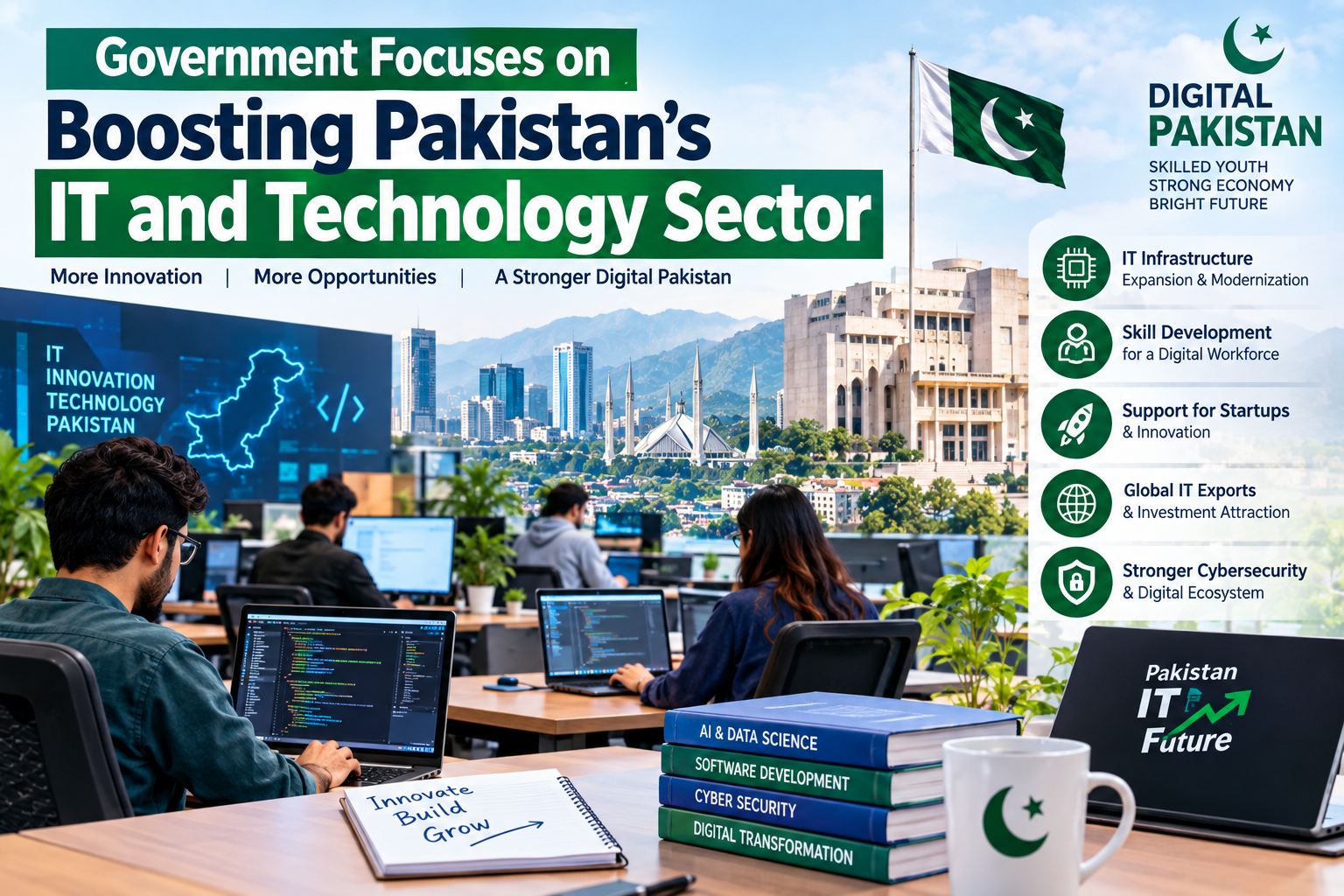
Pakistan’s information technology sector has become one of the most promising areas of the country’s economy. With a large young population, increasing internet access, growing digital adoption, and a rising number of technology professionals, Pakistan has significant potential to become a stronger player in the global digital economy. The government is therefore placing greater attention on information technology, software development, freelancing, digital services, artificial intelligence, cybersecurity, e-commerce, and technology-based entrepreneurship.
The global economy is changing rapidly because businesses are increasingly using digital technologies to provide services, communicate with customers, manage operations, and enter international markets. For Pakistan, this transformation creates an important opportunity. Unlike some traditional industries that require expensive physical infrastructure, many technology services can be delivered internationally through computers and internet connections.
Pakistan’s IT sector can generate foreign exchange, create employment opportunities for young people, support entrepreneurship, and help businesses become more competitive. Technology can also improve public services by making government processes faster, more accessible, and more transparent.
However, realizing this potential requires more than simply increasing the number of internet users. Pakistan needs skilled workers, reliable digital infrastructure, supportive policies, strong cybersecurity, better education, access to finance, and a business environment that encourages innovation.
The government’s increasing focus on technology can therefore play an important role in Pakistan’s broader economic development. If policies are implemented consistently and the private sector is given enough room to innovate, the technology industry could become one of the country's major sources of growth and employment.
Growing Importance of the IT Sector in Pakistan
Information technology has become an important part of modern economic activity. Businesses of almost every size now depend on computers, software, digital communication, online payments, cloud services, and data management.
In Pakistan, the technology sector has expanded beyond traditional software companies. It now includes freelancers, startups, software houses, digital marketing agencies, e-commerce businesses, fintech companies, gaming studios, artificial intelligence developers, cybersecurity professionals, and business-process outsourcing firms.
This diversity gives the sector considerable potential.
Young Pakistanis are particularly interested in digital careers because technology allows skilled individuals to work with local as well as international clients. A person with appropriate skills can provide services to customers in different countries without physically moving abroad.
Freelancing has consequently become an important part of Pakistan’s digital economy. Professionals provide services such as graphic design, programming, website development, content creation, video editing, digital marketing, data entry, virtual assistance, and other online services.
The growth of these activities can generate foreign exchange and create income opportunities for people outside major business centres.
Technology can also help small businesses. A local clothing seller, for example, can use social media and e-commerce platforms to reach customers across Pakistan. A small software company can provide services to overseas clients. A farmer or agricultural business can use digital platforms to obtain market information.
This demonstrates that the benefits of technology extend beyond traditional IT companies.
Government’s Digital Transformation Agenda
The government's focus on technology is linked to a wider effort to promote digital transformation across the economy.
Digital transformation means using technology to improve how businesses, institutions, and public organizations operate. It can involve online government services, digital payments, electronic records, automated systems, online education, telemedicine, and digital business platforms.
For citizens, digital government services can reduce the need to visit government offices repeatedly. Applications, certificates, payments, and information can increasingly be accessed through online systems.
For businesses, digital processes can reduce paperwork and administrative costs.
For government institutions, digital records can improve data management and make it easier to monitor public programmes.
However, digital transformation must be implemented carefully. Systems need to be secure, accessible, reliable, and easy to use.
People who do not have smartphones, computers, reliable internet connections, or sufficient digital literacy should not be excluded from essential public services.
The government therefore needs to combine digitalization with broader improvements in connectivity and digital education.
IT Exports and Foreign Exchange Earnings
One of the strongest reasons for Pakistan to develop its IT sector is its potential to increase exports.
Traditional exports often involve physical products such as textiles, rice, leather, sports goods, and surgical instruments. Technology services are different because they can be delivered electronically.
A software developer in Lahore, Islamabad, Faisalabad, Karachi, or another city can work on a project for a company located in North America, Europe, the Middle East, or another international market.
The resulting payment represents an export of services and can contribute to Pakistan’s foreign exchange earnings.
Increasing IT exports can help diversify the country's export base. A broader export portfolio can reduce dependence on a small number of traditional products.
Pakistan has already developed a growing community of software developers, freelancers, digital agencies, and technology entrepreneurs. With better training and infrastructure, these professionals could compete for more sophisticated international projects.
The country can move gradually from relatively simple digital services toward higher-value activities such as software engineering, artificial intelligence, cybersecurity, cloud computing, financial technology, and specialized business solutions.
Higher-value services generally require stronger skills, but they can also generate greater income per worker.
Freelancing and Youth Employment
Pakistan has a large young population, making youth employment a major economic priority.
The technology sector provides an opportunity to connect young people with international markets. Freelancing platforms and remote-work arrangements have made it possible for skilled workers to offer services without relocating.
This can be particularly valuable for people living outside major metropolitan areas.
A young person with a computer, internet connection, and marketable skills can potentially work for clients in different countries. However, success in freelancing requires more than simply creating an online profile.
Workers need technical abilities, communication skills, time management, professional behavior, and knowledge of international client expectations.
English-language communication can also be important because many international clients use English for business.
Training programmes should therefore combine technical education with practical professional skills.
Students can benefit from learning programming, graphic design, digital marketing, data analysis, video production, cybersecurity, and other marketable skills.
At the same time, they should understand basic business concepts such as pricing, contracts, client communication, invoicing, and financial management.
The government and educational institutions can help by providing accessible training programmes, mentorship, internet facilities, and career guidance.
Artificial Intelligence and Emerging Technologies
Artificial intelligence is rapidly changing the global technology industry. AI tools are being used for data analysis, customer service, software development, healthcare research, education, financial services, content processing, and many other activities.
Pakistan has an opportunity to participate in this transformation by developing local AI skills and encouraging research.
Universities can play an important role by supporting AI laboratories, research projects, technical education, and partnerships with technology companies.
Students should have opportunities to study areas such as machine learning, data science, computer vision, natural-language processing, robotics, and responsible AI.
However, AI development should also be accompanied by discussions about privacy, security, accuracy, employment changes, and ethical use.
AI can increase productivity, but workers may need to adapt as certain tasks become automated.
Instead of viewing technology only as a threat to employment, Pakistan can focus on preparing workers to use technology effectively.
For example, a graphic designer can use AI tools to improve productivity while continuing to provide creative direction. A programmer can use AI-assisted development tools while focusing on system design and problem-solving.
The ability to work alongside emerging technologies may become an important professional advantage.
Cybersecurity and Digital Safety
As Pakistan becomes more digitally connected, cybersecurity is becoming increasingly important.
Businesses, banks, schools, hospitals, government institutions, and individuals all store valuable information digitally. Cyberattacks, scams, data breaches, malware, and unauthorized access can cause significant financial and social damage.
Pakistan therefore needs stronger cybersecurity capabilities.
Universities and training institutions can help develop cybersecurity professionals who understand network security, digital forensics, secure software development, threat detection, and risk management.
Businesses should also invest in basic security measures such as strong passwords, multi-factor authentication, secure backups, software updates, and employee awareness programmes.
Digital safety is not only a technical issue. It also requires public awareness.
People should understand the risks associated with suspicious links, fraudulent messages, fake websites, and unauthorized requests for personal information.
As digital payments and online services become more common, cybersecurity awareness will become even more important.
A strong cybersecurity environment can also improve international confidence in Pakistan’s digital economy. Foreign companies are more likely to work with technology businesses that demonstrate professional security practices.
Expansion of E-Commerce
E-commerce is another area where technology can contribute to Pakistan’s economic development.
Online shopping allows businesses to reach customers beyond their immediate geographic areas. Small companies can sell products through websites, social media, and digital marketplaces without requiring a large network of physical stores.
Pakistan’s young population and increasing smartphone use provide a strong potential customer base for digital commerce.
However, e-commerce growth depends on several supporting systems.
Reliable delivery networks are essential because customers need to receive their purchases efficiently. Digital payment options must be convenient and secure. Customers also need confidence that products will match descriptions and that complaints will be handled fairly.
Businesses must improve product photography, descriptions, customer service, packaging, inventory management, and return policies.
The government can contribute by improving digital payment infrastructure, consumer protection, business registration, and taxation systems.
Greater use of digital payments can also help businesses maintain clearer financial records and improve access to formal financial services.
Digital Payments and Fintech
Financial technology, commonly called fintech, has changed how people and businesses conduct transactions.
Mobile wallets, digital banking, online transfers, QR-based payments, and other financial technologies can make payments faster and more convenient.
Digital payments may also help reduce dependence on cash.
For businesses, digital transactions can create useful records that support accounting and financial planning.
For consumers, electronic payments can make it easier to pay bills, shop online, transfer money, and access financial services.
Pakistan can benefit from expanding digital financial inclusion, particularly among people who have historically had limited access to traditional banking services.
However, trust is essential.
People need confidence that their money and personal information will be protected. Financial institutions and technology companies must therefore invest in cybersecurity, fraud prevention, customer support, and transparent policies.
Digital financial education should also be strengthened so that users understand basic security practices.
A growing fintech sector can support entrepreneurship and economic activity, but its development must be accompanied by responsible regulation.
Technology Startups and Entrepreneurship
Startups can play an important role in creating new products, services, and employment opportunities.
Pakistan has a growing community of technology entrepreneurs working in areas such as fintech, education technology, healthcare technology, logistics, e-commerce, agriculture technology, and software services.
Startups often begin with small teams but can grow rapidly if they identify a real market need.
However, entrepreneurs face challenges including access to investment, regulatory procedures, limited business networks, and difficulty finding experienced mentors.
A stronger startup ecosystem requires cooperation among government agencies, universities, investors, banks, technology companies, and entrepreneurs.
Incubators and accelerators can help early-stage companies by providing workspace, training, mentorship, networking opportunities, and access to investors.
Universities can also encourage students to develop practical solutions rather than focusing only on theoretical education.
Entrepreneurship education can teach students how to identify market problems, develop products, understand customers, manage finances, and build sustainable businesses.
Not every startup will succeed, but a healthy ecosystem can encourage experimentation and innovation.
Improving IT Education in Pakistan
Education is at the centre of technology development.
Pakistan needs more students to acquire strong foundations in mathematics, computer science, communication, problem-solving, and analytical thinking.
Schools can introduce students to basic digital skills from an early stage.
At higher levels, universities and technical institutions should offer programmes that reflect current industry needs.
The technology sector changes quickly, meaning educational curricula must also evolve.
Courses should include modern areas such as cloud computing, artificial intelligence, cybersecurity, data science, mobile development, software engineering, and digital entrepreneurship.
Practical learning is equally important.
Students can gain valuable experience through projects, internships, coding competitions, research activities, and industry partnerships.
Teachers also need opportunities for professional development so they can remain familiar with changing technologies.
Access is another major concern.
Students in smaller cities and rural communities should have opportunities to learn technology skills. Online education can help, but only when students have reliable internet and suitable devices.
Public-private partnerships could support computer labs, digital learning centres, and affordable training programmes.
Role of Universities in Technology Development
Universities can become major centres of innovation if they connect education with industry and research.
Research departments can work on problems related to agriculture, healthcare, energy, transportation, climate change, finance, and public services.
Technology students can develop solutions to real-world challenges through final-year projects and research programmes.
Universities can also establish innovation centres where students and researchers collaborate with businesses.
Strong links between universities and companies can help identify skills that employers need.
Internship programmes can give students workplace experience before graduation.
Research commercialization is another important area. Universities may produce valuable ideas, but those ideas need pathways toward practical products and businesses.
Technology transfer offices, startup incubators, patent support, and industry partnerships can help bridge the gap between research and commercial activity.
If Pakistan strengthens this university-industry connection, it can increase innovation while improving graduate employability.
Digital Infrastructure and Internet Connectivity
A successful digital economy requires reliable infrastructure.
Fast and affordable internet is essential for software companies, freelancers, online students, e-commerce businesses, remote workers, and digital government services.
Mobile connectivity has expanded significantly, but differences remain between urban and rural areas.
Some communities still experience slower internet speeds, service interruptions, or limited access to modern digital services.
Improving connectivity can therefore support economic inclusion.
Digital infrastructure should not be viewed as a luxury. For many businesses, internet access is now as important as electricity and transportation.
Data centres, cloud infrastructure, secure networks, and modern telecommunications systems are also increasingly important as the digital economy grows.
Investment in infrastructure should be accompanied by effective regulation and competition so that consumers and businesses can receive reliable services at reasonable prices.
Supporting Women in Technology
Women can make an important contribution to Pakistan's technology sector.
Digital careers may provide opportunities for women who face difficulties accessing traditional workplaces. Remote work, freelancing, online entrepreneurship, and digital services can create flexible professional pathways.
However, women still need access to quality education, devices, reliable internet, financial services, and professional networks.
Technology programmes should therefore ensure that women are included in training and entrepreneurship opportunities.
Women can participate in software development, design, digital marketing, cybersecurity, data science, education technology, and business management.
Increasing women's participation in the technology sector can expand the country's skilled workforce and encourage greater diversity in innovation.
Businesses can contribute by creating professional environments based on skills and performance and by providing opportunities for career development.
Technology and Rural Development
The benefits of technology should not remain limited to major cities.
Digital tools can support rural communities in agriculture, education, healthcare, commerce, and financial services.
Farmers can use digital platforms to access information about market prices, weather, crop management, and agricultural inputs.
Telemedicine can help connect patients in underserved areas with healthcare professionals when appropriate infrastructure is available.
Online education can give students access to courses and learning materials that may not be available locally.
Small rural businesses can use digital marketing and e-commerce to reach customers in larger markets.
These opportunities require reliable internet connectivity and digital literacy.
Government and private-sector investment in rural digital infrastructure could therefore support both social and economic development.
Technology and Government Services
Digital government can make public administration more efficient.
Online systems can reduce paperwork, shorten processing times, and make information easier to access.
Government departments can use digital databases to improve record management and coordination.
Citizens can benefit from online applications, electronic payments, digital certificates, and information portals.
However, digital systems must be designed with accessibility in mind.
Websites and applications should be easy to use, available on commonly used devices, and supported by clear instructions.
Data protection is also essential. Government institutions hold sensitive information, so cybersecurity and responsible data management must be treated as major priorities.
Digital transformation should improve service quality rather than simply transferring complicated paper processes onto a website.
The goal should be to redesign processes around citizens' needs.
Pakistan’s Potential in Global Technology Markets
Pakistan has several advantages that could help it compete internationally.
The country has a large population, a growing community of technology professionals, relatively strong English-language capabilities among many educated workers, and a developing startup ecosystem.
Its geographic location also provides potential connections with markets in the Middle East, Central Asia, South Asia, and beyond.
However, international competition is intense.
Countries around the world are investing heavily in technology education, digital infrastructure, research, and startup development.
Pakistan therefore needs to focus on quality rather than relying only on relatively low labour costs.
International clients increasingly look for reliability, technical expertise, data security, professional communication, and consistent delivery.
Pakistani technology companies that develop strong reputations can potentially secure long-term contracts and move toward higher-value services.
Building internationally recognized technology brands would also strengthen the country's reputation as a destination for digital services.
Challenges Facing Pakistan’s Technology Sector
Despite its opportunities, the technology sector faces several challenges.
The first is the skills gap. Not every graduate has the practical abilities required by technology employers.
The second is infrastructure. Internet reliability and access remain concerns in some areas.
The third is financing. Startups and small technology businesses may struggle to obtain suitable investment.
The fourth is regulatory uncertainty. Businesses need clear and predictable policies.
The fifth is cybersecurity. As digital activity grows, threats also increase.
The sixth is international competition. Pakistani businesses must compete with companies from countries that have already developed strong technology ecosystems.
Another challenge is the need for stronger links between education and industry.
Addressing these problems requires coordinated action.
Government agencies can improve policies and infrastructure. Universities can strengthen practical education. Private companies can provide training and internships. Investors can support promising startups. Technology professionals can contribute through mentorship and knowledge sharing.
Future Opportunities in Artificial Intelligence, Cloud Computing and Software
The next phase of Pakistan's technology development could involve increasingly sophisticated services.
Artificial intelligence can support healthcare, agriculture, finance, education, customer service, and business analytics.
Cloud computing can help companies access powerful digital infrastructure without building large physical systems themselves.
Cybersecurity services can become increasingly important as organizations move more operations online.
Software development can continue to provide export opportunities, while specialized services can generate higher-value revenue.
Pakistan can also explore opportunities in gaming, animation, digital media, educational technology, health technology, and financial technology.
To benefit from these fields, the country needs workers who are comfortable learning continuously.
Technology changes rapidly, so professional development cannot stop after graduation.
A strong culture of lifelong learning can help workers remain competitive.
The Role of the Private Sector
Government policy is important, but the private sector will remain a major driver of technology growth.
Technology companies can create jobs, develop products, train employees, and enter international markets.
Large companies can support smaller businesses through supply chains and partnerships.
Banks and financial institutions can provide financing to technology entrepreneurs.
Telecommunications companies can invest in connectivity.
Universities can collaborate with businesses on research and training.
This ecosystem approach is more likely to produce sustainable results than relying on one institution alone.
Private companies can also contribute to social development by offering internships, scholarships, training programmes, and community technology initiatives.
Building a More Inclusive Digital Economy
Pakistan's technology development should benefit people from different backgrounds and regions.
Digital inclusion means ensuring that people have access not only to internet connections but also to devices, skills, affordable services, and useful digital opportunities.
A student who has internet access but no suitable device may still struggle to learn effectively.
Similarly, a small business owner may have a smartphone but lack the skills needed to market products online.
Digital inclusion therefore requires a broader approach.
Affordable connectivity, digital literacy, cybersecurity education, online financial services, and accessible training should develop together.
An inclusive digital economy can create opportunities for people who have traditionally been excluded from formal economic activity.
Conclusion
Pakistan’s information technology sector has the potential to become one of the country's most important engines of economic growth. The government’s increasing focus on digital transformation, IT exports, entrepreneurship, artificial intelligence, cybersecurity, digital payments, and technology education reflects the growing importance of the digital economy.
The sector can create employment for young people, generate foreign exchange, support startups, improve public services, and help Pakistani businesses reach international customers.
However, this potential will not be achieved automatically. Pakistan needs consistent policies, reliable internet infrastructure, practical education, cybersecurity protections, access to finance, and a business environment that encourages innovation.
The education system must prepare students for modern technology careers, while universities and private companies should work together to provide practical experience. Rural communities and women should also have meaningful opportunities to participate in the digital economy.
Pakistan can strengthen its international position by moving toward higher-value technology services rather than competing only on low costs. Artificial intelligence, cloud computing, cybersecurity, software development, fintech, e-commerce, and digital services can all contribute to this transition.
The country's young population is one of its greatest potential strengths. With the right education, infrastructure, and opportunities, young Pakistanis can become developers, entrepreneurs, researchers, designers, cybersecurity professionals, digital creators, and international service providers.
The future of Pakistan’s economy will increasingly depend on how effectively it uses technology. Continued investment in digital skills, infrastructure, innovation, and responsible technology policies can help create a stronger, more competitive, and more inclusive economy.
If these efforts are implemented consistently, Pakistan’s technology sector can move from being an emerging area of economic activity to becoming a major contributor to exports, employment, entrepreneurship, and national development.
Frequently Asked Questions (FAQs)
1. Why is the IT sector important for Pakistan?
The IT sector can generate foreign exchange, create employment, support entrepreneurship, increase exports, and help Pakistani businesses compete in international markets.
2. How can Pakistan increase IT exports?
Pakistan can increase IT exports by improving technical skills, expanding digital infrastructure, supporting technology companies, strengthening cybersecurity, and encouraging higher-value services such as software development, AI, and cloud computing.
3. Can technology create more jobs for Pakistani youth?
Yes. Technology can create opportunities in software development, freelancing, digital marketing, cybersecurity, data science, graphic design, e-commerce, artificial intelligence, and other digital fields.
4. What are the major challenges facing Pakistan’s IT sector?
Major challenges include the skills gap, internet and infrastructure limitations, limited startup financing, cybersecurity risks, regulatory uncertainty, and strong international competition.
5. What is the future of technology in Pakistan?
Pakistan has significant potential in IT exports, artificial intelligence, fintech, e-commerce, cybersecurity, cloud computing, software development, and digital services if investment and reforms continue consistently.