Introduction
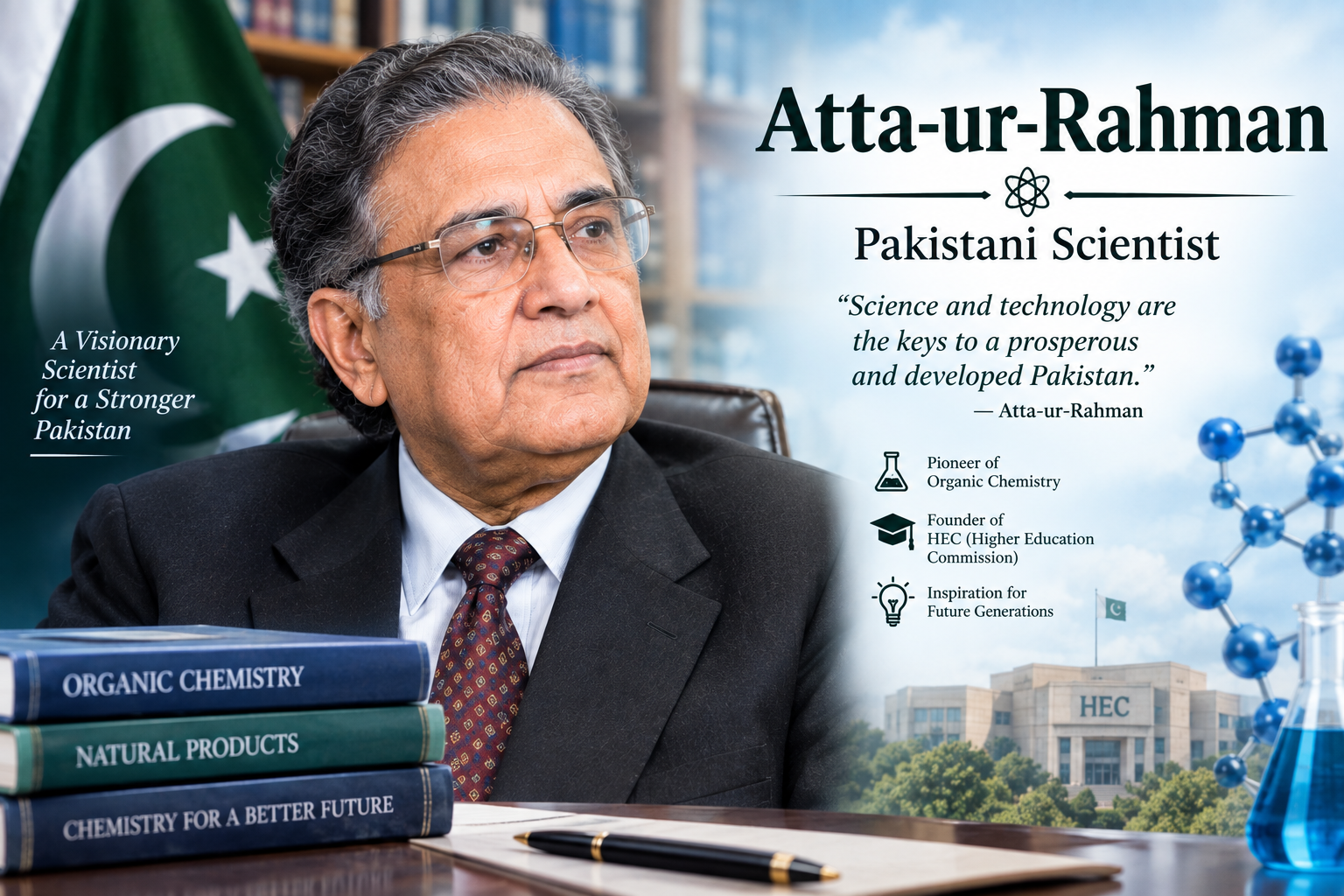
Atta-ur-Rahman is a famous Pakistani scientist and an important name in the field of chemistry. He is especially known for his research in organic chemistry and natural products. He has also played an important role in the development of scientific research and higher education in Pakistan.
Atta-ur-Rahman was born in Delhi, India, on 22 September 1942. He later became one of Pakistan's leading scientists. His educational journey took him from the University of Karachi to the University of Cambridge in the United Kingdom. He completed his higher studies in chemistry and developed a long career in scientific research.
His scientific work has focused mainly on organic chemistry, phytochemistry, natural products, and modern spectroscopy. Phytochemistry is the study of chemicals found in plants. Natural-product research can help scientists understand substances produced by plants and investigate their possible scientific and medical applications.
Apart from laboratory research, Atta-ur-Rahman has worked to promote universities, research institutions, scientific education, and technology in Pakistan. He has served as a professor, research institute director, university administrator, government science minister, and chairman of the Higher Education Commission.
His life is an example of how scientific education can lead to research as well as wider contributions to education and national scientific institutions.
Early Life
Atta-ur-Rahman was born on 22 September 1942 in Delhi. His early life took place during an important period in the history of South Asia.
After the creation of Pakistan in 1947, he became part of the new country's educational and scientific environment. He later pursued higher education in chemistry and developed a strong interest in scientific research.
His early interest in chemistry became the foundation of a career that eventually connected laboratory research with higher education and science policy.
For a scientist, the early years of education are very important. Chemistry requires an understanding of mathematics, laboratory methods, observation, and careful analysis. These skills became important parts of Atta-ur-Rahman's professional life.
Education at the University of Karachi
Atta-ur-Rahman studied at the University of Karachi. According to the Pakistan Academy of Sciences, he completed his B.Sc. (Honours) in Chemistry in 1963 and his M.Sc. in Organic Chemistry in 1964.
His focus on organic chemistry was important because this field studies carbon-containing compounds and their structures, properties, reactions, and uses.
After completing his master's degree, he continued his education abroad. His academic progress demonstrates the importance of advanced education in developing scientific expertise.
Studies at Cambridge University
Atta-ur-Rahman went to Cambridge University in the United Kingdom for doctoral studies. He completed his Ph.D. in Chemistry in 1968. He later received a Sc.D. from Cambridge in 1987.
Cambridge provided him with an advanced scientific environment and opportunities for research.
Studying at a major international university also gave him exposure to modern scientific methods and research communities. After completing his higher education, he continued his scientific career and eventually became a professor at the University of Karachi.
Career in Chemistry
Atta-ur-Rahman's professional career has mainly been connected with chemistry. His research areas include organic chemistry and phytochemistry, with an emphasis on novel natural products and their possible clinical applications. Modern nuclear magnetic resonance, or NMR, spectroscopy is also among his research areas.
Organic chemistry is a large field with applications in medicine, agriculture, materials, pharmaceuticals, and many other areas.
Natural products are substances that come from living organisms, especially plants. Scientists can study these substances to understand their chemical structures and biological properties.
Atta-ur-Rahman's research contributed to the study of natural products and helped develop scientific research in this area in Pakistan.
Research in Natural Products
Natural products have been studied by humans for centuries. Plants contain many different chemical compounds, and scientists can examine these compounds using modern laboratory techniques.
Atta-ur-Rahman became known for research in natural-product chemistry. His work included the isolation and study of chemical compounds from natural sources.
UNESCO records that his scientific work in organic chemistry contributed to research involving plant-based therapies and to the development of an important scientific center in Pakistan.
This type of research demonstrates how traditional knowledge about plants can be examined using modern scientific methods.
Importance of Organic Chemistry
Organic chemistry is important because many substances used in everyday life contain carbon-based compounds.
Medicines, plastics, dyes, fuels, food chemicals, and many biological molecules involve organic chemistry.
For students, learning organic chemistry can help explain how molecules are structured and how chemical reactions take place.
Atta-ur-Rahman's career shows how a strong foundation in chemistry can lead to research in many areas.
Work at the University of Karachi
Atta-ur-Rahman spent many years at the University of Karachi. According to the Pakistan Academy of Sciences, he became a professor there in 1981 and continued in that role until 2011. He also served as Director of the H.E.J. Research Institute of Chemistry from 1990 to 2008.
The research institute became an important center for chemical research in Pakistan.
Research institutions provide scientists with laboratories, equipment, students, researchers, and opportunities for collaboration.
Building such institutions is important because scientific progress depends not only on individual scientists but also on strong research environments.
H.E.J. Research Institute of Chemistry
The H.E.J. Research Institute of Chemistry at the University of Karachi is closely associated with Atta-ur-Rahman's scientific career.
As director, he worked in an environment focused on chemical research and scientific training.
Research centers can provide opportunities for young scientists to learn laboratory methods, conduct experiments, write research papers, and communicate their findings.
Developing such centers can also help a country build a larger community of researchers.
International Scientific Recognition
Atta-ur-Rahman's scientific work received international recognition.
He received the UNESCO Science Prize in 1999. UNESCO records describe the award in connection with his work in organic chemistry and his contribution to the development of a scientific center in Pakistan.
The Pakistan Academy of Sciences also lists many international awards and honors associated with his career, including the International Cooperation Award for Science and Technology and the Friendship Award of China.
These recognitions reflect his long involvement in scientific research and international scientific cooperation.
Awards in Pakistan
Atta-ur-Rahman has received several civilian awards from the Government of Pakistan.
The Pakistan Academy of Sciences lists:
Tamgha-i-Imtiaz in 1983
Sitara-i-Imtiaz in 1991
Hilal-i-Imtiaz in 1997
Nishan-i-Imtiaz in 2002
He has also received several scientific medals and awards from Pakistani and international organizations.
These awards recognize different stages of his scientific and professional career.
UNESCO Science Prize
The UNESCO Science Prize is one of the international recognitions associated with Atta-ur-Rahman's scientific career.
In 1999, UNESCO records recognized his work in organic chemistry and his contribution to developing a scientific center in Pakistan.
International recognition can help bring attention to scientific research conducted in developing countries.
It also shows that researchers working outside the world's largest scientific centers can make contributions that receive international attention.
Chinese International Science and Technology Cooperation Award
Atta-ur-Rahman also received China's International Science and Technology Cooperation Award in 2020.
The Pakistan Academy of Sciences reported that Chinese President Xi Jinping presented the award to him in Beijing on 10 January 2020. The Academy described the honor as recognition of his contributions to chemistry and scientific cooperation.
International scientific cooperation allows researchers from different countries to exchange knowledge and develop professional connections.
Fellowship of the Royal Society
Atta-ur-Rahman became a Fellow of the Royal Society in 2006 according to the Pakistan Academy of Sciences.
The Royal Society is a major scientific institution in the United Kingdom.
Becoming a Fellow is an important recognition within the scientific community. It reflects the international reach of his research career.
Work as a Teacher
Teaching has been another important part of Atta-ur-Rahman's career.
A scientist working at a university does not only conduct research. Professors also teach students, supervise research, guide young scientists, and help develop academic departments.
Atta-ur-Rahman's long association with the University of Karachi allowed him to work with many students and researchers.
Scientific education is especially important for developing countries because universities need trained scientists to continue research in future generations.
Supporting Young Scientists
One important part of scientific development is training young researchers.
Research students learn by working with experienced scientists. They learn how to design experiments, analyze results, use scientific equipment, write research papers, and communicate their findings.
Atta-ur-Rahman's work in universities and research institutions was connected with scientific training.
A strong research culture can encourage students to choose careers in science, technology, engineering, and medicine.
Role in Higher Education
Atta-ur-Rahman also became involved in higher education administration.
He served as Chairman of Pakistan's Higher Education Commission from 2002 to 2008. The Pakistan Academy of Sciences records that he held this position at the federal level.
Higher education includes universities, postgraduate studies, research laboratories, and advanced professional training.
A country's scientific development is closely connected with the quality of its universities.
During his professional career, Atta-ur-Rahman was involved in efforts related to research and higher education development.
Science and Technology Policy
Atta-ur-Rahman has also served in government science and technology positions.
The Pakistan Academy of Sciences records that he served as Federal Minister for Science and Technology from 1999 to 2002. He later served as Advisor to the Prime Minister and Federal Minister in charge of the Ministry of Science and Technology.
These positions placed him in a role where scientific knowledge could be connected with government planning.
Science policy includes decisions about research funding, universities, laboratories, innovation, technology, and scientific institutions.
COMSTECH
Atta-ur-Rahman also served as Coordinator General of COMSTECH from 1996 to 2012 according to the Pakistan Academy of Sciences.
COMSTECH is connected with scientific and technological cooperation among member countries of the Organization of Islamic Cooperation.
International scientific cooperation can help countries share knowledge, research opportunities, and technical expertise.
His work with international scientific organizations expanded his activities beyond Pakistan.
Pakistan Academy of Sciences
Atta-ur-Rahman has had a long relationship with the Pakistan Academy of Sciences.
He was elected a Fellow of the Academy in 1982 and later served as its president during different periods.
Scientific academies provide platforms for researchers to discuss scientific issues, recognize achievements, and encourage research.
The Academy also awards the Dr. Atta-ur-Rahman Gold Medal in Chemistry for scientists under 40. This award recognizes younger Pakistani scientists in chemistry.
Research in NMR Spectroscopy
Modern NMR spectroscopy is another research area associated with Atta-ur-Rahman.
NMR stands for nuclear magnetic resonance. It is a scientific technique used to study the structure of molecules.
Scientists can use NMR information to understand how atoms are arranged within chemical compounds.
This technique is important in chemistry, biochemistry, pharmaceuticals, and natural-product research.
The use of advanced instruments such as NMR spectrometers shows how modern chemistry depends on both theoretical knowledge and technology.
Contribution to Scientific Institutions
A scientist can contribute to a country not only by publishing research papers but also by helping build institutions.
Atta-ur-Rahman's career has included leadership roles in research institutes, universities, scientific academies, and government organizations.
Strong scientific institutions can provide laboratories, research funding, training, equipment, and opportunities for collaboration.
These institutions help create an environment in which future scientists can develop their skills.
Books and Scientific Writing
Atta-ur-Rahman has also been involved in scientific writing and editing.
The Pakistan Academy of Sciences records his association with international and national chemistry journals and with books and scientific publications.
Scientific writing is an important part of research because discoveries need to be communicated to other scientists.
A research paper allows other researchers to understand the methods, results, and conclusions of a scientific study.
Good scientific communication helps knowledge move from one laboratory to another.
Science for National Development
Science and technology are important for the development of any country.
Research can help improve agriculture, healthcare, industry, energy, education, environmental studies, and communication.
Atta-ur-Rahman's career has connected scientific research with higher education and national science policy.
His work demonstrates that a scientist can contribute through laboratory research as well as through teaching and institutional leadership.
Importance of Chemistry for Pakistan
Chemistry has many applications in Pakistan.
Agriculture depends on fertilizers, pesticides, soil chemistry, and food science. Healthcare depends on medicines and pharmaceutical research. Industry depends on materials, chemicals, plastics, dyes, and manufacturing processes.
Natural-product research can also help scientists study the chemical properties of plants.
A strong chemistry research community can therefore support many areas of national development.
Scientific Cooperation
Modern science is international.
Scientists regularly share research findings through journals, conferences, universities, and international organizations.
Atta-ur-Rahman's career included cooperation with scientists and institutions in many countries.
His international fellowships, awards, and academic positions show the importance of scientific communication across national borders.
Scientific cooperation can help researchers learn new methods and work together on complex problems.
Lessons for Students
The life of Atta-ur-Rahman gives several useful lessons to students.
The first lesson is the importance of education. He studied chemistry at the University of Karachi and Cambridge University.
The second lesson is the importance of research. Scientific progress requires curiosity and careful investigation.
The third lesson is the value of teaching. Experienced scientists can help younger students develop their abilities.
The fourth lesson is the importance of institutions. Laboratories, universities, research centers, and scientific organizations provide the environment needed for scientific development.
The fifth lesson is continuous learning. Science changes with time, so scientists must continue learning new methods and technologies.
Inspiration for Young Pakistani Scientists
Young Pakistani students who are interested in science can find useful inspiration in Atta-ur-Rahman's academic journey.
Students can start by developing strong foundations in chemistry, physics, mathematics, biology, and computer skills.
They can also improve their English because much of the world's scientific literature is written in English.
Reading scientific books, watching educational lectures, performing safe school experiments, and asking questions can help develop scientific thinking.
Students should also understand that becoming a scientist usually takes many years of education and research. Patience and consistency are important.
Importance of Hard Work
Scientific careers require dedication.
Experiments may not always produce expected results. Researchers may need to repeat experiments, study previous research, change methods, and analyze new information.
Academic careers also require writing, teaching, reading, and continuous learning.
Atta-ur-Rahman's long career in research and education demonstrates the value of maintaining a long-term commitment to scientific work.
International Impact
Atta-ur-Rahman's career has extended beyond Pakistan.
His international awards, fellowships, research collaborations, and scientific positions have connected him with institutions in different countries.
The Pakistan Academy of Sciences lists affiliations and recognitions involving organizations in the United Kingdom, China, Turkey, Malaysia, Thailand, and other countries.
This international dimension is important because science is a global activity.
A scientist's research can be read and used by researchers in many countries.
A Scientist and Education Leader
Atta-ur-Rahman is notable because his career combines several roles.
He has been a researcher, professor, research institute director, scientific administrator, government science official, and higher education leader.
Each role involves different responsibilities.
As a researcher, the focus is scientific discovery. As a teacher, the focus is students. As an administrator, the focus is institutions. As a science-policy leader, the focus is broader scientific development.
His career therefore provides an example of how scientists can work in different areas during their professional lives.
Legacy
Atta-ur-Rahman's legacy is connected with chemistry, scientific research, higher education, and the development of scientific institutions in Pakistan.
His research in organic chemistry and natural products received international recognition. He also became involved in the development and leadership of research institutions and higher education organizations.
The Pakistan Academy of Sciences continues to list the Dr. Atta-ur-Rahman Gold Medal in Chemistry for younger scientists, connecting his name with the recognition of new researchers.
This is one example of how the contribution of an established scientist can continue to influence future generations.
Conclusion
Atta-ur-Rahman is an important Pakistani scientist whose career has covered chemistry, research, higher education, and science policy.
Born in Delhi in 1942, he studied chemistry at the University of Karachi and later completed his Ph.D. at Cambridge University. His scientific research has focused on organic chemistry, phytochemistry, natural products, and modern spectroscopy.
He spent many years at the University of Karachi and served as Director of the H.E.J. Research Institute of Chemistry. He also held major national positions, including Chairman of the Higher Education Commission and Federal Minister for Science and Technology.
His scientific work received international recognition, including the UNESCO Science Prize in 1999 and China's International Science and Technology Cooperation Award in 2020.
He has also received major civilian awards in Pakistan, including the Tamgha-i-Imtiaz, Sitara-i-Imtiaz, Hilal-i-Imtiaz, and Nishan-i-Imtiaz.
His story shows the importance of education, research, scientific institutions, and international cooperation. For Pakistani students, his career provides an example of how studying science can lead to opportunities in research, teaching, and scientific leadership.
Science continues to play an important role in the future of Pakistan. Students who develop curiosity, knowledge, discipline, and research skills can contribute to the country's scientific and technological development.
FAQs
1. Who is Atta-ur-Rahman?
Atta-ur-Rahman is a Pakistani scientist and chemist known for his research in organic chemistry, natural products, and scientific education.
2. When was Atta-ur-Rahman born?
Atta-ur-Rahman was born on 22 September 1942 in Delhi, India.
3. Where did Atta-ur-Rahman study?
He studied chemistry at the University of Karachi and later completed his Ph.D. in Chemistry at Cambridge University in the United Kingdom.
4. Which major awards has Atta-ur-Rahman received?
He has received several national and international awards, including the UNESCO Science Prize, Nishan-i-Imtiaz, Hilal-i-Imtiaz, and Sitara-i-Imtiaz.
5. What is Atta-ur-Rahman known for?
He is known for his research in organic chemistry and natural products and for his work in higher education and scientific institution building in Pakistan.




