Introduction
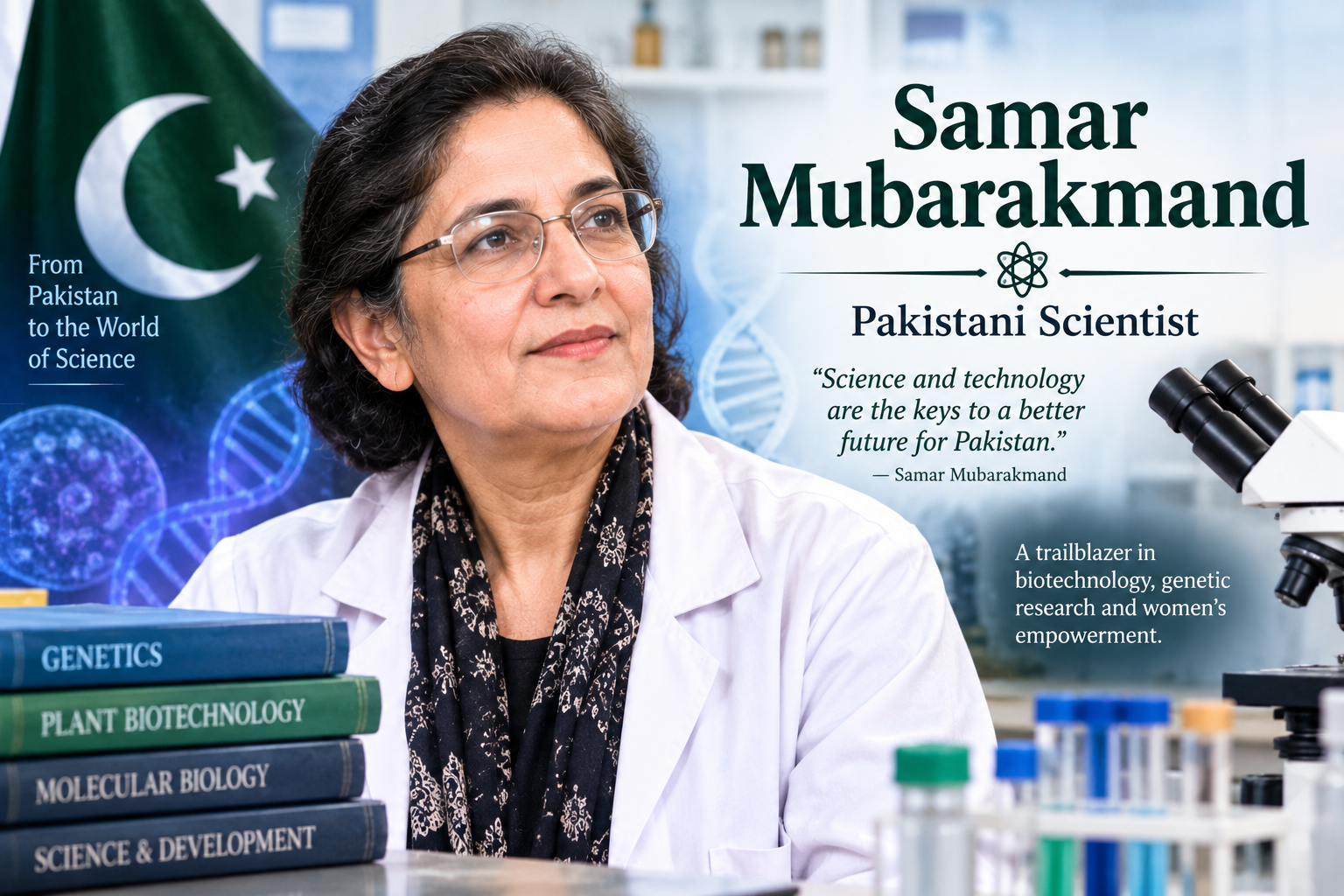
Samar Mubarakmand is a well-known Pakistani scientist and nuclear physicist. He has spent much of his professional life working in science, research, technology, and national scientific projects. His career is connected with several important scientific institutions in Pakistan, including the Pakistan Atomic Energy Commission, the Pakistan Institute of Nuclear Science and Technology, and the National Engineering and Scientific Commission.
Samar Mubarakmand was born on 17 September 1942 in Rawalpindi, in what was then British India. He received his early education in Lahore and later studied physics at Government College Lahore, now known as Government College University Lahore. He then went to the University of Oxford in the United Kingdom, where he completed his doctoral studies in experimental nuclear physics.
His scientific career covers many areas. These include nuclear physics, nuclear instrumentation, nuclear structure, gamma spectroscopy, fiber optics, laser applications, aerospace technology, and other areas of science and engineering. He also held senior positions in important Pakistani scientific organizations.
Samar Mubarakmand is also known for his involvement in major national scientific and technological programs. He received several important civilian awards from the Government of Pakistan, including the Sitara-i-Imtiaz, Hilal-i-Imtiaz, and Nishan-i-Imtiaz.
His life shows how education, research, discipline, and scientific knowledge can help a person contribute to a country's development.
Early Life
Samar Mubarakmand was born on 17 September 1942 in Rawalpindi. He spent part of his early educational life in Lahore. He attended St. Anthony's High School and completed his matriculation in 1956.
From an early stage, he developed an interest in science. He later joined Government College Lahore to study physics. At that time, Government College was an important center of higher education and scientific learning in Pakistan.
His education at Government College played an important role in his future career. He studied experimental physics and later completed a master's degree in experimental nuclear physics. His master's work was related to the construction of a gamma-ray spectrometer.
A strong educational foundation helped him move toward advanced research. Instead of limiting himself to classroom knowledge, he became interested in experiments, scientific instruments, and practical research.
Education at Government College
Government College Lahore was an important part of Samar Mubarakmand's academic journey. According to the Pakistan Academy of Sciences, he completed his M.Sc. in Physics in 1962 and received an academic roll of honour.
His studies focused on experimental physics. Experimental physics is a branch of physics in which scientists learn about natural phenomena through experiments, measurements, and scientific instruments.
This type of education is important because scientific ideas often need practical testing. A scientist must understand not only theories but also how to collect and study data.
During his university years, Samar Mubarakmand developed skills that later became useful in nuclear research. His work eventually took him to one of the world's leading universities for advanced study.
Higher Education at Oxford
After completing his studies in Pakistan, Samar Mubarakmand went to the University of Oxford in England. There he studied experimental nuclear physics and completed his D.Phil. in 1966. His doctoral advisor was the nuclear physicist D. H. Wilkinson.
Oxford gave him an opportunity to work in an advanced scientific environment. During his time there, he gained experience with large scientific equipment and experimental research.
His education at Oxford strengthened his knowledge of nuclear physics and scientific experimentation. It also prepared him for a long professional career in Pakistan.
After completing his doctoral education, he returned to Pakistan and joined the Pakistan Atomic Energy Commission in 1962 as a scientific officer, beginning a career that would continue for many decades.
Career in Pakistan
Samar Mubarakmand spent a large part of his career with the Pakistan Atomic Energy Commission. His positions included Scientific Officer, Senior Scientific Officer, Principal Scientific Officer, Chief Scientific Officer, Director, Director General, and Member Technical.
These positions show the gradual development of his career. He moved from scientific research to senior management and leadership responsibilities.
The Pakistan Atomic Energy Commission has been involved in nuclear science, research, medicine, agriculture, energy, and other scientific areas. Scientists working in such organizations have opportunities to work on projects that require advanced knowledge and teamwork.
Mubarakmand's career was not limited to one scientific subject. His listed research areas include nuclear instrumentation, nuclear structure, fiber optics, laser applications, nuclear diagnostics, aerospace technology, underground coal gasification, power generation, and mineral exploration.
Work in Nuclear Physics
Nuclear physics is the branch of physics that studies the nucleus of an atom. The nucleus contains protons and neutrons and has many interesting properties.
Samar Mubarakmand's scientific work included experimental nuclear physics. He was involved in research related to nuclear structure and nuclear measurement techniques.
One of the areas associated with his early research was gamma spectroscopy. Gamma spectroscopy is a scientific technique used to study gamma radiation and identify information about radioactive materials and atomic nuclei.
Scientific instruments are very important in this type of research. Researchers need accurate equipment to detect and measure radiation and then analyze the results.
Mubarakmand's background in experimental physics allowed him to work with such instruments and research methods.
Gamma Spectroscopy
Gamma spectroscopy was an important area of Samar Mubarakmand's early scientific work. His master's research at Government College was related to the construction of a gamma-ray spectrometer.
A spectrometer is an instrument used to measure properties of radiation or other signals. In gamma spectroscopy, scientists examine gamma rays to learn about atomic nuclei.
This work requires careful measurement and a strong understanding of physics. It also demonstrates the connection between theoretical knowledge and practical scientific instruments.
His work in this field contributed to his development as an experimental nuclear physicist.
Research and Scientific Publications
Scientific research is an important part of a scientist's career. Samar Mubarakmand has been associated with research papers dealing with nuclear physics and scientific instrumentation.
The Pakistan Academy of Sciences lists research areas such as nuclear instrumentation, nuclear structure, and nuclear diagnostics among his scientific interests.
Research publications allow scientists to share their findings with other researchers. Scientific knowledge grows when researchers conduct experiments, analyze results, discuss their findings, and allow other scientists to study their work.
Mubarakmand's career therefore represents not only administrative leadership but also a background in scientific research.
Work with Scientific Institutions
Samar Mubarakmand held positions in several Pakistani scientific institutions.
He served at the Pakistan Atomic Energy Commission for many years. He was also associated with the Pakistan Institute of Nuclear Science and Technology and Government College University.
He later became the founding chairman of the National Engineering and Scientific Commission, commonly known as NESCOM. According to a Senate of Pakistan document, he served as founding chairman from 2001 to 2007.
His work at scientific institutions involved leadership, research management, and the coordination of large scientific and engineering programs.
Role in Science and Technology
Samar Mubarakmand also served in government science and technology positions. The Pakistan Academy of Sciences records that he served as Special Assistant to the Prime Minister on Science and Technology from 2007 to 2008. He later served as Member for Science and Technology in the Planning Commission.
Such positions involve more than laboratory research. Science advisers and senior scientific officials may help governments understand technical subjects and plan scientific and technological projects.
His career therefore connects scientific research with national planning.
Contribution to Pakistan's Scientific Development
One important part of Samar Mubarakmand's career was his involvement in large national scientific programs. His work has included nuclear science, engineering, aerospace technology, and other areas.
Some of these programs have military and national-security dimensions. Because of this, many technical details are not appropriate for a general biography. At a broad historical level, however, his career is recognized as part of Pakistan's development of advanced scientific and engineering capabilities.
The Senate of Pakistan recorded that he played a key leadership role in Pakistan's surface-to-surface solid-fuel Shaheen missile program.
His involvement in such programs shows that modern scientific projects often require teams made up of physicists, engineers, technicians, managers, and other specialists.
Pakistan's 1998 Nuclear Tests
Samar Mubarakmand is also associated with Pakistan's nuclear tests conducted in May 1998. Contemporary reporting by The Express Tribune states that he headed the team of Pakistani scientists involved in the tests.
The tests were a major historical event in Pakistan's history. They were conducted in the Chagai area of Balochistan.
The scientific work behind a national program of this scale required coordination among many experts and institutions. Scientists and engineers worked together on measurement, safety, instrumentation, logistics, and other technical responsibilities.
For a general article about Samar Mubarakmand, it is important to understand that his role was part of a much larger scientific and organizational effort rather than the work of one individual alone.
Leadership and Teamwork
A scientist working on large national projects cannot work alone. Such projects require teams and cooperation.
Samar Mubarakmand's career included many leadership positions. He worked with scientists, engineers, researchers, technicians, administrators, and government organizations.
Leadership in science involves planning research, managing people, solving technical problems, and making decisions based on available evidence.
His career demonstrates how scientific knowledge and organizational skills can come together in large projects.
Work in Energy and Coal
Another area of Samar Mubarakmand's later work was energy and coal. The Pakistan Academy of Sciences lists underground coal gasification and power generation among his research areas.
Coal has historically been an important energy resource in Pakistan, especially in areas such as Thar. Scientific research can help countries understand how natural resources may be explored and used.
Mubarakmand was involved with projects related to the Thar coalfield. His later professional work therefore expanded beyond nuclear physics into energy and resource development.
This part of his career shows that scientists can apply their knowledge to different national challenges.
Mineral Exploration
Samar Mubarakmand has also been associated with mineral exploration. The Pakistan Academy of Sciences lists him as Chairman of the Punjab Mineral Company in its yearbook.
Mineral exploration involves the study of geological information and the identification of useful mineral resources.
Modern mineral exploration can involve physics, chemistry, geology, engineering, computer technology, and data analysis.
His involvement in this field demonstrates the broad nature of his later scientific and administrative work.
Awards and Honors
Samar Mubarakmand has received several major civilian awards in Pakistan.
According to the Pakistan Academy of Sciences, he received:
Sitara-i-Imtiaz in 1992
Hilal-i-Imtiaz in 1998
Nishan-i-Imtiaz in 2003
Dr. Nazir Ahmad Award
International Scientist of the Year award
He was also elected a Fellow of the Pakistan Academy of Sciences in 2003 according to its yearbook.
These honors recognize different aspects of his scientific and professional career.
The Nishan-i-Imtiaz is one of Pakistan's major civilian honors. Receiving several national awards over different years reflects the long period of his professional service.
Fellowship of Pakistan Academy of Sciences
Samar Mubarakmand is a Fellow of the Pakistan Academy of Sciences. The Academy includes scientists from different fields and promotes scientific research and education in Pakistan.
Being part of a national scientific academy connects a researcher with a wider community of scientists.
Scientific academies can help promote research, scientific discussion, education, and cooperation.
Importance of Scientific Education
One of the important lessons from Samar Mubarakmand's life is the value of education.
He started with school education, studied physics at Government College, continued to advanced research at Oxford, and then applied his knowledge in Pakistan.
His journey shows that education is not only about passing examinations. Science education can provide students with skills for research, problem-solving, observation, measurement, and logical thinking.
Students interested in science can learn from this kind of career by developing strong foundations in mathematics and physics.
Science and National Development
Science plays an important role in the development of a country. It can contribute to healthcare, agriculture, energy, communication, industry, environmental studies, and technology.
Samar Mubarakmand's career covered several of these areas.
His work included nuclear research, scientific instruments, energy projects, aerospace technology, and mineral exploration. These areas are different, but they all require scientific thinking.
His professional life provides an example of how a scientist can work across different fields during a long career.
The Importance of Research
Research means trying to understand something through systematic study and evidence.
A researcher may ask a question, design an experiment, collect information, analyze the results, and reach a conclusion.
Samar Mubarakmand's early work in experimental nuclear physics reflects this approach.
For young students, research teaches patience. Sometimes an experiment does not give the expected result. Scientists must then examine the method, identify possible problems, and try again.
This attitude is useful not only in science but also in everyday life and education.
Science Requires Teamwork
Large scientific projects are usually completed by teams rather than one person.
A physicist may work with engineers. An engineer may work with computer experts. Technicians may operate equipment while administrators organize resources.
Samar Mubarakmand's career included leadership roles in major organizations and scientific programs. These responsibilities required cooperation between people with different skills.
Young students can learn from this that teamwork is an important part of success in science.
A Career of Many Fields
One interesting feature of Samar Mubarakmand's professional life is the variety of fields connected with his work.
He is mainly known as a nuclear physicist, but his listed research areas include nuclear instrumentation, fiber optics, lasers, aerospace technology, coal gasification, power generation, and mineral exploration.
This variety shows that scientific knowledge can be applied in many ways.
A student may begin by studying one subject and later discover new areas of interest. Continuous learning can help scientists adapt to new challenges.
Service Through Science
For many scientists, professional work is also a way to contribute to society.
Samar Mubarakmand worked for decades in Pakistani scientific institutions and government organizations.
His career included research, scientific leadership, education-related activities, national planning, and technology projects.
His story can therefore be viewed as an example of long-term professional service through science and education.
Message for Young Students
The life of Samar Mubarakmand gives several useful lessons to students.
First, education creates opportunities. His journey from school in Lahore to Government College and then Oxford shows the value of a strong academic foundation.
Second, science requires curiosity. Students should ask questions and try to understand how things work.
Third, patience is important. Scientific research often takes time.
Fourth, teamwork matters. Major projects need cooperation between people with different skills.
Fifth, learning should continue throughout life. Mubarakmand's career moved through several scientific and technological areas.
Students who want to become scientists should focus on mathematics, physics, computer skills, English, research methods, and communication.
Legacy
Samar Mubarakmand's legacy is connected with Pakistan's scientific and technological institutions and programs. His long career included experimental nuclear physics, scientific instrumentation, national research programs, engineering organizations, energy projects, and mineral exploration.
He also received major national awards and became a Fellow of the Pakistan Academy of Sciences.
His career represents several decades of scientific work in Pakistan.
For students, his life is an example of how advanced education can lead to a long career in research and national scientific institutions.
Conclusion
Samar Mubarakmand is an important name in the history of science and technology in Pakistan. Born in Rawalpindi in 1942, he developed an interest in physics and later studied experimental nuclear physics at Government College and the University of Oxford.
He spent much of his professional life working with scientific institutions in Pakistan. His research and professional interests included nuclear physics, nuclear instrumentation, gamma spectroscopy, fiber optics, laser applications, aerospace technology, energy, and mineral exploration.
He also held senior positions in organizations such as the Pakistan Atomic Energy Commission and NESCOM and worked in science and technology planning.
His involvement in major national scientific programs made him a recognized figure in Pakistan's scientific history. He received the Sitara-i-Imtiaz, Hilal-i-Imtiaz, and Nishan-i-Imtiaz for his services.
The most important lesson from his career is the value of education, research, discipline, teamwork, and continuous learning. His journey from a student of physics to a senior scientist shows how knowledge can become a lifelong profession.
For young Pakistani students, his story can encourage an interest in science and research. Pakistan needs students who are curious, hardworking, and willing to learn new skills. Scientists like Samar Mubarakmand demonstrate the important role that scientific education can play in a country's development.
FAQs
1. Who is Samar Mubarakmand?
Samar Mubarakmand is a Pakistani scientist and nuclear physicist known for his work in experimental nuclear physics, scientific research, and national science and technology programs.
2. When was Samar Mubarakmand born?
Samar Mubarakmand was born on 17 September 1942 in Rawalpindi.
3. Where did Samar Mubarakmand study?
He studied physics at Government College Lahore and later completed his D.Phil. in experimental nuclear physics at the University of Oxford.
4. Which awards did Samar Mubarakmand receive?
He received the Sitara-i-Imtiaz, Hilal-i-Imtiaz, and Nishan-i-Imtiaz, along with other scientific awards.
5. What is Samar Mubarakmand known for?
He is known for his work in nuclear physics, scientific instrumentation, and leadership in Pakistani science and technology programs.




