Introduction
Books can play a wonderful role in a child’s early years. They introduce children to new ideas, interesting characters, different places, useful information, and important life lessons. In Pakistan, children’s books can also help young readers connect with their language, culture, traditions, history, and values.
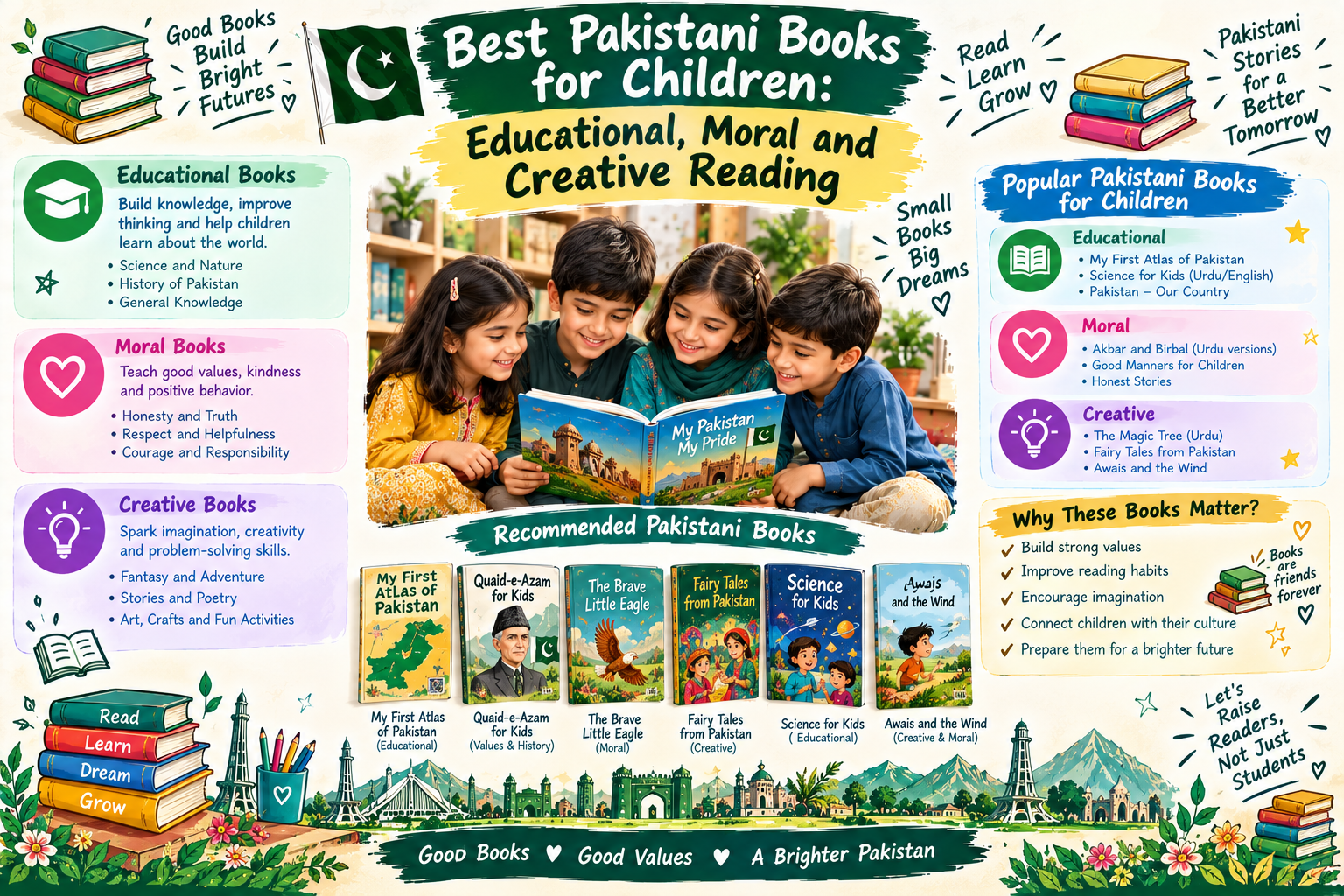
A good children’s book does not have to be complicated. Simple language, attractive illustrations, interesting characters, and an enjoyable story can make reading exciting for children. Educational books can make learning easier, while moral stories can introduce positive values through memorable characters and situations. Creative books can encourage children to imagine, draw, write, explore, and ask questions.
Pakistani children can find many types of reading material, including Urdu stories, regional-language books, folk tales, science books, general knowledge books, biographies, poetry, adventure stories, activity books, and illustrated educational material.
The best book for a child depends on the child's age, reading level, interests, and language. Some children enjoy animals and nature, while others prefer science, history, adventure, humor, or creative activities.
The most important goal is to develop a positive relationship with reading. When children enjoy books, reading can become a lifelong source of learning and entertainment.
Why Children Need Good Books
Children learn from many different sources, including parents, teachers, friends, school activities, television, the internet, and everyday experiences. Books provide another valuable source of knowledge.
A good children's book can help a child:
Learn new words
Improve reading skills
Develop imagination
Understand different ideas
Learn positive values
Increase general knowledge
Improve concentration
Develop creativity
Understand emotions
Become more curious
Books can also encourage independent learning. A child who learns to find answers in books can gradually become more confident in exploring new subjects.
Educational Books for Pakistani Children
Educational books are designed to make learning interesting and accessible. They can cover subjects that children study at school as well as topics outside the classroom.
Popular educational topics include:
Science
Mathematics
Space
Animals
Plants
Geography
History
Computers
General knowledge
Environment
Human body
Inventions
Educational books for younger children often use pictures and short explanations. This makes information easier to understand.
For example, a science book about animals may use pictures to introduce different species. A book about planets may use diagrams and illustrations to explain the solar system.
This combination of information and visuals can make learning more enjoyable.
Moral Stories for Children
Moral stories are another important category of children's literature in Pakistan.
Instead of simply giving instructions about good behavior, a moral story can demonstrate values through characters and situations.
A story may show a character learning the importance of honesty after making a difficult choice. Another story may demonstrate kindness through a character helping someone in need.
Common lessons include:
Honesty
Children can learn that telling the truth and accepting responsibility are important qualities.
Kindness
Stories can show how helping and caring for others can create positive relationships.
Respect
Children can learn the importance of treating parents, teachers, elders, friends, and other people respectfully.
Responsibility
A character who completes an important task can help children understand the value of responsibility.
Patience
Stories can teach that meaningful results may require time and effort.
Cooperation
Group adventures can demonstrate how people can achieve goals by working together.
Creative Books for Young Readers
Creative books are especially useful for children who enjoy drawing, writing, puzzles, coloring, crafts, and imaginative activities.
These books may include:
Drawing exercises
Coloring pages
Puzzles
Word games
Simple writing activities
Story-completion exercises
Matching activities
Observation games
Creative challenges
Creative activities allow children to become active participants rather than simply reading a story.
For example, a book may present the beginning of a story and ask the child to imagine what happens next. Another activity may ask children to design their own character.
Such activities can encourage imagination and independent thinking.
Urdu Books for Children
Urdu children's books have an important role in Pakistan.
For children who speak Urdu at home or study it at school, Urdu books can strengthen vocabulary and reading skills.
Simple Urdu stories can introduce:
Family life
Friendship
Nature
Animals
School experiences
Moral values
History
Imagination
Humor
Urdu poetry can also introduce children to rhythm, sound, and creative language.
When children read in a familiar language, they may find it easier to understand the story and enjoy the experience.
Regional-Language Books
Pakistan's linguistic diversity provides many opportunities for children's literature.
Children can benefit from reading material in languages spoken in their homes and communities. Regional-language literature can preserve local expressions, folk stories, cultural traditions, and community history.
Books in Punjabi, Sindhi, Pashto, Balochi, and other Pakistani languages can help young readers develop language skills while connecting them with their cultural background.
This diversity makes Pakistani children's literature richer and more representative.
Pakistani Folk Tales
Folk tales are a valuable source of storytelling.
They often contain memorable characters, interesting situations, cultural details, and lessons. When adapted for children, traditional stories can become accessible to younger readers through simple language and colorful illustrations.
Folk tales can introduce children to:
Traditional lifestyles
Local customs
Family relationships
Village life
Traditional occupations
Cultural expressions
Local landscapes
These stories can help preserve cultural knowledge while making reading enjoyable.
Adventure Books
Many children love adventure.
Adventure stories can take readers to exciting places and introduce them to characters who face challenges, solve problems, and discover new things.
For Pakistani children, adventure stories can be set in different environments, such as mountains, forests, deserts, cities, villages, historical locations, or imaginary worlds.
Adventure reading can encourage children to imagine themselves exploring new places and solving problems.
It can also develop curiosity and creative thinking.
Science Books for Curious Children
Children naturally ask many questions.
Why does the moon change shape?
How do plants grow?
Why does rain fall?
How do birds fly?
What are stars?
How do computers work?
Science books can help answer such questions in simple language.
A child-friendly science book should avoid unnecessary complexity. Short explanations, illustrations, examples, and simple experiments can make scientific ideas easier to understand.
Science reading can also encourage children to develop an interest in STEM subjects.
Books About Nature and Animals
Nature books are excellent for young readers.
Children often enjoy learning about animals, birds, insects, plants, forests, oceans, mountains, and weather.
A Pakistani nature book can also introduce children to the country's different natural environments.
Children can learn that Pakistan contains a wide variety of landscapes, from northern mountain regions to plains, deserts, rivers, forests, and coastal areas.
Books about nature can also encourage environmental awareness.
Children may learn why plants are important, why animals need protection, and why clean surroundings matter.
History Books for Young Readers
History can sometimes seem difficult when presented only through dates and names. Children's history books can make the subject more interesting through stories, pictures, timelines, maps, and simple explanations.
A child-friendly history book can introduce:
Important historical places
Cultural heritage
Historical personalities
Development of cities
Traditional crafts
Important discoveries
National history
Stories can help children remember historical information more easily.
Biographies for Children
Biographies introduce children to the lives and achievements of important people.
Children can read about writers, scientists, teachers, artists, athletes, explorers, inventors, and other notable individuals.
A biography can show that success often involves learning, effort, patience, mistakes, and determination.
Instead of presenting famous people as perfect characters, age-appropriate biographies can focus on their work, achievements, challenges, and contributions.
This can encourage children to think about their own interests and goals.
Poetry Books for Children
Poetry can help children appreciate language.
Children's poems often use rhythm, repetition, simple words, humor, and memorable images.
Poetry can improve vocabulary while introducing children to creative ways of expressing feelings and ideas.
Urdu poetry has a particularly rich tradition, and children's poetry can provide an accessible introduction to this literary form.
Poems about nature, animals, family, school, friendship, seasons, and everyday experiences can be enjoyable for young readers.
Books About Pakistani Culture
Children can learn about Pakistan through books that explore cultural traditions.
Topics can include:
Traditional clothing
Pakistani foods
Festivals
Crafts
Music
Architecture
Local languages
Family traditions
Historical places
Regional customs
Such books can help children understand the diversity of Pakistani culture.
A child from Punjab may learn about traditions in Sindh. A child from Sindh may discover traditions from Khyber Pakhtunkhwa. A child from one city may learn about life in another part of the country.
This can encourage cultural understanding and appreciation.
The Importance of Illustrations
Pictures can make children's books more attractive and understandable.
Young children often respond strongly to visual information. A well-designed illustration can explain a scene that might be difficult to understand through words alone.
Illustrations can show:
Characters
Locations
Animals
Objects
Activities
Emotions
Historical settings
For beginning readers, pictures can also help children understand the meaning of new words.
Pakistani children's books can use illustrations that represent familiar homes, schools, streets, landscapes, clothing, foods, and cultural settings.
Choosing Books According to Age
The same book is not suitable for every child.
Parents and teachers should consider reading level and age when selecting books.
Early Readers
Early readers usually benefit from:
Large text
Short sentences
Simple vocabulary
Repeated words
Clear pictures
Short stories
Developing Readers
Children who are becoming stronger readers can explore:
Longer stories
Adventure
Science
History
Biographies
Poetry
More detailed fiction
Older Children
Older readers may enjoy:
Novels
Historical fiction
Science books
Technology
Biographies
Mystery and adventure
Creative writing
Allowing children to progress gradually can make reading less stressful and more enjoyable.
How Parents Can Encourage Reading
Parents can help children develop reading habits without making reading feel like homework.
A few simple habits can make a difference.
Create a Reading Corner
A small area with books can encourage children to read whenever they have free time.
Read Together
Parents can read stories with younger children and discuss the characters.
Let Children Choose
Children should have opportunities to select some books based on their interests.
Ask Questions
After reading, parents can ask what the child liked about the story.
Keep Books Accessible
Books should be easy for children to reach and explore.
Make Reading Enjoyable
Reading should not always be connected with tests and grades. It can also be a relaxing activity.
The Role of Teachers
Teachers can encourage reading beyond textbooks.
A classroom reading corner can provide students with additional material. Teachers can also organize storytelling sessions, reading competitions, book discussions, and creative writing activities.
Students can be encouraged to recommend books to classmates and explain what they enjoyed about them.
This creates a positive reading environment.
Libraries for Children
Libraries can provide access to a wide range of books.
A school library can contain educational books, stories, poetry, biographies, science material, folk tales, and creative activity books.
Community libraries can also help children who may not have a large collection of books at home.
A friendly library environment can encourage children to see reading as an enjoyable activity.
Digital Books and Modern Reading
Technology has introduced new ways for children to read.
Digital books can be accessed through computers, tablets, and other devices. They can provide stories, educational information, illustrations, and interactive activities.
Digital reading can be particularly useful when physical books are difficult to access.
However, children can benefit from having a balanced reading routine that includes both digital and physical books where possible.
The quality of the content is more important than whether the book is printed or digital.
Building a Home Library
A home library does not need to be large.
Even a small collection can provide children with regular reading opportunities.
A useful children's collection might include:
Storybooks
Educational books
Science books
Poetry
History
General knowledge
Creative activity books
Nature and animal books
Cultural stories
Age-appropriate biographies
The collection can grow gradually according to the child's interests.
Encouraging Independent Reading
One of the most valuable goals of children's literature is to help children become independent readers.
At first, children may need parents or teachers to read with them. Gradually, they can begin reading short stories themselves.
Independent reading allows children to choose subjects, explore information, and enjoy stories at their own pace.
It can also build confidence.
A child who finishes a book may feel proud of completing something independently.
Reading and Creativity
Reading and creativity are closely connected.
A child who reads a fantasy story may start imagining their own characters. A child who reads about animals may want to draw them. Someone reading poetry may become interested in writing simple poems.
Parents and teachers can encourage children to respond creatively to books.
For example, after reading a story, children can:
Draw their favorite character
Write a different ending
Create a new character
Act out a scene
Write a short review
Make a poster
Tell the story to someone else
These activities can turn reading into a creative experience.
Reading and Communication Skills
Reading exposes children to new vocabulary and different ways of expressing ideas.
Children who regularly read may gradually become more comfortable describing people, places, events, and emotions.
Parents can support this by discussing stories with them.
Simple questions such as “What happened?” or “Why did the character do that?” can encourage children to express their thoughts.
This can be useful for both spoken and written communication.
Supporting Pakistani Children’s Literature
The growth of children's literature depends on many people.
Writers create stories.
Illustrators bring them to life.
Teachers introduce books to students.
Parents encourage reading at home.
Libraries provide access.
Publishers produce and distribute books.
Schools create reading opportunities.
Together, these efforts can create a stronger reading culture.
Supporting local children's literature can also encourage writers and artists to create more material for young Pakistani readers.
Making Books Affordable and Accessible
Access is an important part of building a reading culture.
Some families may not be able to purchase many books. Affordable editions, book-sharing programs, school libraries, community libraries, and digital resources can help.
Children can also exchange books with friends or siblings.
A book does not have to be expensive to be valuable. A simple, well-written story can have a lasting impact on a child's imagination.
The Future of Children's Reading in Pakistan
The future of children's books in Pakistan can combine traditional storytelling with modern subjects.
Future books can explore:
Artificial intelligence
Computers
Space exploration
Environmental protection
Science
Entrepreneurship
Creativity
Digital skills
Pakistani history
Cultural heritage
Adventure
There is also an opportunity to create more books in Pakistan's different languages.
Digital publishing can make it easier for new writers and illustrators to share their work with young readers.
Why Reading Should Be Enjoyable
Children are more likely to develop a lifelong reading habit when they associate books with positive experiences.
Reading should not always mean memorizing information or preparing for an examination.
A child can read simply because a story is funny, exciting, beautiful, mysterious, or interesting.
Enjoyment can become the first step toward learning.
Once children discover the pleasure of reading, they may naturally begin exploring more difficult and informative books.
Conclusion
Pakistani children's books provide valuable opportunities for education, creativity, imagination, cultural learning, and personal development. Educational books can introduce science and general knowledge, moral stories can teach positive values, folk tales can preserve cultural traditions, and creative books can encourage children to explore their own ideas.
The best book for a child is one that matches the child's age, reading level, language, and interests. Parents and teachers can make a major difference by providing children with different types of books and allowing them to discover what they enjoy.
Urdu and regional-language books can strengthen cultural and linguistic connections, while science, technology, history, and adventure books can open the door to wider knowledge.
With supportive families, schools, libraries, writers, illustrators, and publishers, children's reading culture in Pakistan can continue to grow.
A book can be a teacher, a storyteller, a source of imagination, and a friend during quiet moments. By encouraging children to read from an early age, Pakistan can help develop a generation that is curious, creative, knowledgeable, and connected to its culture.
FAQs
1. What types of books are best for Pakistani children?
Educational books, moral stories, folk tales, science books, adventure stories, poetry, biographies, cultural books, and creative activity books can all be useful for children.
2. Are Urdu books useful for children?
Yes. Urdu books can help children improve vocabulary and reading skills while introducing them to stories, poetry, culture, and values.
3. How can parents develop a reading habit in children?
Parents can keep age-appropriate books at home, read with children, allow them to choose some books, and make reading a regular but enjoyable activity.
4. What can children learn from moral stories?
Moral stories can introduce values such as honesty, kindness, respect, responsibility, patience, cooperation, and courage through characters and situations.
5. Can educational books make learning easier?
Yes. Well-designed educational books can use simple explanations, illustrations, examples, and activities to make different subjects easier and more interesting for children.




