Introduction
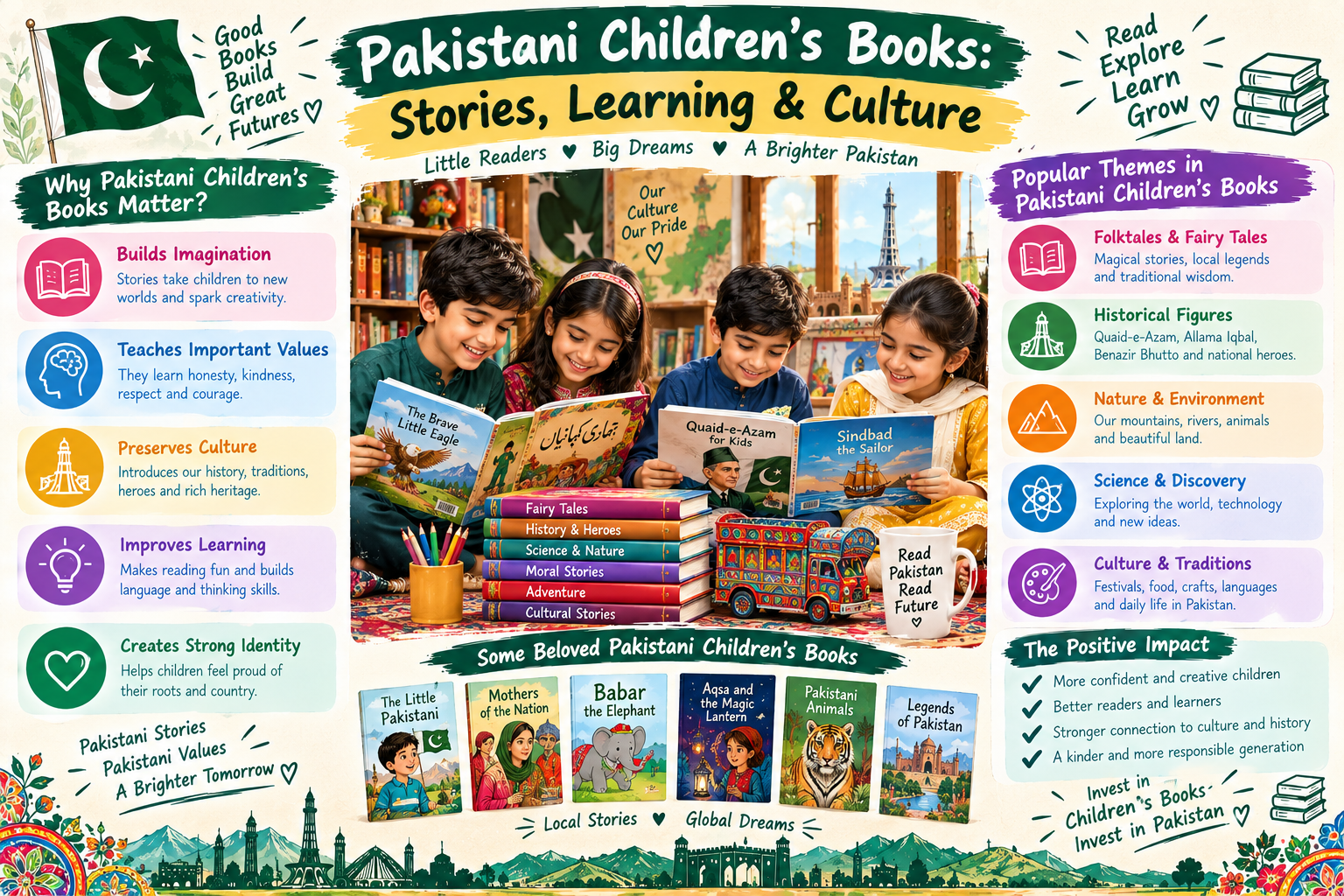
Children’s books play an important role in the learning and development of young minds. In Pakistan, children’s literature has a special place because it combines education, imagination, culture, moral values, family traditions, and enjoyable storytelling. Pakistani children can find stories that introduce them to their own language, history, customs, festivals, landscapes, and social values while also encouraging curiosity and creativity.
Books are more than a source of entertainment for children. A good children’s book can help a young reader develop vocabulary, improve communication skills, understand emotions, learn about relationships, and discover new ideas. Stories can also teach children important values such as honesty, kindness, respect, courage, patience, responsibility, and cooperation.
Pakistan has a rich storytelling tradition. Stories have traditionally been shared within families, schools, communities, and cultural gatherings. Many of these traditions have gradually found their way into children's books. Urdu literature, as well as literature in regional languages, provides children with opportunities to enjoy stories that feel familiar and connected to their everyday lives.
Today, Pakistani children also have access to books about science, technology, adventure, history, nature, animals, and creativity. This variety allows children to enjoy reading while developing knowledge about the world around them.
The Importance of Children’s Books in Pakistan
Children’s books can support learning from an early age. When children regularly read stories, they become familiar with new words and sentence structures. Reading also encourages them to ask questions and think about different situations.
For Pakistani children, locally relevant books can make reading even more meaningful. A story featuring a Pakistani family, school, village, city, festival, or traditional setting can help children recognize elements of their own environment.
Children’s books can contribute to:
Language development
Vocabulary building
Imagination
Creativity
General knowledge
Moral development
Communication skills
Critical thinking
Emotional understanding
Cultural awareness
Reading can also become a healthy and enjoyable habit. Instead of seeing learning only as a classroom activity, children can discover that knowledge can be found in stories, pictures, characters, and adventures.
Pakistani Storytelling Traditions
Pakistan has a long tradition of storytelling. Before the popularity of modern printed books, stories were often shared orally by parents, grandparents, teachers, and other members of the community.
Traditional storytelling included folk tales, family stories, humorous tales, adventure stories, and stories carrying moral lessons. These stories were often remembered and passed from one generation to another.
Children’s books have helped preserve some elements of these traditions by presenting stories in written and illustrated forms. A child can read a story independently and later share it with siblings or friends.
This creates a connection between older storytelling traditions and modern reading habits.
Urdu Children’s Literature
Urdu is an important language of children’s literature in Pakistan. Urdu children’s books can introduce young readers to enjoyable stories while helping them improve their reading and writing abilities.
Simple Urdu stories can be especially useful for younger children who are developing their vocabulary. Stories with short sentences, colorful illustrations, interesting characters, and clear lessons can encourage children to continue reading.
Urdu children’s literature can cover many subjects, including:
Moral stories
Adventure
Nature
Animals
School life
Family relationships
History
Science
Humor
Imagination
The availability of books in a familiar language can make reading more comfortable for children.
Regional Languages and Children’s Books
Pakistan is home to many languages and cultural traditions. Children’s literature can help preserve and celebrate this linguistic diversity.
Books written in languages such as Punjabi, Sindhi, Pashto, Balochi, and other local languages can give children an opportunity to enjoy stories in the language they hear in their homes and communities.
Regional-language books can also preserve local expressions, traditions, folk stories, and cultural knowledge.
For children, this can create a strong connection between reading and their cultural environment. They can learn that their own language and traditions are valuable parts of Pakistan's diverse cultural identity.
Stories That Teach Moral Values
One of the most valuable features of children's literature is its ability to teach lessons through storytelling.
Instead of simply telling a child, “Be honest,” a story can show a character facing a situation where honesty becomes important. The child can observe the character’s decisions and understand the consequences.
Common values found in children's stories include:
Honesty
Stories about honesty can help children understand the importance of telling the truth and taking responsibility for their actions.
Kindness
Characters who help others can teach children that small acts of kindness can make a positive difference.
Respect
Stories can demonstrate respectful behavior toward parents, teachers, elders, friends, and other members of society.
Courage
Adventure stories can show children that courage does not always mean having no fear. It can mean making a responsible decision even when something feels difficult.
Patience
Some stories teach children that good results often require time, effort, and patience.
Cooperation
Stories involving groups of characters can demonstrate the importance of teamwork and helping one another.
Folk Tales and Cultural Stories
Folk tales are an important part of cultural heritage. They can introduce children to traditional characters, places, customs, and ways of thinking.
When folk stories are adapted for children, they can become enjoyable educational material. Illustrations can make traditional settings easier for young readers to imagine.
For example, a story may introduce a child to village life, traditional clothing, local food, family gatherings, crafts, or a historic setting.
Such stories can help children understand that culture is not only something found in museums or history books. Culture can also be experienced through language, food, stories, clothing, family traditions, and everyday life.
Islamic and Values-Based Children’s Books
Values-based books are also popular among Pakistani families. Age-appropriate books can introduce children to concepts such as kindness, honesty, gratitude, responsibility, good manners, and helping others.
For younger children, these books often use simple stories and illustrations to make concepts easy to understand.
The most useful approach is to present values in a way that children can understand and apply in everyday situations, such as sharing with others, speaking politely, helping parents, respecting teachers, and caring for people around them.
Educational Books for Pakistani Children
Not every children's book needs to be fictional. Educational books can make learning enjoyable by presenting information in a simple and visual way.
Children can read books about:
Animals
Plants
Space
Human body
Science
Geography
History
Computers
Environment
General knowledge
Famous personalities
Inventions
Educational books can answer the questions children naturally ask.
A child who wants to know how rain forms can explore a science book. Another child interested in planets can read about the solar system. Someone fascinated by animals can learn about different species.
This type of reading encourages curiosity.
Adventure Books and Imagination
Adventure stories can be particularly attractive to young readers. They introduce exciting situations, interesting characters, discoveries, and journeys.
Adventure books encourage children to imagine places beyond their immediate surroundings.
A Pakistani child may enjoy a story set in a mountain region, historical city, village, forest, desert, or imaginary world. Such stories can combine entertainment with learning.
Imagination is important because it helps children think creatively. When children imagine different possibilities, they learn to look at situations from different perspectives.
Science and Technology Books
Pakistan’s children are growing up in a world where technology is becoming increasingly important. Children’s books can introduce science and technology in age-appropriate ways.
Books about computers, robotics, space, inventions, electricity, machines, and the natural world can encourage children to explore STEM subjects.
A simple science story may turn a difficult concept into something interesting.
For example, instead of giving a child a complicated explanation of electricity, a story could follow a character discovering how electrical devices work. This makes learning feel more connected to everyday life.
Books About Pakistani History
Children’s history books can introduce young readers to important periods, places, personalities, and events in Pakistan’s history.
However, history books for children should use language appropriate for their age. Younger readers benefit from short explanations, timelines, illustrations, maps, and interesting facts.
Books can introduce children to:
Important historical places
Cultural heritage
The development of cities
Famous scholars
Scientists
Writers
Artists
National history
Important inventions and achievements
Learning history through stories can make the subject easier to remember.
The Role of Illustrations
Illustrations are extremely important in children’s books.
A young reader may understand a story more easily when words are supported by pictures. Colorful illustrations can also make books more attractive and encourage children to explore them.
Pictures can help children understand:
Characters
Places
Objects
Animals
Actions
Emotions
Historical settings
For beginning readers, illustrations can also help them guess the meaning of unfamiliar words.
Pakistani children's books can benefit from illustrations that represent local environments and cultural settings. Pictures of Pakistani homes, schools, landscapes, clothing, food, and everyday activities can make stories feel familiar.
Books for Early Readers
Children at different ages have different reading needs.
Early readers usually benefit from:
Large and clear text
Short sentences
Familiar vocabulary
Repeated words
Simple plots
Colorful pictures
Short chapters
As children become stronger readers, books can gradually introduce longer stories and more complex ideas.
Parents and teachers can help children choose books according to their reading level rather than forcing them to read material that is too difficult.
The Role of Parents in Reading
Parents can play an important role in developing a child’s reading habit.
Reading does not always need to be a formal activity. A parent can spend a few minutes reading a story with a child before bedtime or during free time.
Parents can also ask simple questions after a story:
Who was your favorite character?
What happened in the story?
What did the character learn?
What would you have done?
Which part did you enjoy?
These questions encourage children to think about what they have read.
Parents can also create a small reading corner at home with books suitable for the child's age.
The Role of Schools
Schools are another important part of children's reading culture.
Libraries, reading periods, storytelling activities, book discussions, and creative writing exercises can encourage students to develop a stronger relationship with books.
Teachers can recommend different types of books instead of limiting reading to textbooks.
For example, students may be encouraged to read:
Short stories
Poetry
Biographies
Science books
Historical stories
Folk tales
Adventure books
This can help students discover the subjects they personally enjoy.
Libraries and Reading Culture
Libraries can provide children with access to a wide range of books.
A child may not own many books at home, but a school or community library can provide many reading options.
A welcoming library can become a place where children discover new interests. It can also encourage children to share books and discuss stories with classmates.
Developing accessible children's libraries across Pakistan can support reading habits among young people.
Digital Children’s Books
Technology has changed the way children access information. Digital books and reading applications can provide another way for children to enjoy stories.
Digital reading can be useful when physical books are difficult to obtain. Tablets, computers, and smartphones can provide access to digital educational content.
However, digital reading should be balanced with other activities. Children can benefit from a combination of books, outdoor activities, creative play, schoolwork, and family time.
The important goal is to encourage meaningful reading, whether the book is printed or digital.
Pakistani Authors and Illustrators
Authors and illustrators play a major role in creating children's literature.
A good children's writer understands how to communicate ideas in language that young readers can understand. A good illustrator adds visual elements that make stories memorable.
Supporting local writers and illustrators can contribute to the growth of Pakistan’s children's publishing culture.
New writers can also explore modern themes while maintaining cultural connections.
Children today may enjoy stories about technology, friendship, school life, environmental awareness, science, creativity, and adventure. These themes can be presented through Pakistani characters and settings.
Books and Cultural Identity
Children's books can help young readers understand their cultural identity.
A story about Pakistani food may introduce children to traditional dishes. A story about a family celebration can show customs and relationships. A book about a historic place can create interest in Pakistan’s heritage.
This does not mean that children's books should only contain traditional subjects. Children can enjoy both local and international stories.
The goal is to give them a broad reading experience while ensuring that Pakistani culture also has a meaningful place in children's literature.
Encouraging Girls and Boys to Read
Reading should be encouraged equally among girls and boys.
Children can explore books based on their interests rather than limiting reading choices according to gender.
A girl may enjoy science, adventure, history, or technology books. A boy may enjoy poetry, stories, art, nature, or literature.
Providing children with diverse reading choices allows them to discover their own interests and talents.
The Benefits of Regular Reading
Regular reading can provide many benefits.
Better Vocabulary
Children encounter new words while reading and gradually learn how to use them.
Stronger Communication
Reading exposes children to different sentence structures and ways of expressing ideas.
Improved Imagination
Stories encourage children to visualize people, places, and situations.
Better Concentration
Reading requires attention, which can help children practice focusing on one activity.
More Knowledge
Books provide information about subjects that children may not encounter directly in everyday life.
Emotional Understanding
Stories allow children to see situations from different characters’ perspectives.
Creativity
Reading can inspire children to write stories, draw pictures, create characters, or develop their own ideas.
Making Reading a Daily Habit
Children do not need to read for several hours every day to develop a reading habit. Even a small amount of regular reading can be useful.
Families can create a simple reading routine.
For example:
Choose an age-appropriate book.
Set aside a few minutes each day.
Read in a quiet place.
Discuss interesting parts of the story.
Allow the child to choose some books.
Keep different types of books available.
Encourage questions.
Celebrate progress without putting pressure on the child.
The purpose should be to make reading enjoyable rather than turning every book into an examination.
Challenges in Children’s Reading
Children’s reading culture can face several challenges.
Some families may have limited access to children's books. In some areas, libraries may not be easily available. Some children may also find reading difficult if they do not receive enough guidance.
The cost of books can sometimes be another concern.
Schools, libraries, families, publishers, community organizations, and digital platforms can all contribute to making children's reading material more accessible.
Book-sharing programs, school libraries, community reading spaces, and affordable editions can help more children discover books.
The Future of Pakistani Children’s Books
The future of children's literature in Pakistan can include both traditional and modern storytelling.
Future books can combine:
Pakistani culture
Modern technology
Science
Environmental awareness
Creativity
Adventure
History
Language learning
Digital illustration
Interactive learning
There is also an opportunity for more stories representing Pakistan’s different regions, languages, landscapes, and communities.
Children's books can introduce young readers to the mountains of the north, the deserts, rivers, cities, villages, historical sites, traditional crafts, local foods, and diverse cultural traditions of Pakistan.
At the same time, Pakistani writers can create stories that explore universal themes such as friendship, curiosity, courage, family, learning, and dreams.
Why Pakistani Children’s Books Matter
Children’s books are an investment in young minds.
A good book can become a child's first introduction to a new idea. It can inspire a future scientist, writer, teacher, artist, entrepreneur, researcher, or community leader.
For Pakistani children, books can provide both a window to the wider world and a mirror reflecting their own culture.
When children see familiar languages, places, families, traditions, and experiences in books, reading can feel more personal and meaningful.
At the same time, books can introduce them to ideas beyond their immediate environment, helping them develop a broader understanding of the world.
Conclusion
Pakistani children’s books are an important part of education, culture, creativity, and childhood development. From Urdu stories and regional-language literature to science books, adventure stories, folk tales, history books, and modern educational content, children have many opportunities to discover the joy of reading.
Books can teach children important values while also giving them space to imagine, question, explore, and create. Parents, teachers, schools, libraries, writers, illustrators, and publishers all have an important role in building a strong reading culture.
A positive reading environment can help children develop language skills, knowledge, creativity, confidence, and cultural awareness. By making good books accessible and enjoyable, Pakistan can encourage a new generation of young readers who appreciate both their own heritage and the wider world.
The future of Pakistani children's literature can be bright when traditional storytelling and modern ideas come together. Every book placed in a child's hands can open a new door to learning, imagination, and discovery.
FAQs
1. Why are children’s books important in Pakistan?
Children’s books help Pakistani children improve language skills, develop imagination, learn values, gain knowledge, and understand their culture.
2. What types of books are suitable for Pakistani children?
Children can enjoy moral stories, folk tales, science books, history books, adventure stories, educational books, poetry, biographies, and books about nature and animals.
3. How can parents encourage children to read?
Parents can create a small reading routine, provide age-appropriate books, read with children, discuss stories, and allow children to choose books based on their interests.
4. Are Urdu and regional-language books important for children?
Yes. Books in Urdu and regional languages can help children develop language skills while connecting them with local stories, traditions, culture, and heritage.
5. Can digital books help children develop reading habits?
Yes. Digital books can provide another way to access stories and educational material. They can complement physical books when used as part of a balanced reading routine.