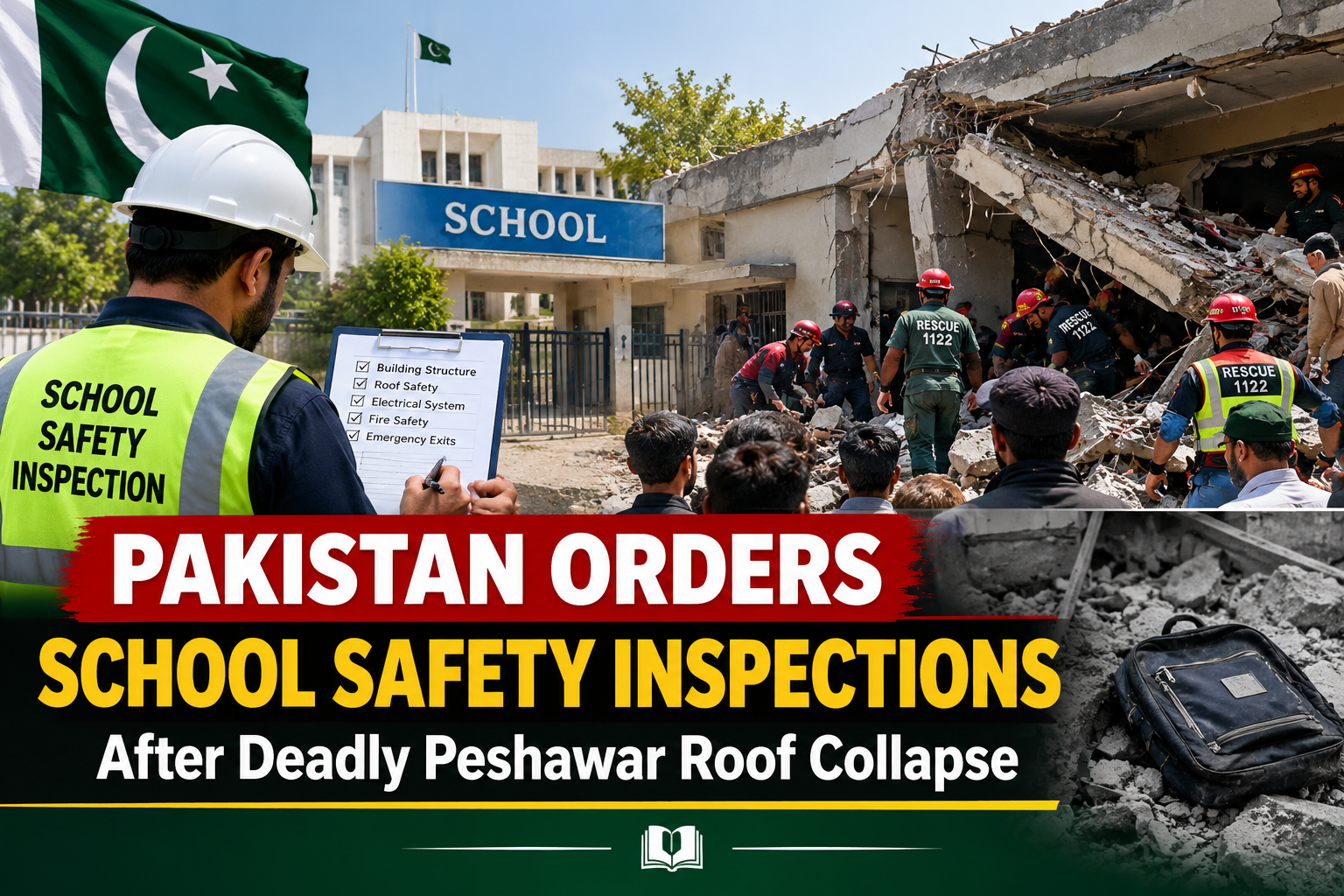
Pakistan has ordered school safety inspections across Khyber Pakhtunkhwa following a tragic roof collapse at Al-Khair Education Centre in Peshawar on October 15, 2026. The incident killed dozens of children and a teacher and injured many others, prompting calls for stronger building standards, accountability, and better protection for students.
The tragedy has raised serious questions about the condition of school buildings, the enforcement of construction regulations, and the responsibility of school administrations to provide safe learning environments. Authorities have launched an investigation and directed officials to assess school structures to identify buildings that require repairs or may be unsafe.
The incident has also renewed public attention on the importance of education infrastructure in Pakistan. Schools are places where children should be able to learn, develop skills, and prepare for their futures without unnecessary risks. Ensuring that these institutions meet basic safety requirements is therefore a responsibility shared by school owners, education departments, building inspectors, and government authorities.
This article explores the Peshawar school tragedy, the government's response, the importance of school safety inspections, the challenges facing educational infrastructure, and the measures that could help prevent similar incidents in the future.
1. What Happened at Al-Khair Education Centre in Peshawar?
The incident occurred on Thursday, October 15, 2026, at Al-Khair Education Centre in Dir Colony, Peshawar, the capital of Khyber Pakhtunkhwa. According to reports from Reuters and the Associated Press, the roof of the school's upper floor collapsed onto classrooms below while students were attending lessons.
The collapse triggered an emergency response involving rescue personnel, ambulances, hospital staff, police, and local residents. Rescue teams worked to reach those trapped inside the damaged building and transport injured students and staff members for medical treatment.
The reported death toll varied across early news updates as authorities and hospitals continued to provide information. Reuters reported that at least 34 children and one female teacher had died, while more than 45 children were injured.
The tragedy deeply affected families in the surrounding neighbourhood. Parents and relatives faced uncertainty as they sought information about their children, while residents and community members gathered to support affected families.
The incident quickly became a national concern because of the number of young lives lost and the questions it raised about the safety of educational institutions.
Investigators began examining the building's structural condition and the circumstances that led to the collapse. Peshawar police chief Saeed Ahmed said the building had a weak structure and that additional construction had placed excessive weight on it. The school owner was arrested as authorities began investigating the incident.
Establishing the precise causes and determining individual responsibility require a thorough investigation. Nevertheless, the incident has highlighted why school buildings must be regularly assessed and why concerns about their condition must receive prompt attention.
2. Government Orders School Safety Inspections
Following the incident, authorities ordered inspections of schools across Khyber Pakhtunkhwa. According to Al Jazeera's reporting, the provincial administration was instructed to begin inspections and submit findings within three days.The purpose of the inspections is to identify buildings that are safe, those that require repairs, and those that may pose serious risks to students and staff.
Such assessments can help authorities understand the condition of educational infrastructure and prioritise urgent improvements. They can also reveal problems that may otherwise remain unnoticed until an emergency occurs.
A comprehensive school inspection should examine important structural elements, including roofs, ceilings, walls, staircases, support structures, and other parts of a building that affect its stability. Inspectors should also consider whether previous repairs were completed properly and whether any unauthorised construction has increased the building's load.
The inspection process must be more than a paperwork exercise. It should involve qualified professionals, documented findings, clear deadlines for repairs, and follow-up visits to verify that identified problems have been addressed.
Where a building is judged unsafe, authorities should take appropriate measures to protect students and staff until the necessary work has been completed and its safety confirmed.
The government also needs a reliable system for recording inspection results. A central database could help education departments track the condition of school buildings, identify recurring problems, and allocate funds according to the level of risk.
The Peshawar tragedy has created an urgent opportunity to strengthen these procedures. Effective implementation could help protect students across the province and establish a more consistent approach to school safety.
3. Why School Building Safety Is Essential
A school building is more than a place where lessons take place. It is an environment in which children spend a significant part of their day learning, socialising, and developing confidence.
Parents trust schools to provide an environment that supports children's education while protecting their well-being. This trust depends on safe classrooms, properly maintained facilities, and responsible management.
Structural safety is especially important because children and teachers may have little warning when a serious building defect becomes dangerous. Regular professional inspections can identify weaknesses before they develop into emergencies.
Roofs require particular attention because they must support their own weight and any additional loads for which they were designed. Poor construction, deterioration, water damage, and unauthorised additions can compromise structural integrity.
Walls, columns, beams, foundations, and staircases also require appropriate assessment. A building may appear acceptable from the outside while still having defects that require specialist attention.
Safety planning should include more than the structure itself. Schools also need suitable exits, accessible evacuation routes, emergency communication procedures, and arrangements for contacting emergency services.
Teachers and other staff should know how to respond to emergencies and how to guide students calmly when evacuation is required. Regular drills can help schools practise these procedures without creating unnecessary fear.
However, emergency preparation cannot replace sound construction and maintenance. The first priority must be to ensure that buildings are appropriately designed, properly constructed, and maintained throughout their useful life.
Every child deserves an educational environment in which preventable building hazards are taken seriously.
4. Questions About Construction Quality and Maintenance
The Peshawar incident has renewed scrutiny of construction quality and building maintenance in Pakistan. Reports about the collapse raised concerns about the school's structural condition, the materials used, and whether earlier warnings about the building had been addressed.Construction quality depends on several factors, including proper design, suitable materials, qualified labour, engineering supervision, and compliance with relevant building regulations.
If any of these elements is neglected, a structure may fail to meet the standards required for safe use. Poor maintenance can make matters worse by allowing cracks, leaks, corrosion, and other signs of deterioration to remain unresolved.
School owners and administrators must understand that maintaining a building is an ongoing responsibility rather than a task to be performed only when visible damage becomes severe.
Regular maintenance plans should include inspections, prompt repairs, records of completed work, and professional advice when structural problems are suspected. Any proposed additional construction should also be reviewed to determine whether the building can safely accommodate it.
Authorities have a complementary responsibility to enforce applicable regulations. Construction approvals, inspections during building work, and checks before educational use can help identify problems before students enter a facility.
Where evidence of negligence emerges, investigations should follow due process and establish the facts. Any legal consequences should be based on evidence and the applicable law.
The broader objective is to ensure that every institution responsible for educating children understands and fulfils its safety obligations.
5. The Importance of Accountability
Public accountability is essential after an incident involving the loss of children's lives. Families need credible answers about what happened, whether warning signs were present, and whether established safety requirements were followed.
Following the Peshawar collapse, police registered a case involving the school's owners, shareholders, and construction contractor, according to a report published by Geo News on October 16. The allegations included concerns about construction materials and the building's condition. These remain matters for investigation and legal determination.
A fair investigation should examine construction records, inspection documents, maintenance history, witness accounts, and any earlier complaints about the structure.
It should also establish whether the relevant authorities fulfilled their responsibilities and whether the building had the necessary approvals for educational use.
Transparency is important because it allows families and the public to understand the findings and assess whether corrective action has been taken.
Accountability should not be limited to one institution if the investigation identifies wider administrative failures. Any systemic problems should be addressed through improved regulations, clearer responsibilities, and stronger enforcement.
At the same time, investigations must respect due process. Allegations should not be treated as proven facts before the appropriate authorities establish responsibility.
The aim of accountability is not only to determine what happened in one case. It is also to identify failures, correct weaknesses, and reduce the likelihood of similar incidents occurring elsewhere.
A transparent process can help rebuild public confidence and demonstrate that children's safety is being treated as a serious public responsibility.
6. Challenges Facing Educational Infrastructure in Pakistan
Pakistan's education system includes government schools, private schools, community institutions, and other learning centres. Their facilities vary considerably, and maintaining safe buildings can be challenging where budgets, professional support, and oversight are limited.
Some institutions operate in buildings originally designed for residential or other purposes. Such premises may require significant modifications before they are suitable for classrooms and the daily movement of large numbers of students.
Older buildings can also require additional maintenance as materials deteriorate over time. Without regular assessments, defects may remain unnoticed until they become serious.
Financial limitations can make repairs difficult, particularly for institutions serving families with limited resources. However, financial pressure cannot justify ignoring serious structural hazards.
Government authorities can help by establishing clear minimum standards, providing technical guidance, and supporting essential repairs where appropriate. They can also work with local administrations to identify institutions that need urgent attention.
Private school owners must likewise ensure that the buildings they operate meet applicable safety requirements. Affordable education should not mean that children have to accept avoidable risks.
Planning is another important part of the solution. New school projects should account for the expected number of students, the needs of different age groups, accessibility, ventilation, sanitation, and safe movement throughout the building.
Effective oversight requires cooperation among education departments, local governments, engineers, building control authorities, and school administrations.
Improving school infrastructure will take sustained effort, but prioritising structural safety can protect students and help ensure that educational institutions remain dependable places of learning.
7. The Impact on Students, Teachers, and Parents
The consequences of a school safety incident extend beyond the physical damage to a building. Such events can affect students' confidence, teachers' ability to work, and parents' trust in educational institutions.
Students need to feel secure in their learning environment. When a serious incident occurs, children who hear about it may become worried about their own schools, even when they attend different institutions.
Teachers also need safe workplaces. Their responsibilities include teaching, supporting students, communicating with parents, and helping maintain an orderly classroom environment. A safe building is essential for them to carry out these duties effectively.
Parents may understandably seek reassurance about the condition of the schools their children attend. Clear information from education departments and school administrations can help address these concerns.
Schools should communicate honestly about inspections, identified problems, and any repairs being undertaken. If temporary arrangements are necessary, parents should receive timely information about changes to classes or facilities.
Children and families affected directly by a tragedy may also need emotional and psychological support. UNICEF expressed condolences following the Peshawar incident and offered support for affected children, families, and communities. The organisation also called for urgent action to ensure that schools meet building safety standards and undergo regular inspections.
Providing appropriate support can help affected families cope with the consequences of a deeply distressing event.
The wider education community should approach the issue with compassion, accurate communication, and a commitment to practical improvements. The objective is to restore confidence by demonstrating that safety concerns are being taken seriously.
8. The Role of School Administrations
School administrations play a central role in ensuring that students and teachers use safe facilities. Their responsibilities begin before a school opens and continue throughout the building's operation.
Before using a property for educational purposes, administrators should ensure that the premises comply with relevant regulations and are suitable for the number of people expected to occupy them.
They should maintain records of building approvals, inspections, maintenance work, and professional assessments. These records can help demonstrate that safety requirements are being followed and identify areas needing further attention.
School management must also establish a straightforward process for reporting hazards. Teachers, staff members, parents, and students should know how to communicate concerns about visible damage or other potentially unsafe conditions.
Reports involving suspected structural weaknesses should be referred promptly to qualified professionals. Administrators should not rely on informal assurances when a building may require expert assessment.
Maintenance budgets should account for preventive work rather than focusing exclusively on immediate classroom needs. Addressing small defects early can sometimes prevent more expensive repairs later, although serious structural issues always require professional evaluation.
School administrations must also cooperate fully with government inspections and comply with lawful instructions regarding repairs or restrictions on building use.
These measures create a culture in which safety is considered a core part of educational management rather than an optional expense.
Responsible administration helps protect students, supports teachers, and strengthens the confidence families place in schools.
9. How Technology Can Improve School Safety Monitoring
Technology can support more consistent monitoring of educational infrastructure across Pakistan. Although digital tools cannot replace professional engineering assessments, they can help authorities organise information and track whether identified problems are addressed.
A central digital register could contain records of school locations, building approvals, inspection dates, structural assessments, and required maintenance. Authorised officials could use this information to identify overdue inspections and prioritise high-risk facilities.
Digital reporting systems could also allow school administrators to submit maintenance requests and upload supporting documents. Each request could be assigned a status so that officials can monitor progress from identification to completion.
Photographs and inspection reports may help document visible changes over time. However, images alone cannot establish whether a building is structurally sound; qualified professionals must determine whether further examination is required.
Technology can also help coordinate communication between education departments, local authorities, and school administrations. Automated reminders may reduce the likelihood that scheduled inspections or essential maintenance tasks are overlooked.
Data protection must remain a priority. Systems should collect only information necessary for safety management and restrict access to authorised personnel.
A digital monitoring programme would be most effective when supported by trained inspectors, adequate funding, clear procedures, and meaningful enforcement.
By combining professional expertise with reliable records, authorities could improve oversight and make it easier to identify recurring safety problems across the education system.
10. The Need for Better Funding and Long-Term Planning
School safety requires financial resources, but effective planning can help authorities use available funds more strategically.
A province-wide assessment can identify which buildings require immediate attention and which can be maintained through scheduled repairs. This allows governments to prioritise serious risks rather than distributing limited resources without a clear understanding of need.
Budgets should account for inspections, professional engineering advice, structural repairs, routine maintenance, and emergency preparedness. Funding decisions should be based on documented conditions and the urgency of the work required.
New school construction should also be planned carefully. Appropriate designs, qualified contractors, suitable materials, and effective supervision can reduce the likelihood of expensive defects emerging later.
Public institutions should maintain transparent records of construction contracts, inspection findings, and completed work. These records can support oversight and help identify gaps between planned improvements and actual delivery.
Where private schools operate under financial pressure, authorities can provide guidance about compliance requirements and available support mechanisms. Any assistance should be accompanied by clear safety obligations and appropriate verification.
Long-term planning is particularly important because educational infrastructure must serve students for many years. Short-term repairs may be necessary in some cases, but they should not replace a comprehensive solution where a building has serious structural problems.
Investment in safe educational facilities is an investment in the future of Pakistan. It helps protect children, supports teachers, and creates conditions in which learning can take place consistently.
11. Practical Steps to Prevent Similar Tragedies
Preventing future incidents requires a coordinated approach that connects building standards, professional inspections, school management, and government oversight.
The following measures can strengthen school safety:
Regular structural inspections: Buildings should be assessed by qualified professionals according to appropriate standards and risk levels.
Prompt repairs: Identified defects should be addressed within clearly defined deadlines.
Safe construction practices: Schools should use suitable materials, approved designs, and qualified contractors.
Control of additional construction: Extra floors and other structural changes should not proceed without the necessary technical assessment and approvals.
Clear reporting procedures: Staff, parents, and students should have a reliable way to report potential hazards.
Transparent enforcement: Authorities should document inspection findings and verify that required improvements have been completed.
Emergency preparedness: Schools should maintain appropriate evacuation procedures and train staff to respond to emergencies.
Public awareness: Parents and communities should receive accurate information about school safety requirements and official inspection programmes.
These measures are most effective when implemented consistently rather than only after a high-profile incident.
Authorities should also review lessons from previous building failures. Identifying recurring weaknesses can help improve regulations and direct attention towards problems that might otherwise be repeated.
The Peshawar incident provides a serious reminder that safety systems must function before an emergency occurs. Effective prevention depends on routine oversight, responsible decision-making, and a willingness to act when concerns are identified.
12. What Parents Should Know About School Safety
Parents have an important role in communicating concerns about their children's learning environments. While they are not expected to assess structural engineering issues themselves, they can ask school administrations about maintenance and official safety checks.
Useful questions include whether the building has undergone the required inspections, whether identified problems have been repaired, and whom parents should contact if they notice a potential hazard.
Parents should communicate concerns through the school's official channels and seek clarification from the relevant education authorities when necessary.
If authorities identify a building as unsafe, families should follow official instructions and avoid entering restricted areas. Decisions about structural safety should be based on qualified assessments rather than appearance alone.
Parents should also be cautious about unverified messages circulating online. Claims about closures, inspection results, or particular schools should be checked through reliable official announcements.
School administrations can help by responding promptly and providing clear, factual updates. Open communication reduces uncertainty and demonstrates respect for families' concerns.
Ultimately, protecting students is a shared responsibility. Parents can raise concerns, school management can respond appropriately, and authorities can provide independent oversight and enforce the applicable standards.
The goal is to create an environment where families do not have to choose between access to education and confidence in their children's safety.
Conclusion
The Peshawar school roof collapse on October 15, 2026, has placed school infrastructure and student safety at the centre of national attention. The incident claimed the lives of dozens of children and a teacher, while many others were injured. Authorities responded by launching an investigation and ordering school safety inspections across Khyber Pakhtunkhwa.
The tragedy highlights the importance of enforcing building standards, conducting professional inspections, maintaining accurate records, and acting promptly when safety concerns arise.
Schools, government departments, building professionals, and local communities each have a role in preventing avoidable risks. Their responsibilities must be supported by adequate resources, transparent procedures, and effective oversight.
The inspections ordered after the incident can be an important first step, but their value will depend on the actions that follow. Unsafe buildings must be addressed, necessary repairs must be completed, and any established negligence must be handled through the appropriate legal process.
Pakistan's children deserve safe places to learn and grow. By treating school safety as a continuing priority rather than a temporary response to a tragedy, authorities and educational institutions can help protect students and strengthen public confidence in the country's education system.
FAQs
1. Why did Pakistan order school safety inspections?
The government ordered inspections following the fatal roof collapse at Al-Khair Education Centre in Peshawar on October 15, 2026.
2. How many people died in the Peshawar school tragedy?
Reuters reported that at least 34 children and one female teacher died. Early reports differed as authorities continued updating casualty figures.
3. What will school safety inspections examine?
Inspections may assess roofs, ceilings, walls, staircases, structural stability, and other building components that affect safety.
4. Who is responsible for ensuring school buildings are safe?
Responsibility is shared by school owners, administrators, qualified construction professionals, and relevant government authorities.
5. How can Pakistan prevent similar school building accidents?
Regular professional inspections, quality construction, timely repairs, enforcement of building regulations, and transparent accountability can help reduce risks.