Introduction
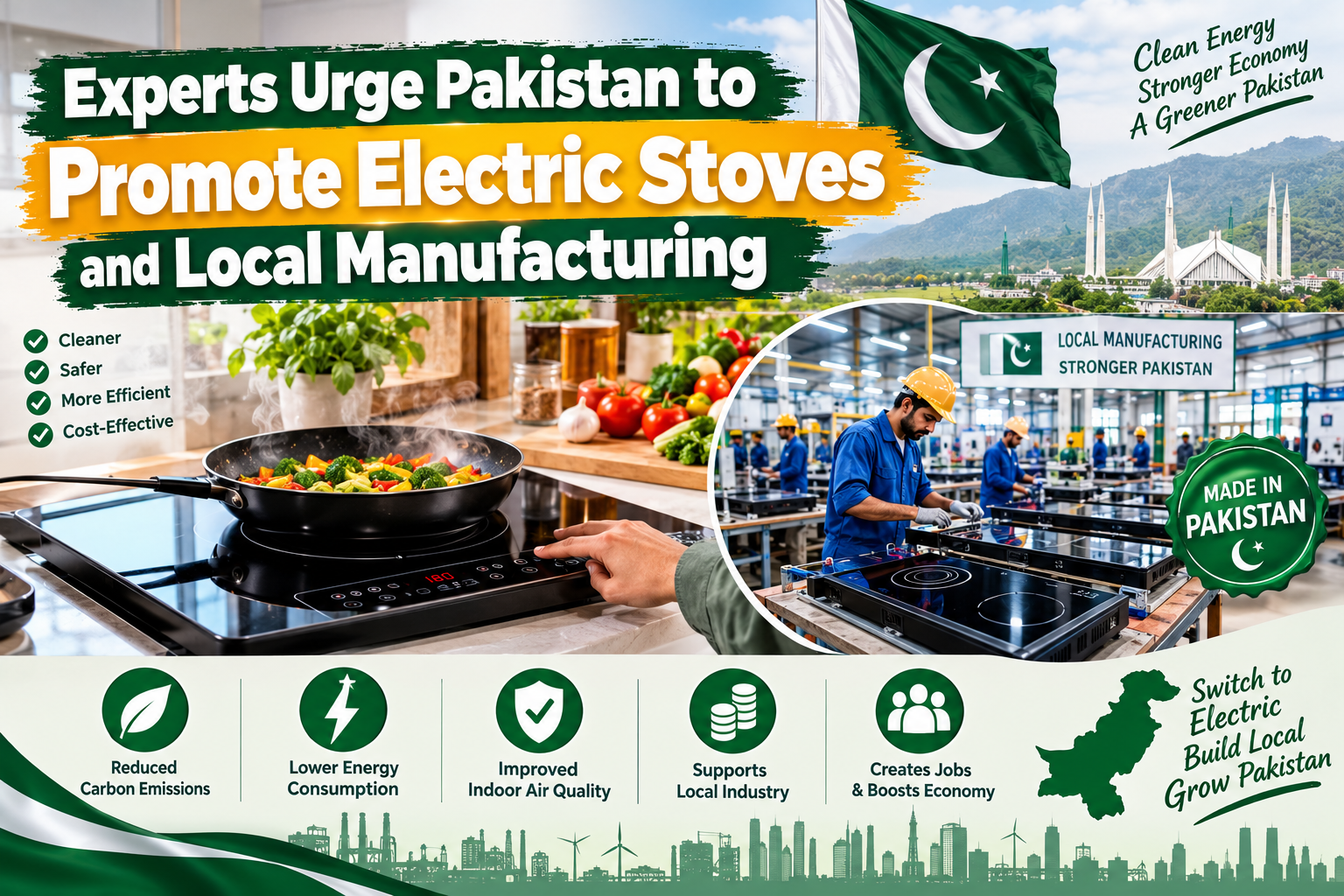
Pakistan’s energy sector is facing an important question: how can households cook their meals safely, affordably, and reliably when gas supplies are uncertain and traditional fuels remain common in many communities? Energy experts have proposed expanding electric cooking and encouraging local production of affordable electric stoves as part of a broader clean-energy strategy.
At a national consultation held in Islamabad on October 15, 2026, experts called for stronger government policies, accessible financing, consumer awareness, and appliances designed for Pakistan’s cooking habits. The event was jointly organised by the Sustainable Development Policy Institute (SDPI) and the National Energy Efficiency and Conservation Authority (NEECA).
The proposal connects several national priorities: reducing reliance on imported gas, making better use of available electricity, improving household air quality, supporting local industry, and expanding access to modern cooking technologies. However, success will depend on whether electric cooking becomes genuinely affordable and practical for ordinary families.
Why Experts Are Calling for Electric Cooking in Pakistan
Cooking is a basic household need, but access to clean and dependable cooking options is not equal across Pakistan. Some urban households depend on piped natural gas, while many rural families continue to use wood, agricultural waste, animal dung, or other traditional fuels. Other households experience interruptions in gas supply, particularly during periods of high winter demand.
According to figures presented by NEECA at the consultation, approximately 51 percent of Pakistan’s population has access to clean cooking facilities. The experts noted that Pakistan remains behind several regional countries, including India, where access exceeds 80 percent, and Bhutan, where the reported figure is 92.8 percent.
These figures highlight the need for solutions that are not only technically available but also affordable, accessible, and suitable for different communities.
Electric cooking could offer one alternative. Modern electric appliances can heat pots directly or use electric heating elements to cook food without burning wood or gas inside the kitchen. Depending on the appliance, electricity supply, cooking practices, and tariff, this can provide a useful option for households seeking to reduce their dependence on traditional fuels.
Experts are therefore asking policymakers to treat electric cooking as an important part of Pakistan’s energy planning rather than simply as a consumer appliance trend.
Pakistan’s Gas Shortages and Dependence on Imported Fuel
Gas availability has become an important concern for households and businesses in Pakistan. During winter, demand for gas rises as families need energy for cooking and heating water. In some areas, households experience low pressure or scheduled interruptions that make everyday activities more difficult.
Pakistan also relies on imported liquefied natural gas (LNG) to meet part of its energy needs. International fuel prices, foreign-exchange requirements, contractual obligations, and domestic supply limitations can all affect the cost and reliability of energy.
Electric cooking could help reduce some of this dependence if households can use electricity instead of imported gas for a portion of their cooking needs. The impact would depend on how many people adopt the technology and whether the electricity used is available at a reasonable cost.
At the consultation, SDPI Executive Director Dr Abid Qaiyum Suleri argued that electric cooking could provide a more reliable alternative when gas supplies are uncertain. He also called for winter electricity incentives to encourage households to consider switching some of their cooking activities to electricity.
Such a change would require careful planning. Pakistan cannot assume that every household can immediately replace a gas stove with an electric one. Appliance costs, household wiring, electricity tariffs, and the reliability of the local power supply all influence whether the transition makes sense.
The government would need to assess these issues before introducing a large-scale programme.
How Solar Energy Could Support Electric Stoves
One of the most important points raised by experts was Pakistan’s growing solar-energy capacity. Solar panels have become a popular option for households and businesses seeking greater control over their electricity costs.
At the October consultation, Alicia Butterfield of the Global Electric Cooking Coalition highlighted Pakistan’s estimated solar photovoltaic capacity of around 50 gigawatts as an opportunity to support electric cooking.
Solar energy and electric cooking can complement each other, but the connection is not automatic. Solar panels generate electricity when sunlight is available, while families need to prepare meals at different times of the day. Households without batteries or reliable grid access may still need electricity from another source during evening cooking hours.
Nevertheless, families with suitable solar installations could potentially use some of their daytime electricity for cooking, particularly when their systems are generating more power than other household appliances require.
For example, a household might prepare certain meals during daylight hours, use a compatible electric cooker when solar generation is strong, or combine solar power with grid electricity when necessary. These possibilities depend on the design and capacity of the household’s electrical system.
Solar-powered electric cooking could be especially useful where grid electricity is expensive or unreliable. However, policymakers must avoid assuming that every household owns solar panels or can afford to install them.
A successful national strategy would need to serve families with different incomes, housing conditions, and access to electricity.
Why Local Manufacturing Is Central to the Proposal
Experts are not only asking the government to encourage electric cooking. They also want Pakistan to produce more affordable appliances locally.
This recommendation matters because a cooking transition involving imported equipment could create another financial burden for consumers. If electric stoves and their components are expensive, low-income households may find it difficult to adopt the technology, even if it offers benefits over time.
Local manufacturing could help develop products designed around Pakistani kitchens, cooking methods, and household budgets. It could also create opportunities for domestic manufacturers, engineering businesses, suppliers, technicians, and retailers.
At the Islamabad consultation, experts encouraged private-sector entrepreneurs to develop affordable appliances suited to local culinary preferences. Gujranwala was mentioned as a possible industrial centre for assembling or replicating available electric-cooking technologies.
Pakistan already has industrial businesses capable of working with metal components, electrical equipment, heating elements, wiring, and household products. With suitable investment and technical support, some manufacturers could explore producing electric cookers and related components.
However, local production must meet meaningful standards. An inexpensive appliance is not a successful product if it consumes excessive electricity, breaks down frequently, overheats, or creates electrical hazards.
Manufacturers would need access to appropriate designs, quality materials, testing facilities, technical training, and reliable supply chains.
Economic Opportunities for Pakistani Businesses
The development of a domestic electric-cooking industry could provide opportunities for small and medium-sized enterprises.
Businesses could explore producing heating plates, induction cooktops, electric hotplates, temperature controls, cookware, replacement parts, and other accessories. Companies could also offer installation, maintenance, repair, and customer-support services.
If demand grows, manufacturers may be able to increase production and spread their costs across larger numbers of appliances. A more competitive market could eventually provide consumers with a wider selection of products at different price points.
Local manufacturing could also encourage technical skills development. Workers may need training in electrical assembly, quality assurance, product design, safety testing, and appliance repair. Vocational institutes and technical colleges could contribute by developing courses relevant to the sector.
The government could support this growth through transparent manufacturing incentives, research partnerships, easier access to business finance, and clear product standards.
Still, industrial expansion should be based on actual demand rather than optimistic projections alone. Businesses need reliable market information, access to components, and confidence that consumers will be able to afford the products they manufacture.
A phased approach would allow Pakistan to test products, understand consumer preferences, and improve designs before attempting a wider rollout.
Clean Cooking and Household Health
The debate around electric stoves is also a public-health issue.
When households burn wood, dung, crop residues, or other solid fuels indoors, smoke and harmful pollutants can accumulate, especially in poorly ventilated kitchens. Exposure can affect the health of household members, with women and children often facing greater exposure because of the time they spend near cooking areas.
During the consultation, UNESCAP Economic Affairs Officer Fadia Ahmadi highlighted the global health burden associated with household air pollution, which is linked to approximately 2.9 million premature deaths annually. She also noted that collecting traditional fuels and spending time cooking can limit opportunities for education and income-generating activities.
Electric cooking can reduce pollution produced directly by burning fuel inside the home. Its overall environmental impact, however, depends partly on how the electricity is generated. Using electricity from renewable sources can strengthen the climate benefits, while electricity generated from fossil fuels has a different emissions profile.
This is why electric cooking should be considered alongside wider policies on renewable energy, electricity reliability, and energy efficiency.
Cleaner kitchens may also make everyday household tasks more comfortable. Families would have another option when traditional fuels are unavailable, while people who collect firewood could potentially spend less time on that activity.
These benefits will only be realised if appliances are safe, practical, and affordable enough for households to use regularly.
The Importance of Affordable Electric Stoves
Affordability is likely to be one of the biggest factors determining whether electric cooking becomes widespread in Pakistan.
A household considering an electric stove needs to think about more than the initial purchase price. The total cost includes the appliance, electricity consumption, suitable cookware where required, possible electrical upgrades, and maintenance over time.
An appliance that is inexpensive to purchase may be costly to operate if it uses electricity inefficiently or if the household pays a high tariff. Conversely, a more efficient model could offer better value over a longer period, depending on how frequently it is used.
The government could help consumers make informed decisions by supporting clear energy-efficiency labels, transparent product information, and independent safety testing.
Affordable financing could also help families spread the purchase cost over time. Any financing scheme should clearly disclose repayment obligations and avoid placing low-income households under unnecessary financial pressure.
Targeted assistance may be more effective than a universal subsidy. For example, a programme could prioritise households that rely heavily on polluting fuels or experience persistent gas shortages, while assessing whether the proposed appliances would actually meet their needs.
Experts at the consultation stressed that affordable products, consumer awareness, and government incentives would be essential to expanding access to clean cooking.
What Role Should the Government Play?
The proposed transition would require coordination among several public institutions, manufacturers, electricity providers, financial institutions, and development organisations.
NEECA could help establish energy-efficiency guidance and coordinate work on standards for electric cooking appliances. Other relevant departments could assess manufacturing incentives, consumer financing, and electricity-tariff options.
Provincial governments could help identify communities where clean-cooking access is limited and work with local organisations to explain the available technologies. Municipal authorities and technical institutes could contribute to consumer education and appliance maintenance training.
At the national level, a clear policy roadmap could set measurable goals for access, product safety, affordability, local manufacturing, and consumer protection.
Such a roadmap should also distinguish between a pilot project and a nationwide programme. Small-scale demonstrations can show whether an appliance works in real kitchens, but larger programmes require evidence about costs, reliability, user satisfaction, and long-term maintenance.
The consultation reviewed work related to developing Pakistan’s national electric-cooking roadmap and sought input from different stakeholders. The experts indicated that the next challenge is moving beyond limited trials towards broader implementation.
A well-designed policy would establish responsibilities, timelines, funding arrangements, and ways to measure progress. Without these elements, the proposal could remain an aspiration rather than delivering practical benefits.
Designing Appliances for Pakistani Cooking Habits
An electric stove must suit the meals people actually prepare. Pakistani households cook a wide variety of foods, including roti, paratha, rice, lentils, curries, vegetables, and dishes that require long periods of simmering or high heat.
A product designed for a different market may not meet these requirements. Some electric cooktops also require compatible cookware, which can create an additional expense for families.
Local manufacturers could help solve these problems by testing different designs with household users and developing products suited to common cooking techniques.
Induction cooktops, for example, heat compatible cookware through electromagnetic induction. Other electric appliances use heated coils or radiant heating surfaces. Each type has different requirements, performance characteristics, and costs.
The best choice will depend on household needs, available electricity, cooking frequency, and the price of the appliance.
Products should also be designed with safety in mind. Clear instructions, suitable temperature controls, durable electrical connections, and protection against overheating can help reduce risks. Appliances should be tested against relevant safety standards before being widely marketed.
Consumer feedback would be valuable throughout this process. Manufacturers need to understand what users find convenient, what problems they encounter, and which features are worth paying for.
Could Electric Cooking Reduce Pressure on Foreign Exchange?
Pakistan’s reliance on imported energy creates exposure to international prices and foreign-exchange requirements. If households replace some imported gas consumption with electricity generated domestically, the country could potentially reduce part of that demand.
The effect would depend on the scale of adoption and the energy sources used to produce electricity. It would also depend on whether the additional electricity is available when people need to cook.
Electric cooking should therefore not be presented as an immediate solution to all of Pakistan’s energy or foreign-exchange challenges. Instead, it could form one part of a broader strategy to use energy resources more efficiently and diversify household energy options.
Local manufacturing may offer a second economic benefit by replacing some imported finished appliances with domestically produced alternatives. Yet manufacturers could still need imported components, machinery, or raw materials. The net economic benefit would depend on how much value is added inside Pakistan.
Policymakers would need to assess these factors using reliable data before estimating national savings.
Electricity Prices and the Challenge of Consumer Confidence
One major obstacle is the cost of electricity for ordinary households.
Families will be reluctant to switch to electric cooking if they believe their monthly bills will rise sharply. This concern may be especially important for people who already face financial pressure from food, transport, education, and other essential expenses.
Government incentives could encourage households to use electricity for cooking during suitable periods, but the details matter. Any incentive should be financially sustainable, clearly explained, and designed to avoid unfairly transferring costs to other consumers.
Another challenge is reliability. Households need to know that they can prepare meals even when electricity supplies are interrupted. Where power outages are frequent, an electric stove alone may not provide the reliability people require.
This means electric cooking policies should be coordinated with broader efforts to improve electricity service and make renewable energy more useful.
Consumer confidence will also depend on product quality. If early buyers encounter unreliable appliances, expensive repairs, or misleading claims about electricity consumption, the wider market could suffer.
Independent testing, clear warranties, reliable repair services, and accurate energy-use information can help build trust.
Why Winter Electricity Incentives Could Matter
Winter is a particularly important period for Pakistan’s cooking-energy debate because gas demand rises while many households experience supply problems.
Experts at the consultation proposed incentives for winter electricity use as a way to encourage electric cooking and potentially reduce the need for imported LNG.
A carefully designed incentive could make electric cooking more attractive during periods when gas is difficult to obtain. However, the government would need to evaluate the cost of the programme, the availability of electricity, and its effects on different categories of consumers.
The policy should also recognise that households have different circumstances. A family with rooftop solar panels may face a different cost calculation from a tenant living in a building with limited electrical capacity. A rural household without reliable grid access may need a different solution altogether.
Rather than assuming one policy will work for everyone, authorities could test targeted incentives and measure their results before expanding them.
How Pakistan Can Strengthen Local Manufacturing
Building a reliable domestic industry requires more than encouraging companies to assemble imported products. Pakistan would benefit from a long-term strategy that develops technical expertise, improves product quality, and gradually increases the local value added in electric-cooking appliances.
Several steps could support this goal.
First, the government and industry should identify which components can be manufactured competitively in Pakistan. This assessment could cover heating elements, metal housings, controls, electrical connections, cookware, and other parts.
Second, manufacturers should have access to product-testing facilities and technical guidance. Quality assurance is essential because cooking appliances operate with electricity and heat and must remain safe during regular household use.
Third, technical colleges and vocational institutes could provide training in appliance assembly, maintenance, electrical safety, and product design. This would help businesses find skilled workers and create opportunities for young people entering technical careers.
Fourth, businesses should be encouraged to work with engineers, researchers, and international technology partners to improve designs. Technology partnerships could help local firms learn from existing products while adapting them to domestic requirements.
Finally, the government should evaluate whether its incentives produce measurable results. Useful indicators could include the number of safe appliances manufactured locally, their retail prices, the proportion of components produced domestically, repair availability, and consumer satisfaction.
These steps could help transform electric cooking from a limited market opportunity into a more established manufacturing sector.
The Role of Consumers and Public Awareness
Even a well-designed policy will struggle if consumers do not understand how electric cooking works or how to select an appropriate appliance.
Public-awareness campaigns could explain the differences between common electric stove types, the importance of compatible cookware, and the need to check electrical safety and energy consumption before buying a product.
Households should also receive realistic information about running costs. Electricity consumption depends on an appliance’s power rating, cooking time, and usage pattern. Solar availability, grid tariffs, and the type of food being prepared can all influence the final cost.
Demonstrations in communities, schools, technical institutes, and local markets could help people experience electric cooking before making a purchase.
Consumer education should not exaggerate the benefits or suggest that every family must immediately abandon gas or traditional fuels. Instead, it should help households compare their options and decide what is suitable for their circumstances.
Manufacturers and retailers also have a responsibility to provide honest product information, reliable after-sales service, and clear safety instructions.
What This Development Means for Pakistan’s Energy Future
The call to promote electric stoves reflects a wider discussion about how Pakistan can improve household energy access while making better use of its electricity resources.
Clean cooking is connected to public health, household budgets, gender equality, industrial development, and energy security. A policy that addresses only one of these areas may fail to deliver its full potential.
For example, promoting appliances without considering electricity prices could make adoption difficult for lower-income families. Offering subsidies without encouraging safe and efficient products could waste public funds. Supporting local manufacturers without establishing quality standards could expose consumers to unreliable equipment.
A more effective approach would coordinate these priorities.
Pakistan could begin by identifying communities with limited clean-cooking access, testing affordable appliances, evaluating consumer costs, and supporting local manufacturers. Evidence from these efforts could then guide a larger programme.
The country would also need to maintain realistic expectations. Electric cooking will not resolve every gas shortage, eliminate all household pollution, or immediately reduce energy imports. Its contribution will depend on how well the technology is integrated into the broader energy system.
Nevertheless, the combination of growing solar capacity, interest from manufacturers, and renewed attention to clean cooking gives policymakers an opportunity to explore practical solutions.
Conclusion
Pakistan’s experts have urged the government to promote affordable electric stoves and encourage local manufacturing as part of a wider effort to improve access to clean cooking. The proposal gained attention at an Islamabad consultation jointly organised by SDPI and NEECA on October 15, 2026.
The central challenge is to make electric cooking accessible to ordinary households rather than limiting it to consumers who can already afford modern appliances. This requires affordable products, reliable electricity, appropriate consumer financing, safety standards, and public awareness.
Local production could support employment, technical skills, and domestic industry while helping manufacturers develop products suited to Pakistani cooking habits. Meanwhile, suitable solar installations and well-designed electricity incentives could make electric cooking more practical for some households.
The next step is turning expert recommendations into a realistic, evidence-based policy. If government institutions, manufacturers, researchers, and consumers work together, electric cooking could become a useful part of Pakistan’s strategy for cleaner kitchens, stronger local industry, and more diversified household energy options.
FAQs
1. Why are experts urging Pakistan to promote electric stoves?
Experts believe electric cooking could help reduce dependence on imported gas and traditional fuels, provide an alternative during gas shortages, and improve indoor air quality.
2. What percentage of Pakistan’s population has access to clean cooking facilities?
Figures presented by NEECA at the October 2026 consultation put access at approximately 51 percent of the population.
3. How could local manufacturing benefit Pakistan?
Local manufacturing could create employment, develop technical skills, support domestic businesses, and encourage the production of appliances designed for Pakistani cooking habits.
4. Can solar energy be used for electric cooking?
Yes. Households with suitable solar installations can use solar-generated electricity for cooking, although the practicality depends on system capacity, sunlight availability, storage, and cooking times.
5. What challenges could slow the adoption of electric stoves in Pakistan?
Major challenges include appliance prices, electricity tariffs, unreliable power supplies, safety concerns, compatible cookware, and the need for consumer awareness and accessible financing.




