Introduction
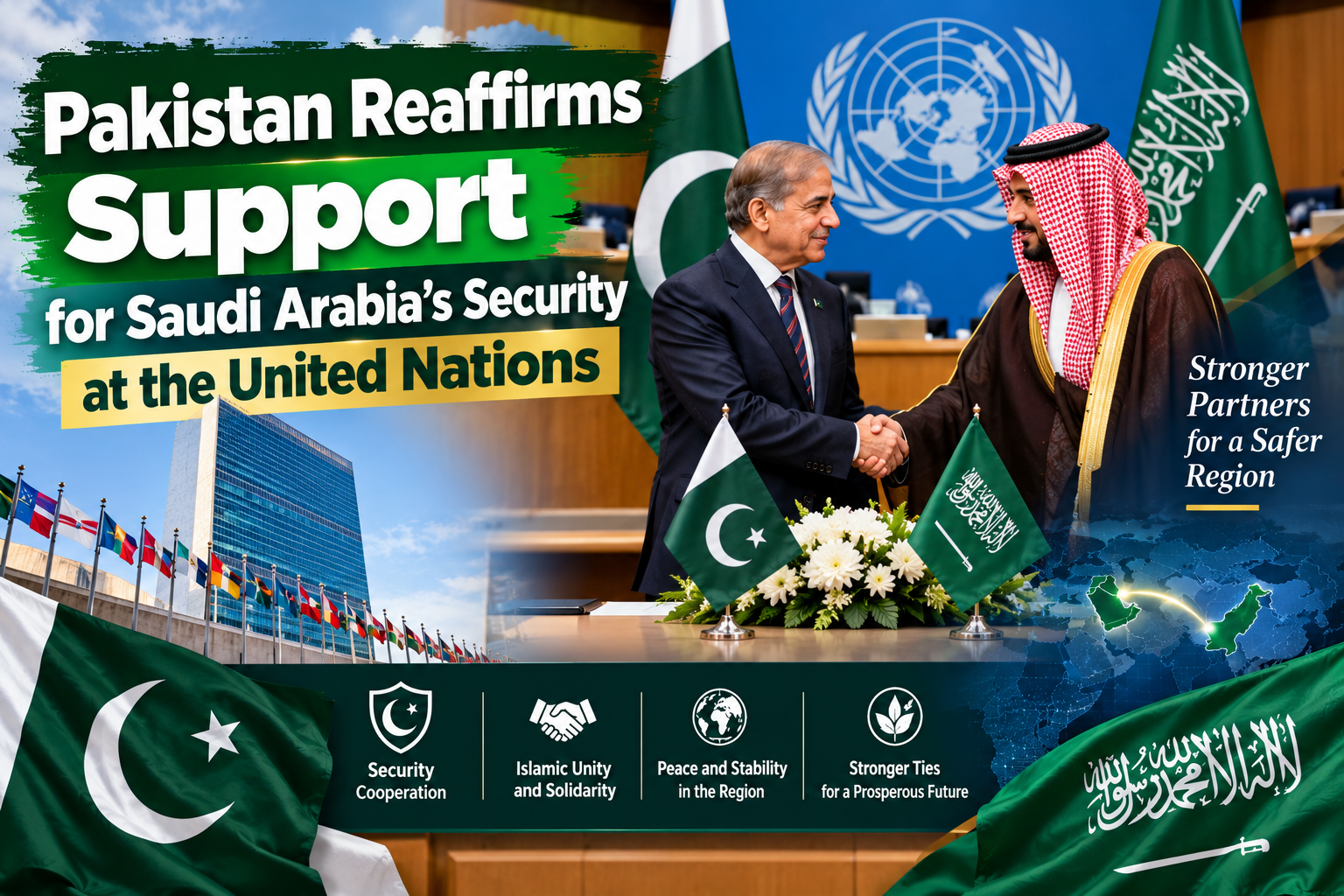
Pakistan has reaffirmed its commitment to Saudi Arabia’s sovereignty, territorial integrity, and security during discussions at the United Nations Security Council (UNSC), as regional tensions and attacks on Saudi territory have raised concerns about peace and stability in the Middle East.
On October 15, 2026, Pakistan’s acting Permanent Representative to the United Nations, Ambassador Usman Jadoon, condemned Houthi attacks targeting Saudi Arabia’s civilian and economic infrastructure. Speaking during a Security Council debate on the Middle East, he called for the attacks to stop and reiterated Pakistan’s support for Saudi Arabia’s security and right to self-defence.
The statement reflects the longstanding relationship between Pakistan and Saudi Arabia, which includes religious, economic, diplomatic, and security cooperation. The two countries have maintained close relations for decades, with Saudi Arabia also serving as an important destination for Pakistani workers and businesses.
Pakistan’s position comes amid wider diplomatic efforts involving regional countries seeking to prevent further escalation. Islamabad has expressed support for Saudi Arabia while also emphasising the importance of dialogue, diplomacy, and lasting regional stability.
The development is significant because instability in the Middle East can affect international trade, energy markets, maritime transportation, and the welfare of millions of people living and working across the region.
What Pakistan Said at the United Nations
Pakistan’s representative addressed the United Nations Security Council during discussions concerning the Middle East and regional security.
According to reporting published on October 16, Ambassador Usman Jadoon condemned attacks on Saudi Arabia’s civilian and economic infrastructure and reaffirmed Pakistan’s support for the kingdom’s security. He also stressed the need for the attacks to cease immediately.
The statement forms part of Pakistan’s broader diplomatic position that countries’ sovereignty and territorial integrity should be respected and that attacks affecting civilians and essential infrastructure are unacceptable.
The Security Council is one of the principal organs of the United Nations. It addresses matters involving international peace and security and provides a forum where member states can discuss conflicts, threats, and possible responses.
Statements delivered at the Council can communicate a country’s diplomatic position, express concern about developments, and encourage international efforts to reduce tensions.
However, a statement of support does not by itself establish a new military operation or determine what action will follow. Any practical measures depend on relevant agreements, decisions by governments, and applicable legal and political requirements.
Pakistan’s remarks therefore need to be understood as part of a broader diplomatic effort to support Saudi security while addressing the regional situation.
Why Saudi Arabia’s Security Matters to Pakistan
Saudi Arabia holds a significant place in Pakistan’s foreign relations.
The relationship is supported by religious connections, decades of diplomatic engagement, economic cooperation, and close people-to-people links. Millions of Pakistanis have travelled to Saudi Arabia for employment, business, religious pilgrimage, and other purposes over the years.
Saudi Arabia is also an important partner for Pakistan in economic and financial matters. Trade, investment, employment opportunities, and financial cooperation contribute to the relationship between the two countries.
Security developments affecting Saudi Arabia can consequently have implications beyond its borders. They may influence the safety of residents and visitors, regional travel, energy transportation, and commercial activity.
In an official briefing on October 9, Pakistan’s Foreign Office said approximately 2.5 million members of the Pakistani community lived in Saudi Arabia. It also emphasised that Pakistan remained concerned about escalation and continued to advocate dialogue and diplomacy.
Protecting the welfare of Pakistani citizens abroad is an important responsibility for the government. This includes monitoring changing conditions, providing consular assistance when necessary, and communicating with host-country authorities.
For these reasons, Pakistan has a direct interest in regional stability and in reducing threats that could affect its citizens and economic relationships.
Background to the Latest Regional Tensions
The latest diplomatic statements followed a period of heightened regional tension involving attacks attributed to Yemen’s Houthi movement against Saudi targets.
On October 10, Pakistan’s representative at the United Nations reaffirmed support for Saudi Arabia’s sovereignty and security amid continued attacks. Subsequent statements by Pakistan’s government and Foreign Office also condemned attacks affecting Saudi territory and infrastructure.
Attacks involving airports, energy facilities, or other civilian and economic infrastructure can create concerns about public safety and the continuity of essential services.
Such incidents can also increase uncertainty for businesses, travellers, airlines, shipping companies, and investors operating in the region.
Saudi Arabia has faced security challenges connected with the conflict in Yemen for years. Efforts to achieve a lasting settlement have involved regional governments, international organisations, and diplomatic initiatives.
The current situation highlights the difficulty of maintaining stability when conflict-related threats cross borders or affect infrastructure important to civilian life.
Pakistan’s statements have sought to condemn attacks while maintaining a public emphasis on regional peace and diplomatic engagement.
Pakistan and the Makkah Joint Defence Agreement
Pakistan’s support for Saudi Arabia has also been linked to the Makkah Joint Defence Agreement, which involves Pakistan, Saudi Arabia, and Türkiye.
The agreement was signed on August 7, 2026, and has been described by the participating countries as a framework for strengthening defence cooperation and collective security.
The agreement has become an important part of recent diplomatic discussions as the three countries consider ways to coordinate their security cooperation.
On October 6, representatives from Pakistan, Saudi Arabia, and Türkiye attended a meeting of the Strategic Political and Defence Committee in Riyadh. The meeting included discussions about regional developments and cooperation under the Makkah agreement. Pakistan’s official statement said the participants reaffirmed their commitment to regional peace, security, and collective defence.
On October 14, Prime Minister Shehbaz Sharif also reiterated Pakistan’s commitment to Saudi Arabia’s sovereignty, territorial integrity, and security during a meeting in Islamabad with the alliance’s first secretary-general, retired Lieutenant General Nauman Mahmood.
The agreement provides a framework for further cooperation, but the precise implementation of any collective security commitment depends on the agreement’s provisions and the decisions of the participating governments.
It is therefore important to distinguish between official expressions of support, existing defence arrangements, and specific decisions about operational activities.
The Role of Diplomacy in Preventing Escalation
Pakistan has repeatedly emphasised the importance of dialogue and diplomacy in addressing regional disputes.
Diplomatic engagement allows governments to communicate concerns, explore possible agreements, and seek ways to prevent incidents from developing into wider conflicts.
The Middle East contains interconnected political, economic, and security interests. Developments in one country can affect neighbouring states and influence international trade and transportation.
A diplomatic approach can help reduce misunderstandings and create opportunities for de-escalation, although negotiations may take time and do not always produce immediate results.
Pakistan’s Foreign Office has said that the country remains committed to Saudi Arabia’s security while supporting efforts aimed at lasting peace and stability.
For Islamabad, balancing security cooperation with diplomatic engagement is an important part of its regional policy.
This approach can involve supporting a partner’s right to protect its territory while also encouraging measures that reduce civilian harm and prevent a wider conflict.
The effectiveness of diplomacy depends on the willingness of the parties involved to engage, the credibility of negotiations, and the availability of practical steps that address the sources of tension.
Why the United Nations Security Council Is Important
The United Nations Security Council has primary responsibility within the UN system for maintaining international peace and security.
Its members discuss conflicts, threats to international stability, and possible responses. Depending on the circumstances, the Council can adopt resolutions, call for changes in behaviour, establish sanctions, or authorise certain international measures.
The Council also provides a forum for countries to explain their positions and raise concerns about developments affecting international peace.
Pakistan’s statement on Saudi security was delivered during a Council debate on the Middle East. The remarks communicated Islamabad’s position and added to wider discussions about regional tensions
However, a statement made during a debate should not be confused with a resolution adopted by the Council. The legal and practical effects of a meeting depend on the decisions taken and the relevant documents issued.
The UN’s role in conflict-related matters can include diplomatic engagement, monitoring, humanitarian coordination, and other measures within its mandate.
For countries affected by regional instability, the organisation provides an international platform where concerns can be raised and collective approaches can be discussed.
Potential Effects on Regional Stability
The security situation involving Saudi Arabia and Yemen could influence the wider region in several ways.
First, continued attacks may increase uncertainty for civilians and businesses. Even when incidents are geographically limited, concerns about further escalation can affect travel, investment, and commercial planning.
Second, threats to energy infrastructure can influence perceptions of supply reliability. Saudi Arabia is an important participant in global energy markets, so developments affecting its production or transportation facilities may attract international attention.
Third, instability can complicate regional diplomacy. Governments may need to devote additional attention to security coordination and emergency planning while continuing negotiations on other issues.
Finally, rising tensions may affect regional transport routes and the cost of commercial activity.
These consequences are possible risks rather than guaranteed outcomes. Their extent depends on the scale and duration of any disruption, the response of regional governments, and the effectiveness of diplomatic efforts.
Pakistan’s calls for an end to attacks and support for regional stability reflect concerns that continued escalation could produce consequences beyond the immediate conflict.
Economic and Energy Implications for Pakistan
Pakistan has an economic interest in stability across the Middle East because regional developments can influence energy prices, trade, employment, and remittance flows.
The country imports energy products and is therefore sensitive to international oil and gas market movements. Disruptions affecting production or shipping can contribute to price volatility, although the actual effect depends on global supply, demand, inventories, and the duration of any disruption.
Higher international energy costs can increase expenses for transportation, electricity generation, industry, and households.
Shipping uncertainty can also affect the movement of goods and the cost of insuring or transporting cargo.
At the same time, Pakistani workers employed across the Gulf region contribute to household incomes and the country’s remittance inflows. Maintaining safe conditions for these workers is therefore an important consideration.
The government must monitor developments carefully and assess their potential implications for energy procurement, trade, and the welfare of overseas Pakistanis.
Diplomatic engagement and communication with regional partners can help Pakistan respond to changing conditions and support efforts to reduce the risk of a broader economic disruption.
The Importance of Protecting Civilians and Essential Infrastructure
Civilian safety is a central concern during regional conflicts.
Airports, hospitals, power facilities, water systems, roads, and other essential infrastructure support everyday life and economic activity. Threats to these facilities can affect large numbers of people, including those who are not directly involved in a conflict.
Damage to critical infrastructure may interrupt transport, limit access to essential services, and create additional challenges for emergency responders.
International humanitarian law contains rules intended to protect civilians and regulate the conduct of hostilities. The application of these rules depends on the circumstances and the relevant legal obligations.
Pakistan’s public statements have condemned attacks affecting Saudi territory and infrastructure while reaffirming support for the kingdom’s security.
Preventing further escalation and protecting civilians remain important goals for regional and international diplomatic efforts.
Public authorities, international organisations, and humanitarian agencies may also need to coordinate assistance and contingency planning if conditions deteriorate.
Pakistan’s Relations with Türkiye and Other Regional Partners
Pakistan’s diplomatic approach to Saudi security also involves cooperation with Türkiye and other regional partners.
The Makkah Joint Defence Agreement has brought Pakistan, Saudi Arabia, and Türkiye into a shared framework for defence discussions. Meanwhile, broader diplomatic consultations have included Egypt and other countries concerned about regional stability.
On September 22, 2026, the foreign ministers of Pakistan, Türkiye, Egypt, and Saudi Arabia met on the sidelines of the United Nations General Assembly and affirmed Saudi Arabia’s right to defend itself in accordance with international law. They also expressed concern about regional conflict and supported dialogue and diplomacy,
These discussions illustrate how regional governments can coordinate their diplomatic positions even when their individual national interests and policies differ.
Cooperation may include consultations, information sharing, diplomatic initiatives, and other measures agreed upon by the participating countries.
However, statements of common concern do not necessarily mean that all countries have identical policies or will participate in every future action.
The practical extent of cooperation depends on the decisions of each government and the terms of the arrangements in place.
What the Latest Statement Means for Pakistan-Saudi Relations
Pakistan’s statement at the United Nations reinforces the importance Islamabad places on its relationship with Riyadh.
The two countries have a long history of diplomatic engagement, economic cooperation, religious connections, and security discussions.
Reaffirming support during a period of heightened regional tension communicates continuity in that relationship and signals that Pakistan is paying close attention to developments affecting Saudi Arabia.
Such statements can also reassure diplomatic partners that consultations will continue through established channels.
Nevertheless, public declarations of support should be distinguished from specific decisions about military deployment, financial assistance, or other operational measures.
Those decisions depend on the relevant agreements, legal requirements, government assessments, and the circumstances at the time.
The immediate significance of the United Nations statement is that Pakistan has publicly condemned attacks on Saudi infrastructure and reiterated its commitment to the kingdom’s security while participating in international discussions about the regional situation.
What to Watch in the Coming Weeks
Several developments will help determine how the situation evolves.
First, the level of regional tension: Further attacks or a reduction in hostilities will influence the security environment and the urgency of diplomatic initiatives.
Second, diplomatic engagement: Meetings involving Pakistan, Saudi Arabia, Türkiye, and other regional countries may indicate whether governments are making progress towards de-escalation.
Third, implementation of the Makkah Joint Defence Agreement: Official announcements may provide additional clarity about how the participating countries intend to coordinate their cooperation.
Fourth, the welfare of overseas Pakistanis: Government advisories and consular communications will remain important for Pakistani citizens living or travelling in affected areas.
Fifth, international energy and transport markets: Changes in shipping conditions and energy prices may help show whether the situation is creating wider economic effects.
Developments in these areas will provide a clearer picture of the implications for Pakistan and the region.
It is important to assess confirmed announcements and reliable reporting rather than assume that every diplomatic statement will lead to immediate policy or military changes.
Outlook: Pakistan Seeks Security and Regional Stability
Pakistan’s reaffirmation of support for Saudi Arabia at the United Nations comes at a time of heightened regional concern.
By condemning attacks on civilian and economic infrastructure, Islamabad has restated its commitment to Saudi Arabia’s sovereignty, territorial integrity, and security. The statement also fits within Pakistan’s broader engagement with Saudi Arabia and Türkiye under the Makkah Joint Defence Agreement.
For Pakistan, the issue involves several interconnected priorities: maintaining close relations with Saudi Arabia, protecting Pakistani citizens living abroad, supporting regional stability, and reducing the risk of economic disruption.
The country’s continued emphasis on dialogue and diplomacy reflects the importance of preventing further escalation while maintaining established partnerships.
The situation remains dependent on developments across the region, the actions of the parties involved, and the effectiveness of diplomatic efforts.
Conclusion
Pakistan has reaffirmed its support for Saudi Arabia’s security at the United Nations Security Council, condemning attacks on the kingdom’s civilian and economic infrastructure and calling for an end to hostilities.
The statement delivered by Ambassador Usman Jadoon on October 15, 2026, highlighted Pakistan’s commitment to Saudi Arabia’s sovereignty and right to self-defence. It also came amid wider diplomatic efforts to address regional tensions and prevent further escalation.
Pakistan’s relationship with Saudi Arabia extends across diplomatic, economic, religious, and security fields. The welfare of Pakistani citizens living in the kingdom and the potential economic consequences of regional instability make these developments especially relevant for Islamabad.
The Makkah Joint Defence Agreement provides an additional framework for cooperation with Saudi Arabia and Türkiye, although its implementation will depend on the provisions of the agreement and decisions made by the participating governments.
Ultimately, the challenge for Pakistan and its regional partners is to protect security interests while encouraging diplomatic solutions that reduce risks to civilians, trade, and regional stability.
The coming weeks will show whether diplomatic engagement can help lower tensions and prevent further disruption across the Middle East.
FAQs
1. What did Pakistan say about Saudi Arabia’s security at the UN?
Pakistan condemned attacks on Saudi Arabia’s civilian and economic infrastructure and reaffirmed its support for the kingdom’s sovereignty, territorial integrity, and security.
2. Who represented Pakistan at the UN Security Council debate?
Pakistan’s acting Permanent Representative to the United Nations, Ambassador Usman Jadoon, delivered the statement during the October 15, 2026, debate.
3. What is the Makkah Joint Defence Agreement?
It is a defence cooperation agreement involving Pakistan, Saudi Arabia, and Türkiye, intended to strengthen coordination on shared security concerns.
4. Why is Saudi Arabia’s security important to Pakistan?
The countries maintain close diplomatic, economic, religious, and security relations. Saudi Arabia is also home to a large Pakistani community, making regional stability important for citizens and economic ties.
5. Is Pakistan also calling for diplomacy and regional peace?
Yes. Pakistan’s Foreign Office has reiterated the country’s support for Saudi Arabia while emphasising dialogue, de-escalation, and efforts to achieve lasting regional peace and stability.




