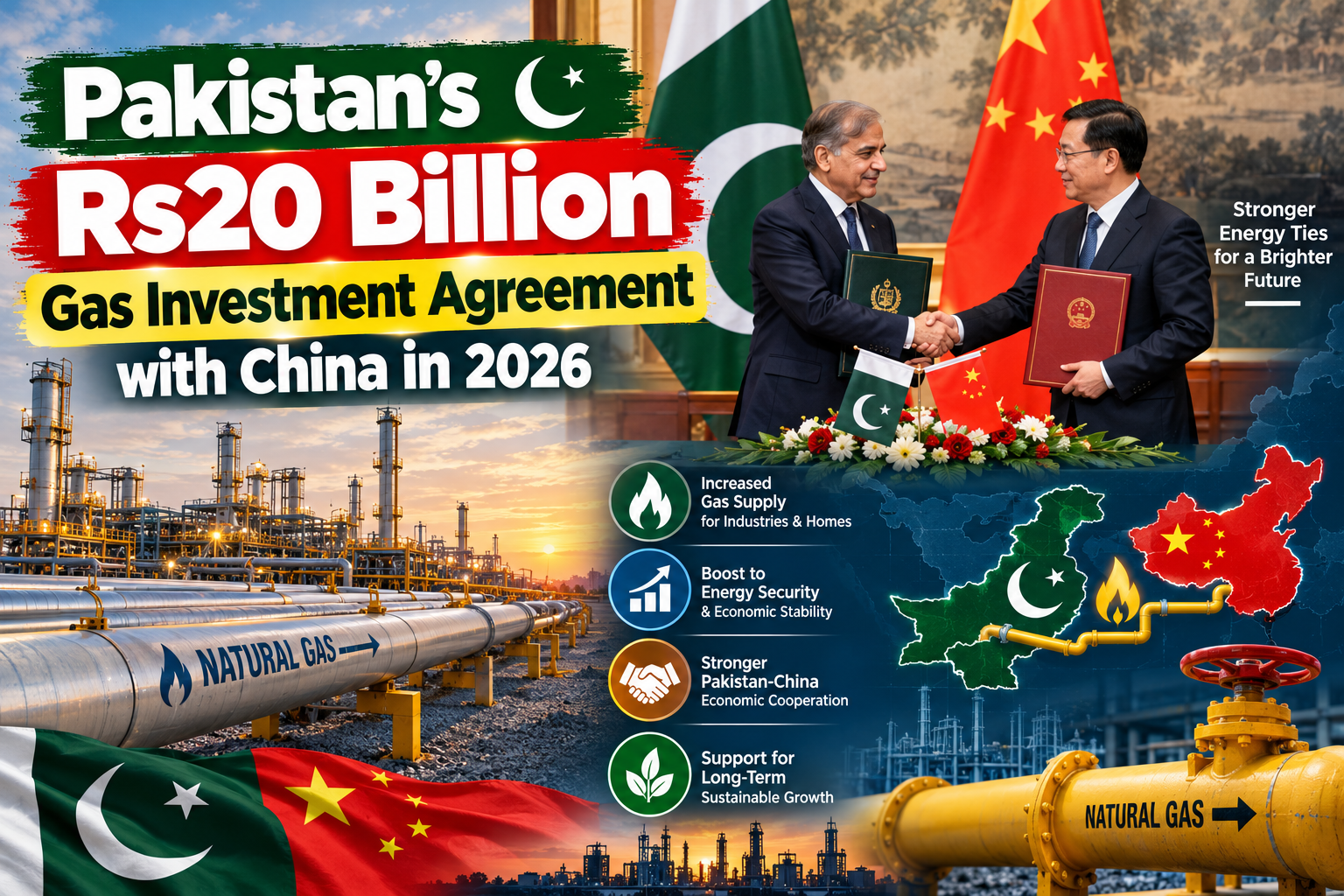
Pakistan’s energy sector continues to seek investment, modern technology, and improved production methods to meet the country’s changing energy requirements. The proposed cooperation between Shaheen Energy (Pvt) Ltd and China’s Anton Oilfield Services Group represents another effort to strengthen Pakistan-China business ties.
The two companies signed a memorandum of understanding to explore investment opportunities worth approximately Rs20 billion over the next three to five years. The proposed programme is expected to examine gas processing, upstream development, production enhancement, and infrastructure projects.
The announcement is significant because natural gas remains an important energy source for Pakistan’s industries, commercial consumers, and other parts of the economy. Better use of available gas resources could support domestic supply and help reduce waste.
However, the agreement is an MoU to explore potential projects, not confirmation that the entire Rs20 billion has already been invested. The companies will need to identify commercially viable opportunities and establish the necessary arrangements before individual projects can proceed.
The partnership also reflects a broader opportunity for Pakistani businesses to work with international companies that possess specialised equipment, technical expertise, and experience in energy operations.
What Are Shaheen Energy and Anton Oilfield Services Group?
Shaheen Energy is a Pakistan-based energy company involved in gas processing and the utilisation of natural gas and flare gas. Its operations include cleaning, purification, dehydration, and compression processes that can make gas suitable for industrial and commercial use.
China’s Anton Oilfield Services Group provides oilfield services and technical capabilities across areas such as drilling, well completion, reservoir engineering, production enhancement, and field management. The company operates internationally and offers services designed to help energy producers develop and manage oil and gas resources
The companies bring different capabilities to the proposed partnership. Shaheen Energy contributes local operational experience and knowledge of Pakistan’s gas market, while Anton can potentially contribute specialised oilfield technology and experience in upstream development.
Combining local expertise with international technical capabilities may help the companies identify projects that would be difficult or expensive to develop without cooperation.
Nevertheless, the final responsibilities of each company will depend on the specific projects selected, the terms of subsequent contracts, and the financing arrangements agreed upon.
Understanding the Rs20 Billion Investment Plan
The proposed Rs20 billion programme is intended to explore opportunities over a period of three to five years.
This timeframe suggests that the cooperation may involve multiple projects rather than a single facility that can be built immediately. Energy developments often require technical assessments, engineering work, equipment, financing, regulatory approvals, and agreements with relevant gas producers or buyers.
The companies are expected to consider several areas:
Third-party sales of eligible natural gas.
Development and expansion of gas fields.
Production enhancement at existing facilities.
Processing and utilisation of low-pressure gas.
Projects involving natural gas and flare gas.
Supporting infrastructure for gas processing, transportation, and supply.
These areas are connected because gas must be produced or recovered, processed to the required standard, transported safely, and delivered to a buyer before it can generate commercial value.
The investment plan could therefore support different stages of the gas supply chain, depending on which opportunities prove commercially viable.
The actual amount invested will depend on the projects that are approved and implemented. The announced figure should be understood as a proposed investment programme rather than money already spent or a guaranteed investment outcome.
What Is Pakistan’s Third-Party Gas Sale Framework?
A central feature of the proposed cooperation is Pakistan’s framework allowing eligible exploration and production companies to sell a portion of their gas to licensed third-party buyers.
Under amendments to the Petroleum (Exploration and Production) Policy 2012 introduced in 2024, eligible companies can sell up to 35% of their share of pipeline-specification gas to third-party buyers licensed by the Oil and Gas Regulatory Authority (OGRA), through a competitive process.
Previously, the commercial arrangements governing gas sales could limit the options available to some producers. The amended framework is intended to provide eligible companies with greater flexibility in marketing part of their gas production.
Third-party sales allow a qualifying producer to sell gas to an eligible buyer other than its existing purchasing arrangement, subject to applicable regulations and contractual conditions.
For the market to function effectively, producers and buyers need to agree on matters such as gas quality, delivery arrangements, transportation, pricing, and payment terms.
The framework may create opportunities for companies that can process gas and connect available supplies with potential customers.
However, it does not mean that all gas producers can sell unlimited quantities to any buyer. Eligibility, licensing, the 35% limit, competitive procedures, and other applicable requirements remain important.
The success of the framework will depend on whether it supports commercially sustainable transactions while maintaining appropriate oversight of the gas market.
Why the Policy Change Matters for Private Investment
Policy changes can influence whether companies consider investing in a particular sector.
When regulations allow more flexible commercial arrangements, businesses may identify new ways to generate revenue from resources that were previously difficult to market.
In Pakistan’s gas sector, the third-party sales framework may create opportunities for eligible producers, processing companies, infrastructure providers, and licensed buyers to develop new commercial relationships.
For example, a company may identify gas that can be processed to meet pipeline specifications and sold to an eligible industrial customer. A commercially viable arrangement would still require suitable infrastructure, regulatory compliance, an agreed price, and a reliable delivery system.
Such opportunities can encourage investment in gas treatment equipment, compression facilities, transportation arrangements, and related services.
However, policy flexibility alone is not enough. Investors also need confidence in contract enforcement, market demand, payment arrangements, and the financial position of potential buyers.
The proposed partnership between Shaheen Energy and Anton Oilfield Services Group will need to evaluate these practical factors when selecting projects.
If the framework creates workable commercial opportunities, it could encourage further private-sector participation in Pakistan’s domestic gas market.
Gas Processing Could Help Recover Underutilised Resources
One of the key opportunities associated with the proposed cooperation is the processing of low-pressure gas.
Natural gas from a field does not always arrive at the pressure or quality required for direct delivery to consumers. Depending on its characteristics, it may need treatment to remove unwanted components, reduce moisture, or adjust pressure before entering a pipeline.
Gas-processing facilities carry out these tasks and can help make otherwise difficult-to-use resources commercially useful.
Shaheen Energy operates a gas-processing facility at the Sinjhoro field with a designed capacity of approximately 10 million standard cubic feet per day. Published reports state that the facility processes around 8–10 million standard cubic feet per day of low-pressure gas using membrane-based technology to remove carbon dioxide and upgrade the gas to pipeline quality.
This example illustrates how specialised processing can help convert available gas into a product that meets delivery requirements.
Additional opportunities may exist at other facilities where gas production, pressure, quality, or transportation constraints prevent resources from being used efficiently.
Each potential project would need a technical assessment to establish whether the available gas can be processed economically and whether there is sufficient demand for the final product.
What Is Low-Pressure Gas?
Low-pressure gas is natural gas available at a pressure that may be insufficient for a particular processing or transportation system without additional equipment.
Its commercial use depends on several factors, including the volume available, gas composition, distance from consumers, treatment requirements, and cost of compression.
Some resources may be difficult to utilise through conventional arrangements because processing them requires additional equipment or infrastructure.
Specialised facilities can sometimes make these resources more useful by treating the gas and adjusting it to the required specifications.
However, not every low-pressure gas source is commercially viable. The costs of recovering, processing, and transporting the gas must be compared with the revenue that can be earned from selling it.
The proposed cooperation could examine opportunities where technical improvements make it possible to use resources that would otherwise remain underutilised.
If successful, these projects could add to the volume of gas available for commercial use without relying entirely on the development of new fields.
Reducing Gas Flaring and Resource Waste
Flare gas is gas that is burned at an oil or gas facility, often when it cannot be captured, processed, or used through the available infrastructure.
Flaring can occur for safety, operational, or technical reasons. However, where gas can be captured and used safely and economically, recovering it may provide both commercial and environmental benefits.
A gas-recovery project typically needs suitable collection equipment, processing facilities, transportation arrangements, and a buyer for the recovered gas.
The economics depend on the gas volume, its composition, the cost of recovery, and the distance to potential customers.
Shaheen Energy’s reported work with low-pressure gas and flare-gas utilisation demonstrates the type of activity that the companies may explore under the broader cooperation framework.
Reducing avoidable flaring could help conserve a valuable resource and create opportunities to generate revenue from gas that would otherwise not reach consumers.
It is important, however, not to assume that every flare can be eliminated or that all flare-gas recovery projects will be profitable. Some flaring is associated with safety requirements or temporary operating conditions, and each site requires an appropriate technical assessment.
The long-term goal should be to improve resource utilisation while maintaining safe operations and meeting environmental requirements.
Upstream Gas Development and Production Enhancement
The proposed MoU also covers upstream gas projects.
In the energy industry, upstream activities generally involve exploring for oil and gas, developing fields, drilling wells, and producing resources from underground reservoirs.
Production enhancement refers to measures intended to improve the output or efficiency of existing operations. Depending on the field, these measures may involve technical assessments, equipment upgrades, well interventions, reservoir management, or other specialised methods.
Increasing production from existing facilities can sometimes be more economical than developing an entirely new field, although the outcome depends on the condition of the reservoir and the costs involved.
International oilfield service providers may contribute specialised equipment, engineering knowledge, and experience in evaluating potential improvements.
For Pakistan, such cooperation could offer opportunities to improve the performance of selected gas fields and develop technical expertise within local operations.
However, production targets cannot be guaranteed before detailed studies are completed. The amount of gas that can be recovered depends on geological conditions, infrastructure, investment requirements, and operational constraints.
The proposed partnership will need to assess these factors on a project-by-project basis.
How Gas Investment Could Support Pakistan’s Industries
Natural gas plays an important role in several parts of Pakistan’s economy.
Industrial businesses use gas as a fuel, while certain industries also use it as a feedstock or as part of their production processes. Commercial facilities and other eligible consumers may also depend on gas supplies.
Unreliable supply or high energy costs can create difficulties for manufacturers. Businesses may face production interruptions, higher operating expenses, or challenges in meeting delivery schedules.
Improving the utilisation of domestic gas resources could help support supply options, depending on the quantity recovered and the arrangements through which it reaches consumers.
For industrial customers, the benefit would depend on whether gas is available at suitable times, meets required specifications, and can be purchased at a commercially sustainable price.
The proposed investment programme could also create demand for engineering, construction, maintenance, transportation, and other services.
These activities may support local businesses and technical employment, although the scale of any benefit will depend on the projects actually implemented.
It is therefore important to evaluate the agreement not only by its headline investment value but also by its eventual contribution to reliable energy supply and productive economic activity.
Potential Benefits for Employment and Technical Skills
Energy projects can generate employment across several stages, including engineering design, construction, equipment installation, plant operations, maintenance, and transportation.
Depending on the projects selected, the proposed partnership may create demand for technicians, engineers, operators, safety specialists, administrative staff, and other professionals.
Some jobs may be temporary and linked to construction, while others may continue during the operation and maintenance of facilities.
The number of positions cannot be determined from the MoU alone. Employment will depend on the size and type of each project, its level of automation, and the extent to which local workers are recruited.
Technical cooperation could also provide opportunities for training and knowledge transfer.
Local professionals may benefit from exposure to modern gas-processing technologies, production-management practices, and international operational standards.
For these benefits to materialise, companies and relevant training institutions would need to identify the skills required and provide appropriate preparation.
A stronger local technical workforce could support the proposed projects while also creating expertise that is useful across Pakistan’s wider energy industry.
Possible Benefits for Local Suppliers and Businesses
Energy projects rely on a network of suppliers and service providers.
These may include companies that provide pipes, valves, electrical equipment, safety systems, industrial materials, transport, maintenance, and specialised technical services.
Where local businesses can meet quality, safety, and delivery requirements, they may have opportunities to participate in project supply chains.
Participation could help suppliers develop their capabilities and build relationships with larger domestic or international companies.
However, local participation is not guaranteed by the signing of an MoU. It will depend on project procurement policies, technical specifications, pricing, capacity, and applicable regulations.
Smaller suppliers may need to improve documentation, quality control, workplace safety, and delivery reliability to qualify for contracts.
Transparent procurement processes and clear information about supplier requirements could help local businesses understand how to compete for available opportunities.
If implemented effectively, the proposed cooperation could provide benefits beyond the two main companies by creating demand for supporting industries.
Challenges That Could Affect the Rs20 Billion Plan
Although the proposed programme has potential, several challenges could influence its implementation.
Financing and commercial viability
Energy projects can require substantial capital. Investors must assess expected revenue, operating expenses, financing costs, and the time needed to recover their investment.
The Rs20 billion figure represents the intended scale of the programme, but individual projects will need their own financial assessments.
Infrastructure requirements
Gas processing and transportation depend on suitable pipelines, compression equipment, treatment facilities, and connections to potential buyers.
If necessary infrastructure is unavailable, projects may require additional investment or take longer to develop.
Gas quality and availability
The quantity and composition of gas can vary between fields. Technical assessments are needed to determine whether a resource can be processed and delivered economically.
Regulatory compliance
Projects must follow applicable petroleum regulations, licensing requirements, safety standards, environmental rules, and contractual obligations.
Market demand and payment risks
Investors need confidence that buyers will purchase the gas and meet their payment obligations. Commercial arrangements must also account for transportation charges and other operating expenses.
Project timelines
Engineering work, procurement, construction, and approvals can take time. Delays may affect costs and the expected start of commercial operations.
Addressing these issues will be important if the proposed investment programme is to deliver sustainable results.
What the Agreement Means for Pakistan-China Economic Relations
China and Pakistan have established economic cooperation across several sectors, including infrastructure, energy, manufacturing, and trade.
The proposed agreement between Shaheen Energy and Anton Oilfield Services Group adds another potential area of business collaboration.
Unlike a government-to-government infrastructure agreement, this arrangement involves companies exploring commercially viable opportunities in the gas sector.
Such partnerships can allow businesses to combine local market knowledge with international technical capabilities.
They can also provide a framework for evaluating new projects without requiring the companies to commit immediately to every possible investment opportunity.
For Pakistan, attracting private-sector participation may help bring technology, expertise, and financing into selected energy activities.
For the Chinese company, cooperation with a local partner may provide insight into Pakistan’s regulatory environment, operational conditions, and potential customers.
The benefits for both sides will depend on whether the projects are commercially sound and whether the companies can manage operational and financial risks.
The announcement is therefore a positive development in business cooperation, but the long-term results will need to be assessed through actual investment and operating performance.
How the Investment Could Affect Energy Security
Energy security refers to the ability to obtain energy supplies that are reliable, affordable, and available when needed.
Pakistan’s energy requirements are influenced by industrial activity, household consumption, seasonal demand, fuel prices, and the availability of domestic and imported resources.
Improving the use of existing gas resources could contribute to supply flexibility if the projects generate additional usable gas and connect it with suitable buyers.
Better processing and infrastructure may also help reduce the loss of resources that cannot currently be used efficiently.
However, the proposed programme should not be treated as a complete solution to Pakistan’s wider energy challenges. The potential contribution will depend on the quantity of gas recovered, the timing of project completion, and the needs of consumers.
Energy security also requires a diverse and well-managed supply system, efficient consumption, suitable infrastructure, and financially sustainable policies.
Gas investment can be one part of this wider approach.
Environmental and Safety Considerations
Gas processing and upstream development must be carried out with appropriate attention to environmental protection and workplace safety.
Facilities may need to manage emissions, wastewater, equipment risks, and the safe handling of gas under pressure. Projects also require procedures for monitoring equipment, preventing leaks, and responding to emergencies.
Capturing gas that would otherwise be flared may reduce waste in suitable cases, but the overall environmental impact of a project depends on its full operating conditions.
Companies should assess emissions, energy use, water requirements, and other relevant factors before selecting and developing a project.
Compliance with applicable environmental and safety standards is essential for protecting workers, nearby communities, and the surrounding environment.
Clear oversight and transparent reporting can help ensure that the economic benefits of investment are pursued responsibly.
What Happens Next?
The next stage will involve identifying and assessing the opportunities that may be developed under the MoU.
The companies will need to determine which projects offer suitable commercial returns and can be implemented within the proposed three-to-five-year timeframe.
This may involve technical assessments, discussions with gas producers and potential buyers, financing negotiations, and reviews of regulatory requirements.
Some opportunities may progress more quickly than others. A project involving an existing facility may require a different process from one that needs new infrastructure or extensive field development.
It will be important to distinguish between proposals under consideration, projects that have secured funding, and facilities that have begun commercial operations.
The most useful indicators of progress will include specific project contracts, confirmed financing, construction or equipment installation, actual investment spending, and additional gas processed or supplied.
These indicators will help establish whether the MoU is producing the intended economic outcomes.
Outlook for Pakistan’s Gas Sector
The proposed Rs20 billion cooperation between Shaheen Energy and Anton Oilfield Services Group highlights opportunities in Pakistan’s domestic gas market.
The partnership is expected to explore third-party gas sales, gas processing, upstream development, production enhancement, and supporting energy infrastructure. It follows policy changes designed to provide eligible producers with greater flexibility in selling a portion of their gas to licensed third-party buyers.
If commercially viable projects are developed, they could help improve the use of underutilised resources, create demand for technical services, and support the availability of processed gas for eligible consumers.
Nevertheless, the scale of these benefits remains uncertain until the companies identify projects, arrange financing, complete approvals, and begin operations.
Pakistan’s wider energy sector will continue to require investment, infrastructure improvements, effective regulation, and sound commercial planning.
The agreement creates a potential pathway for additional private-sector participation, but its success will ultimately depend on implementation.
Conclusion
Shaheen Energy and China’s Anton Oilfield Services Group have signed an MoU to explore approximately Rs20 billion in investment opportunities in Pakistan’s gas and upstream energy sector over the next three to five years.
The proposed cooperation focuses on third-party gas sales, gas processing, field development, production enhancement, and energy infrastructure.
The government’s third-party gas sale framework may provide new commercial opportunities for eligible producers and licensed buyers, while specialised processing technology could help make certain low-pressure gas resources more useful.
If the companies develop viable projects, the partnership may support industrial energy supply, technical employment, local suppliers, and more efficient use of available resources.
However, the announced amount is a proposed investment programme, not confirmation that the full sum has already been spent. The ultimate outcome will depend on project selection, financing, infrastructure, regulatory compliance, and market demand.
For Pakistan, the key priority is to convert investment interest into practical, safe, and commercially sustainable projects that contribute to the country’s long-term energy needs.
FAQs
1. Which companies signed the Rs20 billion gas investment MoU?
Pakistan’s Shaheen Energy (Pvt) Ltd and China’s Anton Oilfield Services Group signed the memorandum of understanding.
2. How much investment are the companies exploring?
The companies intend to explore investment opportunities worth approximately Rs20 billion over the next three to five years. This is a proposed programme, not confirmation that the full amount has already been invested.
3. What areas will the proposed partnership focus on?
The potential projects include third-party gas sales, gas processing, upstream development, field development, production enhancement, and supporting energy infrastructure.
4. What is Pakistan’s third-party gas sale framework?
It is a regulatory framework that allows eligible exploration and production companies to sell up to 35% of their share of pipeline-specification gas to licensed third-party buyers through a competitive process, subject to applicable rules.
5. How could the agreement benefit Pakistan?
If projects are implemented successfully, they could improve the utilisation of gas resources, support energy infrastructure, create technical and industrial opportunities, and contribute to domestic gas supply.




