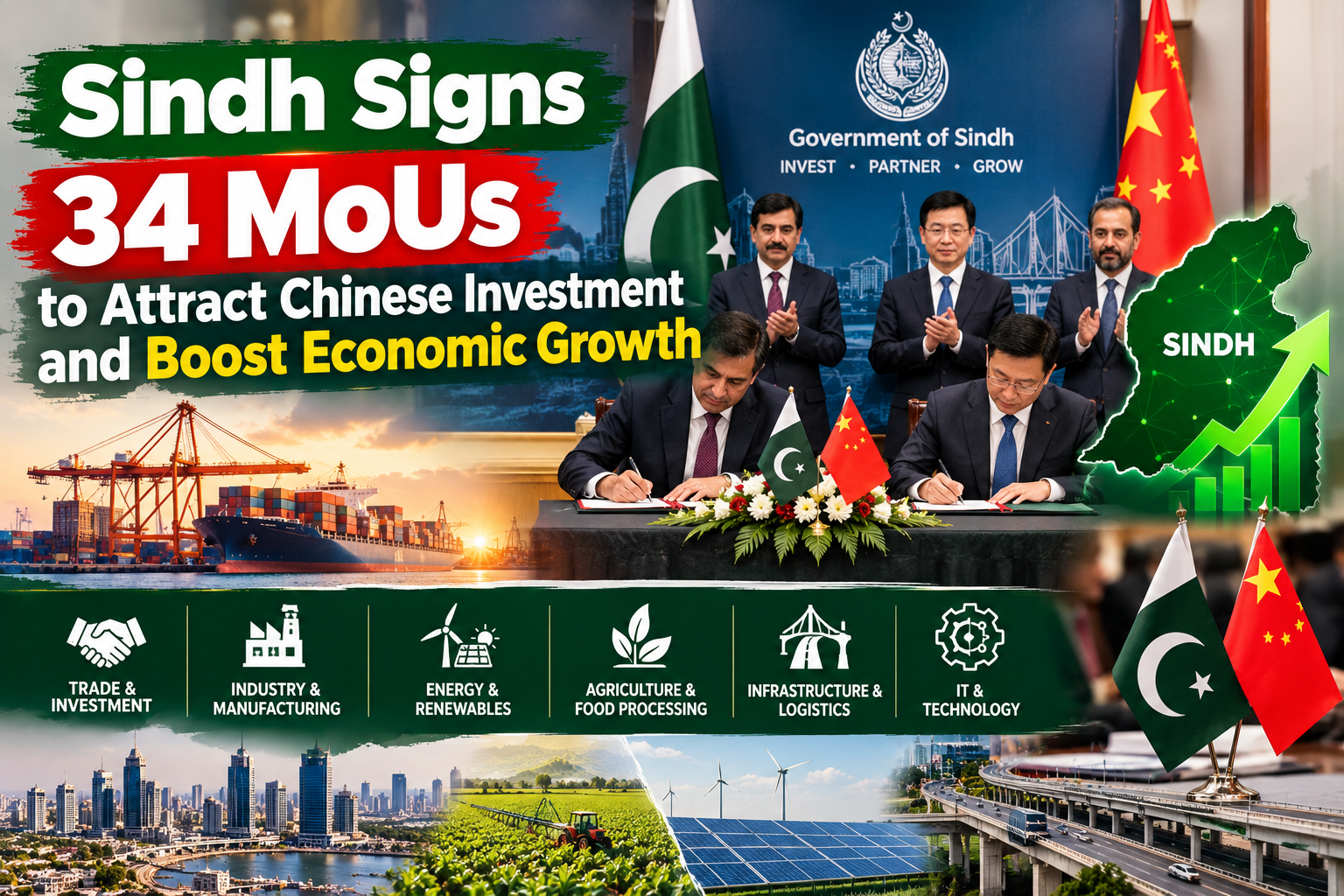
Sindh has taken a step towards strengthening its economic relationship with China after 34 memorandums of understanding (MoUs) were signed during an investment conference in Shanghai. The agreements include 10 government-to-government arrangements and 24 business-to-business agreements, covering several areas of potential cooperation.
The Sindh government presented the province as a potential destination for investment in manufacturing, energy, agriculture, electric vehicles, technology, logistics, and other industries. Officials hope the initiative will encourage new business partnerships, support industrial development, create employment opportunities, and strengthen Pakistan-China economic cooperation.
However, signing an MoU is generally an initial step rather than proof that a project has been completed or that all proposed investment funds have arrived. The longer-term impact will depend on financing, approvals, implementation, and the number of agreements that become operating projects.
Sindh Investment Conference Brings Pakistani and Chinese Businesses Together
The investment conference in Shanghai was organised to highlight business opportunities in Sindh and encourage stronger commercial relationships between Pakistani and Chinese companies. According to published reports, approximately 400 delegates attended the event, including investors, business leaders, and representatives of Chinese companies and financial institutions.
Sindh Chief Minister Syed Murad Ali Shah presented the province as a potential destination for international businesses seeking access to Pakistan’s domestic market and wider regional trade opportunities.
The province offers several advantages for industrial development, including Karachi’s commercial infrastructure, major seaports, an established manufacturing base, agricultural resources, and access to energy and mineral supplies. These factors could make Sindh attractive to companies considering manufacturing facilities or other long-term business investments.
The conference also provided an opportunity for officials and business representatives to discuss possible cooperation in sectors that require investment, technical expertise, infrastructure, and access to international markets.
For Pakistan, such initiatives are important because attracting investment involves more than announcing economic opportunities. Investors also need confidence in business regulations, security arrangements, infrastructure, energy availability, and the ability to transfer profits and conduct operations under predictable conditions.
The Sindh government will now need to demonstrate that the discussions and agreements can progress into practical business activity.
What the 34 Memorandums of Understanding Mean
The reported agreements consist of 10 government-to-government (G2G) arrangements and 24 business-to-business (B2B) agreements.
These two categories serve different purposes.
Government-to-government cooperation can help public institutions establish frameworks for collaboration, coordinate development priorities, and explore projects requiring government participation. Such arrangements may involve infrastructure, energy planning, education, or other areas in which public-sector involvement is important.
Business-to-business agreements, meanwhile, connect private companies and commercial organisations. They may provide a basis for exploring manufacturing partnerships, technology cooperation, supply arrangements, or other investment opportunities.
An MoU usually records an intention to cooperate or establishes a framework for further discussions. Depending on its terms, additional steps may be necessary before a proposal becomes a binding commercial contract or a fully operational project.
These steps can include feasibility studies, financing arrangements, regulatory approvals, land allocation, infrastructure planning, and negotiations over responsibilities and timelines.
Consequently, the announcement of 34 MoUs should be viewed as a starting point for further economic cooperation. Their eventual value will depend on how effectively the parties move from initial commitments to implementation.
Dhabeji Special Economic Zone at the Centre of Investment Plans
One of the major opportunities highlighted during the conference was the Dhabeji Special Economic Zone in Sindh. The zone is associated with the China-Pakistan Economic Corridor (CPEC) and is intended to support industrial development and attract investment.
Special economic zones are designated areas in which businesses may receive particular facilities or incentives under applicable rules. They are often developed to encourage manufacturing, attract investment, support exports, and create employment.
Dhabeji has been presented as a potential location for companies that want to establish industrial facilities serving Pakistan’s domestic market or producing goods for export.
Proposed industrial clusters include automotive and auto-parts manufacturing, light engineering, chemicals, pharmaceuticals, consumer electronics, steel, warehousing, construction materials, textiles, and garments.
If these plans progress, the zone could support a wider network of businesses. A manufacturing facility, for example, may create demand for local transport providers, packaging companies, maintenance services, suppliers, and other supporting industries.
The development of an industrial zone can also encourage investment in roads, utilities, storage facilities, and other infrastructure needed by businesses.
However, investors will assess whether the necessary facilities are available, whether energy supply is reliable, how efficiently goods can move through ports, and whether the costs of operating in the zone are competitive.
The successful development of Dhabeji will therefore depend on both the initial investment commitments and the practical conditions offered to businesses.
Manufacturing Could Create New Employment Opportunities
One of the main reasons governments seek foreign investment is its potential to support employment.
If Chinese companies establish new factories or expand existing business operations in Sindh, they may create demand for engineers, technicians, production workers, managers, accountants, logistics staff, and other professionals.
Manufacturing projects can also support indirect employment. Suppliers may need additional workers to provide materials, transport goods, maintain equipment, or deliver services to industrial facilities.
For young people entering the workforce, new industrial activity could create opportunities to develop practical skills and gain experience in modern production environments.
However, employment benefits are not automatic. The number and quality of jobs created will depend on the type of investment, the scale of each project, the level of automation, and the extent to which local workers and suppliers participate.
Training programmes will be important if companies require technical skills that are not widely available in the local workforce.
The Sindh government and participating businesses could strengthen the benefits of investment by connecting vocational institutions, universities, and technical training centres with the needs of new industries.
Such cooperation could help workers prepare for available positions and enable companies to recruit people with relevant skills.
Electric Vehicles and Automotive Manufacturing
Electric vehicles (EVs) and automotive manufacturing were among the areas identified for greater cooperation during the investment initiative. Sindh officials have highlighted opportunities involving electric-vehicle manufacturing and charging infrastructure.
Electric vehicles are becoming an important part of the global automotive industry. Their development involves vehicle assembly, batteries, electronic components, charging equipment, software, maintenance services, and related infrastructure.
Investment in this sector could provide opportunities for Pakistan to expand its manufacturing capabilities and develop technical expertise.
Local production or assembly could also create demand for component suppliers, workshops, logistics businesses, and training institutions.
However, electric-vehicle manufacturing requires careful planning. Investors need to consider electricity availability, charging networks, consumer demand, vehicle prices, component supply chains, and applicable government policies.
Battery-related infrastructure and technical support are also important for building customer confidence.
If investment proposals move forward, their success will depend on whether companies can offer products suited to local market conditions and develop sustainable supply and service networks.
For Pakistan, the wider opportunity is to encourage industrial activity that creates skills and productive capacity rather than relying exclusively on imported finished goods.
Energy Cooperation and Thar’s Resources
Energy was another important area highlighted during the investment conference. Sindh possesses substantial energy resources, including coal reserves in Thar and potential for renewable energy development.
Cooperation involving energy and mineral resources could help support industrial activity if projects are designed, financed, and implemented effectively.
Manufacturing facilities require dependable energy supplies. Investors often examine the cost, reliability, and long-term availability of electricity before choosing where to establish operations.
Energy-related investment could therefore influence the attractiveness of industrial zones and help support businesses that consume significant amounts of electricity.
The conference also highlighted opportunities involving Thar coal utilisation and the development of related industrial value chains.
A value chain refers to the different stages involved in turning a resource into products or services with economic value. Depending on the project, this may include extraction, processing, transportation, manufacturing, and distribution.
Developing additional processing activities could create opportunities beyond the initial extraction of raw materials.
At the same time, energy projects require careful consideration of costs, environmental effects, technical requirements, and long-term demand. Investors and public authorities need to assess these factors before committing substantial resources.
Renewable energy, including wind and solar power, was also identified as an area for potential cooperation. Such projects could contribute to a more diverse energy system, subject to grid capacity, financing, and project feasibility.
Renewable Energy Investment Could Support Industrial Growth
Sindh has areas with potential for wind and solar energy development. The province’s renewable energy opportunities could attract companies interested in power generation, equipment, technology, and supporting services.
For industrial businesses, energy reliability is an important factor in determining operating costs and production schedules.
A factory that experiences frequent interruptions may face production delays, equipment problems, and difficulties meeting delivery deadlines. Reliable electricity is therefore important for maintaining competitiveness in international markets.
Investment in renewable energy could contribute to electricity generation and create opportunities for technical employment.
Projects may require civil engineers, electrical technicians, equipment suppliers, maintenance workers, and specialists in energy management.
However, renewable energy projects also need suitable grid connections, land arrangements, financing, and systems for managing changes in electricity production.
Their benefits depend on how effectively new generation capacity is integrated into the wider energy system.
Cooperation between investors, government departments, energy companies, and technical institutions could help identify viable projects and address implementation challenges.
Agriculture and Food Processing Offer Additional Opportunities
Agriculture is another sector in which Sindh could seek greater investment and technical cooperation.
The province produces a range of agricultural commodities and has opportunities to develop processing, storage, packaging, and distribution facilities.
Food processing can add value to agricultural products by turning raw materials into products that are easier to transport, store, market, or use in manufacturing.
Depending on the investment, facilities may include grain processing, food packaging, cold storage, agricultural machinery services, and other supporting activities.
Improved storage and processing can also help businesses manage supply more effectively and reduce losses caused by unsuitable storage conditions or delays in transportation.
Investment in agricultural technology may support more efficient production, improved processing methods, and better access to market information.
However, agricultural projects need to account for water availability, local growing conditions, transport infrastructure, electricity costs, and demand for the final products.
Partnerships between investors and local producers could help ensure that new facilities are connected to reliable supplies of raw materials.
If implemented successfully, agricultural investment could create opportunities for farmers, processors, transport companies, and other businesses across the supply chain.
Technology, Artificial Intelligence and Data Centres
Digital technology was another area identified as a potential field for cooperation. The Sindh investment initiative highlighted opportunities involving artificial intelligence (AI), data processing, cloud computing, and data centres.
These technologies are increasingly important for businesses that need to process information, operate digital services, manage supply chains, and improve decision-making.
Data centres provide facilities for storing and processing digital information. They require reliable electricity, cooling systems, telecommunications infrastructure, security arrangements, and skilled technical staff.
AI and data-processing projects can also create demand for software developers, engineers, data specialists, cybersecurity professionals, and other technology workers.
For Pakistan, investment in digital infrastructure could support the growth of local technology businesses and provide opportunities for training and knowledge transfer.
However, these projects require more than investment capital. They also need reliable infrastructure, a skilled workforce, clear data-governance arrangements, and effective cybersecurity practices.
Universities and technical institutions could play an important role by developing courses and practical training programmes related to computing, data management, and software development.
Cooperation between businesses and educational institutions may help ensure that training reflects real industry requirements.
If the proposed initiatives move forward, their contribution will depend on the quality of infrastructure, the number of sustainable projects, and the opportunities created for local businesses and workers.
Universities and Skills Development
Education and university cooperation were also mentioned among the areas covered by the agreements.
Educational partnerships can help strengthen the connection between academic institutions and industry.
Universities may cooperate through research, professional training, technical programmes, academic exchanges, or joint work on practical challenges.
For example, institutions working with manufacturing businesses could develop training in industrial automation, engineering, renewable energy, information technology, or quality management.
Such programmes can help students understand how academic knowledge is applied in workplaces.
Businesses may also benefit from access to graduates with relevant skills and from research that addresses production, technology, and management challenges.
For these partnerships to deliver lasting results, participating institutions need clear objectives and realistic implementation plans.
It is also important that educational cooperation produces opportunities for local students and professionals, rather than remaining limited to formal announcements.
A strong connection between education and industrial development could help Sindh prepare its workforce for changing economic needs.
Karachi’s Ports and Strategic Location
Sindh’s geographic position is another factor highlighted in its investment pitch.
Karachi is Pakistan’s principal commercial centre and is home to major port infrastructure. The province also has access to domestic markets and trade routes connecting Pakistan with regions including the Middle East and Africa.
For manufacturing businesses, access to transportation infrastructure can influence the cost and speed of moving raw materials and finished products.
A company that imports machinery or components and exports finished goods needs dependable logistics arrangements to manage its supply chain.
The availability of ports, warehouses, road connections, and industrial facilities can therefore be an important consideration when choosing a manufacturing location.
The Sindh government has presented the province’s connectivity and industrial base as advantages for investors seeking a location for manufacturing and export-oriented operations.
However, geographic advantages must be supported by efficient services. Delays, administrative difficulties, high transportation expenses, or unreliable infrastructure can reduce the benefits of being close to a major port.
Improving logistics and simplifying relevant procedures could help businesses make better use of Sindh’s location.
What Chinese Investors May Look For
International investors generally assess a range of factors before committing money to a new project.
These may include market demand, operating expenses, access to energy, workforce skills, taxation, infrastructure, regulatory requirements, and the reliability of business arrangements.
For Chinese companies considering investment in Sindh, the province’s industrial opportunities and access to transportation infrastructure may be attractive. Yet each company will need to evaluate whether a particular project meets its commercial and strategic objectives.
Investors may also consider the availability of local suppliers, the ease of importing specialised equipment, and the ability to recruit trained employees.
Government facilitation can help businesses navigate administrative processes, but investors still need clear information about applicable rules and their responsibilities.
A transparent and predictable business environment can improve confidence and make long-term planning easier.
The Sindh government’s next task will be to maintain communication with participating companies and help resolve practical questions that arise during project development.
The Importance of Security and Investor Confidence
Security is an important consideration for companies evaluating long-term projects in Pakistan.
Investors need confidence that their employees, facilities, equipment, and supply chains can operate safely. Security concerns can increase operating costs or make businesses reluctant to commit funds.
During the investment initiative, Sindh Chief Minister Murad Ali Shah said that the provincial government was prioritising the protection of Chinese nationals and projects, while officials also highlighted measures intended to support investment.
Maintaining investor confidence requires consistent coordination among relevant authorities, businesses, and local communities.
Clear communication about safety arrangements and timely responses to concerns can help companies assess risks and plan their operations.
Security is only one part of the investment environment, however. Investors also need reliable utilities, workable regulations, access to financing, and confidence that agreements will be implemented as intended.
A comprehensive approach to business facilitation is therefore more likely to support lasting investment than any single measure.
How Local Businesses Could Benefit
Foreign investment can provide opportunities for local companies when projects are connected to domestic supply chains.
For example, a new manufacturing facility may need packaging, transportation, cleaning, maintenance, construction, catering, and professional services. Local firms that meet the required standards could compete to supply some of these needs.
Industrial investment may also create opportunities for Pakistani businesses to form joint ventures, develop technical partnerships, or supply components to international manufacturers.
However, these benefits depend on whether local firms can meet requirements concerning quality, price, delivery, and production capacity.
Small businesses may need assistance with technical training, certification, financing, and understanding the procurement procedures used by larger companies.
Investment projects could create greater economic value if they actively identify suitable local suppliers and support their ability to participate.
This would help spread some of the benefits beyond the companies directly involved in the original agreements.
Challenges That Could Affect Implementation
Although the signing of 34 MoUs is an important development, several challenges could influence whether the proposed cooperation leads to completed projects.
Financing: Projects need sufficient funding, and the availability of investment capital may depend on market conditions, financing arrangements, and commercial assessments.
Infrastructure: Industrial facilities require dependable electricity, water where necessary, roads, telecommunications, and suitable logistics services.
Regulatory procedures: Investors need clarity about permits, taxation, land arrangements, environmental requirements, and other applicable rules.
Workforce skills: Companies may require technical training and access to employees with specialised experience.
Market demand: Businesses must be confident that their products or services will find customers at prices that support sustainable operations.
Project coordination: Agreements involving several public and private organisations require clear responsibilities, realistic timelines, and regular progress reviews.
Addressing these challenges will require cooperation between government departments, investors, financial institutions, and local businesses.
The number of signed agreements is a useful initial indicator of interest, but the more important measures over time will include actual capital committed, projects completed, jobs created, and the commercial activity generated.
How the Agreements Could Affect Pakistan’s Economy
If the proposed investments progress into operational projects, they could contribute to Pakistan’s economy through several channels.
First, new industrial facilities may increase domestic production and create demand for materials, services, and skilled workers.
Second, export-oriented businesses could help generate foreign-exchange earnings if they sell products to international customers.
Third, technology partnerships may help local companies improve production methods and adopt modern business practices.
Fourth, investment in agriculture and food processing could create additional commercial opportunities for producers and suppliers.
Finally, stronger economic links with Chinese businesses may help Pakistani companies develop relationships with new partners and markets.
These outcomes are possibilities rather than guaranteed results. Their scale will depend on the amount of investment that is ultimately made, the nature of the projects, and their long-term commercial performance.
The government will also need to ensure that development is supported by appropriate infrastructure, sound planning, and transparent implementation.
What Happens Next?
Following the Shanghai conference, attention will turn to the practical work needed to advance the agreements.
The Sindh government has indicated that it intends to follow up on the MoUs and help move proposals towards implementation. Reporting on the conference has also highlighted the importance of assigning responsibility for monitoring agreements and maintaining contact with participating businesses.
The next stages may involve detailed project discussions, feasibility assessments, financing negotiations, regulatory approvals, and the development of implementation schedules.
Some proposals may progress more quickly than others. Projects involving existing facilities or established commercial relationships may follow a different timeline from those requiring extensive infrastructure or new construction.
Regular progress reporting would help the public understand which proposals are advancing and which remain at the planning stage.
Useful indicators would include signed implementation contracts, financial commitments, construction activity, operational facilities, local employment, and the value of new production or exports.
These measures would provide a clearer picture of whether the conference is delivering its intended economic benefits.
Conclusion
Sindh’s signing of 34 memorandums of understanding at the Shanghai investment conference represents an effort to strengthen economic cooperation with China and attract investment into the province.
The agreements include 10 government-to-government arrangements and 24 business-to-business agreements. Areas of potential cooperation include manufacturing, energy, electric vehicles, agriculture, digital technology, logistics, and education.
The Dhabeji Special Economic Zone is one of the major opportunities highlighted by provincial officials, with proposed industrial clusters covering several manufacturing sectors.
If the proposals become operational projects, they could create employment, strengthen local supply chains, encourage technology transfer, and support industrial development.
Nevertheless, MoUs do not automatically guarantee completed projects or a specific amount of realised investment. Their impact will depend on financing, infrastructure, regulatory clarity, security, workforce development, and effective coordination.
For Sindh, the priority now is to turn investment interest into practical results. Transparent progress monitoring and a business environment that supports long-term planning will be important in achieving that goal.
The conference has opened additional avenues for cooperation. Its ultimate success will be measured not simply by the number of agreements announced, but by the projects delivered and the lasting economic opportunities they create for Pakistan.
FAQs
1. How many MoUs did Sindh sign at the Shanghai investment conference?
Sindh announced 34 MoUs, comprising 10 government-to-government arrangements and 24 business-to-business agreements.
2. Which sectors are included in the investment agreements?
The opportunities discussed include manufacturing, energy, coal, electric vehicles, renewable energy, agriculture, technology, logistics, and education.
3. What is the Dhabeji Special Economic Zone?
Dhabeji Special Economic Zone is an industrial development area in Sindh associated with CPEC and presented as an opportunity for manufacturing and export-oriented investment.
4. Will the 34 MoUs immediately create jobs in Sindh?
Not necessarily. Employment opportunities depend on whether the agreements progress into funded, operational projects and how many workers those projects require.
5. How could Chinese investment benefit Pakistan?
Investment could support industrial production, employment, technology cooperation, local supply chains, and exports if projects are implemented successfully and operate sustainably.




