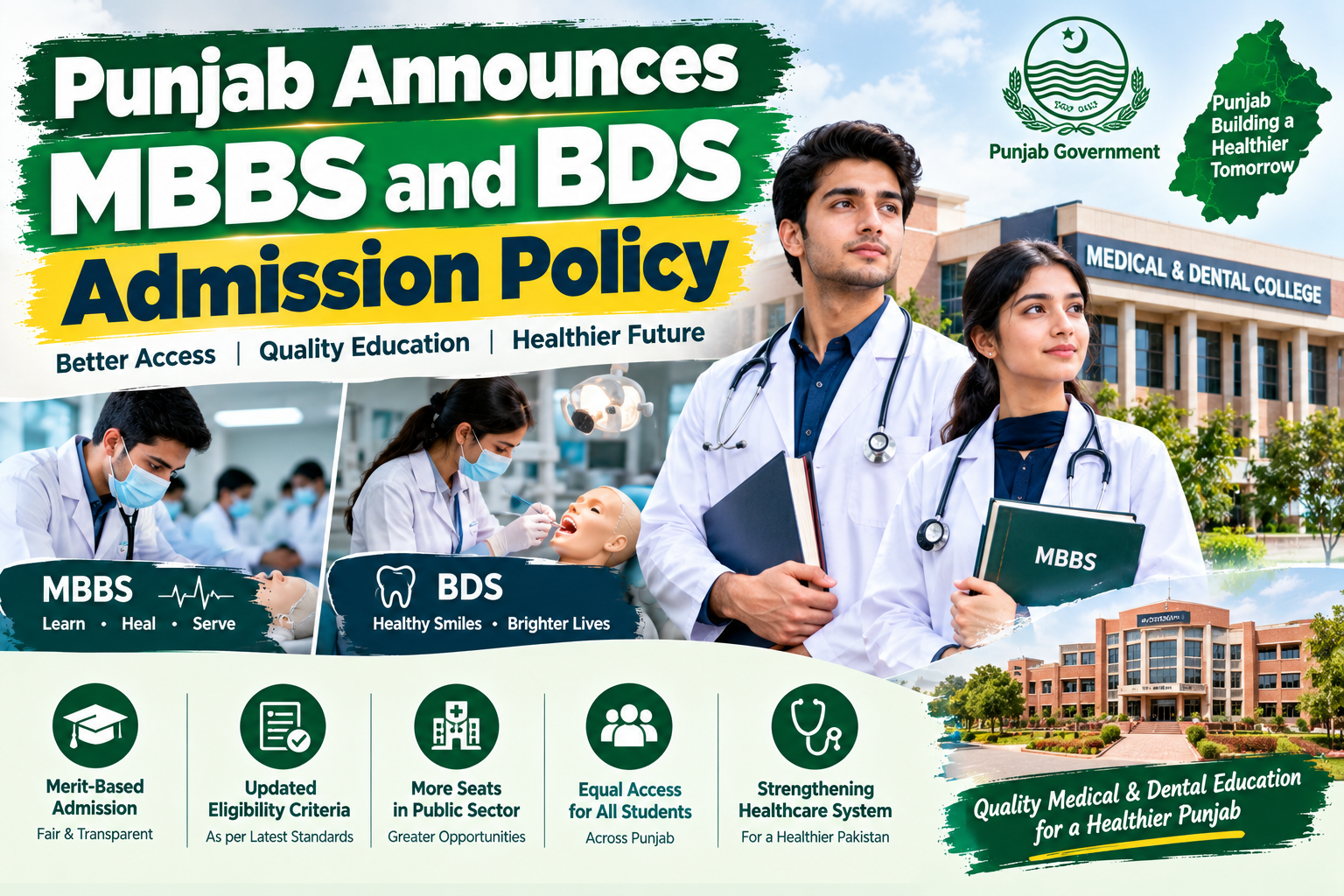
The Government of Punjab has issued its admission policy for MBBS and BDS programmes for the 2026–27 academic session, setting out the rules for students seeking admission to medical and dental colleges across the province. The University of Health Sciences (UHS), Lahore, will manage the centralised admission process for public and private institutions.
The announcement is important for thousands of students who hope to become doctors or dentists. It explains how admission merit will be calculated, which academic qualifications candidates need, how college preferences must be submitted, and what students should understand before accepting an admission offer.
Under the announced policy, the merit formula gives 50 percent weightage to the Medical and Dental College Admission Test (MDCAT), 40 percent to FSc Pre-Medical or an equivalent qualification, and 10 percent to Matriculation or an equivalent qualification. Passing MDCAT is mandatory, and candidates must meet the minimum academic eligibility requirements.
The policy also sets out important requirements for application submission, college selection, tuition fees in public-sector institutions, and confirmation of admission. For students and families planning for the next academic year, understanding these details can help prevent avoidable mistakes during the application process.
1. UHS to Manage Centralised Admissions
The University of Health Sciences Lahore has been designated as the admitting university for MBBS and BDS admissions in Punjab for the 2026–27 academic session.
Centralised admissions mean that applications and selection processes are coordinated through a common system rather than being handled entirely independently by each college. The system is intended to apply the announced eligibility requirements and merit formula consistently across participating institutions.
This process can make it easier for applicants to consider different colleges according to their academic merit and personal preferences. It also places responsibility on students to complete the central application correctly and follow the official admission schedule.
Applicants should carefully read the current UHS instructions before submitting their information. They should confirm which application category applies to them, whether they meet the requirements for their chosen seats, and which documents are necessary.
The official admission notices and prospectus should be treated as the final authority if any information reported elsewhere differs from the university’s instructions.
2. How the Admission Merit Formula Works
One of the most important features of the policy is the distribution of marks used to calculate admission merit.
MBBS and BDS Merit Formula
MDCAT
50%
FSc Pre-Medical / HSSC
40%
Matriculation / SSC
10%
Merit weightage announced for Punjab's 2026–27 MBBS and BDS admissions.
The formula means that the MDCAT result carries the largest individual share of the aggregate. FSc marks also play a substantial role, while Matriculation marks contribute the remaining 10 percent.
Students should understand that these percentages are weightages, not the minimum marks needed to secure a college seat. The final aggregate is calculated from the candidate’s results according to the official method, and selection depends on merit, available seats, eligibility, and college preferences.
For example, a student with strong FSc results should not assume that those marks alone guarantee admission. The MDCAT component represents half of the merit calculation, so preparation for the entrance examination remains important.
Similarly, students should not disregard their Matriculation results simply because that examination carries a smaller share. Every component contributes to the final aggregate.
Applicants should use the official calculation method and verify their aggregate carefully rather than relying on informal calculations or unverified online claims.
3. Minimum Academic Eligibility Requirements
The announced policy requires candidates to have passed MDCAT and obtained at least 60 percent marks in an HSSC, FSc, or equivalent Grade 12 qualification recognised in Pakistan. Candidates must also have studied Biology and Chemistry as compulsory subjects, alongside Physics or Mathematics as an elective subject.
These requirements establish the basic academic conditions for applicants. Meeting them allows a candidate to be considered for admission, but it does not guarantee a seat.
Medical and dental admissions are competitive, and selection depends on the applicable merit calculation and available places. Candidates should therefore distinguish between minimum eligibility and the aggregate needed to obtain a particular college.
Students with foreign qualifications or other equivalent certificates must also pay attention to documentation. The policy requires an equivalence certificate from the Inter Board Coordination Commission (IBCC) where applicable.
Applicants should arrange their academic records early, check that names and other personal details are consistent across documents, and confirm whether any additional certification is required for their particular admission category.
Missing or incorrect documentation can create avoidable problems during a process with strict deadlines.
4. MDCAT Is Mandatory for Admission
The Medical and Dental College Admission Test is a central part of the selection process. Under the announced policy, candidates must pass MDCAT to meet the admission eligibility requirements.
The test assesses the academic knowledge and understanding expected of students entering medical and dental education. Since it accounts for 50 percent of the aggregate, it can significantly influence a candidate’s position on the merit list.
Students preparing for the examination should follow the applicable syllabus, understand the official paper pattern, and practise questions from the relevant subjects. They should also pay attention to examination instructions and the rules governing results and any permitted review procedure.
Applicants must confirm the applicable passing requirements for their programme and admission category from the official policy. They should not assume that meeting the general HSSC requirement automatically satisfies the separate MDCAT requirement.
The MDCAT result announced for Punjab’s 2026 admission cycle relates to the examination held on September 20, 2026, according to UHS’s public notices.
Students should keep their examination details and result records available when completing the application. If a result contains an apparent error, they should use the official procedure and deadline rather than relying on unofficial advice.
5. Separate Applications for MBBS and BDS
Students need to understand the difference between applying for MBBS and applying for BDS.
MBBS is the undergraduate medical degree for students pursuing a career as a physician. BDS is the undergraduate dental degree for students pursuing a career in dentistry.
Although both programmes fall under medical and dental education, they are separate programmes with their own admission preferences and schedules. Reports on the 2026–27 policy state that candidates must submit separate applications for the two programmes. Failing to apply for a programme means the candidate will not be considered for admission to it through that application process.
Students should decide which programmes they genuinely wish to pursue before applying. Candidates interested in both medicine and dentistry should check the relevant instructions and complete each application separately.
It is important not to assume that selecting a medical college automatically places a student in consideration for a dental college, or that an MBBS application covers BDS as well.
Before final submission, applicants should review their programme choices, personal information, academic results, and college preferences. A careful final check can help prevent errors that might be difficult to correct after the deadline.
6. Application Schedule and Important Dates
The admission schedule is one of the most time-sensitive parts of the process. Students should check the official UHS portal and current public notices before acting, because dates can change through a revised notification.
The available published information gives the following schedule for the 2026–27 session:
Admission stage | Announced schedule |
|---|---|
Public-sector MBBS applications | October 16–30, 2026 |
Provisional MBBS merit order | November 13, 2026 |
Final MBBS merit order | November 16, 2026 |
First MBBS selection list | November 17, 2026 |
Public-sector BDS applications | December 15–30, 2026 |
Provisional BDS merit order | January 6, 2027 |
Final BDS merit order | January 9, 2027 |
First BDS selection list | January 11, 2027 |
The dates above were reported for Punjab’s public-sector admissions and should be checked against the latest official UHS notice before submission
Applicants should not wait until the last day to begin an application. High website traffic, incomplete information, payment issues, or missing documents can cause unnecessary stress near a deadline.
Students should also distinguish between application deadlines and the dates on which merit lists are published. Submitting an application does not mean that admission has been confirmed.
After the application period closes, candidates should monitor official announcements for merit lists, selection results, fee instructions, and any permitted changes to the schedule.
7. How College Preferences Affect Selection
College preferences are another important part of the centralised admission process. Candidates are asked to submit their preferred institutions through the online system.
According to the published policy reports, private-sector applicants may select any number of participating colleges, while applicants for public-sector institutions must list the relevant colleges in their preferred order. A college that is not included in the submitted preference list will not be considered for admission or upgradation.
This makes the preference list more than a routine administrative step. It can influence which college a candidate is considered for when their merit position and available seats are assessed.
Students should research their options carefully. Factors worth considering include the programme offered, location, travel arrangements, accommodation needs, total cost, and the institution’s official admission requirements.
Applicants should rank colleges according to their genuine preferences rather than copying another student’s list. Each family has different financial circumstances and practical needs.
The policy reports also state that applications may be modified before the submission deadline, but the number and order of college preferences cannot be changed after that deadline.
Candidates should therefore review their choices carefully before the application period ends. They should confirm that every college they want to be considered for is included and that the order reflects their actual priorities.
8. Public-Sector Medical and Dental College Fees
Tuition fees are a major consideration for students and families planning medical or dental education.
Under the announced policy, annual tuition for public-sector MBBS and BDS colleges is set at Rs50,000, excluding seats under overseas and foreign quotas. Overseas Pakistanis selected on open merit are reported to pay the same tuition fee as Pakistani students.
This published tuition figure is relevant to families comparing public-sector options. However, students should not assume that tuition is the only expense involved in studying medicine or dentistry.
Other possible costs may include admission-related charges, examination fees, books, equipment, transport, accommodation, food, and personal expenses. The exact charges can differ by institution and student circumstances.
Families should ask the relevant college for a complete and current fee breakdown before making financial commitments. They should also verify the payment instructions and deadlines included with an official selection offer.
Applicants considering private-sector institutions should review their fee structures independently and make sure they understand the payment obligations before accepting a seat.
Financial planning is particularly important because medical and dental degrees require sustained commitment over several years. Choosing a college should involve both academic considerations and a realistic assessment of the costs.
9. What Happens After a Merit List Is Published?
Publication of a merit list is an important step, but students must understand that appearing on a merit list and receiving a confirmed admission offer are not necessarily the same thing.
The selection process considers the candidate’s merit position, college preferences, eligibility, and the seats available in the relevant category. UHS prepares college-wise selection lists through the centralised system.
When a candidate is selected, they must follow the instructions issued with the offer. Published reports state that selected candidates must deposit the prescribed college fee within three working days of the merit list being released.
Because this is a short period, students should regularly monitor the official admission portal and keep their documents and payment arrangements ready.
Missing a deadline can put an admission offer at risk. Candidates should carefully check the exact instructions, payment amount, and submission method rather than relying only on information shared by friends or social media accounts.
The policy also addresses upgradation, through which a student may be considered for a higher-preference college when the applicable rules and available seats permit it. Private-sector candidates may be allowed to waive their upgradation right when joining a college, and the published policy reports that such a decision cannot subsequently be reversed.
Students should understand these conditions before making a final decision. They should read the official rules carefully and seek clarification from UHS or the relevant institution if any part of the offer is unclear.
10. No Additional Marks for Hafiz-e-Quran
Another point in the announced policy concerns candidates who have memorised the Holy Quran.
According to the reported admission policy, no additional marks will be awarded for Hifz-e-Quran in calculating merit for MBBS and BDS admissions. The policy refers to the applicable medical and dental undergraduate admission regulations and a court decision dated April 4, 2023.Applicants should use the officially notified merit formula when calculating their expected aggregate. They should not add marks that are not authorised under the current policy.
This is an example of why checking the latest admission notification is important. Rules that applied in previous admission cycles may be revised, and students should not base their application decisions on older information without checking whether it remains valid.
11. Advice for Students Preparing Their Applications
Students can reduce the risk of application problems by approaching the process systematically.
First, check the latest admission policy and confirm that you meet the academic requirements. Make sure your MDCAT result and academic records are accurate.
Second, prepare all required documents in advance. Candidates with equivalent or foreign qualifications should pay particular attention to the certification requirements applicable to them.
Third, review the programme and college choices carefully. Students applying to both MBBS and BDS should complete the separate applications required for each programme.
Fourth, calculate the aggregate using the official formula. Remember that the merit formula determines how results are weighted, while final selection also depends on competition and available seats.
Fifth, keep track of application, merit-list, and fee-payment deadlines. Check official announcements regularly, especially during the days immediately following the publication of selection lists.
Finally, avoid making financial payments based solely on messages from unknown individuals or unofficial social media pages. Follow the verified payment instructions provided by the university or college.
These steps cannot guarantee admission, but they can help students avoid preventable mistakes and make informed decisions.
12. Why the New Policy Matters for Punjab’s Future
Medical and dental admissions are important not only for individual students but also for Punjab’s wider healthcare system.
Medical colleges train future doctors who may eventually work in hospitals, community clinics, research centres, and public-health programmes. Dental colleges prepare professionals who contribute to oral healthcare and the prevention and treatment of dental diseases.
A transparent admission process can help eligible students understand how their academic performance is assessed and how they may be considered for available seats.
At the same time, admission policies must be communicated clearly. Students need reliable information about eligibility, merit, fees, college preferences, and deadlines to make decisions without unnecessary confusion.
The centralised process administered by UHS provides a common framework for participating institutions. Its effectiveness will depend on clear communication, accurate records, consistent application of the rules, and timely publication of selection information.
For families, the key is to treat the official policy as the starting point for planning. Students should understand the requirements, assess their options realistically, and make decisions based on verified information.
Conclusion
Punjab’s MBBS and BDS admission policy for the 2026–27 academic session establishes the requirements and procedures for students seeking entry into public and private medical and dental colleges.
The key features include a merit formula of 50 percent MDCAT, 40 percent FSc or equivalent, and 10 percent Matriculation or equivalent; a minimum 60 percent HSSC requirement; mandatory MDCAT qualification; separate applications for MBBS and BDS; and rules governing college preferences and admission confirmation.
Public-sector tuition has been set at Rs50,000 annually under the reported policy, excluding overseas and foreign quotas. Students must also pay close attention to application deadlines and the short period allowed for confirming a selection.
The most important advice for applicants is to verify every requirement through the latest official UHS admission notice, submit complete applications, review college preferences before the deadline, and follow selection and payment instructions carefully.
With proper preparation and reliable information, students can approach the admission process with greater confidence and make better-informed choices about their academic futures.
FAQs
1. What is the merit formula for MBBS and BDS admissions in Punjab for 2026–27?
The announced formula assigns 50 percent weightage to MDCAT, 40 percent to FSc Pre-Medical or equivalent, and 10 percent to Matriculation or equivalent.
2. What is the minimum HSSC percentage required for admission?
The announced policy requires at least 60 percent marks in HSSC, FSc, or an equivalent recognised Grade 12 qualification, along with the other eligibility requirements.
3. Is MDCAT compulsory for MBBS and BDS admissions?
Yes. Under the announced policy, passing MDCAT is mandatory for admission eligibility, subject to any specific exceptions stated in the official rules.
4. How much is the annual tuition fee at public-sector medical and dental colleges?
The reported annual tuition fee is Rs50,000 for public-sector MBBS and BDS colleges, excluding overseas and foreign quotas. Students should verify other applicable charges with their institutions.
5. Where should students check the official admission schedule?
Students should check the latest admission notices and instructions issued by the University of Health Sciences Lahore, which is responsible for centralised admissions in Punjab.