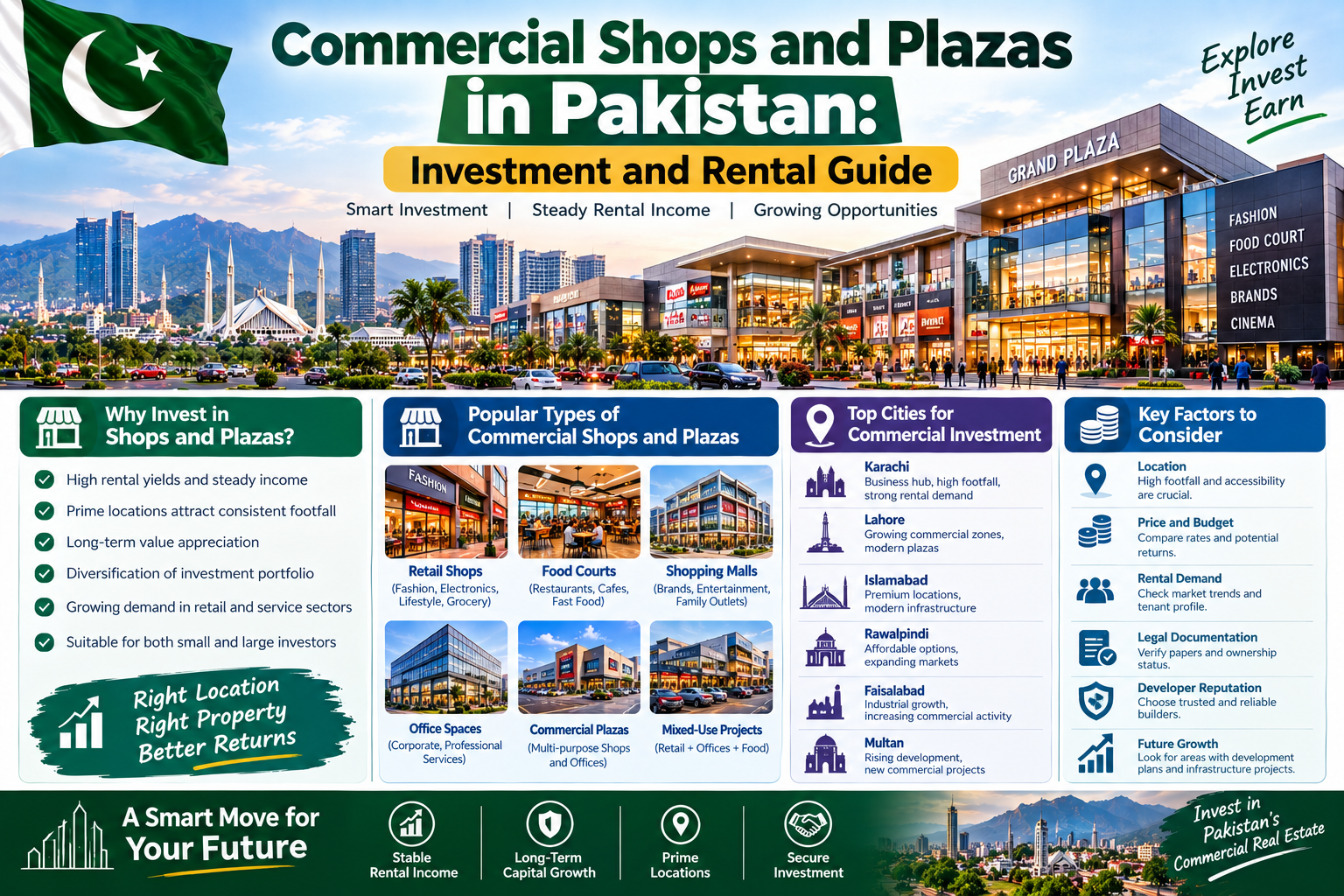
Commercial shops and plazas are an important part of Pakistan’s real estate market. From small shops in local markets to large commercial plazas in major cities, these properties provide opportunities for both investment and rental income. Many people prefer commercial property because a well-located shop or office can generate regular rent while the property itself may increase in value over time.
However, buying a commercial shop or plaza is different from buying a residential property. Location, footfall, accessibility, tenant demand, parking, surrounding businesses, development plans, and legal documentation can all affect the success of a commercial property investment.
For beginners, understanding these factors is important before spending money on a commercial property. This guide explains commercial shops and plazas in Pakistan, their investment potential, rental considerations, important costs, risks, and practical points buyers should understand.
What Is Commercial Real Estate?
Commercial real estate refers to properties that are mainly used for business activities rather than residential living.
Examples include:
Shops
Commercial plazas
Offices
Showrooms
Restaurants
Retail outlets
Warehouses
Business centers
Commercial buildings
Small shopping centers
Commercial shops and plazas are particularly common in cities and developing housing societies across Pakistan.
The purpose of purchasing such a property may be different for every investor. Some people buy a shop to operate their own business, while others purchase commercial property and rent it to another business.
What Is a Commercial Shop?
A commercial shop is a specific retail or business unit located in a market, plaza, shopping center, or commercial area.
A shop can be used for businesses such as:
Clothing stores
Grocery stores
Pharmacies
Mobile shops
Beauty salons
Restaurants
Cafés
Electronics stores
Offices
Boutiques
General retail businesses
The value of a shop depends heavily on its location and business potential.
For example, two shops with similar sizes can have very different prices if one is located on a busy main road and the other is inside a less-developed street.
What Is a Commercial Plaza?
A commercial plaza is a larger building containing multiple commercial units.
A plaza may include:
Ground-floor shops
Offices
Showrooms
Restaurants
Upper-floor commercial units
Parking areas
Storage spaces
Many investors purchase individual units within a plaza rather than buying the entire building.
Plazas can be attractive because multiple businesses may operate in one location, creating regular customer activity.
Why Do People Invest in Commercial Shops and Plazas?
Commercial property attracts investors for several reasons.
1. Potential Rental Income
One of the main reasons people purchase commercial property is rental income.
A shop located in a strong commercial area may attract businesses that are willing to pay rent for a suitable location.
Rental demand can depend on:
Customer traffic
Business activity
Road visibility
Parking
Nearby residential areas
Accessibility
Size of the shop
Type of business
A property with strong tenant demand may provide more consistent rental opportunities than a property in an inactive commercial area.
2. Long-Term Property Value
Commercial property may also increase in value over the long term.
When an area develops, new roads, housing projects, schools, offices, restaurants, and other businesses may increase commercial activity.
As demand increases, property values may also change.
However, appreciation is not guaranteed. Investors should examine the actual development and demand of an area instead of purchasing property only because someone promises that its price will rise.
3. Business Use
Some buyers purchase commercial shops because they want to operate their own businesses.
Instead of paying rent to another property owner, a business owner can use their own shop.
This can provide greater control over the location and property.
4. Diversification
Investors who already own residential property may consider commercial property as another type of real estate investment.
Different property types can have different demand patterns, costs, and risks.
Importance of Location
Location is one of the most important factors in commercial real estate.
A shop may have excellent construction but still perform poorly if customers cannot easily reach it.
Important location factors include:
Main road access
Visibility
Traffic
Pedestrian movement
Nearby residential population
Parking
Public transport
Road width
Nearby offices
Schools and educational institutions
Hospitals
Restaurants
Banks
Supermarkets
Other established businesses
A commercial property should be evaluated according to the type of business that is likely to operate there.
Main Road vs Secondary Road Shops
Main-road shops often receive greater visibility because more people pass by them.
However, they can also be more expensive.
Secondary-road shops may cost less but can have different levels of customer activity.
An investor should not automatically assume that the most expensive location is the most suitable. The important question is whether the expected business activity justifies the price.
Footfall and Customer Traffic
Footfall refers to the number of people who regularly pass through or visit a commercial location.
For retail businesses, footfall can be extremely important.
Before purchasing a shop, an investor can visit the location at different times:
Morning
Afternoon
Evening
Weekdays
Weekends
This can provide a better understanding of how active the area actually is.
A location that looks busy for a short period may not necessarily have strong activity throughout the day.
Parking Facilities
Parking is another important factor.
Customers may avoid businesses where parking is difficult.
A commercial plaza with:
Dedicated parking
Easy entrance
Sufficient space
Safe access
may be more convenient for customers and tenants.
When evaluating a commercial property, investors should check whether the advertised parking actually exists and whether it is legally part of the project or merely an informal arrangement.
Ground-Floor Shops vs Upper-Floor Shops
Ground-floor shops generally receive more direct visibility because customers can access them easily.
Upper-floor units can sometimes be suitable for:
Offices
Clinics
Training centers
Studios
Professional services
The appropriate floor depends on the intended business.
A buyer should therefore consider the expected tenant or business type before choosing a unit.
Buying a Commercial Shop for Rental Income
If the main purpose is rental income, investors should study the rental market before purchasing.
Important questions include:
What is the current rent in the area?
How many shops are vacant?
How quickly do shops find tenants?
What businesses operate nearby?
What size shops are most demanded?
What are the maintenance charges?
Who pays utility bills?
Are there additional building charges?
A property should not be evaluated only by its purchase price.
Understanding Rental Yield
Rental yield is a useful way to compare the relationship between property price and annual rental income.
A simple formula is:
Rental Yield = Annual Rent ÷ Property Price × 100
For example, suppose a commercial shop costs Rs. 20 million and generates Rs. 1.2 million in annual rent.
Rental yield would be:
Rs. 1.2 million ÷ Rs. 20 million × 100 = 6%
This is a simplified calculation.
Actual returns may be lower after considering:
Maintenance
Vacancies
Taxes
Repairs
Service charges
Other property expenses
Therefore, investors should calculate net income rather than looking only at the advertised rent.
Vacancy Risk
A commercial property does not necessarily generate rent every month.
Sometimes a tenant leaves and the property remains vacant.
During this period, the owner may still have expenses.
Vacancy risk can be affected by:
Location
Property size
Rent level
Economic conditions
Business demand
Competition
Accessibility
A property with realistic rent and strong tenant demand may be easier to rent than an overpriced unit.
Buying a Shop for Your Own Business
Buying a shop for personal business use requires a different analysis.
A business owner should consider:
Customer accessibility
Visibility
Required shop size
Storage
Parking
Electricity availability
Water supply
Nearby competition
Expansion possibilities
The cheapest shop is not necessarily the best choice for a business.
For example, a clothing store may benefit from strong pedestrian activity, while a warehouse-related business may prioritize road access and loading space.
Commercial Plazas in Housing Societies
Many housing societies in Pakistan develop commercial areas to serve residents.
These areas may include:
Grocery stores
Restaurants
Pharmacies
Clinics
Salons
Schools
Offices
Banks
Cafés
Commercial properties inside large residential communities may benefit from the surrounding population.
However, investors should check whether the society is sufficiently developed and whether the expected population has actually moved into the area.
Established Areas vs New Developments
Established commercial areas already have businesses, customers, roads, and infrastructure.
New developments may offer lower entry prices in some cases but can involve greater uncertainty.
Before buying in a new project, investors should investigate:
Development progress
Legal status
Approved land use
Road infrastructure
Electricity
Water
Population growth
Nearby projects
Commercial activity
Promises about future development should be verified through reliable documentation.
Legal Documents to Check
Legal verification is essential before purchasing commercial property.
Important documents may include:
Sale deed
Ownership documents
Title documents
Allotment letter
Transfer documents
Approved building plans
Commercial approval
Development authority approvals
NOC where applicable
Property tax records
Utility documentation
The exact requirements can differ depending on the city, authority, and type of property.
Buyers should verify documents through the relevant authorities and seek professional legal advice when necessary.
Verify the Seller
Before paying a large amount, buyers should verify who actually owns the property.
Important questions include:
Is the seller the legal owner?
Is the property jointly owned?
Are there outstanding disputes?
Is the property mortgaged?
Are there unpaid taxes?
Are there outstanding society dues?
A property lawyer or qualified professional can help examine documentation.
Beware of Unauthorized Commercial Projects
Not every commercial project advertised in the market has the same legal status.
Investors should be cautious about projects where sellers make claims such as:
Guaranteed profits
Guaranteed rent
Double returns
Immediate price increases
Limited-time opportunities
Such statements should not replace proper legal and financial verification.
Development Authority Approval
Commercial construction generally involves regulatory requirements.
Depending on the location, different development authorities or local government bodies may be involved.
Investors should verify whether:
The land is approved for commercial use.
The building has the necessary approvals.
The development is legally authorized.
The commercial unit exists according to approved plans.
Checking these matters before purchasing can reduce future complications.
Construction Quality
The quality of construction can affect the long-term usability and attractiveness of a commercial property.
Investors should examine:
Building structure
Flooring
Electrical systems
Plumbing
Elevators
Fire safety arrangements
Common areas
Ventilation
Security
Maintenance
A visually attractive building is not enough. The underlying construction and building management also matter.
Maintenance Charges
Commercial plazas may have regular maintenance expenses.
These can include:
Security
Cleaning
Lift maintenance
Electricity for common areas
Parking management
Building repairs
Generator expenses
Administrative charges
The buyer should understand these costs before calculating expected rental returns.
Electricity and Utility Requirements
Businesses can have different electricity requirements.
Restaurants, salons, workshops, offices, and retail stores may require different levels of power.
Before purchasing a shop, investors should confirm:
Electricity connection
Load capacity
Backup power
Water supply
Gas availability where relevant
Drainage
Internet availability
Utility limitations can affect which businesses can operate in a property.
Commercial Property Taxes and Costs
Buying commercial property involves more than the advertised purchase price.
Potential costs can include:
Government taxes
Transfer charges
Registration costs
Society or authority charges
Documentation expenses
Legal fees
Brokerage
Renovation
Maintenance
Tax rules and rates can change and may vary depending on the buyer, seller, property value, and jurisdiction.
Therefore, buyers should confirm current applicable charges before completing a transaction.
Role of Real Estate Agents
Real estate agents can provide useful information about local prices, rents, and available properties.
However, buyers should independently verify important claims.
An agent's statement about:
Future prices
Rental income
Approval status
Development plans
Property ownership
should not be accepted without documentation.
It is better to compare information from multiple sources.
How to Compare Two Commercial Shops
Suppose you are considering two shops.
Shop A:
Lower price
Secondary location
Limited parking
Lower rent
Shop B:
Higher price
Main commercial road
Better visibility
Higher rent
Instead of looking only at the purchase price, compare:
Expected annual rent
Rental yield
Vacancy risk
Maintenance costs
Future development
Accessibility
Legal status
Resale demand
This gives a more complete picture.
Commercial Property and Inflation
Real estate is sometimes considered a way to preserve the value of assets over longer periods, but commercial property is not automatically protected from inflation.
Operating costs, construction costs, rents, and property values can all change differently.
Investors should consider the broader economic environment and avoid assuming that property prices will always increase.
Financing a Commercial Property
Some buyers use their own savings, while others may consider financing options.
Before taking financing, an investor should understand:
Total repayment amount
Interest or financing cost
Monthly payment
Down payment
Processing charges
Legal requirements
Ability to make payments during vacancy periods
A commercial property investment should not create an unsustainable financial burden.
Common Mistakes to Avoid
Buying Only Because Someone Says Prices Will Rise
Future appreciation is uncertain.
Always investigate actual market conditions.
Ignoring Legal Verification
A cheap property can become expensive if ownership or approval problems arise.
Focusing Only on Rent
High advertised rent does not guarantee reliable tenants.
Check actual rental demand.
Ignoring Vacancy
Calculate what happens if the shop remains vacant for several months.
Forgetting Maintenance Costs
Building charges can reduce the actual return.
Buying Without Visiting the Property
Online advertisements may not show the complete situation.
Visit the property personally whenever possible.
Ignoring Parking
Poor parking can reduce customer activity.
Paying Without Proper Documentation
Large payments should be made only after proper verification and according to a documented transaction process.
How Beginners Can Start
A beginner can follow a simple process.
Step 1: Define Your Goal
Decide whether you want:
Rental income
Long-term investment
Your own business
Resale opportunity
Step 2: Choose the Area
Research commercial activity, population, roads, accessibility, and development.
Step 3: Study Prices
Compare several properties rather than relying on one seller.
Step 4: Study Rents
Find out what similar shops are actually renting for.
Step 5: Calculate Potential Return
Estimate annual rent and subtract expected expenses.
Step 6: Verify Legal Status
Check ownership, approvals, taxes, and other documentation.
Step 7: Inspect the Property
Visit the location and examine construction, access, parking, utilities, and surrounding businesses.
Step 8: Negotiate Carefully
After research, negotiate based on the property's actual characteristics.
Step 9: Complete Documentation
Use proper legal and official procedures for the transaction.
Future of Commercial Shops and Plazas in Pakistan
Commercial real estate in Pakistan is influenced by urban growth, population movement, new housing projects, changing consumer habits, and business expansion.
Traditional markets remain important, while modern commercial centers, shopping plazas, mixed-use buildings, and neighborhood commercial areas continue to develop.
Technology is also changing the way businesses operate. Online shopping has increased competition for traditional retailers, while restaurants, delivery businesses, services, clinics, offices, and experience-based businesses continue to require physical locations.
This means the demand for commercial property may vary by business category and location.
Conclusion
Commercial shops and plazas can provide opportunities for business use, rental income, and long-term property investment in Pakistan. However, success depends heavily on location, tenant demand, accessibility, legal status, construction quality, and the overall financial calculation.
Before purchasing a commercial property, investors should examine the actual market instead of relying only on advertisements or promises. Rental income, vacancy risk, maintenance costs, taxes, financing expenses, and resale demand should all be considered.
Legal verification is equally important. Buyers should confirm ownership, approvals, commercial status, documentation, and outstanding dues before completing a transaction.
For beginners, the most practical approach is to research several properties, compare prices and rents, visit locations personally, verify documents, and calculate the potential return carefully. Commercial real estate can be a useful part of a property portfolio, but every investment decision should be based on proper research and an understanding of its risks.
FAQs
1. Are commercial shops a good investment in Pakistan?
Commercial shops can provide rental income and potential long-term value, but their performance depends on location, demand, legal status, costs, and market conditions.
2. What should I check before buying a commercial shop?
Check ownership documents, approvals, commercial status, location, parking, utilities, rental demand, maintenance charges, taxes, and the property's overall condition.
3. Is a ground-floor shop better than an upper-floor shop?
It depends on the intended business. Retail businesses may benefit from ground-floor visibility, while offices and professional services may operate successfully on upper floors.
4. How is commercial property rental yield calculated?
A simple rental-yield formula is annual rent divided by the property price, multiplied by 100. Other expenses should also be considered for a more realistic return calculation.
5. What are the major risks of commercial property investment?
Major risks include vacancy, weak location, legal issues, unexpected costs, low tenant demand, poor construction, and changes in the local property market.




