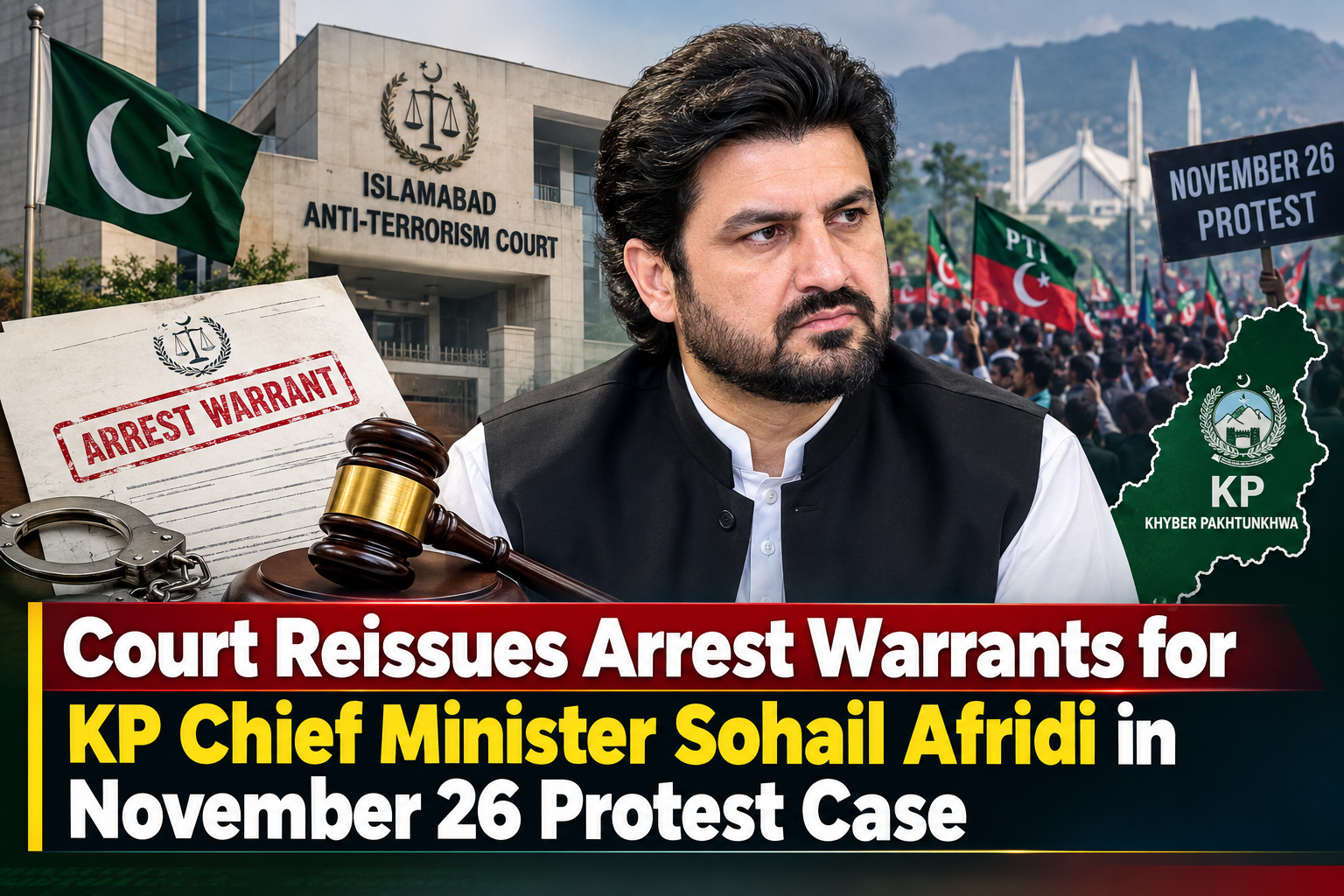
An Anti-Terrorism Court (ATC) in Islamabad has reissued arrest warrants for Khyber Pakhtunkhwa Chief Minister Sohail Afridi and other individuals in connection with a case related to the November 26 protest. The development was reported on October 1, 2026, after the accused failed to appear before the court despite judicial summons.
The case is registered at Margalla Police Station and involves PTI leaders and workers. During Wednesday's hearing, ATC Judge Tahir Abbas Sipra was informed that the accused had not appeared before the court. The court consequently reissued the arrest warrants and directed the police to complete another important part of the proceedings: submission of the case challan.
The court also learned that police had not yet submitted the challan in the case. The judge directed the authorities to file the document promptly and adjourned the proceedings until October 9, 2026.
The latest development comes at a politically sensitive time in Pakistan, particularly because the KP government is led by the PTI while the federal government is dealing with a separate political dispute over the party's planned October 4 protest march.
Background of the November 26 Protest Case
The case involving Sohail Afridi and other PTI figures relates to the November 26 protest.
The November 26 protests were part of PTI's political activities and involved supporters moving toward Islamabad. The protests led to legal cases being registered against several party leaders and workers.
The case currently being heard by the Anti-Terrorism Court is registered at Margalla Police Station. The prosecution and police are responsible for presenting the relevant legal documents and evidence before the court as proceedings continue.
The court has previously issued orders requiring the nominated individuals to appear.
The latest hearing again focused on the failure of the accused to appear and the absence of the challan from the police.
What Happened at the Latest Hearing?
According to Dawn, the accused did not appear during Wednesday's hearing. Because they failed to comply with the court's summons, Judge Tahir Abbas Sipra reissued their arrest warrants.
The court was also informed that the police had not submitted the case challan.
A challan is an important document in criminal proceedings because it sets out the prosecution's case and the material collected during investigation. Its submission allows the judicial process to move forward through the next stages.
The judge directed the police to submit the challan without further delay.
The next hearing has been scheduled for October 9.
Sohail Afridi's Role in the Case
Sohail Afridi is the sitting Chief Minister of Khyber Pakhtunkhwa and a senior PTI figure.
His involvement in the case has attracted particular attention because he holds an important constitutional position in the province.
The reissuance of arrest warrants concerns his appearance in the criminal proceedings. It does not itself constitute a final determination of guilt or innocence.
Those questions are to be determined through the judicial process.
The court will continue to examine the case according to the applicable law and the material submitted by the prosecution and defence.
Why the Court Reissued the Warrants
The immediate reason given in the reports is the failure of the accused to appear despite judicial summons.
Courts can issue warrants when individuals required to appear before them fail to attend proceedings in accordance with court orders.
In this case, the ATC had previously required the accused to appear. Their absence during Wednesday's hearing led the court to reissue the warrants.
The court also directed police to submit the pending challan.
Both developments are connected to the progress of the criminal proceedings.
The Missing Challan
One of the notable points from the hearing was that police had still not submitted the challan.
According to the Express Tribune, the court expressed annoyance after being informed that the challan had not been filed and directed police to submit it at the earliest.
The absence of the challan has delayed the progress of the case.
The court therefore adjourned the hearing until October 9.
The next hearing could provide further information about whether the police have completed the required documentation and whether the nominated individuals appear before the court.
Legal Proceedings Continue
The reissued warrants do not bring the case to an end.
Instead, they represent another procedural development in an ongoing judicial process.
The court must still consider the allegations, the evidence presented by the prosecution and the responses of the accused.
A criminal case can pass through several stages before reaching a final decision.
The October 9 hearing is expected to address the progress of the case and the outstanding procedural requirements.
Political Context
The court's decision comes during a period of increased political activity involving the PTI.
The party has announced plans for a protest march toward Islamabad on October 4.
PTI leaders have said that the march will proceed as planned and will be led by KP Chief Minister Sohail Afridi.
The timing of the court development has therefore attracted political attention.
However, the court proceedings and the planned protest are separate developments. The warrants relate to an existing criminal case concerning the November 26 protest, while the October 4 march is a new political activity.
PTI's Planned October 4 March
The PTI has repeatedly said that it intends to hold its October 4 protest.
PTI MNA Shandana Gulzar Khan said the march would begin on October 4 and would be led by Chief Minister Sohail Afridi. She also said that the party would continue with its plan despite possible restrictions.
This means that Sohail Afridi is currently involved in both an important political programme and an ongoing court case.
The developments have added to the political attention surrounding the KP chief minister.
Federal Government's Position
The federal government has separately been discussing the political and security situation in KP.
Prime Minister Shehbaz Sharif is expected to consult political allies about the province and the PTI's planned protest.
Government officials have also discussed possible constitutional measures in response to security concerns in KP.
These developments have created a broader political debate involving the federal government, the KP administration and the PTI.
The court case involving Sohail Afridi is another development occurring within this wider political environment.
PTI's Response to Political Developments
PTI representatives have criticized discussions about possible emergency measures or governor's rule in KP.
Shandana Gulzar said the party believed that such discussions were connected to attempts to stop its planned protest.
The federal government has presented security concerns as an important reason for considering possible constitutional measures.
These competing positions remain part of the wider political debate.
The judicial proceedings against Sohail Afridi are separate from these political claims and will continue through the court system.
Previous Legal Proceedings Involving Sohail Afridi
The latest warrants are not the first legal development involving Sohail Afridi.
Earlier in 2026, courts issued warrants for the KP chief minister in other cases after he failed to appear at hearings.
For example, an Islamabad court previously issued a non-bailable arrest warrant in a case concerning alleged misleading statements about state institutions.
In June, an Islamabad court maintained non-bailable warrants and directed police to produce him before the court.
These earlier cases are separate from the November 26 protest case.
It is therefore important to distinguish between different legal proceedings involving the same political figure.
November 26 Case and PTI Workers
The case at Margalla Police Station involves PTI leaders and workers.
Political protests can result in multiple cases when police allege violations of criminal or public-order laws.
The November 26 demonstrations generated cases involving several PTI supporters and leaders.
The court proceedings are intended to determine the legal status of the allegations against the nominated individuals.
The prosecution must present its case according to the applicable legal procedures, while the accused have the opportunity to respond through their lawyers.
Importance of the Anti-Terrorism Court
The case is being heard by an Anti-Terrorism Court.
Pakistan has specialized courts for cases falling within the scope of anti-terrorism legislation.
The jurisdiction of such courts depends on the allegations and provisions of the relevant law.
In the November 26 case, the prosecution has brought the matter before the ATC, where the proceedings are continuing.
The court's role is to consider the case according to the law and the evidence placed before it.
What Is a Court Warrant?
A court warrant is a formal legal order.
In cases involving a person's required appearance, an arrest warrant can authorize law-enforcement authorities to take the person into custody and produce them before the court, subject to the terms of the order and applicable law.
In the present case, the ATC reissued the warrants after the accused failed to appear.
The issuance of a warrant is a procedural step and should not be treated as a final judgment on the allegations.
A person's guilt or innocence is determined through the judicial process.
Why the October 9 Hearing Matters
The court has adjourned the proceedings until October 9.
By that date, the police are expected to have addressed the court's direction concerning the challan.
The appearance of the accused will also remain an important issue because the warrants were reissued after their absence.
The next hearing could therefore provide information about the progress of the case and the response to the court's latest orders.
The Broader Political Environment
The court development comes at a time when Pakistan's political environment is already active.
The federal government and PTI are discussing political issues while also publicly disagreeing over the planned October 4 protest.
Rana Sanaullah, the prime minister's adviser on political affairs, said on October 1 that government and PTI representatives were engaged in off-the-record discussions concerning the planned protest.
He also said that the government had arrangements in place if the protest proceeded.
The combination of court proceedings and political negotiations means that the coming days could contain several important developments.
Federal and Provincial Relations
The case also highlights the complicated relationship between Pakistan's federal government and the KP administration.
The federal government and the KP government are controlled by different political forces.
This can create disagreements over security policy, political protests and administrative responsibilities.
Sohail Afridi's position as KP chief minister makes the legal case particularly notable because he is both a provincial executive leader and a defendant in an ongoing case.
The constitutional roles of federal and provincial institutions remain important in understanding the political context.
Importance of Rule of Law
The continuation of the case through the courts highlights the role of judicial institutions in handling political disputes that also involve criminal allegations.
Political leaders and ordinary citizens are subject to different legal proceedings depending on the allegations against them.
The courts are responsible for examining cases according to law.
For the public, the important distinction is between an allegation, a court order and a final judgment.
The reissuance of a warrant is a court order connected to attendance in proceedings. It is not a final ruling on whether the accused committed the alleged offences.
Political Activity and Court Cases
Pakistan has a long history of political leaders facing legal proceedings while participating in political activity.
The current situation involving Sohail Afridi reflects the overlap between political activity and judicial proceedings.
However, each case must be considered according to its own facts.
The November 26 protest case concerns events associated with that protest.
The planned October 4 protest is a separate event.
Similarly, earlier cases involving the KP chief minister concern different allegations and legal proceedings.
Keeping these matters separate is important for accurate reporting.
Possible Next Developments
Several developments could occur before the next hearing.
The police may submit the challan as directed by the court.
The nominated individuals may appear before the court or seek appropriate legal relief.
The court may issue further directions depending on the status of the case.
Meanwhile, political developments surrounding the October 4 PTI march will continue separately.
The interaction between political activity and legal proceedings will likely keep the case in public attention.
Public Interest in the Case
The case is attracting attention because it involves the chief minister of one of Pakistan's largest provinces.
The KP chief minister's political position means that any major legal development involving him can have wider political implications.
At the same time, the judicial process remains separate from political debate.
The court's responsibility is to deal with the case according to law, while political parties and government institutions continue their separate political activities.
Importance of Accurate Information
Because the case involves a senior political figure, accurate reporting is particularly important.
The confirmed facts are that the ATC reissued warrants after the accused failed to appear, the police had not submitted the challan, the court directed police to submit it promptly, and the next hearing was fixed for October 9.
Other political interpretations should be identified as statements made by the relevant parties rather than presented as established facts.
This distinction helps readers understand the legal development without confusing it with political claims.
Conclusion
An Anti-Terrorism Court in Islamabad has reissued arrest warrants for Khyber Pakhtunkhwa Chief Minister Sohail Afridi and other individuals in connection with the November 26 protest case. The warrants were reissued after the accused failed to appear before the court despite judicial summons.
During the hearing, the court was also informed that police had not yet submitted the case challan. Judge Tahir Abbas Sipra directed police to file the document promptly and adjourned the case until October 9, 2026.
The development comes at a politically active moment in Pakistan. The PTI is preparing for an October 4 protest march toward Islamabad, which the party says will be led by Sohail Afridi. At the same time, the federal government is consulting political allies about the political and security situation in KP.
The court case itself remains an ongoing judicial matter. The reissued warrants concern the accused's appearance before the court and do not represent a final determination of guilt or innocence.
The next hearing on October 9 is expected to provide further information about the status of the case, the submission of the challan and the appearance of the nominated individuals.
Meanwhile, political developments surrounding the October 4 protest will continue separately. With both legal and political issues developing at the same time, the situation involving the KP chief minister remains an important national news story.
FAQs
1. Why were arrest warrants reissued for Sohail Afridi?
The Anti-Terrorism Court reissued the warrants after Sohail Afridi and other accused individuals failed to appear despite judicial summons.
2. Which case is Sohail Afridi facing?
The warrants relate to a case concerning the November 26 protest, registered at Margalla Police Station.
3. When is the next hearing?
The court has adjourned the proceedings until October 9, 2026.
4. Why did the court direct police to submit the challan?
The court was informed that police had not yet filed the challan, so the judge directed authorities to submit it promptly.
5. Is the warrant a final judgment against Sohail Afridi?
No. A warrant connected with appearance in court is a procedural legal order and is not itself a final determination of guilt or innocence.




