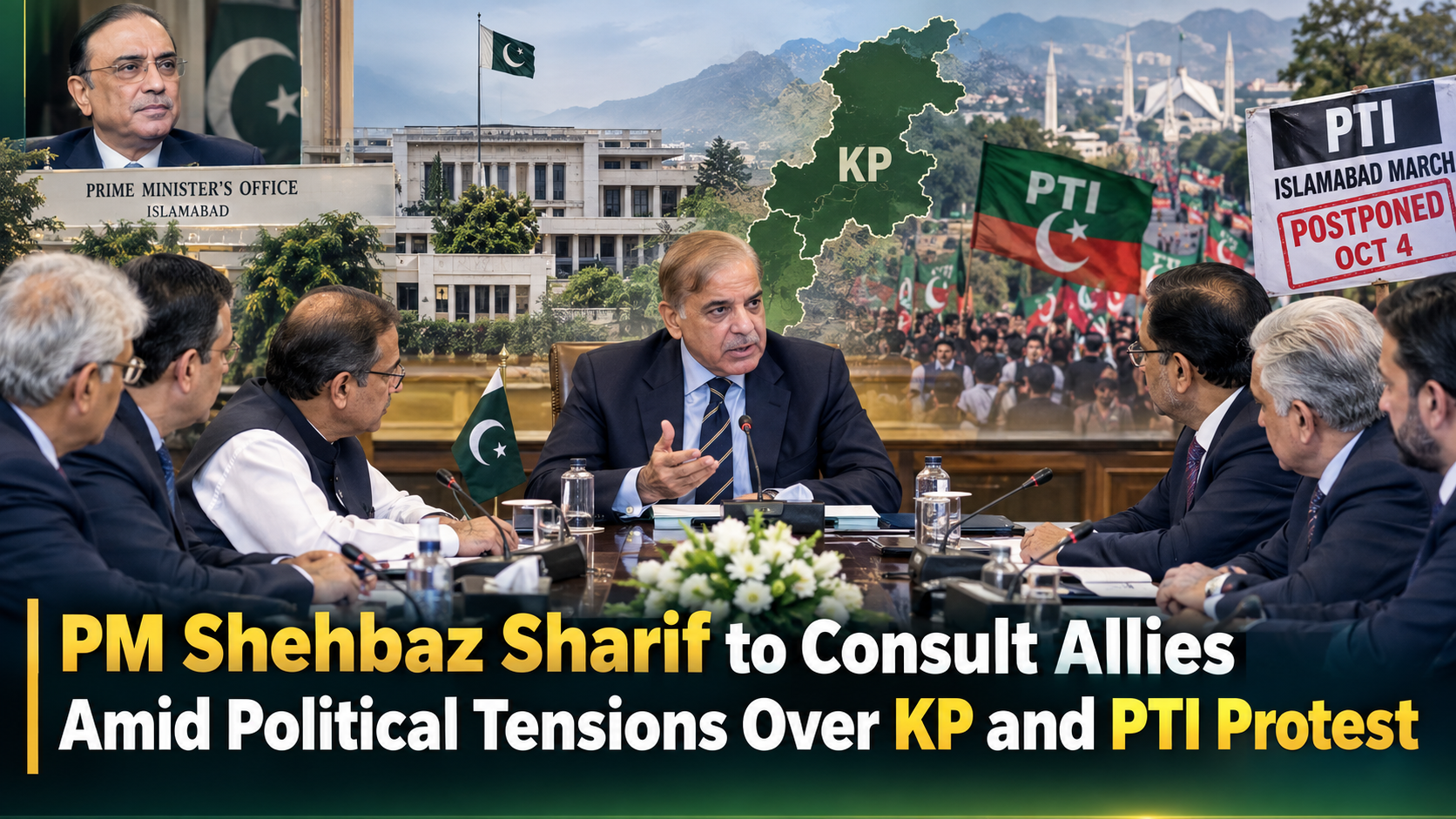
Pakistan's political situation remained active on October 1, 2026, as Prime Minister Shehbaz Sharif prepared to consult government allies over political and security developments, particularly the situation in Khyber Pakhtunkhwa (KP) and the Pakistan Tehreek-e-Insaf (PTI) protest planned for October 4.
According to a report published by Dawn on October 1, Prime Minister Shehbaz Sharif was expected to meet political allies, including leaders of the Pakistan Peoples Party (PPP), to discuss the situation in KP and the planned PTI march toward Islamabad. The discussions come amid disagreement between the federal government and the PTI-led KP administration over security, political responsibilities and the proposed protest.
The PTI has maintained that its October 4 protest will proceed as planned, while government officials have discussed possible constitutional measures in KP if the security situation continues to deteriorate. At the same time, government representatives have said that talks with the PTI are taking place behind the scenes.
The situation involves several interconnected issues, including political dialogue, provincial governance, security concerns, constitutional procedures and the right to political protest.
Prime Minister Plans Consultations With Political Allies
Prime Minister Shehbaz Sharif is expected to hold consultations with government allies as political tensions increase.
Dawn reported that the prime minister was likely to meet President Asif Ali Zardari and PPP Chairman Bilawal Bhutto-Zardari. The consultations are expected to cover the political and security situation, especially developments in Khyber Pakhtunkhwa, which is governed by the PTI.
The federal government is also considering discussions with opposition representatives. According to Dawn, Prime Minister Shehbaz Sharif had extended an invitation to National Assembly opposition leader Mahmood Khan Achakzai for consultations on national issues and matters related to the PTI.
The proposed meetings demonstrate the importance of political consultation as the October 4 protest approaches.
The government faces the challenge of dealing with security concerns in KP while also responding to the political demands of the opposition.
PTI Plans October 4 Protest
The PTI has announced that it intends to proceed with a protest march toward Islamabad on October 4.
The party had initially announced an earlier date for the protest, but the schedule was later changed. PTI leaders have now repeatedly stated that the march will begin on October 4.
Former National Assembly speaker and senior PTI leader Asad Qaiser said on October 1 that there was no possibility of postponing the protest. He said the party would proceed with its planned programme.
PTI MNA Shandana Gulzar Khan also said that the party's protest march would proceed on October 4 and would be led by KP Chief Minister Sohail Afridi.
The PTI has described the planned demonstration as a political protest and has called for dialogue rather than confrontation.
The party has also raised concerns about possible restrictions on its political activities and about discussions concerning emergency measures or governor's rule in KP.
Government Discusses Security Situation in KP
Security concerns in Khyber Pakhtunkhwa have become an important part of the political discussion.
Federal government representatives have pointed to terrorism and law-and-order concerns in the province.
Dawn reported that Law Minister Azam Nazir Tarar and Parliamentary Affairs Minister Tariq Fazal Chaudhry discussed the situation with PPP representatives. According to the report, the possibility of emergency measures in KP was also discussed.
Tariq Fazal Chaudhry said the federal government was considering the possibility of imposing an emergency under Article 232 of the Constitution because of terrorism in the province.
He emphasized that, according to the government's position, such a measure would be connected to security concerns rather than political disagreements.
This issue has become controversial because the PTI believes that discussions about emergency or governor's rule are connected to its planned protest.
PTI Rejects the Government's Position
PTI leaders have rejected suggestions that political pressure should be used to stop their planned demonstration.
Shandana Gulzar said the party believed that discussions about emergency or governor's rule were related to the planned march. She called for dialogue between the government and the PTI.
Former National Assembly speaker Asad Qaiser also said that the political situation should be addressed through constitutional means.
He called for an Apex Committee meeting to discuss the law-and-order situation in KP and said that implementation of the National Action Plan was important for restoring peace and supporting economic activity and employment.
The PTI's position is that political disagreements should be handled through dialogue and constitutional processes rather than confrontation.
Government and PTI Talks Reportedly Continuing
Despite the public disagreement between the two sides, government officials have indicated that communication between the government and PTI is continuing.
Prime Minister's Adviser on Political Affairs Rana Sanaullah said on October 1 that the federal government and PTI were involved in what he described as “off-the-record talks” concerning the October 4 protest.
He said the decision about whether to continue or postpone the march rested with PTI leadership.
At the same time, he stated that the government had arrangements in place in case the protest proceeded.
The existence of discussions suggests that communication channels between the two sides remain open even while their public positions continue to differ.
The Role of the PPP
The Pakistan Peoples Party is an important part of the federal government's political structure and has been involved in consultations over the KP situation.
Dawn reported that PPP representatives Sherry Rehman and Syed Naveed Qamar met federal ministers, including Law Minister Azam Nazir Tarar and Parliamentary Affairs Minister Tariq Fazal Chaudhry. The discussions included the situation in KP.
PPP leader Nayyar Bukhari said that if his party was consulted about governor's rule, it would provide its opinion according to the Constitution and law.
He also said the PPP supported political dialogue and negotiations as a way to address national issues.
The PPP's position is therefore an important part of the federal government's consultations as it considers how to respond to the developing situation.
Constitutional Questions
The discussion about emergency or governor's rule in KP has also brought constitutional questions into the political debate.
Pakistan's Constitution contains provisions dealing with emergencies and the administration of provinces under certain circumstances.
Government officials have referred to Article 232 in discussions about a possible emergency in KP. However, the actual application of such constitutional provisions involves legal and political procedures.
The discussion does not itself mean that a final decision has been made.
Dawn reported that the government was considering the possibility because of the security situation in the province, while PPP representatives said their views would be provided within the constitutional and legal framework.
The issue therefore remains under political discussion.
Why Khyber Pakhtunkhwa Is Central to the Debate
Khyber Pakhtunkhwa has become central to the current political discussion because it is governed by the PTI while the federal government is led by the PML-N.
The province has also faced significant security challenges.
Government officials have pointed to militant attacks and law-and-order problems as reasons for considering additional measures.
The PTI, meanwhile, argues that the provincial government should be allowed to perform its constitutional responsibilities and that political disagreements should not be used to undermine the provincial administration.
These different perspectives have contributed to the current political tension.
Security and Political Issues Overlap
The current situation demonstrates how security and politics can become closely connected.
The federal government is discussing security conditions in KP at the same time that the provincial government is preparing for a major political protest.
This creates questions about how security resources should be used, how political demonstrations should be managed and how provincial and federal responsibilities should be coordinated.
Both sides have publicly emphasized their own positions.
The federal government has focused on security and constitutional responsibilities.
The PTI has focused on political rights, dialogue and opposition to measures that it believes could restrict its political activities.
Government's Concerns About the Protest
Federal authorities have expressed concern about the planned protest and its possible effects on security and public order.
Rana Sanaullah said the government had arrangements in place if the PTI decided to proceed with the march.
Large political demonstrations can require significant security arrangements, especially when they involve movement between cities and large gatherings.
Authorities generally have to consider traffic, public safety, access to important government buildings and the possibility of clashes.
The government therefore faces the task of managing public order while dealing with the political demands of the opposition.
PTI's Position on Peaceful Protest
PTI representatives have repeatedly said that they intend to hold a political protest.
Shandana Gulzar said the party wanted a peaceful demonstration and urged the government to choose dialogue rather than confrontation.
Asad Qaiser also emphasized constitutional methods and called for political differences to be resolved through established procedures.
The party's public position is that political protest is part of its democratic activity.
The government's responsibility is to maintain public order while political parties exercise their lawful rights.
Economic Concerns Also Enter the Debate
Political discussions have also included economic concerns.
PTI representatives have criticized the government's handling of essential commodities and household expenses. Shandana Gulzar referred to the costs of petrol, electricity and flour while discussing the political situation.
Economic pressures can become an important part of political demonstrations because citizens often connect government policies with household expenses.
However, the current dispute is primarily centered on the planned protest, the political relationship between the federal and provincial governments, and security concerns in KP.
The Importance of Political Dialogue
Dialogue remains one of the major themes in statements from both government and opposition representatives.
PPP leader Nayyar Bukhari said political issues should be addressed through negotiations and dialogue.
PTI representatives have also called for dialogue.
The federal government has reportedly maintained communication with PTI representatives behind the scenes.
These developments suggest that, despite public disagreements, political communication remains part of the process.
Dialogue can allow political parties to discuss their demands, security concerns and constitutional questions without relying exclusively on public confrontation.
The National Action Plan Discussion
Asad Qaiser has called for an Apex Committee meeting and implementation of the National Action Plan in relation to the security situation in KP.
The National Action Plan was developed as a framework for countering terrorism and improving internal security.
The PTI leader argued that restoring peace was important for economic activity and employment opportunities.
The government's current focus on security in KP has therefore also brought earlier national counterterrorism frameworks back into political discussion.
Possible Impact on Public Life
Political protests can affect ordinary people when large numbers of participants travel between cities.
Road closures, traffic restrictions and additional security arrangements can affect commuters, businesses, students and transport services.
Islamabad, being the federal capital, often receives heightened security during major demonstrations because it contains important government institutions.
The authorities therefore have to balance security requirements with the need to keep essential services and transportation functioning.
The Role of Provincial Government
The KP government is led by PTI Chief Minister Sohail Afridi.
The provincial government's involvement in the planned protest has become one of the major points of disagreement with the federal government.
Federal representatives have questioned the use of provincial resources for political activities, while PTI representatives maintain that the provincial leadership has political and constitutional rights.
Dawn reported that PPP leader Nayyar Bukhari raised concerns about the use of provincial resources for a march on Islamabad and the use of government authority for political purposes.
The issue is therefore not limited to the protest itself but also involves questions about the responsibilities of provincial officeholders.
Importance of Constitutional Procedures
The current political dispute has repeatedly returned to the Constitution.
The federal government has referred to constitutional provisions concerning emergency measures.
The PTI has called for constitutional methods to resolve political disagreements.
The PPP has also said that it would consider the issue within the constitutional and legal framework if formally consulted.
This emphasis on constitutional procedures is significant because decisions affecting provincial governments have legal consequences beyond the immediate political dispute.
The Situation Ahead of October 4
With the protest scheduled for October 4, the next few days are likely to remain politically active.
The government is consulting its allies and considering its response.
PTI leaders continue to say that the protest will proceed.
At the same time, government officials have acknowledged that communication with PTI representatives is continuing.
The final situation will depend on developments in the coming days and on whether the political parties reach any understanding.
Importance of Responsible Political Reporting
Because the situation involves competing claims from political parties, responsible reporting requires distinguishing confirmed developments from allegations.
For example, the government has said that emergency measures are being considered because of security concerns in KP. The PTI has argued that the discussions are connected to its planned protest.
These are different political interpretations of the same development.
Reporting them separately allows readers to understand the positions of both sides without treating an allegation as an established fact.
National Political Environment
The developments in KP are taking place within a broader period of political activity in Pakistan.
The federal government is working with coalition partners while the opposition continues political activities.
The planned PTI protest adds another major issue to the national political agenda.
At the same time, security challenges in KP create an additional layer of complexity.
The government therefore has to address political, administrative and security questions simultaneously.
Importance of Federal-Provincial Coordination
Pakistan's federal system requires coordination between the federal government and provincial governments.
Security responsibilities, administrative functions and public services often involve cooperation between different levels of government.
When political parties control different governments, disagreements can make coordination more difficult.
The current situation in KP illustrates the importance of communication between federal and provincial authorities.
Regardless of political differences, security and public administration require coordination to protect citizens and maintain essential services.
What the Government May Discuss With Allies
The prime minister's consultations are expected to cover several areas.
These include the security situation in KP, the planned PTI protest, possible constitutional measures, relations with opposition parties and broader national issues.
The government may also discuss parliamentary legislation and coordination with coalition partners.
Dawn reported that the PPP and government representatives discussed several bills connected with federal institutions and that some of the legislation was linked to International Monetary Fund-related directives.
This shows that the political consultations are not limited to the protest.
Importance of Coalition Politics
The federal government depends on cooperation among coalition partners for parliamentary matters and major political decisions.
The PPP is therefore an important partner in discussions concerning national governance.
The prime minister's consultations with allies can help the government understand the positions of its coalition partners before making major decisions.
The PPP has indicated that it will consider constitutional and legal aspects if asked for its opinion regarding KP.
This means the party's position could be relevant to future discussions.
Political Dialogue and Stability
The current situation highlights the continuing importance of dialogue in Pakistan's political system.
Political parties may have major disagreements over elections, governance, security and public policy.
However, parliamentary discussions, constitutional mechanisms and negotiations provide channels through which those disagreements can be addressed.
The government's reported consultations and the ongoing off-the-record communication with PTI show that dialogue remains part of the political process.
Conclusion
Pakistan's political environment remained active on October 1, 2026, as Prime Minister Shehbaz Sharif prepared to consult political allies over the situation in Khyber Pakhtunkhwa and the PTI's planned October 4 protest.
The federal government has highlighted security concerns in KP and has discussed the possibility of constitutional emergency measures. At the same time, PTI leaders have said their protest will proceed and have called for dialogue and constitutional solutions.
Government and opposition representatives have also indicated that communication is continuing. Prime Minister's Adviser on Political Affairs Rana Sanaullah said that off-the-record discussions between the government and PTI were ongoing regarding the planned protest.
The situation involves several important issues, including provincial governance, national security, political protest, constitutional procedures and federal-provincial relations.
The coming days will be significant as October 4 approaches. Whether the parties reach an understanding or continue with their existing positions will shape the immediate political environment.
For citizens, businesses and institutions, maintaining public safety and continuity of daily life will remain important regardless of political disagreements. At the same time, the competing positions of the government, PTI and other political parties demonstrate the complexity of Pakistan's current political landscape.
Continued communication, constitutional procedures and reliable information will be important as developments unfold.
FAQs
1. Why is Prime Minister Shehbaz Sharif consulting political allies?
The prime minister is consulting allies about the political and security situation, particularly developments in Khyber Pakhtunkhwa and the PTI's planned October 4 protest.
2. When is the PTI protest scheduled?
PTI leaders have said that the protest march is scheduled to begin on October 4, 2026.
3. Why is KP central to the current political dispute?
KP is governed by the PTI and has also faced security concerns. The federal government and PTI have different positions regarding the provincial government's responsibilities and the proposed protest.
4. Is the government considering emergency measures in KP?
Federal officials have said that an emergency under Article 232 is being considered because of security concerns in KP. No final decision is established by the reports cited here.
5. Are the government and PTI still communicating?
Yes. Prime Minister's Adviser on Political Affairs Rana Sanaullah said on October 1 that off-the-record discussions between the government and PTI regarding the planned protest were continuing.