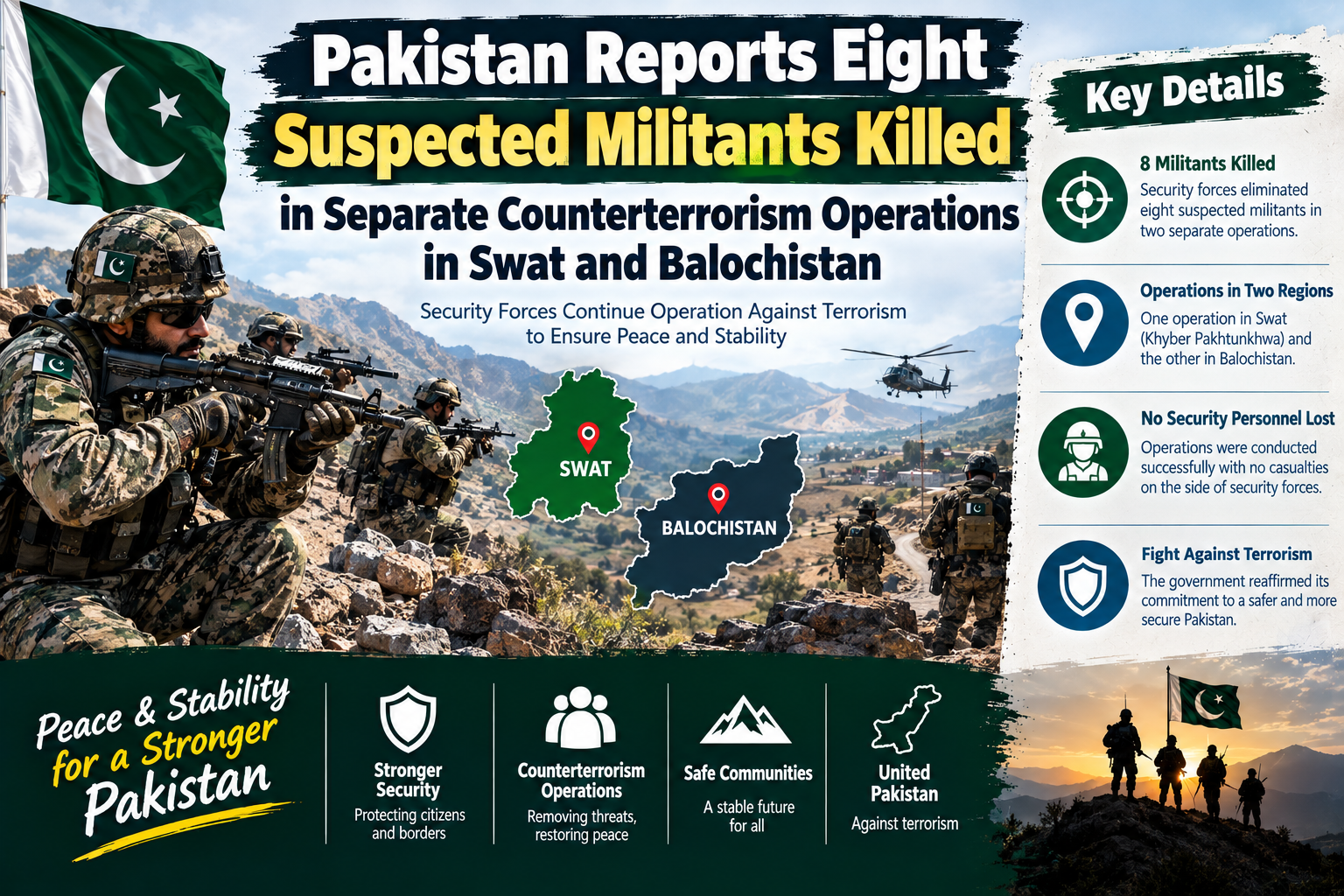
Pakistan’s security forces and law enforcement agencies have reported progress in separate counterterrorism operations conducted in Swat, Khyber Pakhtunkhwa, and Washuk district of Balochistan. According to official reports published on October 15, 2026, three suspected militants were killed during a joint operation involving the Counter Terrorism Department (CTD) and local police in Swat, while five were killed during an intelligence-based operation in Washuk.
The operations have drawn attention to Pakistan’s continuing efforts to address militant violence, protect local communities, and strengthen security in areas affected by terrorism. The two incidents occurred in different provinces and involved separate law enforcement activities, but both highlight the importance of intelligence gathering, coordination between security agencies, and the protection of civilians.
Security remains an important national issue because militant violence can affect daily life, education, transportation, employment, tourism, and local business activity. Communities in affected areas need not only immediate protection but also long-term measures that allow residents to live, study, work, and travel without fear.
This article examines the reported operations, the role of security institutions, the challenges facing affected communities, and the importance of sustainable peace across Pakistan.
1. Overview of the Latest Counterterrorism Operations
According to official reporting, eight suspected militants were killed in two separate operations in Pakistan on October 14 and October 15, 2026.
The first operation took place in the Palantak area of Washuk district in Balochistan. Security sources reported that five militants were killed and four others injured during an intelligence-based operation. The action was reported under Operation Radd-ul-Fitna 3.
The second operation took place in the Sakha Dob area of Swat district in Khyber Pakhtunkhwa. According to the Counter Terrorism Department, a joint operation involving CTD personnel and local police resulted in the deaths of three wanted suspects. Authorities said the individuals were suspected of involvement in several previous incidents of terrorism and targeted violence.
Although the operations were conducted separately, both demonstrate the continuing role of intelligence-led policing and security coordination in responding to reported militant threats.
It is important to distinguish between confirmed details of the operations and allegations made by authorities. Information about the identities, affiliations, and suspected activities of the individuals involved has largely come from official statements. Any allegations of criminal involvement should therefore be understood as claims attributed to the relevant authorities.
2. Details of the Washuk Operation in Balochistan
Washuk district is located in Balochistan, a province that has faced longstanding security challenges, including militant attacks, separatist violence, and threats to public infrastructure.
According to official reports, security forces conducted an intelligence-based operation in the Palantak area of Washuk after receiving information about the presence of suspected militants. The operation was carried out under Operation Radd-ul-Fitna 3.
Security sources reported that five suspected militants were killed and four others injured. Officials also stated that weapons and other items were recovered during the operation.
Authorities described the action as part of wider efforts to prevent militant groups from threatening residents and disrupting public life. They also alleged that the individuals targeted had been involved in activities affecting local communities and infrastructure.
Such statements reflect the security agencies’ explanation for the operation. Independent verification of every allegation was not available in the reports reviewed for this article.
The operation is significant because residents of remote districts can face additional difficulties when security threats disrupt access to markets, public services, transportation, and economic opportunities.
For communities in Balochistan, sustainable security requires a combination of effective law enforcement, accessible public services, economic development, and public confidence in institutions.
3. Three Suspects Killed in a Joint Operation in Swat
A separate counterterrorism operation was reported in the Sakha Dob area of Swat district, Khyber Pakhtunkhwa.
According to the Counter Terrorism Department, the operation was conducted jointly by CTD personnel and district police following intelligence about the presence of wanted suspects.
Authorities reported that three individuals were killed during the operation. The CTD identified them as Abdullah, Mansoor Ali, and Ghufranullah, and said they were associated with a group led by a militant commander known as Mufti Muzaffar, also referred to as Khalid.
The department further alleged that the suspects were wanted in connection with multiple incidents of targeted violence and other militant activities reported earlier in the year.
Police and CTD officials said that weapons and other items were recovered from the location. A search effort was also reported in connection with two suspects who, according to officials, escaped.
These details have been attributed to the relevant authorities. They should not be interpreted as independent judicial findings about the responsibility of the individuals involved in earlier incidents.
The operation has renewed attention on security in Swat, a region known for its natural beauty, cultural heritage, educational institutions, and tourism potential.
For residents and businesses, the long-term objective is to maintain an environment in which families can live normally, students can attend educational institutions, and visitors can explore the region safely.
4. Why Intelligence-Based Operations Matter
Intelligence-based operations are an important component of modern counterterrorism strategies. Instead of relying only on general security patrols, agencies use information about potential threats to identify locations or individuals requiring investigation.
The effectiveness of such operations depends on the quality of information, coordination between institutions, appropriate legal procedures, and careful planning to protect civilians.
Information may come from investigations, community reporting, surveillance conducted under applicable laws, or cooperation between law enforcement agencies. Authorities must assess the reliability of such information before acting on it.
In Pakistan, counterterrorism responsibilities are shared among different institutions. Police departments investigate crimes and maintain public order, while specialised CTD units investigate and respond to terrorism-related threats. Federal security institutions also play roles according to their legal responsibilities.
Coordination helps agencies share relevant information and avoid gaps in security coverage. However, successful counterterrorism work should also include accountability, respect for legal rights, and procedures for investigating allegations of wrongdoing.
A security operation cannot be evaluated only by the number of suspects reported killed or arrested. Its broader effectiveness also depends on whether it reduces future attacks, protects civilians, improves public confidence, and supports lasting stability.
5. The Security Challenges Facing Balochistan
Balochistan is Pakistan’s largest province by area and contains important natural resources, transport routes, border regions, and economic development opportunities.
Despite this potential, many communities face challenges related to access to education, healthcare, employment, infrastructure, and public services. Security incidents can make these problems more difficult to address.
Militant violence can disrupt commercial transportation, discourage investment, damage public infrastructure, and create uncertainty for families and businesses. When roads or public facilities become unsafe, residents may experience delays in receiving essential services.
Security operations are intended to address immediate threats, but lasting stability requires a broader approach.
Investment in schools, hospitals, roads, communication services, and vocational training can help communities access opportunities and strengthen local resilience. Fair administration and accessible complaint mechanisms are also important for maintaining public trust.
Balochistan’s long-term development depends on enabling residents to participate in economic and civic life without facing intimidation or violence. Counterterrorism measures and development initiatives should therefore support the shared goal of protecting communities and expanding opportunities.
6. Why Security in Swat Matters
Swat has an important place in Pakistan’s tourism, culture, agriculture, and education sectors. Its landscapes and historical sites attract visitors, while local businesses depend on residents and tourism-related economic activity.
Periods of insecurity can affect this activity. Families may become concerned about travel, businesses may experience fewer customers, and students may worry about disruptions to education.
A stable security environment is essential for the region’s social and economic recovery. Residents need reliable public services, effective policing, and confidence that threats will be addressed lawfully.
The recent operation reported by the CTD highlights the continued importance of local law enforcement in responding to suspected militant activity.
At the same time, a lasting improvement in security requires more than individual operations. Authorities need effective investigations, cooperation with communities, protection for vulnerable people, and measures that prevent militant networks from rebuilding their influence.
Local residents can contribute to community safety by reporting credible concerns through appropriate official channels. Such reporting should be handled responsibly, with safeguards against false accusations and retaliation.
Swat’s future depends on protecting its residents while preserving the educational, cultural, and economic opportunities that make the region important to Pakistan.
7. Impact of Terrorism on Ordinary Citizens
The effects of terrorism extend well beyond the immediate location of an incident. Families, students, teachers, workers, shopkeepers, farmers, and transport operators may all experience the consequences of insecurity.
Parents may worry about their children travelling to school. Business owners may face uncertainty about opening hours and customer activity. Farmers and workers may encounter difficulties reaching markets or workplaces.
Repeated security concerns can also affect mental well-being and community relationships. People may become reluctant to travel, attend public events, or participate in activities that are essential to normal social life.
These effects demonstrate why public safety must remain central to counterterrorism policy.
Security institutions have an important responsibility to prevent attacks and respond to credible threats. Public authorities also need to communicate clearly with residents, provide accurate information, and avoid spreading unnecessary fear.
Where communities experience disruption, practical support can make a difference. This may include continuity of schooling, access to healthcare, reliable transport, support for affected businesses, and assistance for families directly affected by violence.
The ultimate purpose of security measures is to protect people and enable ordinary life to continue with confidence.
8. The Importance of Protecting Civilians
Civilian protection is one of the most important principles in any counterterrorism effort.
Operations in populated or nearby areas require careful assessment of potential risks to residents, homes, schools, medical facilities, and public infrastructure. Security agencies must follow applicable laws and procedures while taking reasonable measures to minimise harm.
Accurate public communication is also essential. When authorities release information about an operation, they should distinguish verified facts from preliminary assessments and allegations that remain under investigation.
This distinction helps the public understand what has happened without confusing official claims with independent findings.
Responsible reporting matters as well. News coverage should avoid unverified rumours, misleading images, and language that unnecessarily inflames tensions between communities.
When deaths occur during security operations, reporting should remain factual and respectful. It should focus on the verified circumstances, public safety implications, and relevant official statements rather than sensational details.
Protecting civilians is not separate from national security. It is a fundamental part of building public trust and preventing further instability.
9. Coordination Between Police and Security Agencies
The reported operations in Swat and Washuk illustrate the role of cooperation among different security institutions.
In Swat, the operation was attributed to the Counter Terrorism Department and local police. Their cooperation can help combine specialised investigative responsibilities with knowledge of local conditions.
In Balochistan, security forces conducted the reported intelligence-based operation in Washuk. Authorities said the action targeted a suspected militant presence in the area.
Effective coordination can help agencies respond to threats more efficiently, but cooperation must be supported by clear responsibilities, reliable information, and appropriate oversight.
Investigations also need to continue after an operation where necessary. Authorities may need to examine recovered evidence, establish the identities of those involved, investigate possible networks, and assess whether additional security measures are required.
Public confidence depends on more than visible enforcement activity. Residents should be able to access police services, report threats safely, and expect complaints to be handled professionally.
A coordinated security system should ultimately reduce the risks faced by ordinary people while maintaining respect for legal rights.
10. The Role of Government in Long-Term Stability
Government policy is essential to sustaining progress against terrorism.
Law enforcement can address immediate threats, but public institutions also need to address conditions that leave communities vulnerable to instability. These responsibilities include strengthening education, improving access to justice, creating employment opportunities, and ensuring that public services reach remote areas.
Local administrations can support peace by communicating with community representatives, responding to residents’ concerns, and making services accessible.
Economic opportunities are particularly important for young people. Access to education, professional training, technology, and lawful employment can help individuals build secure futures and strengthen communities.
Development should not be treated as a replacement for law enforcement. Instead, effective security and social investment should reinforce one another.
A safe environment makes development possible, while functioning institutions and economic opportunities can help communities resist intimidation and instability.
For Balochistan and Khyber Pakhtunkhwa, sustainable progress will require consistent policies, cooperation among institutions, and a focus on the everyday needs of residents.
11. Public Awareness and Responsible Reporting
Accurate information is especially important when security incidents receive widespread attention.
Unverified messages can create confusion, increase fear, and sometimes put people at risk. Residents should therefore check information through credible news organisations and official announcements before sharing claims about an incident.
People should also avoid circulating unconfirmed names, private details, or images of individuals connected to an investigation. Responsible information-sharing protects privacy and reduces the likelihood of harm caused by misinformation.
Journalists have a particular responsibility to verify information, attribute claims, and correct mistakes when new facts become available.
Government agencies should also provide timely updates that help people understand whether an area is affected, what precautions are necessary, and whether public services are operating normally.
Clear communication helps residents make informed decisions without relying on speculation.
Public awareness does not mean that every security claim should be accepted without question. It means distinguishing reliable evidence from rumours and understanding the difference between an official allegation and an independently established fact.
12. What These Operations Mean for Pakistan’s Security Policy
The reported operations in Swat and Washuk demonstrate that counterterrorism remains a significant national priority.
However, individual operations provide only a limited picture of the overall security situation. A complete assessment would require broader data about attacks, arrests, investigations, civilian harm, regional trends, and the long-term impact of security measures.
The number of suspects reported killed in two incidents does not, by itself, establish whether overall terrorism levels are rising or falling. That question requires consistent information covering a longer period.
Authorities can strengthen public confidence by publishing clear and verifiable information about security developments and the results of investigations.
Independent scrutiny, lawful procedures, and reliable reporting also help the public assess whether counterterrorism measures are achieving their intended goals.
The broader objective should be a sustained reduction in violence, the protection of civilians, and the prevention of future attacks.
Pakistan’s security strategy will be most effective when immediate law enforcement measures are combined with institutional accountability, community cooperation, and policies that support stable and prosperous local communities.
13. The Importance of Peace for Education, Tourism, and Business
Peace is essential to the development of both Swat and Balochistan.
In Swat, tourism can support hotels, restaurants, transport services, small shops, and local guides. Visitors are more likely to travel when they have confidence in public safety and access to reliable information.
In Balochistan, improved security can support transport networks, local markets, agriculture, public infrastructure, and investment. Communities need dependable access to essential services and economic opportunities to benefit from the province’s potential.
Education is equally important. Schools and colleges provide young people with knowledge and skills that can support their future careers. Families need confidence that students can attend classes safely and consistently.
Businesses also depend on stability. Uncertainty can increase costs, interrupt deliveries, and discourage new investment. Predictable security conditions help employers plan and create opportunities.
These connections show that peace is not only a law enforcement objective. It is also a foundation for social development, economic progress, and a better quality of life.
14. The Road Ahead for Swat and Balochistan
The latest reports from Swat and Washuk underline the continuing need for effective security arrangements in areas facing militant threats.
Authorities have stated that counterterrorism efforts will continue. The long-term success of those efforts will depend on whether they help prevent future violence and allow communities to live safely.
Several priorities remain important: reliable intelligence, coordinated investigations, professional policing, civilian protection, responsible public communication, and accessible public services.
Governments should also continue investing in education, healthcare, infrastructure, and employment. These measures can help ensure that security improvements translate into meaningful benefits for residents.
Community trust is another essential factor. People are more likely to cooperate with public institutions when they believe their concerns will be heard and their rights respected.
Progress should be assessed through sustained improvements in safety and everyday life, rather than relying on individual incident figures alone.
Swat and Balochistan have different histories and local challenges, but both need a future in which residents can pursue education, work, travel, and economic opportunities without fear.
Conclusion
Pakistan’s security agencies reported eight suspected militants killed in two separate counterterrorism operations in Swat and Balochistan on October 14–15, 2026. The reported operation in Washuk resulted in five deaths and four injuries, while the joint CTD-police operation in Swat resulted in three deaths, according to official statements.
These developments highlight the continuing work of security institutions to respond to suspected militant threats. They also underline the need for careful investigations, accurate reporting, civilian protection, and coordination among relevant authorities.
The wider challenge is to turn immediate security actions into lasting peace. That requires effective law enforcement alongside stronger public services, educational opportunities, economic development, and public confidence in institutions.
For residents of Swat, Balochistan, and the rest of Pakistan, the most meaningful measure of progress will be a sustained reduction in violence and the ability to live everyday life safely.
Lasting peace is achieved not only by addressing immediate threats but also by building communities where people can learn, work, travel, and plan for the future with confidence.
FAQs
1. What happened in Pakistan’s latest counterterrorism operations?
Official reports said eight suspected militants were killed in two separate operations: three in Swat and five in Washuk district of Balochistan.
2. Where did the operation in Balochistan take place?
The reported operation took place in the Palantak area of Washuk district, Balochistan.
3. Which agencies conducted the operation in Swat?
According to official reporting, the Counter Terrorism Department and Swat district police conducted the joint operation in the Sakha Dob area.
4. Why are counterterrorism operations important for Pakistan?
They aim to address suspected militant threats, protect communities, and support safer conditions for education, business, transport, and everyday life.
5. What is needed for lasting peace in Swat and Balochistan?
Long-term stability requires effective law enforcement, civilian protection, reliable public services, education, employment opportunities, and public trust in institutions.
Remove unsupported operation detailsCondense repetitive policy sections