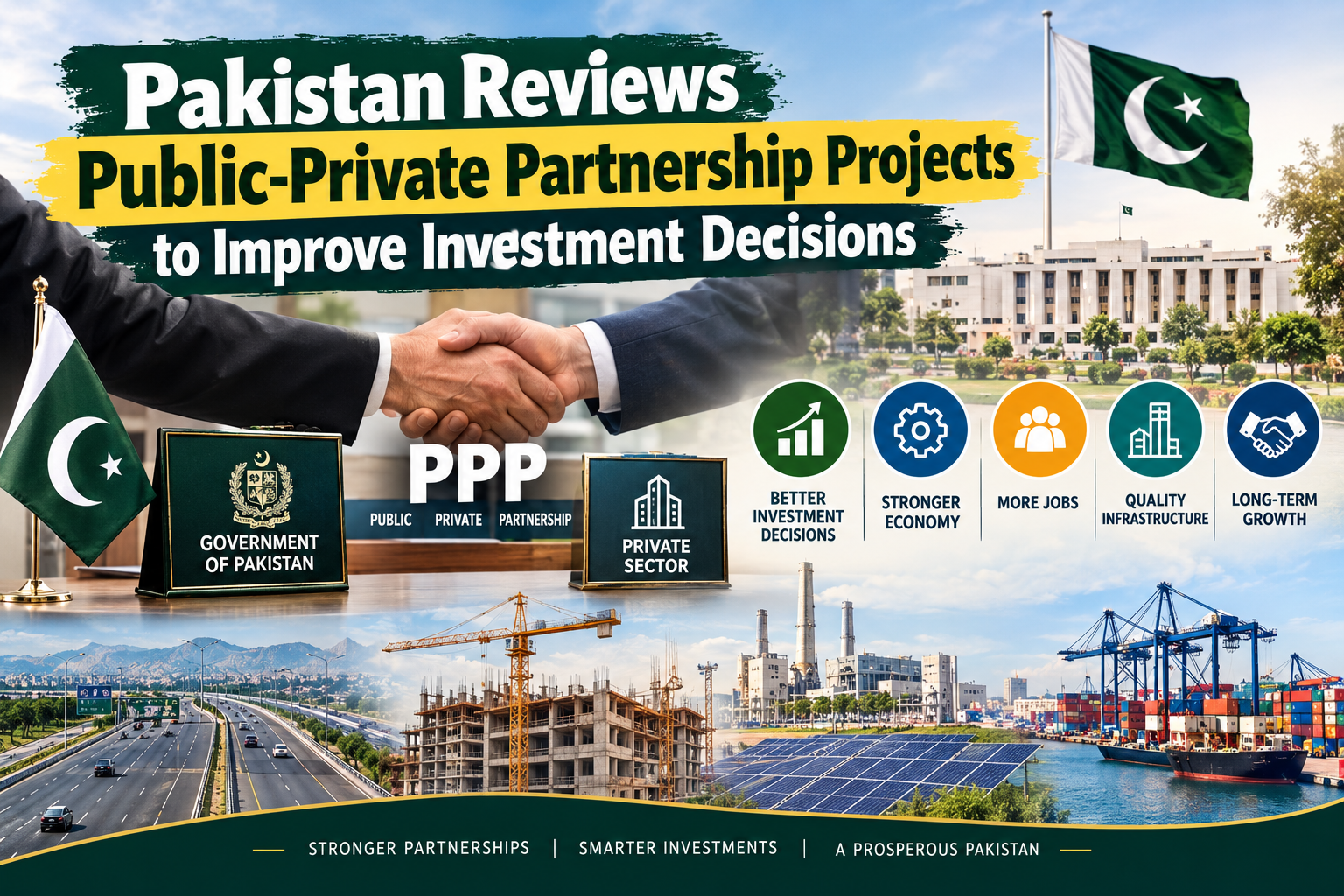
Pakistan is strengthening its approach to public-private partnerships (PPPs) as the government seeks to attract private investment, improve infrastructure, and support sustainable economic growth. The initiative comes at a time when the country faces significant development needs alongside limited public financial resources.
Public-private partnerships allow governments to work with private companies and investors to finance, build, operate, or maintain projects that serve the public. These arrangements can support roads, hospitals, water supply systems, educational facilities, energy infrastructure, tourism, and other essential services.
On October 19, 2026, renewed attention was drawn to how Pakistan selects and manages PPP projects, particularly the need to evaluate their long-term financial risks before approving them. The central issue is not simply how to attract private capital, but how to ensure that investment decisions deliver genuine public benefits without creating unaffordable obligations for taxpayers.
Pakistan has already taken steps to strengthen its PPP framework and encourage greater private-sector participation. However, the success of these efforts will depend on transparent project selection, careful financial planning, effective regulation, and strong coordination between federal and provincial institutions.
Understanding Public-Private Partnerships
A public-private partnership is a contractual arrangement in which a government body works with a private-sector organisation to deliver infrastructure or public services.
Under these arrangements, private companies may provide financing, construction expertise, technology, management, maintenance, or a combination of these services. The government defines the public objectives and establishes the contractual requirements under which the project operates.
For example, a government may need a new road but lack sufficient funds to pay for its entire construction immediately. Through a PPP, a private partner could finance and construct the road and recover its investment through an agreed arrangement over a specified period.
Depending on the contract, payments may come from tolls paid by users, government payments linked to service availability, or a combination of revenue sources.
However, the private sector does not make infrastructure free. The investment must eventually be repaid, and the cost may be borne by users, taxpayers, or both.
This distinction is important for Pakistan because the government must balance development priorities with fiscal responsibility.
A well-designed PPP can improve project delivery and introduce specialist expertise. A poorly designed arrangement, however, can leave the government responsible for unexpected costs, financial guarantees, or services that fail to meet public expectations.
The government must therefore assess each proposal carefully rather than treating private investment as an automatic solution to limited public funding.
Why Pakistan Is Reviewing Its PPP Projects
Pakistan faces substantial requirements for new and improved infrastructure. Population growth, urbanisation, industrial development, and changing environmental conditions have increased demand for reliable public services.
Roads need maintenance and expansion, cities require better water and sanitation systems, hospitals need modern facilities, and educational institutions require additional capacity. Agricultural communities also depend on irrigation systems, storage facilities, transport connections, and access to markets.
Meeting these requirements through public expenditure alone can be difficult. Government budgets must also cover salaries, debt servicing, social protection, security, and the day-to-day operation of public institutions.
Public-private partnerships can provide another way to mobilise capital and technical expertise. Nevertheless, they require careful financial assessment because the government's responsibilities may continue for many years after a project begins.
A review of PPP projects can help policymakers determine which proposals are suitable for private-sector participation and which would be better delivered through conventional public procurement.
The review process should examine construction costs, projected demand, operating expenses, expected revenue, maintenance requirements, and potential risks.
It should also determine whether the proposed arrangement offers better value than alternative methods of delivering the same service.
For Pakistan, the objective should be to select projects that provide measurable economic and social benefits while keeping public financial commitments manageable.
Pakistan's Financial Constraints and Infrastructure Needs
Pakistan's infrastructure requirements remain significant, but public resources are limited.
The government must make difficult decisions about how to allocate available funds between development spending and existing obligations. Debt servicing and other recurring expenditures can restrict the amount available for new infrastructure.
This financial pressure has encouraged policymakers to explore alternatives that bring private capital into development projects.
However, financial constraints should not lead to the approval of projects without sufficient scrutiny. A PPP may reduce the amount of money required at the beginning, but it can create long-term payment obligations.
For example, a government may agree to make regular payments to a private operator over several years. These payments could become a significant budgetary commitment even if the initial construction costs are not recorded as immediate government spending.
Guarantees and other contractual commitments can also create risks if a project generates less revenue than expected or encounters operational difficulties.
The government must therefore consider the full cost of a project over its entire life cycle.
A responsible investment decision should establish whether the project is necessary, whether its benefits justify its cost, and whether the government can afford its obligations under different economic scenarios.
This approach can help prevent short-term financing decisions from creating larger financial pressures in the future.
The Difference Between Financing and Funding
One of the most important concepts in PPP planning is the distinction between financing and funding.
Financing refers to obtaining the money needed to construct or develop a project. Funding refers to the source of money that ultimately pays for the investment and its operating costs.
Private investors can provide financing, but they generally expect to recover their investment and earn an appropriate return.
That return may come from user charges, such as road tolls, or from payments made by the government under a contract.
If a project cannot generate enough revenue to cover its costs, the government may need to provide support. Depending on the agreement, this support could include subsidies, guaranteed payments, or other financial commitments.
This means that private financing does not automatically remove the financial burden from the public sector.
For Pakistan, this distinction should guide the assessment of proposed infrastructure projects. Policymakers need to identify who will ultimately pay, how much the project will cost, and whether the payment arrangements are sustainable.
The government should also assess what happens if construction becomes more expensive, demand falls below expectations, or operating costs increase.
Clear answers to these questions can help policymakers distinguish between genuinely valuable PPPs and arrangements that merely postpone financial pressure.
The Role of the Public-Private Partnership Authority
Pakistan has established institutional arrangements to evaluate and manage public-private partnerships.
The Public Private Partnership Authority, commonly known as P3A, plays an important role in the federal PPP framework. It supports the development and assessment of projects and helps establish processes for private-sector participation in public infrastructure.
A strong review process can help ensure that proposals are examined according to consistent standards.
Before a project receives approval, authorities should consider whether it addresses a genuine public need, whether the proposed technical design is suitable, and whether the financial structure is realistic.
The review should also examine the proposed contract, the allocation of risks, the expected benefits, and the government's responsibilities throughout the agreement.
Institutional coordination is equally important. Different government departments may be responsible for planning, finance, procurement, regulation, and service delivery.
If these responsibilities are unclear, projects may experience delays, duplicated work, or disagreements over financial commitments.
Clear decision-making procedures can help identify which institution is responsible for approving a project, monitoring performance, and responding when problems arise.
The objective should be to create a system in which private investment is encouraged without weakening public accountability.
Why Project Selection Matters
Not every infrastructure project is suitable for a PPP.
Some projects may be better delivered through conventional public procurement, particularly when they have limited revenue potential or require substantial public funding regardless of who constructs them.
Other projects may benefit from private-sector expertise, long-term maintenance contracts, or investment arrangements that link payments to performance.
The government should assess these alternatives before selecting a delivery method.
A project should not become a PPP simply because the public budget cannot cover its initial cost. Instead, the decision should be based on whether the partnership provides better value, better service quality, or more effective management than available alternatives.
For example, a road project may be suitable for private participation if traffic demand is reasonably predictable and the contractual arrangements allocate risks appropriately.
A water supply project may require a different model because affordability and access to essential services are important considerations.
Hospitals and educational facilities may also need arrangements that protect public access while maintaining clear standards for service quality.
Each sector has different requirements, and a single model cannot be applied effectively to every project.
A structured assessment can help the government avoid approving projects that appear attractive at the beginning but become expensive or difficult to manage later.
Lessons from Pakistan's Energy Sector
Pakistan's experience with independent power producers offers an important lesson for future PPP decisions.
Energy projects have helped expand electricity generation capacity, but some contractual arrangements have also created financial pressures involving capacity payments, guarantees, and the relationship between electricity costs and government obligations.
The circumstances of power projects differ from those of roads, hospitals, or water systems. Nevertheless, the broader lesson is relevant: contracts can create long-term liabilities that must be understood before commitments are made.
A project may provide an important service while still placing pressure on public finances if its financial structure is poorly designed.
Policymakers should therefore examine how risks are allocated and whether payment arrangements remain affordable under different conditions.
They should also ensure that contracts contain clear performance standards, monitoring requirements, and appropriate procedures for resolving disputes.
The government should learn from earlier projects without assuming that every PPP will produce the same outcome.
A careful review of past experiences can help officials identify common weaknesses and improve future project design.
Attracting Domestic and Foreign Investors
Pakistan wants to increase investment from both domestic and international sources.
Private investors can bring capital, technology, specialist expertise, and experience in operating infrastructure. Their involvement may also introduce new management practices and improve efficiency.
However, investors usually assess more than the potential return from a project. They also consider political stability, legal protections, currency risks, regulatory consistency, payment reliability, and the process for resolving disputes.
A predictable investment environment can make Pakistan more attractive to businesses considering long-term projects.
Clear tendering procedures, reliable project information, transparent contracts, and timely government decisions can reduce uncertainty.
Investors also need confidence that projects will be evaluated fairly and that agreed contractual terms will be respected.
At the same time, the government must protect the public interest. Attracting investors should not require accepting unreasonable guarantees or transferring excessive financial risks to taxpayers.
A balanced approach can help create opportunities for investment while preserving the government's ability to regulate services and enforce public standards.
National SDGs Investment Fair and Development Opportunities
Pakistan has also been promoting investment opportunities connected with sustainable development.
The National Sustainable Development Goals Investment Fair took place in Karachi on October 6 and 7, 2026. Organised by the United Nations Development Programme and the Government of Pakistan under the SDGs Plus Programme, the event brought together government representatives, investors, financial institutions, and development partners.
The fair presented 35 public-private partnership projects aligned with the Sustainable Development Goals, with an indicative value of approximately US$26 billion.
The projects covered development priorities intended to attract domestic and international investment. The event also concluded with a letter of intent for a tourism-sector project valued at US$40 million.
These figures indicate the scale of investment opportunities being presented to potential partners. However, the total value of projects showcased should not be confused with investment already received or projects completed.
Each proposal must still pass through the relevant assessment, financing, procurement, and implementation stages.
The event nevertheless provided an opportunity for government institutions to present projects, discuss financing arrangements, and explore cooperation with investors.
For Pakistan, the next challenge is to convert promising proposals into projects that are financially viable, transparently managed, and capable of delivering measurable benefits.
Punjab's Role in Developing PPP Projects
Provincial governments have an important role in Pakistan's PPP landscape because many infrastructure and public-service responsibilities are managed at the provincial level.
Punjab has been developing a pipeline of projects through its Punjab Public Private Partnership Authority, known as P4A.
At the National SDGs Investment Fair in Karachi, Punjab presented several opportunities, including road projects, a university hostels concept, and a facility for producing a foot-and-mouth disease vaccine.
These proposals illustrate how PPP arrangements can extend beyond large highways and transport infrastructure into education, agriculture, and other sectors.
Provincial participation is important because local governments often have a better understanding of the needs of particular districts and communities.
However, projects still require careful technical and financial assessment. A proposal should not advance solely because it addresses a recognised need; authorities must also establish that the proposed delivery model is appropriate.
Provincial and federal institutions can improve results by sharing technical expertise, using consistent evaluation standards where appropriate, and coordinating financial planning.
Well-prepared projects can help investors understand the expected costs, contractual responsibilities, and potential benefits before deciding whether to participate.
Roads and Transport Infrastructure
Transport infrastructure is one of the most familiar areas for public-private partnerships.
Pakistan needs reliable roads and transport links to connect cities, industrial areas, agricultural markets, and smaller communities. Better transport can reduce travel times, support commercial activity, and improve access to public services.
Private investment may help finance construction and maintenance where the project's expected benefits and revenue arrangements justify the cost.
However, road projects require careful demand forecasting. If traffic is lower than anticipated, toll revenue may not be sufficient to cover operating costs or repay investment.
Contracts must also clarify responsibility for maintenance, road safety, emergency services, and service quality.
Toll charges require particular attention because they affect commuters, transport companies, and businesses that depend on road networks.
Authorities should assess whether proposed charges are affordable and whether alternative funding arrangements would be more appropriate.
A project should also be evaluated for its wider economic impact. A road that improves access to underserved communities may generate substantial social benefits even if direct toll revenue is limited.
The government should consider these benefits alongside financial returns when selecting projects.
Water Supply and Sanitation Projects
Water and sanitation infrastructure can also benefit from public-private cooperation.
Growing cities and expanding communities need dependable water supplies, wastewater treatment, drainage systems, and reliable maintenance.
Poor water and sanitation services can affect public health, household expenses, business activity, and environmental conditions.
PPP arrangements may provide access to specialist engineering, modern equipment, and long-term operational expertise.
However, water is an essential service, so affordability and fair access must remain central to project design.
Contracts should establish clear service standards, transparent pricing rules, maintenance obligations, and mechanisms for handling complaints.
Governments should also assess how a project will serve low-income households and communities that may be less commercially attractive to private operators.
Punjab has been exploring water supply and sanitation partnerships, including advisory work related to projects in Kasur and Chakwal.
Such initiatives illustrate the importance of preparing projects carefully before construction and financing decisions are finalised.
Technical, legal, environmental, social, and financial assessments can help authorities identify problems early and develop arrangements that protect public interests.
Healthcare and Education Opportunities
Healthcare and education are essential sectors where carefully designed PPPs may help address gaps in infrastructure and service delivery.
Hospitals need buildings, equipment, reliable utilities, and maintenance systems. Educational institutions require classrooms, hostels, laboratories, and other facilities that support learning.
Private partners may contribute construction expertise, technology, operational management, or financing.
Nevertheless, the public interest must guide these arrangements. Access to healthcare and education should not depend entirely on an individual's ability to pay.
Contracts should therefore establish clear expectations about service availability, quality, affordability, and accountability.
For healthcare projects, authorities should consider patient safety, staffing, equipment maintenance, and continuity of care.
For education projects, they should consider accessibility, student welfare, facilities, and the quality of the learning environment.
Governments must also assess whether they can afford long-term payments and whether the proposed arrangement offers better value than public procurement.
When these issues are addressed properly, PPPs may help improve infrastructure without removing the government's responsibility to ensure essential services are available.
Tourism and Economic Development
Tourism is another area where public-private partnerships may support investment and job creation.
Pakistan has diverse tourism opportunities, including mountain destinations, historical sites, cultural attractions, and coastal areas.
Developing tourism infrastructure can require roads, accommodation, sanitation, transport services, visitor facilities, and environmental management.
Private companies may be willing to invest in hotels, resorts, visitor services, and other commercial facilities when they have confidence in demand and the operating environment.
Government institutions can support these investments by improving public infrastructure, clarifying regulations, and ensuring that development follows appropriate environmental and planning standards.
Tourism projects should also consider local communities. Development can create employment and business opportunities, but poorly planned projects may place pressure on water supplies, waste systems, and sensitive natural areas.
A well-designed partnership should establish how economic benefits will be generated and how environmental and social risks will be managed.
The tourism project discussed at the October investment fair demonstrates the type of opportunity Pakistan is seeking to develop. Its eventual contribution will depend on implementation, financing, and the quality of the final arrangements.
Agriculture and Rural Development
Agriculture remains important to Pakistan's economy, employment, food supply, and export potential.
Rural communities need irrigation systems, storage facilities, reliable transport, agricultural technology, processing plants, and access to markets.
Public-private partnerships may help develop some of these facilities where private expertise and investment can improve efficiency.
For example, a project involving agricultural processing could connect farmers with buyers, reduce post-harvest losses, and create opportunities for local employment.
However, the design must consider the financial position of farmers and smaller businesses.
If service charges are too high or the project primarily benefits larger commercial operators, smaller producers may struggle to participate.
Authorities should therefore examine who will benefit, how services will be priced, and whether the project can support inclusive development.
Environmental sustainability is also important. Agricultural infrastructure should account for water availability, climate risks, soil conditions, and the long-term needs of farming communities.
Careful planning can help ensure that investment produces benefits that extend beyond the project's immediate commercial returns.
Managing Financial Risks and Government Guarantees
Financial risk management is one of the most important responsibilities in PPP planning.
A government may provide guarantees or agree to payments that become due under specific conditions. These commitments can create financial pressure if project revenue is lower than expected or costs increase.
Some risks arise during construction, including delays, higher material prices, and technical difficulties. Others appear during operation, such as lower demand, higher maintenance costs, or changes in economic conditions.
The government should identify these risks before signing a contract and determine which party is best positioned to manage each one.
Transferring every risk to the private partner may increase the price of the contract if the company believes the risks are difficult to control.
Keeping every risk with the government, meanwhile, can undermine the purpose of the partnership.
A balanced arrangement allocates risks according to the ability of each party to manage them.
Authorities should also record and monitor government commitments throughout the project's life cycle. This includes direct payments, guarantees, subsidies, and other obligations that could affect future budgets.
Regular reviews can help identify emerging problems before they become expensive crises.
Transparency and Accountability
Transparency is essential for maintaining public confidence in PPP projects.
Citizens should be able to understand why a project was selected, what public benefits it is expected to deliver, and how the government will measure its performance.
Procurement processes should be competitive and based on clear criteria. Contractual responsibilities should be documented, and appropriate information should be made available for public scrutiny.
Transparency also helps investors. When project rules and evaluation criteria are clear, businesses can prepare proposals more effectively and assess the risks of participating.
Accountability must continue after a contract is awarded. Authorities need to monitor construction progress, service quality, financial performance, and compliance with contractual requirements.
If a private operator fails to meet agreed standards, the government should have clear procedures for requiring corrective action.
Similarly, changes to a contract should be assessed carefully to prevent unnecessary costs or unfair advantages.
Effective oversight can reduce the risk of poor project selection, avoidable disputes, and financial commitments that were not properly understood at the beginning.
Environmental and Climate Considerations
Infrastructure investment must also account for environmental risks and climate resilience.
Pakistan faces challenges related to flooding, heat, water scarcity, and other climate-related pressures. These risks can damage infrastructure, interrupt services, and increase maintenance costs.
A road, water system, or energy facility designed without considering local environmental conditions may become more expensive to operate over time.
PPP projects should therefore include appropriate environmental assessments and climate-risk planning.
Authorities should examine how construction could affect local ecosystems, water resources, communities, and land use.
They should also consider whether the proposed infrastructure can withstand expected weather conditions and whether emergency arrangements are adequate.
Environmental planning is not simply an additional administrative step. It can help protect the long-term value of an investment and reduce the risk of costly damage.
Private investors may also benefit from clear environmental standards because predictable requirements make it easier to plan projects and estimate costs.
A sustainable PPP framework should therefore combine financial discipline with environmental responsibility.
Challenges That Could Slow Investment
Despite the potential benefits of PPPs, several obstacles can delay implementation.
One challenge is the preparation of bankable projects. Investors need reliable feasibility studies, clear contracts, realistic financial forecasts, and a credible explanation of how the project will generate revenue or receive payments.
If project documents are incomplete, investors may hesitate or demand additional guarantees.
Another challenge is regulatory uncertainty. Frequent policy changes or unclear approval procedures can increase costs and make it harder for companies to plan long-term investments.
Coordination between government departments can also affect progress. A project may require several approvals, and delays at one stage can hold up the entire process.
Currency risks can be particularly important for projects that require imported equipment or foreign financing. Changes in exchange rates may affect costs and the ability to repay loans.
Public acceptance is another consideration. Projects involving tolls, user charges, land acquisition, or changes in service delivery may face objections if the benefits and costs are not explained clearly.
The government can address these problems through better project preparation, consistent regulations, early consultation, and stronger institutional coordination.
Improving these areas would help Pakistan attract investment while reducing the risk of costly delays.
How PPPs Could Support Job Creation
Infrastructure investment can support employment during construction and throughout a project's operating life.
Road projects require engineers, construction workers, equipment operators, transport services, and maintenance teams. Hospitals and educational facilities require technical staff, support workers, administrators, and service providers.
Tourism projects can create opportunities in hospitality, transport, food services, local crafts, and visitor management.
Agricultural infrastructure may generate work in processing, storage, logistics, and distribution.
However, the number and quality of jobs depend on project design and implementation. Announced investment values do not automatically translate into a specific number of permanent jobs.
The government should assess employment projections realistically and monitor whether projects deliver the expected opportunities.
Training programmes can also help local workers acquire the skills required by new infrastructure and service operations.
Where practical, projects can support local suppliers and small businesses through transparent procurement processes.
Employment benefits should be considered alongside financial and social outcomes when deciding whether a project represents good value.
Recommendations for Better Investment Decisions
Pakistan can strengthen its PPP framework by adopting a consistent and transparent approach to project selection.
First, every proposal should undergo a credible feasibility assessment covering technical requirements, financial sustainability, demand forecasts, environmental effects, and social benefits.
Second, authorities should compare PPP delivery with conventional public procurement. The chosen model should provide demonstrable value rather than merely postponing government expenditure.
Third, all direct and indirect government commitments should be identified before approval. This includes guarantees and long-term payment obligations.
Fourth, responsibilities should be clearly allocated among federal agencies, provincial authorities, regulators, and private partners.
Fifth, competitive procurement and transparent contract management should be standard practice. Independent monitoring can help assess whether projects meet their targets.
Sixth, public consultation should take place when projects may affect communities, user charges, land, or access to essential services.
Finally, the government should publish regular information about project progress, financial commitments, and results wherever appropriate.
These steps would help decision-makers prioritise projects that provide lasting value and avoid arrangements that create unnecessary fiscal risks.
Outlook for Pakistan's PPP Programme
Pakistan's efforts to attract private investment reflect a broader attempt to support economic development while managing limited public resources.
The National SDGs Investment Fair and the continued development of federal and provincial project pipelines indicate that public-private partnerships remain an important part of the country's investment strategy.
However, the value of this approach will depend on implementation rather than the size of announced project portfolios alone.
Investors need credible projects, predictable rules, and reliable contractual arrangements. Citizens need affordable services, transparent decisions, and evidence that public resources are being used responsibly.
The government must therefore maintain a balance between encouraging private-sector participation and protecting the long-term financial interests of the state.
If projects are selected carefully and managed effectively, PPPs could help improve transport, water, healthcare, education, tourism, and agricultural infrastructure.
If risks are not assessed properly, however, they may create financial obligations that place pressure on future budgets.
The coming years will be important in determining whether Pakistan can convert its investment pipeline into completed projects that improve public services and support sustainable growth.
Conclusion
Pakistan is reviewing its approach to public-private partnerships as it seeks to improve infrastructure, attract investment, and make more effective use of limited public resources.
The government's strategy reflects the recognition that private capital and expertise can contribute to development, but they cannot replace careful planning or remove the need for public accountability.
Recent investment initiatives have presented opportunities across transport, tourism, agriculture, education, water, and other sectors. Yet each project must be assessed on its individual merits, including its expected benefits, financial structure, risks, and long-term affordability.
The experience of earlier infrastructure arrangements highlights the importance of distinguishing between financing a project today and paying for it over time.
For Pakistan, the most effective PPP framework will be one that encourages credible investors, maintains transparent procedures, protects essential public services, and ensures that government commitments remain manageable.
Better project selection, strong oversight, reliable financial analysis, and coordination between institutions can help transform investment proposals into useful infrastructure.
Ultimately, the success of Pakistan's PPP programme should not be measured only by the amount of private capital announced. It should be measured by completed projects, improved services, responsible use of public funds, job opportunities, and lasting benefits for citizens.
FAQs
1. What is a public-private partnership in Pakistan?
A public-private partnership is an arrangement in which a government body works with a private company to finance, build, operate, or maintain infrastructure or public services under an agreed contract.
2. Why is Pakistan reviewing its PPP projects?
Pakistan is reviewing projects to ensure that they provide genuine public benefits, remain financially sustainable, and offer better value than alternative methods of procurement.
3. Which sectors can benefit from PPP projects?
Potential sectors include roads, transport, water supply, sanitation, healthcare, education, tourism, agriculture, and energy infrastructure.
4. Do PPPs eliminate the government's financial responsibilities?
No. Private investment provides financing, but costs must eventually be covered through user payments, government payments, or other revenue sources. Guarantees and long-term commitments can also create public financial risks.
5. How can Pakistan improve the success of PPP projects?
Pakistan can improve outcomes through strong feasibility studies, transparent procurement, clear contracts, realistic financial assessments, effective monitoring, and careful management of long-term government obligations.