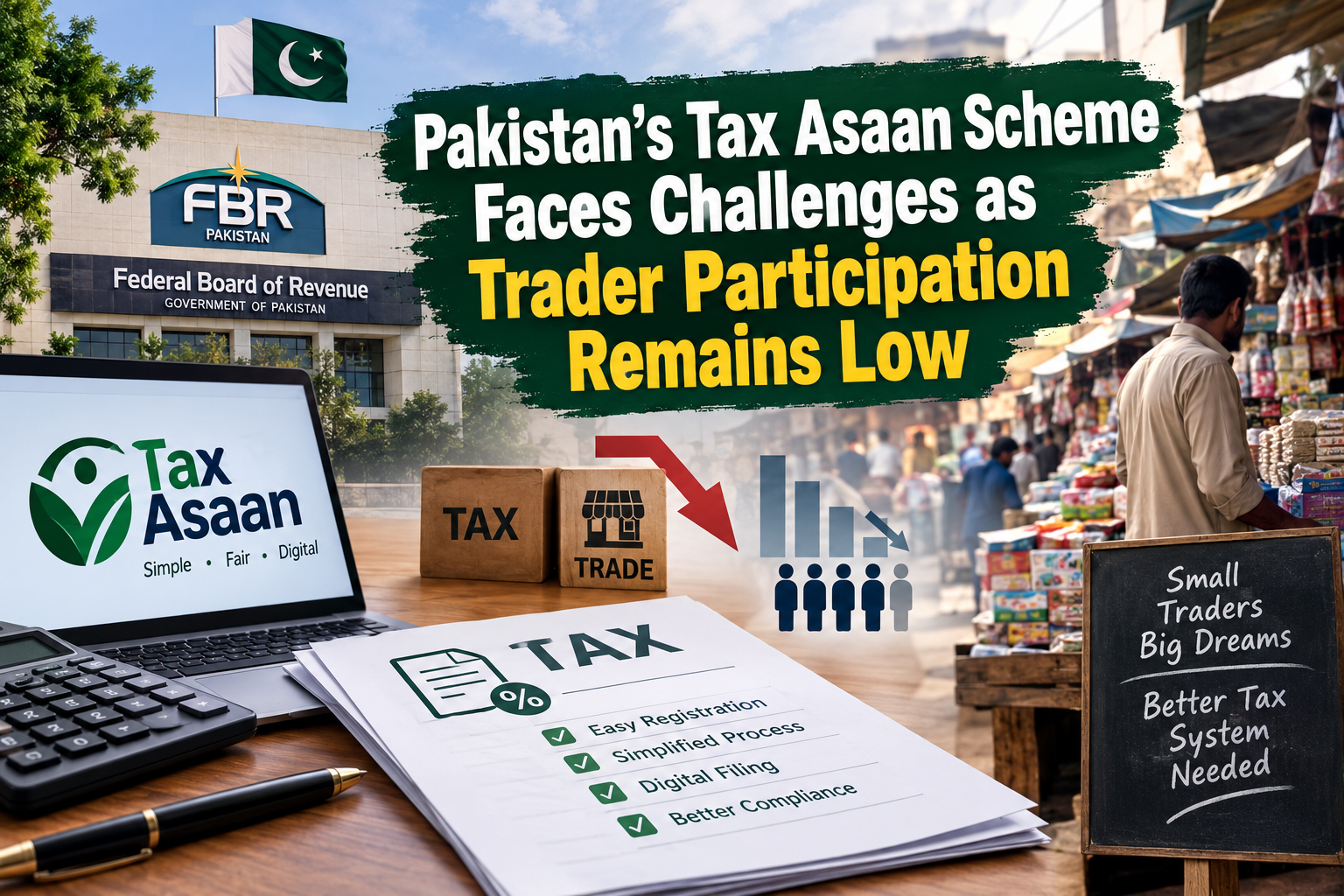
Pakistan’s Asaan Tax Scheme for small shopkeepers and retailers is facing challenges as the government attempts to expand the tax base and encourage businesses to enter the formal economy. Although the initiative was designed to simplify tax registration and make compliance easier for traders, recent reports indicate that participation and completed tax returns remain below expectations.
The issue has renewed debate about Pakistan’s tax system, the relationship between the government and the business community, and the reforms needed to improve tax compliance. The Federal Board of Revenue (FBR) has been working to address registration difficulties and improve communication with traders, while critics argue that simplified schemes alone may not solve the long-standing problem of documenting retail businesses.
Understanding Pakistan’s Asaan Tax Scheme
The Asaan Tax Scheme was introduced to make tax compliance simpler for small traders and shopkeepers. For many years, Pakistan has struggled to bring a large portion of its retail sector into a fully documented tax system. Successive governments have introduced different initiatives to encourage registration, but many have faced difficulties in achieving lasting results.
The basic objective of the Asaan Tax Scheme is to provide eligible businesses with a simplified method of calculating and paying taxes. Rather than requiring small retailers to navigate complicated procedures designed for larger businesses, the initiative seeks to make registration and filing more accessible.
The scheme is particularly relevant to small and medium-sized shops, including retailers operating in local markets, commercial streets, and neighbourhood shopping areas. These businesses contribute to employment, consumer spending, and the movement of goods throughout Pakistan.
Under the announced framework, eligible traders can use a simplified tax arrangement based on declared annual sales turnover. The government has presented the initiative as an opportunity for shopkeepers to become part of the documented economy without facing unnecessarily complicated compliance requirements.
However, a simplified system can only succeed if traders understand its rules, trust the process, and believe that participation offers a practical advantage. Registration figures are therefore only one measure of success. The number of completed returns, the amount of tax collected, and the participation of previously undocumented businesses are also important indicators.
The latest developments suggest that the government still needs to address these challenges if it wants the scheme to achieve its intended objectives.
Low Participation Raises Questions About Effectiveness
The Asaan Tax Scheme has attracted attention because the number of traders completing their tax obligations has remained limited compared with the government's broader ambitions.
An official review in September 2026 reported that 9,806 shopkeepers had joined the scheme during its first month. Of those, 1,929 were entering the tax system for the first time, while 428 had already filed their returns at the time of the review.
However, a report published on October 19 highlighted that only around 1,400 traders had filed returns for the 2026 tax year under the scheme, including approximately 150 new taxpayers. The figures refer to different reporting dates and stages of participation, illustrating the difference between registering for a scheme and completing the required tax process.
This distinction is important. A business may begin registration without submitting a return or completing the payment process. As a result, a large registration figure does not necessarily mean that the government has expanded its effective tax base by the same amount.
The difference between registrations and completed returns raises questions about the reasons traders are not moving through the entire process. Some may be experiencing technical difficulties, while others may be uncertain about the rules or reluctant to disclose their business information.
The government needs reliable data to understand these factors. Without identifying the specific obstacles, it may be difficult to improve participation through awareness campaigns or further extensions.
The scheme's effectiveness should ultimately be judged by sustained compliance rather than the number of people who initially express interest.
Why Pakistan Wants to Expand Its Tax Base
Tax revenue is essential for the functioning of a modern state. The government needs funds to support public education, healthcare, infrastructure, law enforcement, social protection, and other services.
When a relatively small section of the economy contributes a large share of direct tax revenue, the burden can become uneven. Salaried employees and businesses already operating within the documented system may face greater pressure, while some economic activity remains difficult for authorities to assess.
Expanding the tax base can help distribute responsibilities more fairly across different parts of the economy. It can also improve the government's ability to plan spending and manage public finances.
Pakistan has repeatedly faced challenges involving revenue collection, public expenditure, debt servicing, and the need to maintain economic stability. A more effective tax system could help the government reduce some of these pressures over time.
However, expanding the tax base is not simply a matter of registering more people. Authorities must ensure that the system is understandable, consistent, and fair.
Businesses need to know which taxes apply to them, how their liabilities are calculated, and what records they must maintain. They also need confidence that tax rules will be implemented consistently rather than changed unpredictably.
A successful tax reform programme should therefore combine simpler procedures with reliable enforcement, clear communication, and improved public confidence.
Challenges Facing Small Shopkeepers
Small retailers operate under different conditions from large companies. Many have limited administrative staff and manage their accounts through basic records or manual bookkeeping.
A shopkeeper may handle purchasing, sales, inventory, customer service, supplier payments, and employee responsibilities without professional accounting support. Adding unfamiliar tax procedures can create an additional burden.
Some retailers may not understand the difference between registration, submitting an income tax return, declaring turnover, and paying the amount due. Others may struggle to determine which category applies to their business.
These problems can become more complicated when a trader has limited access to reliable digital services or cannot easily obtain professional advice.
Smaller businesses may also worry about whether registration will expose them to additional obligations beyond those they initially expect. Even when a scheme offers simplified procedures, uncertainty can discourage participation.
The government can respond by offering practical guidance in straightforward language. Information should explain eligibility, tax calculation, filing deadlines, recordkeeping requirements, and the consequences of non-compliance.
Workshops in commercial markets and accessible assistance centres could help shopkeepers understand the process. Support should focus on helping traders complete their obligations correctly rather than expecting them to interpret complicated rules independently.
Simplification must be practical. A process that appears easy in official announcements may still be difficult for a shopkeeper who has never filed a tax return before.
Concerns About Documentation and Business Records
One of the central challenges facing the Asaan Tax Scheme is the limited documentation of many retail transactions.
In parts of Pakistan's economy, cash remains a common method of payment. Cash transactions are not inherently unlawful, but they can make it more difficult to establish reliable records when businesses do not maintain accurate sales and purchasing information.
Without consistent records, tax authorities may struggle to assess whether declared turnover reflects a business's actual activity. Traders may also find it difficult to calculate their liabilities accurately if they do not maintain basic accounts.
Improving documentation does not necessarily require every small shop to adopt an expensive accounting system. Affordable digital tools and simple bookkeeping methods can help businesses record daily sales, purchases, operating expenses, and stock movements.
The government could encourage traders to maintain basic electronic records by providing accessible software, clear instructions, and reasonable implementation timelines.
Digital payment systems can also contribute to better documentation. When customers and businesses use reliable electronic payment options, transaction records may become easier to reconcile.
Nevertheless, digitalisation must account for the realities of small businesses. Payment fees, internet access, equipment costs, and limited technical knowledge can create barriers.
A practical approach would gradually improve recordkeeping while ensuring that smaller retailers are not required to make costly changes without sufficient support.
Trust Between Traders and the Government
Trust is a major factor in determining whether businesses cooperate with tax authorities.
Some traders may be reluctant to register because they have concerns about how their financial information will be used or whether compliance will lead to additional demands. Others may have negative experiences with previous tax initiatives and question whether the latest programme will remain stable.
Pakistan has introduced multiple trader-registration and tax-compliance schemes over the years. When similar initiatives repeatedly fail to deliver lasting results, business owners may become less willing to participate in new programmes.
The government therefore needs to demonstrate that the Asaan Tax Scheme offers a clear and predictable process.
Authorities should communicate the rules consistently, explain the rights and responsibilities of participants, and provide accessible channels for resolving disputes.
They should also clarify how information will be handled and how traders can seek assistance if their records or assessments appear incorrect.
Trust cannot be established through announcements alone. It develops when businesses experience predictable treatment, receive timely responses, and understand how the system works.
Trader associations can help build this confidence by communicating concerns to officials and explaining the scheme to their members.
Regular consultation between the government and business representatives could also help identify practical problems before they become major obstacles.
FBR's Efforts to Improve Registration
The Federal Board of Revenue has acknowledged that implementation challenges need attention. During a review meeting in September, officials were directed to address technical objections raised by shopkeepers and lawyers.
The government also discussed closer engagement between FBR officials and trader representatives. One proposed measure involved joint field teams visiting markets to facilitate shopkeeper registration.
Such initiatives could help traders who are unfamiliar with online procedures or who need assistance understanding the requirements.
Market visits may be particularly useful in areas where business owners have limited access to professional tax advice. Instead of requiring every trader to visit a tax office, officials can explain the process directly and help eligible businesses complete the necessary steps.
However, outreach must be followed by effective support. If traders receive assistance with registration but cannot complete their returns, the underlying problem will remain.
The FBR should therefore track the full process, including registrations, completed returns, payments, technical complaints, and the number of new taxpayers who remain compliant in subsequent years.
These indicators would allow officials to identify where participants are dropping out and determine which improvements are most effective.
The aim should be to establish a reliable system rather than repeatedly launch initiatives without resolving persistent implementation problems.
The Difference Between Registration and Revenue Collection
A tax scheme can produce encouraging registration figures while generating much less revenue than expected.
This happens because registration is only the first stage of the process. A registered trader must still understand the applicable rules, submit the required return, and pay the amount due.
In September 2026, criticism of the scheme focused on the difference between the government's ambitious revenue expectations and the amount collected during its initial implementation period.
Such comparisons need to be interpreted carefully because collection figures can change as the scheme progresses. Nevertheless, a substantial gap between targets and actual receipts suggests that implementation requires closer examination.
Revenue targets should be based on realistic assumptions about the number of eligible businesses, their turnover, likely participation, and the time needed to establish compliance.
Authorities should also distinguish between money collected from existing taxpayers and revenue generated by bringing previously undocumented businesses into the system.
The latter is particularly important when evaluating whether a scheme is genuinely broadening the tax base.
Regular publication of clear, comparable statistics could help policymakers assess progress and allow traders to understand how the programme is developing.
Transparent reporting would also make it easier to identify whether poor performance results from limited participation, technical problems, unrealistic targets, or weaknesses in the overall design.
Impact on Pakistan's Small Business Community
Small businesses play an important role in Pakistan's economy. Retail shops provide goods and services, support local employment, and connect consumers with wholesalers and manufacturers.
Many families rely on small commercial businesses as their primary source of income. A tax policy affecting these businesses can therefore have consequences for household finances and local economic activity.
If tax rules are unclear or compliance becomes unnecessarily expensive, small retailers may struggle to manage their obligations alongside rent, electricity bills, wages, inventory costs, and other expenses.
On the other hand, a well-designed system can help businesses maintain better financial records and operate with greater transparency.
Formal tax compliance may also improve a business's ability to demonstrate its financial position when dealing with suppliers, financial institutions, or other commercial partners.
The key is to ensure that compliance is proportionate to the size and circumstances of the business.
Small retailers need clear requirements and predictable treatment. The government, meanwhile, needs a credible way to ensure that eligible businesses contribute according to the applicable rules.
A cooperative approach could support both objectives by making compliance easier while maintaining reasonable accountability.
Possible Effects on Consumers and Prices
Tax policy can influence business decisions, although the effect on consumer prices depends on several factors.
Retailers consider their purchase costs, rent, electricity expenses, wages, competition, and expected demand when setting prices. Changes in tax obligations may become one additional factor in those calculations.
Some businesses may absorb additional costs, while others may attempt to pass part of them on to customers. The outcome can vary across products, markets, and business categories.
It would be inaccurate to assume that the Asaan Tax Scheme will automatically increase prices across Pakistan. Any such effect would depend on how the rules are implemented and how individual businesses respond.
Clear communication can help prevent misunderstandings. Traders should understand their actual obligations rather than making pricing decisions based on rumours about tax changes.
The government should also monitor whether the scheme creates unintended effects for smaller businesses or encourages some retailers to remain outside the documented system.
A tax framework that supports compliance without creating unnecessary uncertainty is more likely to benefit both businesses and consumers.
Why Previous Tax Initiatives Have Struggled
Pakistan's difficulty in documenting the retail sector did not begin with the Asaan Tax Scheme.
Successive governments have introduced different programmes intended to register traders, improve recordkeeping, or increase revenue from retail businesses. Yet many initiatives have struggled to achieve sustained participation.
One reason is that simplifying registration does not automatically change the incentives facing businesses.
A trader may still be reluctant to participate if the perceived administrative burden is high, the rules are unclear, or enforcement appears inconsistent.
Another problem is the lack of reliable information about the size and structure of individual businesses. Authorities need accurate data to distinguish between different types of retailers and assess their obligations fairly.
Frequent changes in policy can also create uncertainty. If traders believe that a scheme may soon be replaced, they may postpone decisions until the government announces its next step.
Finally, weak follow-up can undermine the effectiveness of registration campaigns. Businesses may sign up initially but fail to complete returns or remain compliant in subsequent years.
Lessons from previous programmes suggest that tax reform requires continuity, credible administration, and practical engagement with the business community.
The government should evaluate earlier initiatives carefully and use evidence to determine which measures worked, which failed, and why.
The Importance of Fair Taxation
Fair taxation is essential for building a sustainable relationship between citizens, businesses, and the state.
A fair system should apply clear rules to comparable taxpayers while recognising legitimate differences between businesses of different sizes and circumstances.
If some businesses comply fully while others remain outside the system indefinitely, compliant businesses may feel that they face an unfair disadvantage.
At the same time, small retailers should not be treated as though they have the same administrative resources as large corporations.
The Asaan Tax Scheme attempts to address this challenge by providing eligible traders with a simplified framework. Its success will depend on whether that framework creates a practical path towards compliance without undermining fairness.
Authorities should focus on accurate information, proportionate requirements, and consistent enforcement.
They should also ensure that businesses understand the process for correcting mistakes, raising objections, and obtaining guidance.
Fairness is not achieved simply by imposing more obligations. It requires rules that are understandable, consistently applied, and appropriate to the circumstances of those expected to follow them.
Digitalisation Could Improve Tax Compliance
Digital technology offers opportunities to make tax administration more efficient.
Online registration, electronic returns, digital records, and accessible payment options can reduce paperwork and help businesses manage their obligations more easily.
However, digitalisation should be designed around users' needs. An online form may be convenient for one trader but confusing for another who has limited experience with digital services.
The FBR could improve accessibility through simple interfaces, Urdu-language instructions, clear error messages, and step-by-step guidance.
Assistance should also be available for people who encounter technical problems. If a registration system repeatedly fails or provides unclear instructions, traders may abandon the process.
Affordable digital bookkeeping tools could help shopkeepers record transactions without requiring expensive equipment or specialised staff.
The government could also explore ways to make electronic payments more accessible to small businesses, including measures to address transaction costs and improve reliability.
Digitalisation is most effective when it solves real problems rather than simply moving complicated paperwork onto a screen.
What the Government Should Do Next
The government's next steps will be important in determining whether the Asaan Tax Scheme becomes a lasting reform or another short-lived initiative.
First, the authorities should publish clear information about participation, completed returns, tax payments, and the number of previously unregistered traders brought into the system.
Second, the FBR should identify the most common reasons for incomplete registration and filing. This would allow it to target assistance rather than relying on general awareness campaigns.
Third, trader associations should be involved in practical discussions about implementation. Their participation could help officials understand the concerns of shopkeepers in different markets.
Fourth, the government should provide consistent guidance about eligibility, tax calculations, deadlines, and penalties. Conflicting explanations can create unnecessary confusion.
Fifth, the authorities should review whether the scheme's design and revenue expectations are realistic. If the rules are too complicated or the targets are based on unrealistic assumptions, adjustments may be necessary.
Finally, the government should maintain policy continuity. Businesses are more likely to cooperate when they believe that a programme will operate according to stable and clearly communicated rules.
These measures could improve compliance while reducing the frustration that often accompanies tax-related procedures.
The Role of Trader Associations
Trader associations can help bridge the gap between government policy and the daily realities of retail businesses.
Many shopkeepers rely on local business representatives for information about market conditions, regulations, and negotiations with public authorities.
Associations can explain registration procedures, collect feedback from members, and identify common difficulties affecting different markets.
They can also help the government distinguish between genuine implementation problems and objections that require broader policy discussion.
However, effective cooperation requires accurate information and a willingness to engage constructively.
Associations should communicate the requirements clearly to their members, while government officials should respond to concerns with practical solutions.
Joint meetings, market visits, and written guidance could help establish a more reliable relationship between tax authorities and retailers.
Trader participation is unlikely to improve significantly if businesses believe that their concerns are ignored. Similarly, government reforms may struggle if business representatives do not help communicate the rules.
A sustained partnership could make compliance easier and reduce misunderstandings.
What Success Would Look Like
The success of the Asaan Tax Scheme should be assessed against measurable outcomes.
One important indicator is the number of previously unregistered traders who complete their returns and pay the applicable taxes. This would show whether the initiative is expanding the effective tax base rather than merely attracting registrations.
Another indicator is continued participation in later tax years. A scheme that produces a temporary increase in registrations but fails to maintain compliance may not achieve lasting benefits.
The government should also monitor the time and cost required for small businesses to comply. If the process becomes easier and less expensive, traders may be more willing to participate.
Other useful measures include the resolution of technical complaints, the accuracy of submitted information, the predictability of tax assessments, and the amount of revenue collected compared with realistic expectations.
The quality of public communication matters as well. Traders should be able to find clear answers to common questions without repeatedly visiting offices or relying on rumours.
Publishing these indicators would help policymakers evaluate progress and make informed adjustments.
Success should not be defined by a single headline figure. It should be measured through sustained compliance, fair treatment, better documentation, and a more reliable relationship between businesses and tax authorities.
Outlook for Pakistan's Tax Reforms
The challenges facing the Asaan Tax Scheme reflect a wider issue in Pakistan's economic management: the need to expand tax collection while maintaining confidence among businesses and citizens.
Improving tax compliance is a long-term task. It requires more than introducing a new scheme or setting a revenue target.
The government must build a system that businesses can understand, that officials can administer effectively, and that treats taxpayers consistently.
For small retailers, the most important factors are likely to include simple procedures, reliable guidance, clear rules, and confidence that compliance will not expose them to unpredictable demands.
For the government, the priority is to improve documentation, establish a broader tax base, and generate sustainable revenue to support public services and economic stability.
The latest figures indicate that the gap between initial registration and completed tax returns remains a concern. However, the programme's ultimate outcome will depend on how authorities respond to these difficulties and whether participation improves over time.
A careful review of the scheme could help the government identify practical changes that support both revenue collection and small business development.
Conclusion
Pakistan's Asaan Tax Scheme faces an important test as the government attempts to bring more shopkeepers into the formal tax system. The initiative was designed to simplify compliance, but the limited number of completed returns compared with broader participation figures has raised concerns about its effectiveness.
The difference between registration and actual compliance shows why tax reforms must be evaluated through reliable data and measurable results. Technical difficulties, uncertainty about the rules, limited recordkeeping, and concerns about government procedures may all contribute to the challenges facing the programme.
The FBR has begun efforts to improve registration support and communication with trader representatives. These steps could help, but lasting progress will require consistent implementation, transparent reporting, and a better understanding of traders' concerns.
Pakistan needs a tax system that distributes responsibilities fairly, supports public services, and encourages businesses to maintain accurate records. Small retailers should receive clear guidance and practical assistance, while authorities should ensure that applicable rules are enforced consistently.
The Asaan Tax Scheme can contribute to these objectives if it develops into a dependable long-term framework rather than another temporary registration drive. Its success will ultimately depend on whether more traders complete their returns, remain compliant, and gain confidence in the tax system.
FAQs
1. What is Pakistan's Asaan Tax Scheme?
The Asaan Tax Scheme is a simplified tax arrangement intended to help eligible small traders and shopkeepers register, declare their business turnover, and meet their tax obligations.
2. Why is the Asaan Tax Scheme facing challenges?
Challenges include low completion of tax returns, technical difficulties, uncertainty about requirements, limited business documentation, and concerns about compliance procedures.
3. How many shopkeepers registered under the scheme in its first month?
An official review in September 2026 reported that 9,806 shopkeepers had joined the scheme during its first month, although registration did not mean every participant had completed a return.
4. What is the role of the FBR in improving the scheme?
The Federal Board of Revenue is responsible for administering the scheme, helping eligible traders with registration, addressing technical problems, explaining requirements, and monitoring compliance.
5. How could the Asaan Tax Scheme benefit Pakistan's economy?
If implemented effectively, the scheme could broaden the tax base, improve business documentation, support fairer tax contributions, and help generate revenue for public services.




