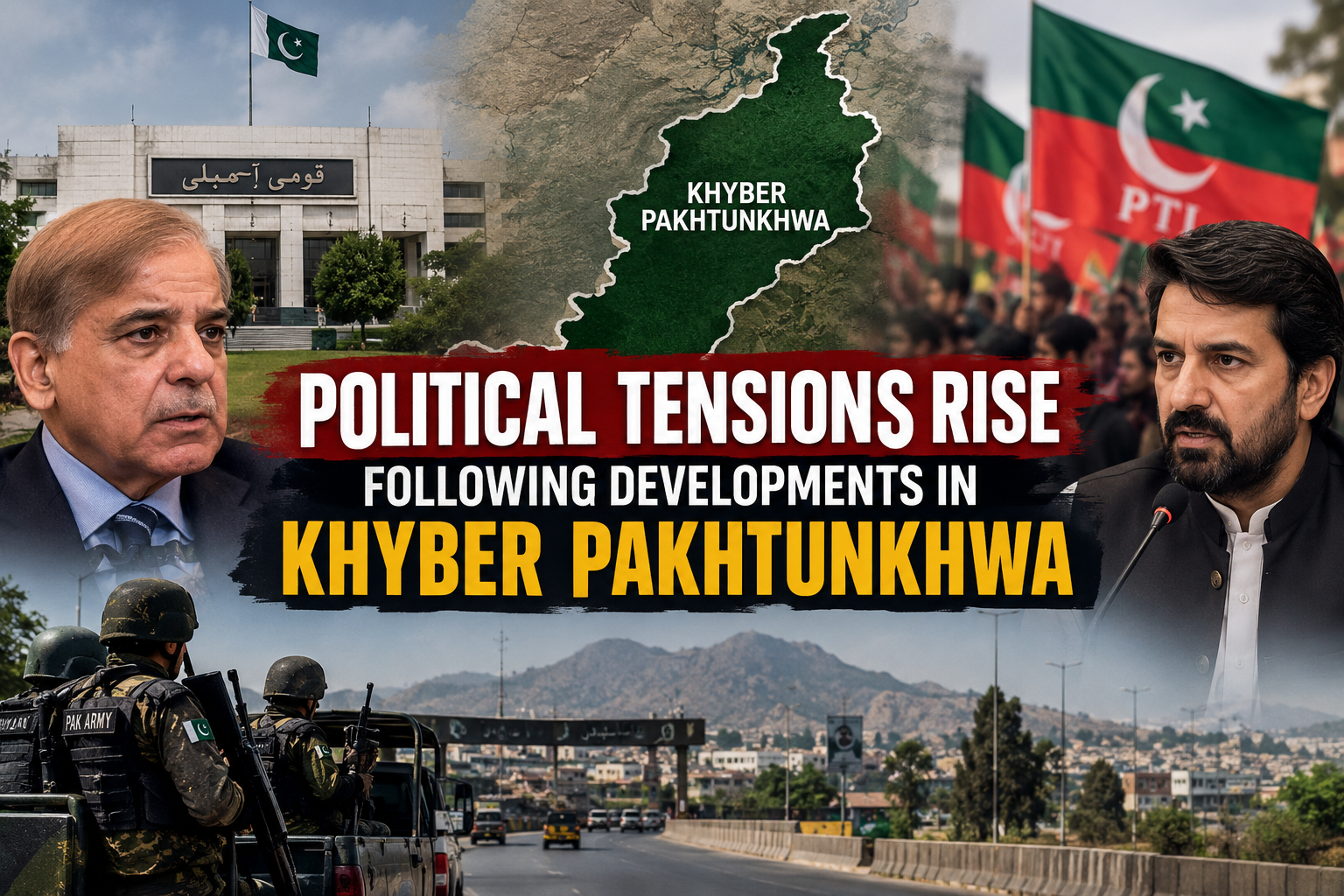
Political tensions in Pakistan have increased following major developments in Khyber Pakhtunkhwa (KP), where disagreements between the federal government and the Pakistan Tehreek-e-Insaf (PTI) have become a significant national issue. The situation intensified in October 2026 after the federal government introduced emergency measures and governor’s rule in the province, citing security concerns and the need for stronger action against militancy.
The decision has generated debate about constitutional authority, provincial autonomy, democratic representation, counterterrorism policy, and the future of political dialogue in Pakistan. While federal officials argue that extraordinary steps were necessary to address serious security challenges, PTI leaders have rejected the decision and described it as politically motivated. The disagreement has increased uncertainty for provincial governance and raised questions about how Pakistan can balance national security with democratic principles.
Background of the Political Situation
Khyber Pakhtunkhwa occupies an important position in Pakistan’s political and security landscape. The province shares a long border with Afghanistan and includes districts that have experienced militant violence, displacement, and security operations over many years. Its geographical location makes cooperation between provincial and federal institutions particularly important.
The province has also been a major political stronghold for PTI, the party associated with former prime minister Imran Khan. PTI has maintained a significant political presence in KP, and disagreements between the party and federal authorities have contributed to broader national political tensions.
Relations between the federal government and the PTI-led provincial administration deteriorated further during 2026. Both sides disagreed over security policy, political negotiations, and the responsibilities of provincial leadership in addressing militant violence.
These disagreements eventually contributed to the federal government's decision to impose emergency measures in the province in October. The move placed the provincial administration under a different governing arrangement and intensified the dispute between the ruling coalition and the opposition.
The situation is significant because it involves more than a disagreement between political parties. It also raises questions about constitutional procedures, the distribution of powers between federal and provincial governments, and the ability of public institutions to cooperate during a security crisis.
Federal Government Introduces Emergency Measures
In October 2026, President Asif Ali Zardari approved emergency measures affecting Khyber Pakhtunkhwa on the advice of Prime Minister Shehbaz Sharif. Federal officials said the decision was necessary because of growing security concerns and what they described as insufficient cooperation from the previous provincial administration in counterterrorism efforts.
The measures effectively suspended the PTI-led provincial government and introduced governor’s rule. The federal government presented the decision as a constitutional response to a serious law-and-order situation.
Officials argued that the state needed a coordinated approach to confront militancy and protect the lives and property of citizens. They also maintained that disagreements between the provincial and federal administrations had made cooperation more difficult.
However, the decision immediately became controversial. Opposition representatives questioned the government's justification and argued that political disagreements should not be used to remove an elected provincial administration from power.
The development placed constitutional questions at the centre of national political debate. Supporters of the federal government's decision focused on the urgency of improving security, while critics emphasized the importance of protecting democratic representation and provincial autonomy.
The long-term consequences will depend on the legal process, the implementation of the emergency arrangement, and whether political leaders can reach an understanding about the province's future governance.
PTI Rejects the Decision
The Pakistan Tehreek-e-Insaf has strongly opposed the federal government's intervention in Khyber Pakhtunkhwa. Party representatives have argued that the decision undermines the democratic mandate of the provincial electorate and weakens the authority of an elected government.
PTI has also rejected allegations that its leadership supported or cooperated with militant groups. The party has maintained that political opposition should not be treated as evidence of wrongdoing and that disputes between governments should be addressed through constitutional institutions.
The party has indicated that it intends to challenge the emergency measures through legal channels. This has made the courts an important part of the unfolding political situation.
The dispute also reflects the broader confrontation between PTI and the federal coalition. Political disagreements have continued over the treatment of Imran Khan, the direction of national policy, the role of opposition parties, and the conditions required for meaningful political negotiations.
For PTI supporters, the suspension of their party's provincial government represents a serious setback. For the federal government, the priority is to establish a governing arrangement that it believes can respond more effectively to security challenges.
These competing positions demonstrate why the situation remains difficult to resolve. Both sides are defending their interpretation of events, and a lasting solution will require more than public statements or political accusations.
Security Concerns Remain Central
Security is one of the most important factors behind the developments in Khyber Pakhtunkhwa. The province has faced militant attacks and security challenges for many years, particularly in areas close to the Afghan border.
Militant violence affects ordinary citizens, police officers, security personnel, government employees, traders, students, and families. It can interrupt education, restrict economic activity, discourage investment, and create uncertainty for people who already face economic difficulties.
Federal officials have argued that stronger coordination is required to address these challenges. Their position is that national security operations depend on cooperation between federal authorities, provincial institutions, law-enforcement agencies, and local administrations.
PTI, meanwhile, has disputed the federal government's accusations and criticized the decision to suspend its provincial government. The party has argued that political intervention is not the appropriate way to resolve disagreements over security policy.
A central question is whether the new administrative arrangement will produce measurable improvements in public safety. Residents need protection from violence, reliable law enforcement, and the confidence that government decisions are being made in their interests.
The effectiveness of any security policy should therefore be assessed through practical outcomes. These include changes in attacks, protection of civilians, the performance of police and counterterrorism institutions, and the ability of communities to continue their daily activities.
Political statements alone cannot establish whether a policy is successful. Transparent information and consistent assessments are essential for determining whether the situation is improving.
Parliament's Role in the Crisis
Parliament has become another important institution in the debate over Khyber Pakhtunkhwa. Federal lawmakers considered and endorsed emergency measures during October, while opposition representatives raised objections about their legality and political consequences.
The involvement of Parliament matters because major constitutional decisions require a clear legal foundation and proper institutional scrutiny. Parliamentary debate also provides an opportunity for elected representatives to question government policy, examine evidence, and express the concerns of their constituents.
Supporters of the emergency measures argue that the government must have the authority to respond when security conditions become serious. Critics argue that such powers should be exercised cautiously and should not weaken democratic institutions unnecessarily.
Both perspectives highlight the importance of constitutional safeguards. Emergency arrangements should have a clear purpose, follow applicable legal requirements, and remain subject to appropriate review.
Parliament can contribute to a more stable outcome by encouraging evidence-based debate and ensuring that security decisions are examined carefully. It can also provide a platform for discussing the concerns of people living in Khyber Pakhtunkhwa.
The crisis demonstrates that institutional cooperation is particularly important when political tensions and security challenges occur simultaneously.
Impact on Provincial Autonomy
Provincial autonomy is a major issue in Pakistan's federal system. The Constitution distributes responsibilities between the federal government and the provinces, allowing provincial administrations to manage many matters affecting local communities.
The intervention in Khyber Pakhtunkhwa has renewed debate about the limits of federal authority and the circumstances in which emergency arrangements may be introduced.
Supporters of provincial autonomy argue that elected provincial governments should retain authority over their constitutional responsibilities. They believe that decisions affecting a province should reflect the views and interests of its residents.
Those supporting federal intervention emphasize that national security can require coordination across different levels of government. They argue that serious threats cannot be managed effectively when institutions are unable to cooperate.
The challenge is to reconcile these responsibilities without undermining either public safety or democratic representation.
Pakistan's federal system depends on cooperation rather than permanent confrontation. The federal government and provincial institutions need reliable channels for sharing information, coordinating security policy, and resolving disagreements.
A clear legal framework and transparent decision-making can help reduce uncertainty. Public explanations of the reasons for exceptional measures, together with meaningful judicial and parliamentary oversight, can also strengthen confidence in the system.
The situation in KP may influence future discussions about how federal and provincial governments should respond when political disagreements overlap with security emergencies.
Public Reaction and Political Uncertainty
The emergency measures have generated strong reactions among political supporters, commentators, and members of civil society. Some people prioritize the need for immediate improvements in security, while others are concerned about the consequences of suspending an elected provincial administration.
Public opinion is not necessarily uniform. Residents of the province may evaluate the situation according to their experiences with violence, public services, political representation, economic conditions, and government performance.
For families living in areas affected by militancy, safety is an immediate concern. They want children to attend school, businesses to operate, public transport to function, and communities to live without persistent fear.
For voters who supported PTI, the suspension of the provincial government may raise concerns about whether their electoral preferences are being respected. Other citizens may focus more heavily on whether the new arrangement can improve administration and law enforcement.
These different priorities demonstrate why responsible public communication is essential. Political leaders should avoid treating all residents as if they share the same views.
Peaceful political expression, access to reliable information, and respect for legal procedures can help prevent disagreements from becoming more damaging.
The authorities must also ensure that public safety measures are proportionate and that citizens can access essential services without unnecessary disruption.
The Importance of Political Dialogue
Political dialogue remains one of the most practical ways to reduce tensions. When disagreements become entrenched, negotiations can help identify areas of common ground and prevent disputes from affecting the wider population.
The federal government and PTI have struggled to reach an understanding over several issues. Their disagreements include the emergency measures in KP, counterterrorism policy, political representation, and the treatment of PTI leadership.
Despite these differences, both sides have reasons to support a peaceful and stable province. Better security, functioning public services, economic development, and public confidence are important objectives regardless of political affiliation.
Dialogue does not require either side to abandon its position immediately. Instead, negotiations can establish a process for examining disputed claims, discussing constitutional concerns, and identifying practical steps that can be taken without violence.
An effective dialogue process should have clear objectives, credible representatives, and a commitment to following agreed procedures. It should also allow disagreements to be addressed without threats or intimidation.
Political negotiations may take time, but they can reduce uncertainty and help institutions focus on the problems facing citizens.
A lasting agreement will be more achievable if the parties distinguish between legitimate political competition and the shared responsibility to protect the public.
Legal Challenges and Constitutional Questions
The legal dimension of the KP crisis is central to determining how the emergency arrangement will proceed. PTI has opposed the federal intervention and indicated that it would seek judicial review.
Courts can examine whether government actions comply with constitutional requirements and whether the relevant legal procedures have been followed. Judicial review is particularly important when a decision affects the structure of provincial government and the exercise of political authority.
The precise legal questions must be assessed by the relevant courts on the basis of constitutional provisions, official documents, and arguments presented by the parties.
It is important to distinguish allegations from established findings. Claims made by government officials or opposition leaders do not automatically become proven facts simply because they receive widespread attention.
A transparent legal process can help establish which arguments are supported by the law and what remedies, if any, are appropriate.
Respect for court decisions is equally important. When political parties accept lawful procedures, they provide citizens with a peaceful way to resolve disputes.
The case may also contribute to broader discussion about emergency powers, provincial autonomy, and the relationship between elected governments and federal institutions.
Economic Consequences for Khyber Pakhtunkhwa
Political uncertainty can affect economic activity in several ways. Businesses often need predictable regulations, reliable public services, functioning transport networks, and confidence that government institutions will remain operational.
When political tensions rise, investors may postpone decisions until the situation becomes clearer. Traders may face interruptions, consumers may become cautious, and businesses may delay expansion plans.
Khyber Pakhtunkhwa has economic potential in agriculture, tourism, retail, construction, small manufacturing, transport, and services. Many people depend on these activities for their livelihoods.
The province also contains areas with important tourism attractions. However, tourism requires safe travel routes, dependable facilities, effective local administration, and a positive reputation among visitors.
If political uncertainty affects these conditions, businesses and workers may face additional difficulties. Conversely, improvements in security and governance could help create a more supportive environment for economic activity.
The new administration will therefore face expectations that extend beyond political management. Citizens will want to know whether markets remain accessible, development projects continue, public offices function efficiently, and services are delivered fairly.
Economic progress will require sustained planning and cooperation among relevant institutions. Political stability alone cannot solve every economic problem, but prolonged confrontation can make those problems harder to address.
Effects on Education and Public Services
Education and public services are among the areas that require particular attention during political transitions.
Schools, colleges, hospitals, local government offices, and public welfare programmes need continuity even when political leadership changes. Students should not lose valuable learning time because of avoidable administrative disruption, and patients should be able to access essential medical services.
Local administrations also need sufficient resources to maintain sanitation, roads, water services, and other basic facilities. When government departments receive unclear instructions or face coordination problems, the delivery of services can suffer.
The people most affected by these disruptions are often those with limited financial resources. Families who cannot easily afford private education or healthcare depend heavily on public institutions.
Authorities responsible for the new arrangement should therefore establish clear administrative priorities. Public employees need reliable instructions, while citizens need accessible information about services and any changes in government procedures.
Political leaders should avoid using public services as instruments of confrontation. Schools, hospitals, and welfare institutions serve the entire population and should operate according to public need.
Regular assessments can help identify service interruptions and allow authorities to respond quickly.
The success of any governing arrangement should ultimately be judged partly by whether ordinary citizens experience improvements in their daily lives.
The Role of Law-Enforcement Institutions
Law-enforcement agencies face a difficult responsibility during periods of political tension. They must protect public safety while respecting applicable laws and the rights of citizens.
When protests occur, authorities need to maintain order without creating unnecessary confrontation. Clear communication, appropriate planning, and proportionate responses can help reduce the risk of injuries and property damage.
Political parties also have responsibilities. Organizers should communicate peaceful expectations to supporters and discourage violence, intimidation, and damage to public property.
Citizens should be able to express political views through lawful means. At the same time, public gatherings must be managed in ways that protect participants, nearby residents, emergency services, and businesses.
Allegations about the conduct of police or protesters should be investigated fairly. Where evidence supports claims of misconduct, the relevant institutions should respond according to the law.
Independent and transparent procedures can help prevent rumours from replacing reliable information.
The broader goal should be to preserve public order without deepening political divisions. Trust between communities and law-enforcement agencies is especially important in regions that have experienced prolonged security challenges.
Media Coverage and the Spread of Information
Media organizations have an important role in explaining the developments in Khyber Pakhtunkhwa. Citizens need accurate reporting about government decisions, court proceedings, political negotiations, and security conditions.
However, rapidly changing political situations can create opportunities for misinformation. Unverified claims, misleading headlines, edited videos, and rumours may circulate before facts are established.
Responsible reporting should clearly distinguish between official statements, allegations, confirmed developments, and independent analysis.
News organizations should verify information before presenting it as fact. They should also correct errors when reliable evidence shows that a report was inaccurate.
Readers can contribute to a healthier information environment by checking the date and context of a report and avoiding the immediate sharing of sensational claims.
This is particularly important when reports concern security incidents or public protests, because inaccurate information may increase anxiety or encourage unnecessary confrontation.
Social media can help people receive updates quickly, but speed does not guarantee accuracy. Official announcements should be considered alongside independent reporting and, where relevant, verified legal documents.
A well-informed public is better able to understand the political situation and evaluate competing claims.
Human Rights and Democratic Representation
The KP crisis has also raised concerns about democratic representation and the protection of fundamental rights.
Emergency arrangements can have significant consequences for political activity and public life. For this reason, their legal basis, duration, and practical effects deserve careful scrutiny.
Human rights advocates have emphasized the importance of protecting fundamental freedoms and restoring meaningful political dialogue. Concerns include the ability to express opinions peacefully, participate in political activities, and access fair legal procedures.
Democratic representation is not limited to holding elections. It also involves institutions that operate according to the Constitution, opposition parties that can perform their legitimate role, and public officials who remain accountable for their decisions.
At the same time, democratic rights exist within a legal framework that allows authorities to address genuine threats to public safety.
The challenge is to ensure that security measures remain lawful and proportionate. Measures that lack public confidence or are perceived as unfair may deepen resentment and make cooperation more difficult.
Transparent procedures, judicial oversight, and open communication can help maintain a balance between security requirements and individual rights.
The situation offers an important reminder that public trust is an essential part of effective governance.
What Could Happen Next?
Several factors will influence the future of Khyber Pakhtunkhwa.
First, the legal challenges to the emergency measures may clarify the constitutional position and determine what procedures must be followed. Court decisions could shape the next stage of the dispute.
Second, the federal government will face pressure to demonstrate that the new arrangement can improve security and administrative coordination. Public expectations will focus on practical results rather than political explanations alone.
Third, PTI will continue to determine how it responds through legal proceedings, political statements, and peaceful political activity. Its approach will influence the broader political atmosphere.
Fourth, the possibility of renewed dialogue could reduce tensions if both sides agree on a credible process. Even limited cooperation on security and public services could provide a starting point for wider negotiations.
Finally, the reaction of citizens will remain important. Residents will assess developments according to their safety, access to services, economic opportunities, and confidence in public institutions.
It would be premature to assume that the situation will be resolved quickly. Political and constitutional disputes can take time, especially when they involve competing interpretations of security needs and democratic authority.
Nevertheless, a peaceful and lawful resolution remains possible if institutions follow established procedures and political leaders prioritize public welfare.
Why Stability in Khyber Pakhtunkhwa Matters to Pakistan
Khyber Pakhtunkhwa's political and security situation has implications beyond the province. The region's location, population, economic activity, and proximity to Afghanistan make it important to Pakistan's broader stability.
Persistent insecurity can affect trade, transportation, investment, tourism, and relations with neighbouring areas. Political conflict can create additional difficulties by reducing cooperation between institutions that need to work together.
A stable province can contribute to national development by supporting local businesses, improving educational opportunities, strengthening public services, and creating conditions for investment.
National stability also depends on the ability of political parties to compete peacefully. Disagreements are a normal part of democratic politics, but they become more damaging when institutions cannot establish a trusted process for resolving them.
The federal government, provincial representatives, courts, parliamentarians, and civil society all have roles to play in maintaining a constructive political environment.
The crisis should therefore be viewed as an opportunity to examine how security policy, constitutional safeguards, and democratic dialogue can work together more effectively.
Conclusion
Political tensions in Khyber Pakhtunkhwa have intensified following the federal government's decision to introduce emergency measures and governor’s rule in October 2026. The move, justified by federal officials on security grounds, has been strongly opposed by PTI, which disputes the government's position and has challenged the intervention.
The situation involves several interconnected issues, including counterterrorism, provincial autonomy, constitutional authority, public safety, democratic representation, and economic stability.
The immediate priority must be the protection of citizens and the continuity of essential public services. At the same time, legal procedures and democratic principles remain important for ensuring that extraordinary government measures are properly scrutinized.
Political dialogue could help reduce confrontation and establish a path towards a more stable arrangement. Transparent investigations, reliable information, and respect for lawful decisions can also help rebuild public confidence.
Ultimately, the success of any political response should be measured by its impact on ordinary people. A safer environment, functioning institutions, access to education and healthcare, and greater economic confidence are the outcomes residents need.
Khyber Pakhtunkhwa's future will depend not only on the decisions taken by political leaders but also on their willingness to cooperate, respect constitutional processes, and place public welfare above partisan interests.
FAQs
1. Why have political tensions increased in Khyber Pakhtunkhwa?
Tensions increased after the federal government introduced emergency measures and governor’s rule in October 2026, citing security concerns and inadequate cooperation in counterterrorism efforts. PTI has challenged the decision.
2. Which political party previously governed Khyber Pakhtunkhwa?
The province was governed by the Pakistan Tehreek-e-Insaf, or PTI, before the federal intervention in October 2026.
3. What reasons did the federal government give for imposing emergency measures?
Federal officials cited law-and-order concerns, militant violence, and the need for better coordination in counterterrorism efforts.
4. How has PTI responded to the federal government's decision?
PTI has rejected the intervention, described it as politically motivated, disputed allegations against its leadership, and pursued legal challenges.
5. How could the political crisis affect residents of Khyber Pakhtunkhwa?
Prolonged uncertainty could affect public services, business confidence, education, tourism, and political stability. Improved security, transparent administration, and peaceful dialogue could help reduce these concerns.




