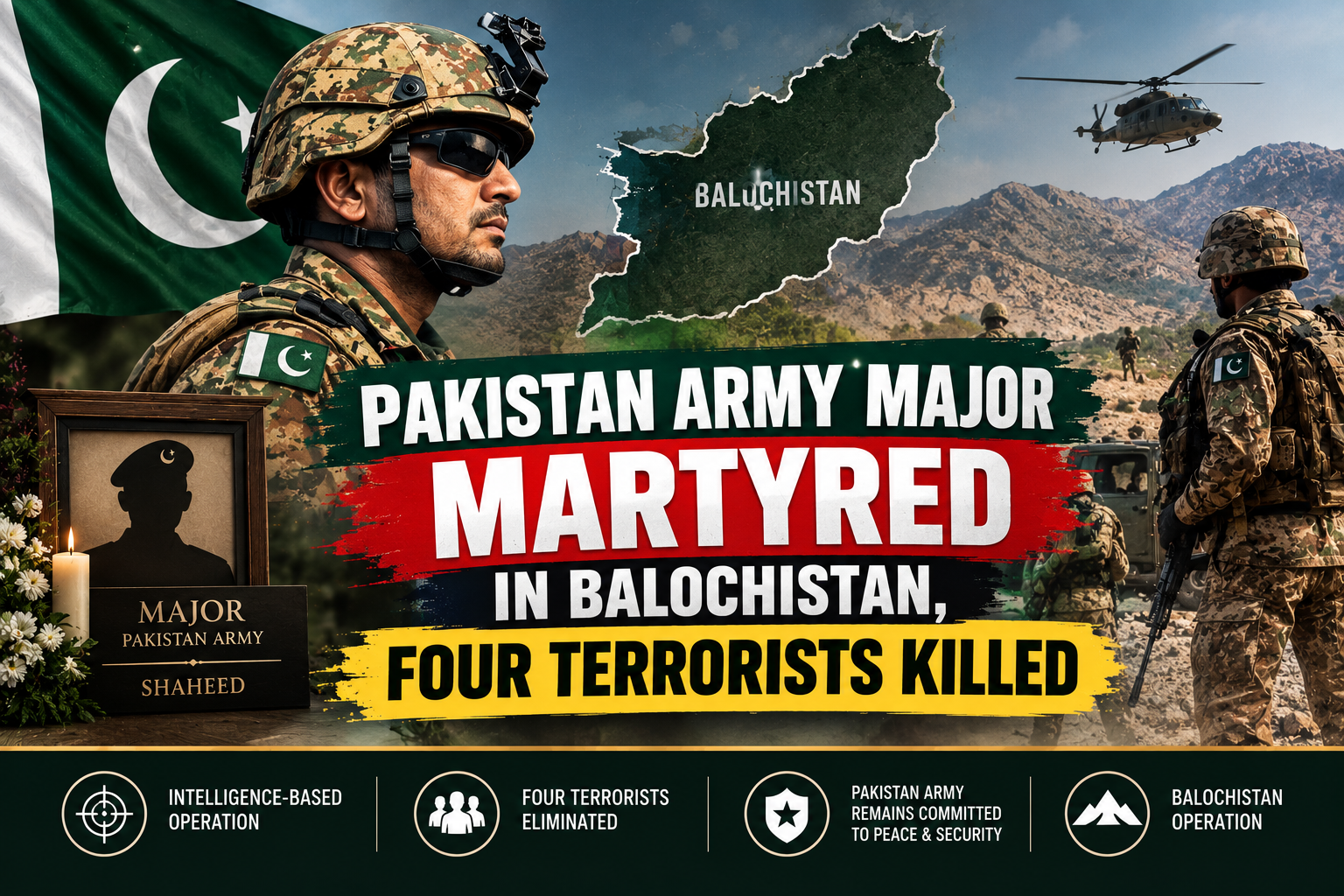
Pakistan Army Major Martyred in Balochistan, Four Terrorists Killed in Security Operations is the major security development reported on October 19, 2026. According to Pakistan’s military media wing, an Army major lost his life during a security operation in the Gwadar district, while security forces killed four terrorists in a separate intelligence-based operation in Kalat district. The incidents highlight the continuing security challenges facing Balochistan and the importance of protecting local communities, transport routes, public infrastructure, and economic activities.
The operations took place in the Shadi Kaur area of Pasni in Gwadar district and the Jattakabad area of Kalat district. Officials stated that security forces had received intelligence regarding suspected militant hideouts in these locations. During the operation in Kalat, four militants were killed, and a significant quantity of arms and ammunition was reportedly recovered. In a separate incident in Gwadar, Major Wajahat Waheed was martyred after a security forces contingent came under attack from an improvised explosive device.
The developments have drawn attention to the sacrifices made by security personnel and the wider challenges associated with counterterrorism operations in Pakistan’s largest province by area. They also raise important questions about regional stability, the safety of civilians, economic development, and the long-term measures required to establish lasting peace in Balochistan.
Major Wajahat Waheed Martyred During Security Operation
According to the Inter-Services Public Relations, Major Wajahat Waheed was leading a security forces contingent during clearance operations in the Shadi Kaur area of Pasni, within Gwadar district. The operation was being conducted as part of efforts to address reported militant activity and improve security in the surrounding area.
During the operation, the contingent was targeted by an improvised explosive device. The blast resulted in the martyrdom of Major Wajahat Waheed, who was identified in reports as a resident of Lahore.
The death of an officer during an operational assignment is a significant loss for the armed forces and his family. Military personnel involved in counterterrorism activities often work in challenging conditions, particularly in areas where security threats may be difficult to identify before an operation begins.
The reported incident also demonstrates the risks associated with clearance operations. Even when security forces have information about suspected militant locations, the presence of concealed explosive devices can create serious dangers for personnel working to secure an area.
Following the incident, security forces continued their activities in the surrounding region. Officials stated that clearance and sanitisation operations would continue to identify and address any remaining threats.
The loss of Major Wajahat Waheed has also focused public attention on the families of personnel who serve in difficult operational environments. Behind every military casualty is a family facing personal grief, uncertainty, and a sudden change in everyday life.
The incident serves as a reminder that security operations involve substantial human costs. While official reports focus on operational developments, the personal loss experienced by families remains an important part of the wider story.
Four Terrorists Killed in Kalat District
In a separate development, security forces conducted an intelligence-based operation in Jattakabad, an area of Kalat district in Balochistan, on October 18, 2026.
According to the military’s statement, intelligence agencies had reported the presence of suspected militant hideouts in the area. Security personnel engaged the reported location, and an exchange of fire followed.
Officials stated that four terrorists were killed during the operation. A large quantity of arms and ammunition was also reportedly recovered from the location.
Intelligence-based operations are intended to use information gathered by security and intelligence agencies to identify potential threats. Their objectives may include disrupting suspected militant networks, locating hideouts, recovering weapons, and preventing attacks against civilians or security personnel.
The results of this operation were reported as part of Pakistan’s broader counterterrorism campaign. However, the long-term impact of any single operation depends on several factors, including whether further threats are identified, whether local communities can return to normal activities, and whether security improvements can be sustained.
The recovery of weapons and ammunition can be relevant to investigations into suspected militant activity. Authorities may examine recovered material as part of efforts to understand the nature of the threat and establish whether additional individuals or networks are involved.
The operation in Kalat and the incident in Gwadar occurred in separate locations. Although both were reported within the same broader security context, the details of each incident should be considered individually.
The killing of four suspected militants does not, by itself, mean that all security concerns in the surrounding districts have been resolved. Continued monitoring, reliable intelligence, lawful investigations, and cooperation with local communities remain important elements of an effective security response.
Security Operations in Gwadar and Kalat
Gwadar and Kalat have different geographical and economic characteristics, but security developments in both districts can affect the wider stability of Balochistan.
Gwadar is a coastal district with strategic importance because of its location along the Arabian Sea. Its port, coastal communities, transport connections, and potential for investment make security an important consideration for residents, businesses, and public institutions.
Pasni, where the reported incident involving Major Wajahat Waheed occurred, is a coastal town within Gwadar district. Local communities depend on a range of activities, including fishing, trade, transportation, and other services.
Security concerns in coastal areas can affect public confidence and the movement of people and goods. When incidents occur, authorities must balance the need to address threats with the need to protect civilian life and minimise disruption to normal activities.
Kalat, meanwhile, is an important district within Balochistan’s interior. Like many areas of the province, it faces challenges connected to geography, access to public services, transportation, and the provision of security across extensive distances.
The two operations illustrate why counterterrorism efforts in Balochistan require coordination across different districts. Threats can emerge in locations with different terrain, infrastructure, and community needs, making a consistent and locally informed approach important.
At the same time, security policy cannot depend entirely on operations. Improvements in education, healthcare, employment, transport, and access to justice can also contribute to stability by strengthening public trust and improving the quality of life for residents.
Why Balochistan Remains a Major Security Concern
Balochistan has experienced a prolonged period of insecurity involving militant violence, separatist insurgency, attacks on security personnel, and incidents affecting civilians and infrastructure.
The province’s large geographical area presents practical challenges for public administration and security provision. Many communities are separated by long distances, while some areas have limited access to transport, healthcare facilities, and other essential services.
These conditions can make it difficult for authorities to respond quickly to incidents or maintain a consistent presence across remote locations. They also make cooperation between local communities and public institutions particularly important.
Security challenges in Balochistan are not limited to one district or one type of incident. Different areas can face different threats, requiring responses based on local conditions and credible information.
The province is also economically significant. It contains substantial mineral resources, has a long coastline, and occupies an important position in Pakistan’s regional trade and transport networks. These characteristics create opportunities for economic development but also make the protection of infrastructure and communities an important responsibility.
Continued violence can affect investment decisions, disrupt business activity, and create uncertainty for residents. It can also place additional pressure on public finances, as resources must be allocated to emergency responses and security requirements.
Addressing these challenges requires a comprehensive strategy. Law enforcement and counterterrorism measures are important, but they are most effective when supported by functioning public services, transparent governance, local participation, and credible opportunities for young people.
Government and Military Response
Following the reported operations, the military stated that clearance activities would continue in the affected areas to address any remaining threats.
The operations were described as part of the wider counterterrorism campaign associated with Azm-e-Istehkam, which has been presented as a framework for strengthening Pakistan’s response to security threats under the National Action Plan.
The broad objective of counterterrorism efforts is to prevent attacks, disrupt militant activity, and improve security for citizens and public institutions. Achieving these objectives requires coordination among the armed forces, intelligence agencies, police, and other law enforcement bodies.
Different institutions have distinct responsibilities. Military forces may conduct operations in designated areas, while civilian law enforcement agencies are important for maintaining public order, investigating offences, and supporting the administration of justice.
Effective coordination can help authorities respond more consistently to security incidents. It can also improve the collection and assessment of information, allowing decisions to be based on evidence rather than speculation.
Government communication is another important element of the response. Clear, timely, and accurate information can help the public understand what has happened, what measures are being taken, and whether any precautions are necessary.
At the same time, official claims about the identities, affiliations, or alleged sponsors of suspected militants should be distinguished from independently established findings. Investigations and credible evidence are important when assessing responsibility for attacks or establishing connections between individuals and organisations.
A sustained response should also include accountability, respect for the law, and protection for civilians. These principles are essential to public confidence and the long-term legitimacy of security institutions.
Importance of Protecting Civilian Communities
One of the central objectives of counterterrorism operations is to protect ordinary people from violence and intimidation.
Residents of affected areas may experience disruption even when they are not directly involved in a security incident. They may face temporary travel restrictions, interruptions to work, concerns about personal safety, or uncertainty about access to essential services.
In rural and remote communities, such disruption can have particularly serious consequences. Families may depend on daily earnings, while students and patients may need to travel considerable distances to reach schools or healthcare facilities.
Authorities therefore need to consider the needs of residents when planning and conducting security operations. Clear communication, appropriate safety precautions, and arrangements for essential services can help reduce the burden on communities.
Local residents can also play an important role in building safer communities when they have confidence in public institutions. People are more likely to cooperate with lawful authorities when they believe their concerns will be taken seriously and their rights will be respected.
Community trust should not be treated as a secondary issue. It is a practical part of long-term security because reliable local information and cooperation can help authorities understand changing conditions.
Protecting civilians also means avoiding unnecessary disruption and ensuring that people affected by security incidents can access assistance. Families who suffer losses or displacement may require support from relevant government departments and local services.
Peace is not measured only by the number of operations conducted or militants reported killed. It is also reflected in whether children can attend school, businesses can operate, families can travel safely, and communities can plan for their futures without persistent fear.
Balochistan’s Economic Importance
Balochistan has considerable economic potential, including mineral resources, coastal industries, agriculture in suitable areas, and opportunities connected to transport and trade.
Gwadar has received particular attention because of its location and its potential role in regional commerce. Port-related activities and supporting infrastructure could contribute to employment and economic growth if development is accompanied by reliable services and lasting security.
However, investment depends on more than geographical advantages. Businesses also consider the safety of employees, the reliability of transport, the availability of utilities, the predictability of regulations, and the confidence that projects can operate over the long term.
Repeated security incidents can increase uncertainty and raise operating costs. Companies may delay decisions, while smaller businesses can struggle when customers reduce travel or commercial activity becomes unpredictable.
Local people may experience these effects through fewer employment opportunities, reduced demand for services, or interruptions to trade. For communities already facing limited economic options, prolonged insecurity can make development more difficult.
For this reason, security and economic policy need to support one another. Protecting workers, transport routes, public facilities, and commercial centres is important, but economic progress also requires investment in skills, education, healthcare, and local businesses.
Development initiatives are more likely to produce lasting benefits when residents can participate in decisions and access the opportunities created by new projects. Employment, training, and transparent resource management can help ensure that economic gains reach communities across the province.
The latest operations in Gwadar and Kalat therefore have significance beyond the immediate security situation. They highlight the importance of creating conditions in which residents and businesses can operate safely and contribute to the province’s future.
Impact on Investors and Business Confidence
Investors often assess security conditions before committing money to infrastructure, manufacturing, transport, tourism, or natural-resource projects.
A single incident does not automatically determine whether a project will proceed. Investors generally consider a broader range of factors, including the frequency of incidents, the effectiveness of government responses, the availability of insurance, and the resilience of transport and supply chains.
Nevertheless, repeated violence can influence perceptions of risk. Businesses may need additional security arrangements, while employees and contractors may have concerns about travelling to certain locations.
For smaller enterprises, even temporary interruptions can create financial pressure. Transport operators, shopkeepers, service providers, and local suppliers may depend on regular customer activity to meet their expenses.
Improving business confidence therefore requires sustained results rather than isolated announcements. Authorities need to demonstrate that security arrangements are effective, public services remain functional, and concerns raised by residents and businesses receive attention.
Clear information about local conditions can also help prevent rumours from spreading. Inaccurate reports may create unnecessary anxiety or lead people to make decisions based on unverified claims.
Long-term economic confidence depends on stability, fair treatment, predictable regulations, and opportunities for communities to benefit from investment. Security operations can contribute to these goals when they are part of a wider approach to peace and development.
The Role of Intelligence-Based Operations
Intelligence-based operations are a component of modern security responses. They are intended to use information and analysis to identify suspected threats and direct resources toward specific locations.
In principle, reliable intelligence can help authorities make more informed decisions than approaches based solely on broad assumptions. It can also support efforts to prevent attacks and identify individuals suspected of planning or carrying out violence.
However, intelligence must be assessed carefully. Information can be incomplete, outdated, or difficult to verify, so professional evaluation and appropriate oversight remain important.
After an operation, authorities may need to examine recovered material, establish the identities of those involved, and determine whether there is evidence of links to other incidents. Such investigations can help clarify the nature of a threat and support lawful proceedings where appropriate.
The reported recovery of arms and ammunition in Kalat is therefore a relevant part of the official account. The significance of that material will depend on the findings of further examination and investigation.
It is also important to communicate operational results accurately. Reporting should distinguish between information confirmed by officials, claims that remain under investigation, and conclusions that have not been independently established.
Accurate reporting supports public understanding and reduces the risk that speculation will be mistaken for verified information.
Security Challenges and Regional Stability
Balochistan’s security situation is connected to broader regional dynamics, including border management, movement across remote areas, and relations between neighbouring countries.
Pakistan has repeatedly raised concerns about militant activity and the need to prevent attacks against its territory. Allegations involving foreign sponsorship or cross-border support are politically sensitive and should be assessed through reliable evidence and appropriate diplomatic channels.
Regional security challenges cannot be resolved through statements alone. Cooperation, information sharing where appropriate, border management, and sustained diplomatic engagement may contribute to reducing tensions.
At the same time, the immediate responsibility to protect people within Pakistan remains central. Security institutions must respond to credible threats while civilian authorities continue their work on public services, economic development, and local governance.
Regional stability also matters for trade and investment. Businesses operating across borders need predictable conditions, while communities benefit when transportation and commercial activity can proceed without repeated disruption.
The latest incidents in Balochistan underline the importance of addressing security concerns at local, national, and regional levels. Each level has different responsibilities, and progress depends on practical coordination rather than reliance on any single measure.
The Importance of Accurate News Reporting
Security incidents often generate strong public reactions, especially when military personnel lose their lives. In such circumstances, responsible reporting becomes particularly important.
Readers need to know what has been confirmed, where the incidents occurred, and what authorities have announced. They also need to understand the difference between an official statement and an independently verified conclusion.
Reports about casualty figures, alleged organisational links, or the possible involvement of outside actors should be handled carefully. Publishing unverified information can create confusion, intensify tensions, and cause unnecessary distress to families.
News organisations and readers can contribute to a more informed public discussion by checking dates, comparing credible accounts, and avoiding the spread of rumours.
It is equally important to report the human impact of violence respectfully. The death of a security officer should not be reduced to a statistic, and the experiences of affected civilian communities should not be overlooked.
Balanced reporting can acknowledge the sacrifices of security personnel while also examining the broader conditions that influence peace and stability. This approach provides readers with a clearer understanding of the event and its wider significance.
What Happens Next in Balochistan?
Following the October 18 operations, officials stated that clearance activities would continue in the affected areas. Further developments will depend on the findings of those operations and any subsequent investigations.
Authorities may continue assessing suspected militant activity, reviewing recovered material, and determining whether additional security measures are necessary. The public will also be watching for updates about the investigation into the attack that resulted in Major Wajahat Waheed’s martyrdom.
In the longer term, the challenge is to translate security efforts into conditions that allow communities to live and work with greater confidence.
This requires consistent law enforcement, reliable public services, better economic opportunities, and meaningful engagement with local residents. It also requires attention to the concerns of families affected by violence and the needs of people whose livelihoods depend on stable conditions.
No single operation can resolve every challenge facing a large and diverse province. Sustainable progress generally comes from a combination of security measures, effective administration, investment, education, and public trust.
The results should ultimately be measured through improvements in everyday life. Reduced violence, safer travel, functioning schools, dependable healthcare, stronger local businesses, and greater confidence in public institutions would all represent meaningful progress.
Conclusion
The martyrdom of Major Wajahat Waheed during a security operation in Gwadar and the reported killing of four terrorists in Kalat represent significant developments in Pakistan’s ongoing counterterrorism efforts.
According to the military’s statement, the officer was killed in an improvised explosive device attack while leading a security forces contingent in the Shadi Kaur area of Pasni. In a separate operation in Jattakabad, Kalat district, four suspected militants were killed and a quantity of arms and ammunition was reportedly recovered.
The incidents highlight the risks faced by security personnel and the continuing challenges of maintaining peace across Balochistan. They also demonstrate why security, civilian protection, economic development, and effective governance must be considered together.
Protecting communities requires more than responding to individual incidents. It involves preventing future attacks, strengthening public institutions, supporting local livelihoods, and building confidence between residents and authorities.
Balochistan’s economic potential makes lasting stability especially important. A safer environment can support trade, investment, employment, and improved access to essential services. Achieving that environment, however, requires sustained efforts and a commitment to the well-being of local communities.
As investigations and clearance operations continue, accurate information and responsible public discussion will remain important. The long-term goal should be a peaceful environment in which security personnel can carry out their duties, civilians can live without fear, and communities across Balochistan can pursue better opportunities.
FAQs
1. What happened in Balochistan on October 19, 2026?
A Pakistan Army major was reported martyred during a security operation in Gwadar, while security forces killed four terrorists in a separate operation in Kalat district.
2. Who was the martyred Pakistan Army officer?
The military identified the officer as Major Wajahat Waheed, a resident of Lahore.
3. Where were the security operations conducted?
The reported operations took place in the Shadi Kaur area of Pasni in Gwadar district and the Jattakabad area of Kalat district.
4. How many terrorists were killed in the Kalat operation?
According to the military’s statement, four terrorists were killed during the intelligence-based operation, and arms and ammunition were recovered.
5. Why are security operations important for Balochistan?
They aim to address security threats and protect communities. Long-term stability also depends on effective governance, public services, economic opportunities, and cooperation with local residents.
Tighten repetitive security analysisAdd a concise breaking-news lead