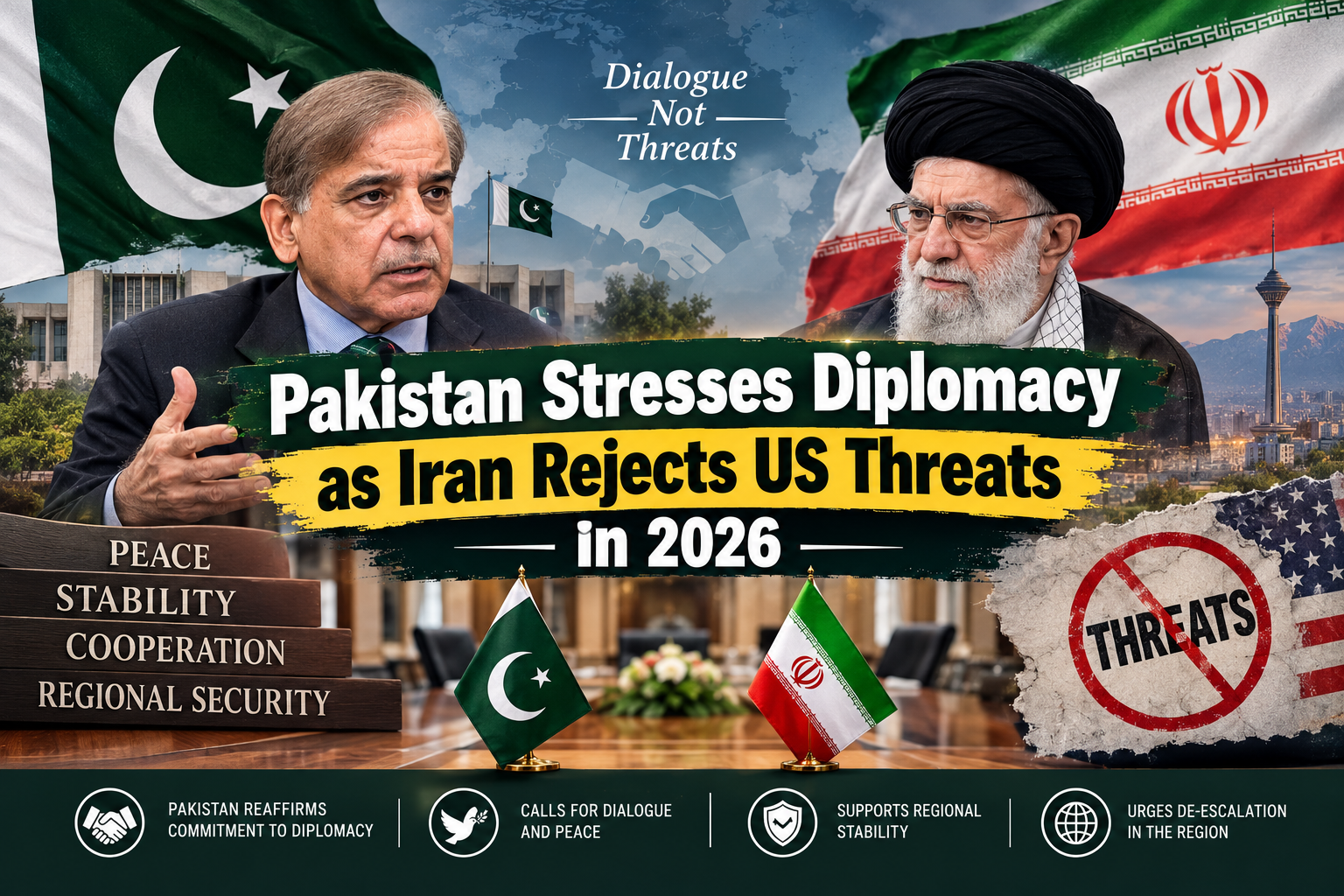
Pakistan is navigating a sensitive regional diplomatic situation as tensions between Iran and the United States continue to raise concerns about peace, security, trade, and stability across the Middle East and South Asia. Islamabad has consistently emphasized dialogue, peaceful negotiations, and diplomatic engagement as important tools for preventing further escalation.
Iran’s rejection of US threats reflects the wider disagreement between the two countries over security, regional influence, sanctions, and the future of diplomatic negotiations. These tensions matter to Pakistan because of its geographical proximity to Iran, its economic interests, its energy requirements, and its desire to maintain constructive relations with countries across the region.
For Pakistan, the challenge is to support peaceful solutions while protecting its national interests. Escalating tensions could affect regional trade, border security, energy markets, and the movement of goods and people. A diplomatic approach could help reduce these risks and create opportunities for broader regional cooperation.
Pakistan's Diplomatic Efforts Amid US-Iran Tensions
Pakistan's diplomatic approach reflects its interest in preventing a wider regional crisis. Islamabad maintains relationships with both Washington and Tehran, although the two countries have significant disagreements over security, sanctions, regional influence, and maritime access.
Pakistan's Deputy Prime Minister and Foreign Minister Ishaq Dar spoke by telephone with Iranian Foreign Minister Abbas Araghchi on October 18, 2026. According to Pakistan's Foreign Office, the ministers discussed the evolving regional situation and the ongoing meeting of the Organisation of Islamic Cooperation's Council of Foreign Ministers in Baghdad.
During the conversation, Dar emphasized the importance of continued dialogue and diplomacy in addressing regional challenges. Both sides agreed to remain in close contact.
The discussion came as Iran continued to reject what it described as American coercion and intimidation while maintaining that it was prepared to negotiate under conditions based on mutual respect and credible guarantees.
Pakistan's position is significant because the country has previously helped facilitate communication between the United States and Iran. Islamabad has supported negotiations as a means of resolving disagreements and preventing further escalation.
For Pakistan, diplomatic engagement offers an opportunity to contribute to regional stability without becoming directly involved in the confrontation. It also helps protect the country's economic and security interests at a time when instability could have consequences well beyond the immediate conflict zone.
Iran Rejects Threats but Keeps the Door Open to Dialogue
Iranian Foreign Minister Abbas Araghchi reiterated Tehran's position during discussions at the OIC meeting in Baghdad. He stated that Iran would not accept coercion, threats, or intimidation and would not surrender its sovereign rights under pressure.
At the same time, Araghchi indicated that Iran remained prepared for dialogue based on mutual respect and credible guarantees.
This distinction is important. Iran's rejection of threats does not necessarily mean that it has abandoned negotiations. Instead, Tehran has argued that any diplomatic process must address its stated concerns and provide assurances that agreements will be respected.
The United States and Iran have disagreed over the conditions required for a settlement, including sanctions, maritime security, regional hostilities, and broader security questions.
Such disagreements can make negotiations difficult because each side may seek concessions before agreeing to further steps. If neither side is willing to compromise, diplomatic discussions can become prolonged and regional tensions may remain high.
Nevertheless, the continued exchange of proposals suggests that diplomacy remains an available channel.
For Pakistan, the challenge is to encourage both governments to continue communicating while recognising that the final decisions rest with the parties directly involved.
A successful diplomatic effort would need to address the concerns of both sides, establish credible arrangements, and reduce the risk of further confrontation.
The Strait of Hormuz Remains a Major Concern
The Strait of Hormuz is one of the world's most important maritime passages. Located between Iran and Oman, it connects the Persian Gulf with the Gulf of Oman and the wider Arabian Sea.
A substantial share of internationally traded oil and liquefied natural gas normally passes through this waterway. As a result, disruptions can affect energy markets, shipping costs, insurance premiums, and the availability of fuel in countries that depend on imported energy.
The current tensions have placed the strait at the centre of diplomatic discussions.
On October 19, Araghchi said Iran's proposal to reopen the strategic waterway within seven days remained on the table. He indicated that Tehran was reviewing comments received from the United States.
Iran's proposal includes conditions relating to the US blockade on Iranian ports, sanctions affecting Iranian oil exports, and the cessation of hostilities across regional fronts. Araghchi said that, if Washington accepted Tehran's conditions, the strait could reopen within six days, with talks resuming the following day.
These statements describe Iran's position and proposed sequence of steps; they do not establish that an agreement has been reached.
The United States and Iran would still need to resolve disagreements over the terms, implementation, and verification of any arrangement.
For Pakistan, the waterway's status matters because maritime disruption can influence the price of imported energy and the cost of transporting goods.
A diplomatic agreement that restores predictable shipping conditions could help reduce uncertainty for energy-importing countries and international businesses.
Why the Strait Matters to Pakistan's Economy
Pakistan depends on international energy markets to meet a substantial portion of its domestic requirements. Changes in global oil prices can influence transport expenses, electricity generation costs, industrial production, and household budgets.
When shipping routes become less predictable, the effects may extend beyond the price of crude oil. Higher insurance premiums and freight charges can increase the cost of transporting energy and other goods.
These additional expenses can place pressure on businesses that already face challenges involving electricity costs, financing, and operating expenses.
Transport companies may experience higher fuel bills, while manufacturers can face rising production costs. If businesses pass some of those expenses on to consumers, household spending power may also be affected.
The actual impact depends on several factors, including the duration of the disruption, international oil prices, alternative supply arrangements, currency movements, and Pakistan's domestic energy policies.
A temporary rise in uncertainty does not automatically translate into a specific increase in local prices. Nevertheless, prolonged instability can make economic planning more difficult.
Pakistan therefore has a direct interest in efforts to maintain safe maritime routes and prevent regional disagreements from creating a wider energy crisis.
Diplomatic engagement is one way Islamabad can support these objectives while protecting its own economic interests.
Pakistan's Role as a Diplomatic Intermediary
Pakistan has maintained communication with both the United States and Iran during the continuing tensions. Its diplomatic role provides an opportunity to help convey messages, encourage negotiations, and support efforts to narrow differences.
Pakistan's Foreign Office has previously described Islamabad as a mediator in communication between the two countries. Officials have emphasised the importance of restraint, dialogue, and respect for agreed commitments.
The country has also highlighted the importance of the Islamabad Memorandum of Understanding as a foundation for resolving outstanding disagreements.
Acting as an intermediary requires careful communication. Pakistan must understand the concerns expressed by both parties without making commitments on their behalf.
The role does not mean Islamabad can independently determine the outcome. Any settlement depends on decisions taken by Washington and Tehran, together with the practical arrangements needed to implement an agreement.
Pakistan's diplomatic engagement can nevertheless help maintain communication when direct relations are difficult.
It may also provide a channel through which proposals can be exchanged without requiring every discussion to take place publicly.
For such efforts to be effective, the parties must be willing to communicate honestly, consider possible compromises, and respect the arrangements they accept.
Pakistan's objective is to support a peaceful outcome that reduces regional instability and protects the interests of countries affected by the conflict.
The Importance of the Islamabad Memorandum of Understanding
The Islamabad Memorandum of Understanding has been referenced by Pakistani officials as an important basis for resolving the US-Iran dispute.
Pakistan's Foreign Office has said that the framework provides a foundation for further negotiations and reflects understandings reached between the two sides.
The significance of such an arrangement depends on its precise provisions, the commitments accepted by the parties, and whether those commitments are implemented.
Diplomatic agreements often require detailed follow-up. Governments may need to establish timetables, clarify technical questions, define responsibilities, and agree on how compliance will be assessed.
Even when a general understanding exists, disagreements can emerge over the order in which steps should be taken.
One side may want sanctions relief or changes to military activity before taking further action, while the other may demand evidence of compliance first.
This creates a sequencing problem that negotiators must address.
Pakistan can encourage the parties to use established diplomatic channels to clarify these questions rather than allowing misunderstandings to undermine progress.
A durable agreement would need clear language, credible assurances, and mechanisms for addressing disputes that arise during implementation.
The broader objective should be to create conditions in which both parties have reasons to honour their commitments and avoid a return to confrontation.
Pakistan and the United States: Balancing Important Relations
Pakistan and the United States have longstanding diplomatic, economic, and security ties. Their relationship includes trade, development cooperation, regional security discussions, and engagement on international issues.
Islamabad has indicated that it values this partnership and wants to strengthen its ties with Washington.
At the same time, Pakistan shares a border with Iran and has longstanding cultural, historical, religious, and economic connections with its western neighbour.
These circumstances require a careful foreign policy approach. Pakistan has an interest in maintaining constructive relations with the United States while avoiding unnecessary deterioration in relations with Iran.
A regional crisis could create difficult choices for countries with connections to multiple parties. Diplomatic engagement allows Pakistan to communicate its concerns and encourage peaceful solutions without automatically adopting every position advanced by either side.
Pakistan has also emphasised adherence to applicable international and domestic legal frameworks, including those governing sanctions.
This is important because economic and diplomatic relationships operate within legal obligations as well as political considerations.
A balanced approach does not mean that Pakistan can eliminate every disagreement. Instead, it seeks to preserve communication, reduce risks, and protect national interests while supporting regional peace.
For Islamabad, the most useful outcome would be a settlement that reduces conflict, improves regional predictability, and allows countries to focus on economic development.
Pakistan's Relationship with Iran
Pakistan and Iran share a border and have longstanding connections shaped by geography, culture, history, and regional interests.
Both countries have reasons to maintain effective communication on border management, trade, security, and regional developments.
Stability in the neighbouring region is particularly important for communities living near the Pakistan-Iran border. Cross-border economic activity can support traders, transport operators, and local businesses when conditions allow.
Regional conflict, by contrast, can create uncertainty and place additional demands on border authorities.
Pakistan's diplomatic contact with Iranian officials provides an opportunity to discuss developments that could affect both countries.
The relationship also requires careful management because Islamabad must consider its broader international obligations and relationships with other countries.
Maintaining communication with Tehran does not require Pakistan to endorse every Iranian policy. Similarly, maintaining a relationship with Washington does not prevent Pakistan from advocating diplomacy.
Countries often preserve relationships with multiple partners because communication can help reduce misunderstandings and create opportunities for cooperation.
Pakistan's interest is to keep bilateral channels open, protect border stability, and encourage a regional environment in which economic and diplomatic engagement remains possible.
Regional Cooperation with Egypt, Türkiye, and Saudi Arabia
Pakistan's diplomatic efforts have also involved consultations with other regional countries.
On October 18, Ishaq Dar held a telephone conversation with Egyptian Foreign Minister Badr Abdelatty to exchange views on regional developments.
The two ministers condemned Houthi attacks against Saudi Arabia and reaffirmed their support for the kingdom's sovereignty, territorial integrity, and security.
They also discussed cooperation through the Regional Four framework, known as R-4, which brings together Pakistan, Egypt, Türkiye, and Saudi Arabia.
The ministers looked forward to the next R-4 meeting to coordinate further on regional matters.
Such consultations demonstrate that Pakistan's diplomatic approach extends beyond bilateral communication with Iran and the United States.
Regional governments face overlapping concerns involving security, trade, energy supplies, maritime transport, and the possibility of a wider conflict.
Coordination can help governments exchange assessments, identify shared priorities, and communicate support for de-escalation.
However, regional cooperation does not automatically produce a settlement. The countries involved may have different priorities and different relationships with the parties to a dispute.
The effectiveness of the R-4 framework will depend on continued consultation and whether discussions lead to practical steps that support stability.
For Pakistan, these relationships offer additional channels for encouraging dialogue and addressing shared regional concerns.
The Role of the Organisation of Islamic Cooperation
The Organisation of Islamic Cooperation provides a platform for its member countries to discuss political, economic, humanitarian, and security issues.
The OIC's Council of Foreign Ministers meeting in Baghdad brought regional developments into a wider diplomatic setting.
Such gatherings allow ministers to exchange views, communicate national positions, and discuss areas where cooperation may be possible.
They can also provide opportunities for governments to express concern about conflict and encourage peaceful negotiations.
For Pakistan, participation in the OIC reflects its interest in maintaining engagement with Muslim-majority countries on regional and international issues.
However, the organisation's ability to influence events depends on the willingness of its members to agree on practical measures.
Member countries do not always share identical views on foreign policy or security questions. Reaching a common position can therefore require extensive consultation.
Even so, multilateral discussions can help keep diplomatic options open and provide a forum for addressing issues that affect several countries.
The current regional situation demonstrates the importance of communication among governments that share concerns about stability, energy supplies, maritime routes, and humanitarian consequences.
How Regional Tensions Can Affect Global Energy Markets
International energy markets respond to both actual supply disruptions and expectations about future risks.
When traders believe that a major shipping route could remain restricted, oil prices may become more volatile. Shipping companies may reconsider routes, insurers may adjust premiums, and importers may seek alternative supplies.
These reactions can occur even before a complete interruption in supply takes place.
The Strait of Hormuz is particularly important because of the volume of oil and gas that normally travels through it. Uncertainty surrounding the passage can therefore affect energy markets around the world.
Countries that import large amounts of fuel may be especially vulnerable to prolonged disruption.
Pakistan is among the countries that need to monitor these developments carefully because imported energy contributes to its transport, industrial, and electricity requirements.
Higher global prices can increase the cost of imports and place pressure on foreign exchange reserves. The final effect on consumers depends on domestic pricing arrangements, taxes, subsidies, exchange rates, and government policy.
A sustained increase in energy costs may also affect inflation and business confidence.
For these reasons, Pakistan has an economic interest in diplomatic efforts that improve maritime security and reduce uncertainty in international markets.
Potential Effects on Trade and Shipping
Regional instability can influence more than energy shipments.
Commercial vessels transport food, industrial inputs, machinery, chemicals, consumer products, and other goods needed by businesses and households.
When maritime routes become less predictable, shipping companies may face additional insurance costs, delays, or operational restrictions.
Businesses that depend on imported materials may need to adjust delivery schedules and inventory plans.
Exporters can also face difficulties if transportation costs rise or buyers become concerned about the reliability of supply chains.
For Pakistan, such pressures could affect industries that rely on imported raw materials and equipment.
The consequences would vary by sector. Some companies may have alternative suppliers, while others may be more exposed to disruptions involving particular routes or products.
Businesses can reduce some risks by monitoring supply chains, maintaining reasonable inventory levels, and reviewing alternative transport arrangements where practical.
However, no individual business can fully resolve a major regional shipping crisis.
International cooperation and diplomatic efforts remain important for restoring predictable movement of goods and reducing costs associated with prolonged uncertainty.
A peaceful settlement would benefit not only the countries directly involved but also many trading partners that depend on stable maritime connections.
Security Implications for the Wider Region
The US-Iran dispute has security implications extending beyond the two countries.
Regional governments are concerned that renewed confrontation could affect maritime security, increase pressure on neighbouring states, and complicate efforts to manage other conflicts.
Pakistan has particular reasons to monitor these developments because instability near its region can create diplomatic and economic challenges.
The government has also expressed concern about renewed fighting in Yemen and attacks affecting Saudi Arabia.
These developments demonstrate how several security issues can overlap and make diplomatic coordination more complicated.
When governments face simultaneous crises, the risk of misunderstanding may increase. Actions taken in one area can affect perceptions and decisions elsewhere.
Diplomatic communication can help clarify intentions, reduce uncertainty, and create opportunities for de-escalation.
Pakistan's position has been that regional challenges should be addressed through dialogue and cooperation rather than further escalation.
The practical success of this approach depends on whether the parties involved are willing to restrain their actions and engage with credible proposals.
Regional security cannot be guaranteed by statements alone, but sustained diplomacy can help establish conditions for more stable arrangements.
The Human and Economic Cost of Prolonged Conflict
Beyond government negotiations and strategic calculations, regional conflict can affect ordinary people in numerous ways.
Families may face uncertainty about safety, employment, education, travel, and access to essential goods. Businesses may delay investment, while workers can experience reduced opportunities if economic activity slows.
Higher energy and transportation costs may affect household budgets far from the immediate conflict area.
Countries that depend on trade and imported fuel can face additional financial pressures, potentially making it more difficult to fund development priorities.
Conflict can also interrupt humanitarian operations and complicate the delivery of essential supplies.
These consequences underline why diplomatic efforts matter even when negotiations appear slow or difficult.
Preventing further escalation can reduce the likelihood of additional disruption and create space for governments to address underlying disputes.
For Pakistan, regional peace is closely connected to economic stability and the welfare of its citizens.
A peaceful settlement would not automatically resolve every economic challenge, but it could reduce an important source of uncertainty affecting energy, trade, and regional relations.
Challenges Facing Diplomatic Negotiations
Despite continued diplomatic contact, several obstacles could prevent a rapid settlement between Iran and the United States.
The two sides disagree about the conditions that should be met before further negotiations or changes in maritime arrangements.
They also have different views about sanctions, regional security, and the assurances required for a lasting agreement.
Trust is another major issue. When governments have experienced prolonged confrontation, each side may question whether the other will honour its commitments.
This can make negotiators reluctant to take the first step, particularly when they believe that a concession could leave them at a disadvantage.
Domestic political considerations may also influence negotiating positions. Leaders may face pressure to demonstrate firmness, making compromises more difficult to explain to their supporters.
In addition, regional developments can affect the diplomatic environment. Fighting or attacks involving other parties may create new concerns and complicate efforts to reach a broader settlement.
To overcome these obstacles, negotiations need clear objectives, credible guarantees, and an agreed process for implementing commitments.
Mediators can help communicate proposals and identify possible compromises, but they cannot substitute for the willingness of the main parties to reach an agreement.
What Pakistan Can Do Next
Pakistan can continue supporting diplomacy through several practical measures.
First, Islamabad can maintain regular communication with Washington and Tehran to encourage restraint and prevent misunderstandings.
Second, Pakistan can support the use of established diplomatic frameworks and agreements as a basis for further discussions.
Third, it can coordinate with regional partners, including Egypt, Türkiye, and Saudi Arabia, on shared concerns involving security and economic stability.
Fourth, Pakistan can monitor the possible effects of maritime disruption on energy supplies, trade, and domestic economic conditions.
Fifth, it can communicate clearly that its objective is a peaceful outcome that respects applicable international and domestic legal frameworks.
Pakistan should also avoid presenting diplomatic progress as guaranteed before an agreement has actually been reached.
Realistic communication is important because negotiations may take time and proposals may change as the parties examine each other's positions.
A careful approach would allow Islamabad to contribute constructively while protecting its national interests and maintaining relationships with multiple international partners.
What to Expect in the Coming Days
The next stage of the situation will depend on whether Washington and Tehran can narrow their differences over the Strait of Hormuz and the conditions for further negotiations.
Iran has said that its seven-day proposal remains available and that it is reviewing the US response. However, the announcement does not mean that the two countries have accepted a final settlement.
Further diplomatic exchanges may focus on the order of steps, the status of sanctions, maritime access, and the security arrangements required to reduce tensions.
Pakistan is likely to remain interested in efforts to keep communication open because any improvement in regional stability could benefit its economy and foreign policy objectives.
Regional consultations may also continue as governments discuss the security implications of the dispute and developments involving Yemen and Saudi Arabia.
It is important to distinguish between diplomatic proposals and confirmed outcomes. A proposal may create an opportunity for negotiations, but implementation requires agreement and practical follow-through.
For businesses and consumers, uncertainty may persist until there is clearer evidence that shipping conditions and regional security are improving.
The most constructive outcome would be an agreement that reduces immediate tensions, restores predictable maritime access, and establishes a process for addressing outstanding disagreements.
Conclusion
Pakistan has reiterated the importance of diplomacy as tensions between Iran and the United States continue to affect regional security and international economic interests.
Deputy Prime Minister and Foreign Minister Ishaq Dar's October 18 conversation with Iranian Foreign Minister Abbas Araghchi reflected Islamabad's support for continued dialogue. Iran, meanwhile, has rejected what it describes as American threats while maintaining that it remains open to negotiations based on mutual respect and credible guarantees.
The Strait of Hormuz remains a central issue because of its importance to global energy shipments and international trade. Iran's proposal to reopen the waterway within seven days has provided a potential basis for further discussion, but important differences remain unresolved.
Pakistan's geographical position, energy requirements, and relationships with both countries give it a strong interest in preventing further escalation. Its diplomatic engagement with Iran, the United States, Egypt, and other regional partners reflects an effort to support peace while protecting national interests.
A lasting settlement will require practical compromises, credible commitments, and a willingness by the parties to resolve disagreements through peaceful means.
For Pakistan and the wider region, the benefits of de-escalation could include more predictable energy markets, safer maritime trade, stronger economic confidence, and reduced security risks.
Although the outcome remains uncertain, continued diplomacy offers a constructive path forward. The priority should be to preserve communication, avoid further escalation, and work towards an arrangement that supports regional stability and international economic security.
FAQs
1. Why is Pakistan stressing diplomacy between Iran and the United States?
Pakistan wants to reduce regional tensions, protect its economic and security interests, and encourage a peaceful resolution through dialogue rather than further escalation.
2. What did Pakistan's foreign minister discuss with his Iranian counterpart?
Ishaq Dar and Abbas Araghchi discussed the evolving regional situation and the importance of continued dialogue during a telephone conversation on October 18, 2026.
3. Why is the Strait of Hormuz important?
The Strait of Hormuz is a major international shipping route through which a substantial share of globally traded oil and liquefied natural gas normally passes. Disruption can affect energy prices and shipping costs.
4. What is Iran's seven-day proposal?
Iranian Foreign Minister Abbas Araghchi said Tehran's proposal to reopen the Strait of Hormuz within seven days remained on the table. Iran has linked the proposal to conditions involving the US blockade on Iranian ports, oil sanctions, and regional hostilities.
5. How could US-Iran tensions affect Pakistan?
Prolonged tensions could affect Pakistan through higher energy costs, shipping disruptions, trade uncertainty, and wider regional security concerns. A peaceful settlement could help reduce these risks.
Make the article more conciseImprove the article’s section structure