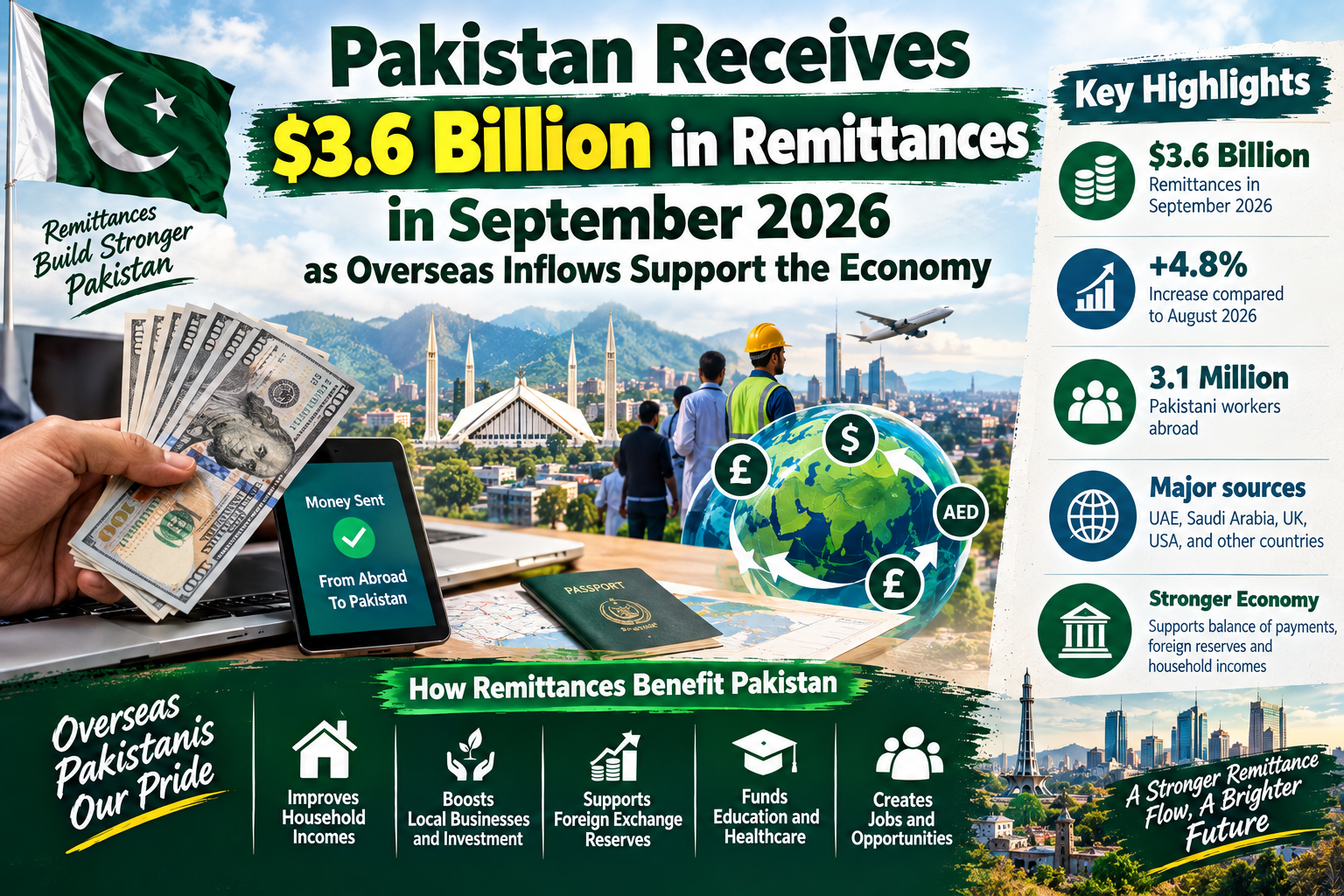
Pakistan received approximately $3.6 billion in workers’ remittances during September 2026, highlighting the continuing importance of overseas Pakistanis to the country’s economy. According to data released by the State Bank of Pakistan (SBP), remittance inflows increased by 12.7 percent compared with September 2025, although they declined slightly from the previous month.
The latest figures show that remittances remain an important source of foreign exchange for Pakistan. Millions of Pakistanis live and work abroad, sending money to their families to support everyday expenses, education, healthcare, housing and other financial needs. These transfers also contribute to the country’s external account and help support economic activity.
During the first quarter of the 2026–27 fiscal year, covering July through September, Pakistan received approximately $10.87 billion in workers’ remittances. This represented an increase of around 14 percent compared with the $9.54 billion recorded during the same period of the previous fiscal year.
The figures present an encouraging year-on-year trend, but they also highlight the importance of examining monthly changes and the factors influencing money transfers. Remittances can vary according to employment conditions in host countries, seasonal financial needs, exchange rates, transfer costs and the availability of formal banking channels.
For Pakistan, the challenge is to maintain reliable remittance inflows while creating an economic environment in which overseas Pakistanis can send money conveniently and securely. The funds they transfer provide direct support to households and contribute to the country’s broader financial stability.
September Remittances Reach $3.6 Billion
The State Bank of Pakistan reported that workers’ remittances reached approximately $3.6 billion in September 2026.
The amount was 12.7 percent higher than the approximately $3.18 billion received in September 2025. This year-on-year increase indicates that overseas Pakistanis continued to send more money home than they did during the same month a year earlier.
However, the monthly comparison showed a different trend. Remittances declined by approximately 1.9 percent from August 2026, when inflows stood at around $3.66 billion.
These figures are not necessarily contradictory. A monthly decline can occur even when the overall trend remains positive compared with the previous year. Changes in the timing of transfers, household needs and employment-related payments can affect monthly totals.
The important point is that Pakistan maintained a substantial level of remittance inflows during September. The amount provides support to families and contributes to the country’s supply of foreign exchange.
The figures also demonstrate why monthly data should be considered alongside longer-term trends. One month’s increase or decrease does not, by itself, establish whether remittances will rise or fall throughout the fiscal year.
Continued monitoring will help policymakers understand whether the growth recorded during the first quarter can be sustained in the months ahead.
First Quarter of FY2026–27 Records Strong Growth
Pakistan’s remittance performance during the first quarter of fiscal year 2026–27 was stronger than during the corresponding period of the previous fiscal year.
Between July and September 2026, the country received approximately $10.87 billion in workers’ remittances, compared with $9.54 billion during July–September 2025.
This represented growth of approximately 14 percent.
The quarterly total is important because it provides a broader view of remittance activity than a single month’s figures. Although September inflows were slightly lower than August, the three-month total remained considerably higher than the previous year’s corresponding result.
Strong quarterly inflows can help support Pakistan’s external account by bringing foreign currency into the country. They can also provide financial assistance to households that depend on money sent by family members working abroad.
The performance is particularly relevant because remittances are an established source of foreign exchange for Pakistan. They contribute to the country’s external financial position and help families meet expenses that might otherwise be difficult to manage through domestic earnings alone.
Nevertheless, a strong quarter does not guarantee that the same growth rate will continue throughout the year. Future results will depend on employment conditions abroad, the economic outlook in major host countries and the decisions of overseas workers.
Policymakers and financial institutions will therefore need to monitor subsequent monthly releases to assess the durability of the trend.
Saudi Arabia Remains the Largest Source of Remittances
Saudi Arabia continued to be Pakistan’s largest source of workers’ remittances in September 2026.
According to the reported figures, transfers from Saudi Arabia amounted to approximately $899.1 million during the month. The United Arab Emirates contributed around $748.5 million, while other Gulf Cooperation Council countries accounted for approximately $342.1 million.
The United Kingdom also remained an important source, contributing around $515.1 million. Remittances from the United States reached approximately $305.9 million.
These figures illustrate the importance of several major overseas employment destinations to Pakistan’s remittance economy.
Saudi Arabia and the UAE have long been significant destinations for Pakistani workers across various occupations. These include construction, transport, hospitality, retail, healthcare, technical services and other areas of employment.
The United Kingdom and the United States also contribute through Pakistani workers, professionals, businesspeople and members of the wider Pakistani diaspora.
The distribution of remittances across several countries can provide some diversification. However, Pakistan remains exposed to economic developments in the countries where large numbers of its citizens work.
Changes in employment demand, wages, immigration rules or economic activity in major destination countries may influence the amount of money workers are able to send home.
Maintaining strong international employment connections and improving access to secure transfer services can help Pakistan support this important source of household and national income.
The Contribution of Overseas Pakistanis
Overseas Pakistanis make a significant contribution to the country through remittances and their wider economic connections.
Many leave Pakistan to seek employment opportunities, develop professional careers or support their families. Their financial transfers often help relatives manage regular household expenses and prepare for future needs.
For some families, remittances provide a dependable source of income that helps cover rent, food, electricity bills, healthcare and education. They can also support the construction or improvement of homes and help relatives establish small businesses.
The impact extends beyond immediate family support. When recipients spend money on goods and services, those payments can contribute to local economic activity. Shops, transport providers, educational institutions and service businesses may benefit from the spending generated by remittance-supported households.
However, the benefits depend on the circumstances of individual families. Remittances are not distributed equally across the population, and not every household has access to financial support from relatives abroad.
It is also important to recognise that overseas employment can involve personal and financial sacrifices. Workers may spend long periods away from their families, face living costs in host countries and experience uncertainty about employment.
Their contributions should therefore be understood in both economic and human terms.
Pakistan can strengthen these connections by improving the ease of sending money, providing reliable financial services and supporting productive opportunities for families that receive remittances.
How Remittances Support Pakistan’s Economy
Remittances play several roles in Pakistan’s economy.
First, they provide foreign exchange. Money transferred from abroad increases the flow of foreign currency into the country, supporting the external account.
Second, remittances support household consumption. Families use the money for necessities and other expenses, helping them manage financial responsibilities.
Third, they can support education and healthcare. Some families use remittances to pay school fees, purchase learning materials, obtain medical treatment or meet other costs associated with wellbeing.
Fourth, remittances may help finance housing improvements and small businesses. These uses can contribute to local economic activity, although outcomes depend on how funds are allocated.
Remittances can also help families manage periods of economic difficulty. When domestic earnings are insufficient or employment becomes uncertain, money from relatives abroad may provide an additional source of support.
At the national level, reliable inflows can contribute to Pakistan’s external financial stability. They are particularly important because the country needs foreign exchange to pay for imports and meet other international obligations.
Nevertheless, remittances cannot replace a strong domestic economy. Pakistan still needs productive employment, investment, exports, effective public institutions and sustainable fiscal policies.
The most beneficial approach is to recognise remittances as an important source of support while also expanding opportunities for economic growth within the country.
Remittances and Foreign Exchange Stability
Foreign exchange availability is an important consideration for Pakistan because the country imports many essential goods, including energy products, machinery, industrial inputs and certain food items.
When overseas Pakistanis send money home, those transfers contribute to the supply of foreign currency entering the country through formal channels.
This can help support the external account and provide resources that contribute to meeting international payment needs.
However, remittances are only one part of the external account. Exports, imports, services, investment flows, external borrowing and other financial transactions also influence the country’s overall position.
A rise in remittances does not automatically guarantee currency stability or eliminate external financing pressures. The impact depends on the broader economic environment and the balance between foreign currency inflows and outflows.
For example, higher remittance receipts may coincide with increased import costs or other external payments. In such circumstances, the overall financial position will depend on how all these factors interact.
Policymakers should therefore assess remittance data alongside other indicators, including exports, foreign exchange reserves, the current account and external financing requirements.
The September figures provide a positive contribution to the overall picture, but sustained stability requires progress across multiple areas of the economy.
Why Monthly Remittances Can Fluctuate
Remittance flows do not necessarily follow a straight upward or downward path. Monthly totals can change for several reasons.
One factor is the timing of household transfers. Workers may send additional money before holidays, family celebrations, school expenses or other occasions when relatives need financial support.
Employment conditions can also influence the amounts transferred. Workers who receive overtime payments, bonuses or additional shifts may be able to send more money home during certain months.
Economic conditions in host countries are another consideration. Changes in employment demand, wages, living costs or business activity can affect the amount workers retain after paying their own expenses.
Exchange rates and transfer fees may also influence how much money reaches recipients in Pakistan. If sending money becomes more expensive or exchange conditions change, workers may adjust the timing or method of their transfers.
These factors mean that a monthly decline should not automatically be interpreted as a sign of long-term weakness.
In September 2026, the month-on-month decrease was relatively small compared with the positive year-on-year change. The quarterly increase also indicates that the overall first-quarter performance remained stronger than in the previous year.
Future data will provide a clearer indication of whether this pattern continues.
Formal Banking Channels and Digital Transfers
The channels used to send remittances are important for both workers and recipients.
Formal banking services, authorised money-transfer providers and regulated digital payment services can offer ways to move funds securely and maintain transaction records.
Reliable transfer systems can help recipients access money conveniently while allowing financial institutions to process transactions through established procedures.
Digital services may also reduce the need for people to travel long distances to collect funds, depending on the provider and the recipient’s access to banking facilities.
However, access is not identical across all parts of Pakistan. Some people may have limited familiarity with digital financial services, while others may face connectivity problems or difficulties accessing banking facilities.
Financial institutions can help address these challenges through clear customer guidance, accessible service points, transparent fees and appropriate customer protection.
Security is also important. Customers should use authorised providers, protect account information and verify payment details before completing transactions.
For overseas workers, the cost and reliability of sending money are important considerations. Lower transfer costs can help more of the money they earn reach their intended recipients.
Improving formal remittance channels can therefore benefit households while strengthening the reliability of financial data available to policymakers.
Remittances and Household Living Standards
For many Pakistani families, remittances have a direct relationship with everyday living standards.
Money received from relatives abroad can help cover food, clothing, accommodation, utilities, transport and other regular expenses. It may also help families deal with unexpected costs, such as medical bills or urgent household repairs.
Education is another important area. Some households use remittances to pay tuition fees, purchase books, obtain learning materials or meet transport expenses associated with schooling.
Healthcare costs can also be significant. Remittances may help families access consultations, medicines and treatment when domestic earnings alone are insufficient.
The effect on household wellbeing depends on the size and regularity of the transfers and the family’s overall financial circumstances.
A household with stable remittance income may be better able to plan its spending than one receiving irregular payments. However, overseas employment can also be uncertain, and the financial needs of the worker abroad must be considered.
Remittances should not be viewed as a universal solution to poverty or rising living costs. Families without relatives working abroad may not receive this support, and the amount received can differ substantially between households.
Public policy remains important for improving access to education, healthcare, employment and social protection.
Can Remittances Support Small Businesses?
Remittances can sometimes help families establish or expand small businesses.
Recipients may use part of the money to purchase equipment, acquire stock, rent commercial space or support a home-based enterprise. Others may invest in agricultural activities, transport services or local retail operations.
When these investments succeed, they can generate income and potentially create employment opportunities.
However, business investment involves risks. Market demand, competition, operating costs and management skills all influence whether an enterprise can remain profitable.
Families considering business activity need access to reliable information, realistic planning and appropriate financial services. Remittance income should not automatically be treated as risk-free capital, particularly when the household also depends on it for essential expenses.
Financial literacy and business support programmes can help people evaluate opportunities more carefully.
Banks and other regulated financial institutions may also play a role by providing suitable accounts, payment services and information about available business financing.
At the national level, productive use of remittances can complement broader economic development efforts. Yet policymakers should respect household choices rather than assume that every recipient must invest the money in a business.
Families have legitimate reasons to use remittances for immediate needs, education, healthcare or savings.
The Importance of Pakistan’s Overseas Employment Strategy
Pakistan’s remittance performance is closely connected to the employment opportunities available to its citizens abroad.
Workers seek opportunities in countries where employers need labour, technical expertise or professional services. The type of work available, wages, recruitment costs and employment conditions can influence the amount of money workers are able to send home.
A stronger overseas employment strategy could focus on skills development, transparent recruitment and better access to verified employment information.
Training can help workers meet the requirements of particular occupations, although the skills needed differ across industries and destination countries.
Clear information about employment contracts, wages and recruitment arrangements can also help people make more informed decisions before leaving Pakistan.
Worker protection is important. Recruitment costs, misleading employment offers and unclear contractual conditions can create financial pressure for workers and their families.
Responsible recruitment practices and access to appropriate assistance can help reduce these risks.
Pakistan can also strengthen connections with its diaspora by improving access to reliable public information and financial services.
At the same time, domestic employment and economic opportunities remain essential. Overseas employment should complement, rather than replace, efforts to create productive jobs within Pakistan.
The Government’s Remittance Outlook for FY2026–27
The strong first-quarter performance has contributed to expectations that Pakistan could maintain substantial remittance inflows during fiscal year 2026–27.
The State Bank of Pakistan and market analysts monitor these flows because they influence the external account and provide information about financial transfers from overseas workers.
The government has an annual remittance target of approximately $44 billion for FY2026–27, according to reporting on the latest figures.
The first-quarter total of approximately $10.87 billion provides a useful starting point for assessing progress towards that objective. However, the eventual annual result will depend on the performance of remittances during the remaining months.
It would be premature to assume that the target will necessarily be achieved based on one quarter alone.
Seasonal patterns, employment conditions in host countries and broader international economic developments can influence the pace of future inflows.
Policymakers should therefore continue monitoring monthly data and consider how transfer costs, formal financial services and overseas employment conditions affect the figures.
The annual target is useful as a planning reference, but the quality of the remittance system also matters. Reliable channels, transparent charges and strong customer protection can provide lasting benefits even when monthly totals fluctuate.
Challenges That Could Affect Future Remittance Growth
Several factors could influence Pakistan’s remittance performance in the coming months.
Economic slowdowns in major destination countries could affect employment opportunities and wages. If workers experience reduced earnings or higher living costs, the amount available to send home may decline.
Changes in recruitment and immigration policies can also affect the movement of workers into particular labour markets.
Another consideration is the cost of sending money. High fees or unfavourable exchange conditions can reduce the amount received by families and may affect the choice of transfer channel.
Competition between authorised providers, improved digital access and transparent pricing can help make remittance services more convenient.
Pakistan must also consider the risks associated with depending heavily on any single source of foreign exchange. Remittances are valuable, but sustainable economic management requires a broader base of exports, investment and productive domestic activity.
Finally, the experience of overseas workers matters. Employment conditions, access to reliable contracts and the ability to maintain stable earnings can influence their capacity to support families.
Addressing these issues requires cooperation between government agencies, financial institutions, employers and relevant overseas partners.
Conclusion
Pakistan received approximately $3.6 billion in workers’ remittances during September 2026, with inflows increasing 12.7 percent compared with the same month last year. The country also recorded approximately $10.87 billion in remittances during the first quarter of FY2026–27, representing growth of around 14 percent year on year.
Although September’s total was slightly lower than August’s figure, the quarterly results demonstrate the continued importance of overseas Pakistanis to the country’s economy.
Saudi Arabia remained the largest source of remittances, followed by significant contributions from the United Arab Emirates, the United Kingdom, other Gulf countries and the United States.
These transfers support household spending, education, healthcare and other family needs. They also contribute to Pakistan’s foreign exchange inflows and wider economic activity.
However, remittances alone cannot resolve the country’s economic challenges. Pakistan still needs stronger domestic employment, export growth, investment and effective public policies.
Looking ahead, reliable financial channels, transparent transfer costs, responsible overseas recruitment and improved access to financial services can help maintain the benefits of remittances.
The September figures provide an encouraging indication of the role overseas Pakistanis continue to play. Sustaining that contribution will require attention to both the financial systems that transfer their earnings and the economic opportunities available to workers abroad and families at home.
Frequently Asked Questions (FAQs)
1. How much remittance did Pakistan receive in September 2026?
Pakistan received approximately $3.6 billion in workers’ remittances during September 2026, according to State Bank of Pakistan data.
2. How much did remittances increase in the first quarter of FY2026–27?
Remittances reached approximately $10.87 billion between July and September 2026, around 14 percent higher than the same period of the previous fiscal year.
3. Which country sent the most remittances to Pakistan in September 2026?
Saudi Arabia was the largest source, contributing approximately $899.1 million during the month.
4. Why are remittances important for Pakistan?
Remittances support household expenses, education and healthcare while contributing to foreign exchange inflows and economic activity.
5. Will Pakistan achieve its remittance target for FY2026–27?
Pakistan has an annual target of approximately $44 billion. First-quarter results are encouraging, but the final outcome will depend on remittance inflows during the remaining months of the fiscal year.