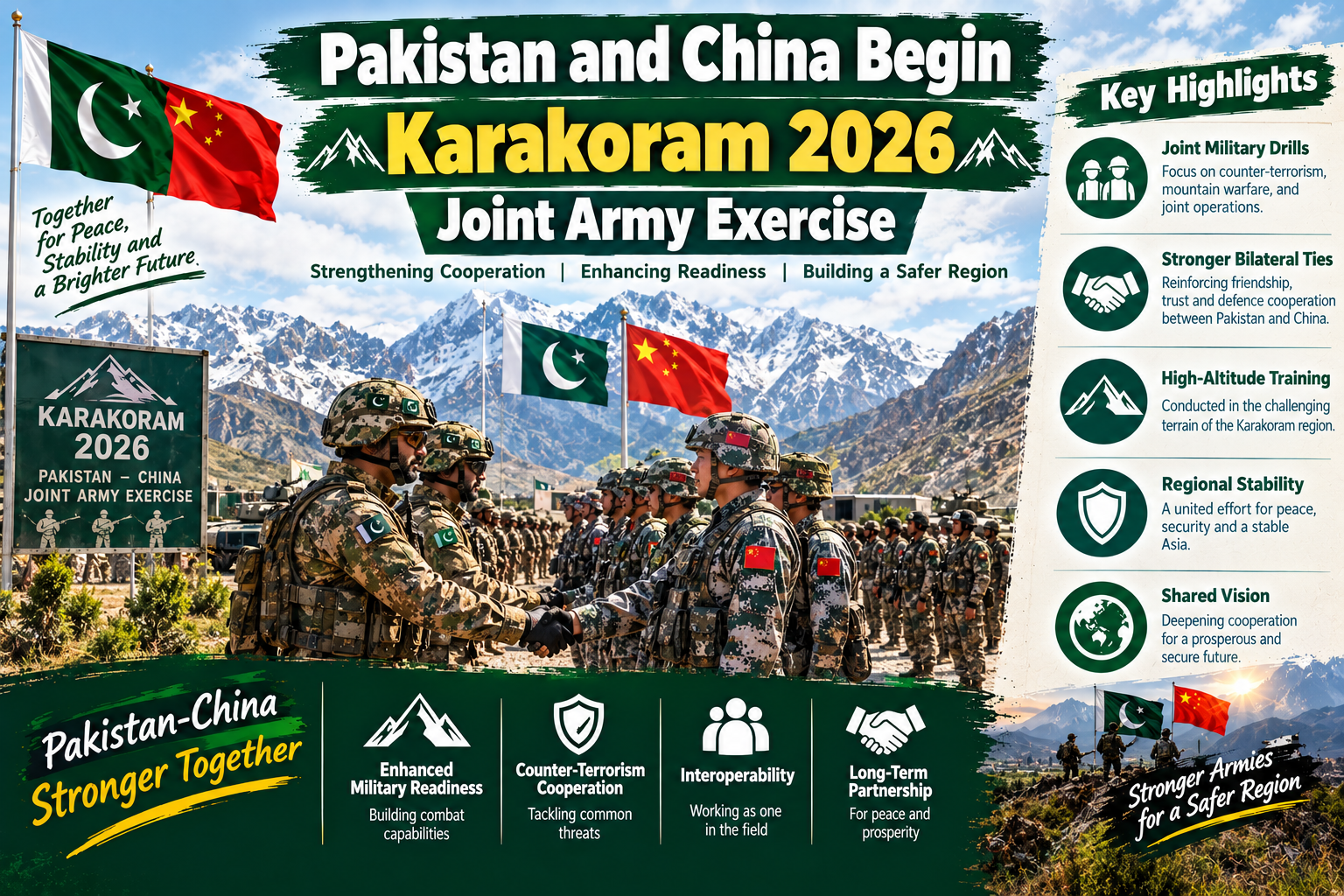
Pakistan-China Relations: A New Chapter in Military Training, Regional Security, and Strategic Cooperation
Pakistan and China have begun a new chapter in their longstanding defence relationship with the launch of the Karakoram 2026 joint army training exercise in Korla, located in China’s Xinjiang region. The exercise officially began on October 14, 2026, bringing the two countries together for training focused on counterterrorism cooperation and operations in high-altitude environments.
The exercise represents an important development in military engagement between the neighbouring countries. According to reports, the training is intended to improve cooperation, encourage the exchange of professional experience, and strengthen the ability of both armies to coordinate when responding to security challenges.
Pakistan and China have maintained close diplomatic, economic, and defence relations for decades. Their cooperation includes infrastructure development, trade, education, technology, diplomatic engagement, and military training. The Karakoram 2026 exercise adds another element to this broad relationship.
The announcement has attracted attention because both countries consider regional stability and counterterrorism cooperation important parts of their security policies. The exercise also comes at a time when international partnerships and regional security arrangements continue to influence diplomatic relations across Asia.
This article examines the purpose of Karakoram 2026, its significance for Pakistan-China relations, the importance of military training, and the wider implications for regional cooperation and stability.
1. Karakoram 2026 Exercise Begins in China
The joint army exercise began on October 14, 2026, in Korla, a city in the Xinjiang region of northwestern China.
According to published reports, the opening ceremony marked the beginning of a training programme involving personnel from the Chinese and Pakistani armies. The exercise is designed around counterterrorism operations in high-altitude environments, where geography and environmental conditions can create particular challenges for military personnel.
Chinese defence officials announced the planned exercise on October 10. The announcement described the programme as an opportunity for the two countries to deepen military exchanges and improve their ability to cooperate in responding to terrorist threats.
The exercise is notable because it is being described by Chinese officials as the first joint army training exercise between the two countries under this format.
However, Pakistan and China have conducted military exercises together before. Their earlier cooperation includes the Warrior series of joint counterterrorism exercises, alongside other forms of military training and engagement.
Karakoram 2026 therefore represents a new exercise initiative within a much longer history of defence cooperation rather than the beginning of military relations between the two countries.
The training is scheduled to continue into the latter part of October, according to reports about the exercise.
2. Why Pakistan and China Are Conducting Joint Training
Joint military training allows participating countries to practise working together, exchange professional experience, and improve coordination between their armed forces.
When military personnel from different countries train together, they may have different procedures, communication practices, organisational structures, and operational experiences. Exercises can help them understand those differences and develop more effective methods of cooperation.
For Pakistan and China, counterterrorism is a significant area of shared security interest. Both governments have identified terrorism as a threat to public safety and national stability.
The Karakoram 2026 exercise is intended to strengthen cooperation in addressing such challenges. Its focus on high-altitude environments also reflects the importance of preparing personnel to operate in demanding geographical conditions.
Joint exercises can support broader institutional relationships by allowing personnel to exchange lessons learned and become more familiar with the professional practices of their counterparts.
Nevertheless, an exercise should not automatically be interpreted as evidence of a new military alliance or a specific future operation. The announced purpose of Karakoram 2026 is training and cooperation, and any broader conclusions would require additional evidence.
The significance of the exercise lies in the continued development of a defence relationship that has remained an important part of Pakistan-China relations.
3. The Importance of High-Altitude Training
High-altitude environments present distinct challenges for people working in them. Weather conditions can change quickly, temperatures may be low, and transportation and communication can be more complicated than in many lowland areas.
Mountainous terrain can also make emergency response and logistical support more difficult. Personnel operating in such environments need appropriate preparation, reliable communication, and a clear understanding of local conditions.
Training programmes focused on high-altitude environments allow participating forces to improve their preparedness and learn from one another’s experience.
For Pakistan, mountain regions have particular geographical significance. The country includes extensive mountainous areas in the north, including parts of Gilgit-Baltistan and Khyber Pakhtunkhwa. These regions are important for communities, tourism, transportation, and connections with neighbouring countries.
China also has extensive mountainous and high-altitude areas, making experience in these environments relevant to its defence institutions.
The Karakoram 2026 exercise provides an opportunity for personnel from both countries to exchange knowledge connected with these demanding settings.
Such training can also reinforce the importance of preparation, safety, communication, and coordination when personnel work under difficult environmental conditions.
4. Pakistan-China Defence Relations
Pakistan and China have developed a close relationship that extends across diplomatic, economic, scientific, educational, and defence sectors.
Their governments regularly engage through official visits, bilateral meetings, and institutional discussions. Defence cooperation has been one component of this relationship, with military exchanges and joint training contributing to professional engagement between the two countries.
The relationship has developed over several decades and has adapted to changing regional and international circumstances.
For Pakistan, cooperation with China is an important element of its foreign policy and defence engagement. For China, Pakistan is a significant regional partner with longstanding diplomatic and economic connections.
Military training can help maintain communication between institutions and create opportunities for professional exchanges. It also allows the participating countries to discuss shared security concerns within established bilateral channels.
At the same time, Pakistan-China relations are broader than defence cooperation. Trade, infrastructure, education, technology, investment, and people-to-people contacts also play important roles.
A balanced assessment of the relationship therefore requires looking beyond military exercises to consider the many ways in which the two countries interact.
5. How Joint Exercises Can Improve Cooperation
A joint exercise is a structured opportunity for participating forces to practise cooperation under an agreed training framework.
Such programmes can help participants become familiar with one another’s organisational procedures and communication methods. They may also encourage the exchange of experience gained from previous assignments and professional training.
Cooperation is particularly important when institutions from different countries have to coordinate their work. Clear communication can reduce misunderstandings and improve the ability of personnel to work toward shared objectives.
In counterterrorism contexts, coordination among responsible institutions can be important for protecting civilians, responding to threats, and supporting public safety.
Joint training can also help identify areas where additional preparation or communication may be beneficial.
However, the results of an exercise cannot be fully assessed simply because it has begun. Its longer-term value depends on the lessons participants gain, how those lessons are evaluated, and whether cooperation improves in practice.
For Karakoram 2026, the publicly announced objective is to deepen exchanges and strengthen coordination between the Pakistani and Chinese armies.
The exercise is therefore one part of a continuing process of professional engagement rather than a standalone measure of regional security.
6. The Broader Role of Counterterrorism Cooperation
Terrorism can affect public safety, economic activity, education, transportation, and the confidence of local communities.
Governments use a range of measures to respond to terrorist threats, including law enforcement, intelligence cooperation, border management, investigations, and public protection policies.
International cooperation can contribute to these efforts when countries share relevant experience and coordinate within their respective legal frameworks.
Joint training is one form of that cooperation. It allows participating institutions to discuss professional practices and improve their familiarity with one another’s procedures.
Pakistan has faced serious security challenges from militant violence over many years. China has also identified terrorism and security threats as important concerns.
These shared interests help explain why counterterrorism training features prominently in the Karakoram 2026 programme.
However, lasting security requires more than military preparation. Effective policing, functioning courts, community engagement, education, economic opportunity, and protection of civilian rights are also essential.
Military exercises can contribute to institutional preparedness, but they cannot independently resolve every cause or consequence of terrorism.
The wider objective for both countries is to support a safer environment in which communities can pursue education, employment, trade, and ordinary daily activities with greater confidence.
7. The Economic Dimension of Pakistan-China Relations
Although Karakoram 2026 is a military exercise, it takes place within a broader relationship that includes significant economic cooperation.
Pakistan and China have worked together on infrastructure, energy, transport, industrial development, and other areas of economic engagement.
The China-Pakistan Economic Corridor, commonly known as CPEC, is one of the most prominent examples of this cooperation. It forms part of a wider effort to improve connectivity and support economic activity through infrastructure and related development projects.
Economic cooperation can create opportunities for trade, employment, and investment. Infrastructure projects can also improve transportation and connect communities with markets and public services, although their benefits depend on implementation, financing, local participation, and long-term economic performance.
Security is relevant to this economic relationship because businesses and infrastructure projects require predictable conditions in which people and goods can move safely.
At the same time, economic development and security should be viewed as connected but distinct policy areas. Progress in one does not automatically guarantee progress in the other.
Pakistan-China relations involve a variety of institutions and agreements, and each project must be evaluated on its own merits.
The Karakoram 2026 exercise adds to the defence dimension of this relationship, while economic cooperation remains an important part of the wider bilateral partnership.
8. What the Exercise Means for Pakistan
For Pakistan, the exercise offers an opportunity for military personnel to exchange experience with their Chinese counterparts and participate in a structured programme focused on counterterrorism cooperation.
Pakistan’s geography includes mountain ranges, remote districts, major cities, border regions, and important transportation routes. The country therefore faces a range of security and emergency-response challenges that vary by location.
Professional training and international exchanges can help institutions assess different approaches to preparation, communication, and coordination.
The exercise also reflects the continuing importance of Pakistan’s relationship with China, particularly in defence and strategic engagement.
Nevertheless, the practical impact of Karakoram 2026 will depend on the lessons learned and how they contribute to future institutional preparedness.
The exercise should not be taken as proof that all security challenges have been addressed or that a particular future outcome is guaranteed.
For the public, the broader significance lies in the continued emphasis on cooperation and preparedness. National security is most valuable when it contributes to protecting communities and supporting a stable environment for economic and social development.
9. What the Exercise Means for China
China has described Karakoram 2026 as a means of deepening exchanges with Pakistan and strengthening cooperation in counterterrorism.
The exercise is taking place in Xinjiang, a region with important geographical and economic connections to Central Asia and other parts of China.
China has developed a range of international defence relationships, including training programmes and military exchanges with partner countries. These activities can support professional communication and help participating institutions become more familiar with one another’s practices.
For China, its relationship with Pakistan includes diplomatic coordination, trade, infrastructure, and security cooperation.
Joint training also provides an opportunity to maintain engagement between military institutions and discuss shared concerns within an established bilateral framework.
As with Pakistan, the significance of the exercise should be assessed according to its stated objectives and actual outcomes rather than assumptions about broader military developments.
The announced focus is on counterterrorism cooperation and high-altitude training, with the stated goal of improving coordination between the participating armies.
10. Regional Security and Stability in Asia
South and Central Asia are connected through trade routes, geography, energy interests, and diplomatic relationships.
Developments in one part of the region can affect transportation, commerce, investment, and relations among neighbouring states.
Pakistan and China have an interest in maintaining communication and cooperation on issues they consider important to regional stability.
Joint training exercises can contribute to professional engagement between partner countries. They can also serve as a visible demonstration that the participating governments intend to maintain established defence contacts.
However, regional security is influenced by many factors, including political disputes, economic pressures, border management, diplomatic negotiations, and internal security challenges.
A single exercise cannot determine the future direction of regional relations.
Long-term stability also depends on diplomacy, peaceful dispute resolution, respect for international obligations, and communication between governments.
For Pakistan and China, the immediate purpose of Karakoram 2026 is to develop their bilateral training and cooperation. Its wider significance should be understood within this broader and complex regional environment.
11. The Importance of Responsible Public Communication
News about military exercises can attract significant public attention, especially when it involves two countries with close strategic ties.
Clear and accurate communication helps the public understand what an exercise involves and why it is being conducted.
Official announcements provide information about stated objectives, participating institutions, and the expected scope of training. Journalists and analysts can then examine those announcements alongside other available evidence.
Responsible reporting should distinguish confirmed information from speculation. It should also avoid presenting routine training activity as proof of an imminent conflict or a dramatic change in international relations without supporting evidence.
For Karakoram 2026, the available reporting establishes that the exercise began in Korla on October 14 and focuses on counterterrorism cooperation in high-altitude environments.
The reports also describe the exercise as a new joint army training initiative between Pakistan and China.
Those details provide a sufficient basis for understanding the event without making unsupported predictions about its future consequences.
Public discussion is more useful when it focuses on verified facts, the stated goals of the exercise, and the broader context of bilateral relations.
12. Challenges and Limitations of Military Training
Military exercises can strengthen familiarity and cooperation, but they also have limitations.
Training takes place within a particular schedule and set of conditions. Real-world situations may involve different circumstances, unexpected developments, and competing demands.
For this reason, the results of an exercise need to be evaluated carefully. Institutions may review lessons learned, identify areas for improvement, and use those findings to inform future training.
International exercises also require coordination between participating countries, including agreement on objectives, responsibilities, communication, and relevant procedures.
The public may not receive every detail of a military training programme, and official announcements may focus on its broad purpose rather than a full assessment of its results.
Consequently, it would be premature to judge the overall success of Karakoram 2026 before the exercise concludes and its outcomes are assessed.
The most reasonable expectation is that the programme will provide an opportunity for professional exchange and closer coordination, consistent with the objectives announced by the two countries.
Any claims about measurable improvements would need to be supported by subsequent information.
13. The Future of Pakistan-China Cooperation
The Pakistan-China relationship is likely to continue involving multiple areas of engagement, including diplomacy, trade, infrastructure, education, technology, and defence.
Joint exercises such as Karakoram 2026 provide a framework for maintaining communication between military institutions and exchanging professional experience.
Other areas of cooperation may also shape the relationship in the coming years. Economic performance, infrastructure planning, regional developments, and changing international circumstances can all influence the priorities of both governments.
For Pakistan, maintaining a broad and balanced foreign policy remains important. International partnerships can provide opportunities for economic development, technical cooperation, and diplomatic engagement.
For China, relationships with neighbouring and regional partners are part of its wider approach to international cooperation.
The long-term strength of the Pakistan-China relationship will depend not only on official agreements but also on how cooperation translates into practical benefits.
These benefits may include stronger economic connections, educational opportunities, reliable infrastructure, improved institutional communication, and constructive engagement on shared challenges.
Karakoram 2026 is one current example of the countries’ continued interaction in the defence sector.
14. Why Peace and Stability Remain the Main Priorities
The most important outcome of security cooperation should be a safer environment for ordinary people.
Families need access to education and healthcare. Businesses need predictable conditions in which to operate. Students need opportunities to develop skills, and workers need access to employment.
Security policies are most meaningful when they help protect these everyday opportunities.
For Pakistan, stability is closely connected to economic development and the effective delivery of public services. For China, regional stability is also relevant to commerce, connectivity, and its international relationships.
Military training may contribute to preparedness, but a comprehensive approach to peace also requires diplomacy, effective institutions, public accountability, and economic opportunity.
Cooperation between countries can support these goals when it is directed toward clearly defined purposes and accompanied by responsible decision-making.
The Karakoram 2026 exercise demonstrates continued engagement between Pakistan and China on a shared security concern. Its lasting significance will depend on the lessons gained and how those lessons contribute to broader institutional cooperation.
Conclusion
Pakistan and China began the Karakoram 2026 joint army training exercise in Korla, Xinjiang, on October 14, 2026. The programme focuses on counterterrorism cooperation in high-altitude environments and is intended to deepen exchanges between the two armies.
The exercise is an important development in a longstanding defence relationship that also includes diplomatic engagement, economic cooperation, infrastructure development, and other areas of partnership.
Joint training can help participating institutions improve familiarity, communication, and coordination. However, its effectiveness must be assessed through the outcomes achieved rather than assumptions about what the exercise may accomplish.
For Pakistan, the programme offers another opportunity to exchange professional experience with China. For both countries, it reflects a continuing interest in cooperation on security concerns.
Ultimately, the wider value of such engagement should be measured by its contribution to stability, responsible security practices, and an environment in which communities can pursue education, employment, trade, and development.
Karakoram 2026 is a new step in Pakistan-China military engagement, while lasting regional stability will continue to depend on effective cooperation, diplomacy, and sustained attention to the needs of ordinary people.
FAQs
1. What is the Karakoram 2026 exercise?
Karakoram 2026 is a joint army training exercise between Pakistan and China focused on counterterrorism cooperation and high-altitude environments.
2. When did Karakoram 2026 begin?
The exercise began on October 14, 2026, according to published reports.
3. Where is the joint exercise taking place?
The exercise is being held in Korla, in China’s Xinjiang region.
4. What is the main purpose of Karakoram 2026?
Its stated purpose is to strengthen professional exchanges, improve coordination, and enhance cooperation between the Pakistani and Chinese armies in counterterrorism.
5. Have Pakistan and China conducted joint military exercises before?
Yes. The two countries have a history of joint military training, including the Warrior series of counterterrorism exercises. Karakoram 2026 is a new joint training initiative within their broader defence relationship.