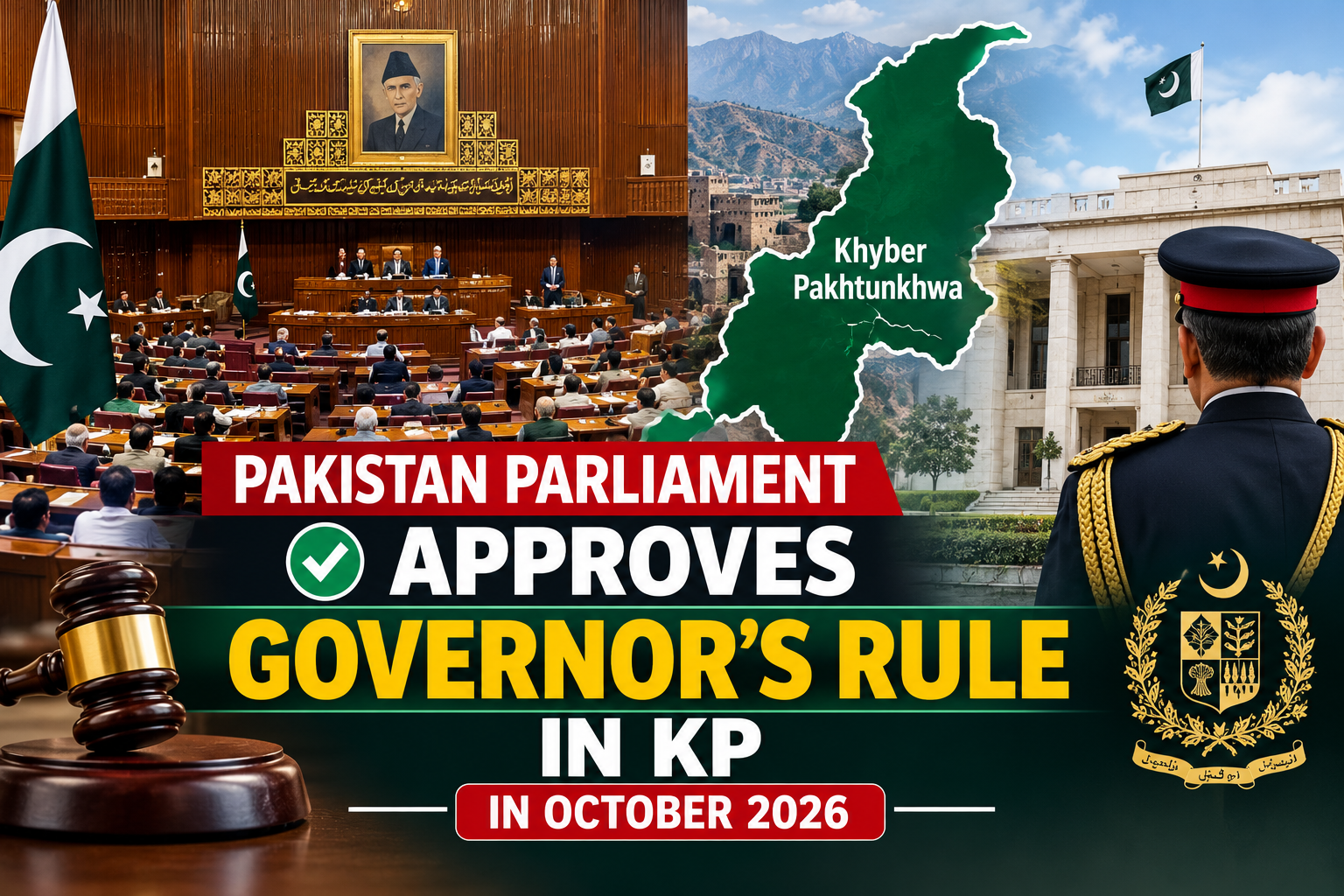
Pakistan’s political landscape has been shaped by ongoing discussions about federal authority, provincial autonomy, public security and constitutional governance. Khyber Pakhtunkhwa remains an important part of these discussions because of its security challenges and the political differences between the provincial and federal governments.
Governor’s Rule is a significant constitutional measure because it can change how a province is administered. Any decision involving such a measure raises important questions about the role of elected representatives, the responsibilities of government institutions and the protection of democratic principles.
For Pakistan, the central challenge is to maintain public safety while ensuring that constitutional procedures are respected and essential public services continue without disruption.
Parliament Approves the Emergency Proclamation
Pakistan’s parliament approved the emergency proclamation and Governor’s Rule in Khyber Pakhtunkhwa during a joint sitting on October 15, 2026. The measures had initially been announced by President Asif Ali Zardari on October 11 under Articles 232 and 234 of the Constitution.
The joint sitting brought together members of the National Assembly and Senate to consider the presidential proclamations. The resolutions were presented by Federal Minister for Parliamentary Affairs Tariq Fazal Chaudhary.
The government defended its decision by pointing to security concerns and disagreements over counterterrorism cooperation. Opposition members, particularly representatives of Pakistan Tehreek-e-Insaf (PTI), protested against the measures and questioned their constitutional justification.
The approval represents an important development in Pakistan’s federal-provincial relations. It also highlights the challenges of balancing national security concerns with democratic representation and provincial autonomy.
Although parliament has approved the proclamations, political disagreement over the decision remains significant. The implementation of the measures, possible legal challenges and the future of political negotiations will continue to shape the situation.
Why Did the Federal Government Introduce Governor’s Rule?
The federal government has cited security concerns in Khyber Pakhtunkhwa as the main reason for introducing emergency measures.
The province has experienced militant violence, particularly in areas near the Afghanistan border. Security incidents have placed pressure on law enforcement agencies, local communities and public institutions.
Federal officials have argued that stronger coordination between the provincial and federal administrations is necessary to respond effectively to these challenges. They have also accused the suspended provincial government of failing to provide adequate cooperation in counterterrorism efforts.
PTI has rejected the allegations and challenged the federal government's justification for the intervention. The party maintains that suspending an elected provincial administration is an unacceptable response to political and security disagreements.
These competing positions make it important to distinguish official allegations from independently established findings. The federal government has presented its case, while the opposition has disputed both the accusations and the constitutional basis of the decision.
The broader question is whether the new administrative arrangement can improve security while respecting the legal protections that govern relations between Pakistan’s federal and provincial institutions.
The effectiveness of the measures will ultimately depend on their implementation, the quality of security coordination and the decisions of the relevant constitutional institutions.
What Is Governor’s Rule in Pakistan?
Governor’s Rule is an exceptional constitutional arrangement that can transfer specified provincial governmental functions to the governor under the applicable constitutional framework.
Pakistan’s Constitution addresses this issue in Article 234. The provision establishes a process for situations in which a province’s government cannot be carried on in accordance with the Constitution.
Such a measure has important implications because it changes how provincial executive responsibilities are exercised. It is not an ordinary administrative adjustment and must operate within the legal limits established by the Constitution.
In Khyber Pakhtunkhwa, the proclamation transferred functions previously exercised by the chief minister and provincial cabinet to the governor under the announced arrangement. The federal government also established an advisory council to assist with provincial affairs.
The constitutional framework provides safeguards for parliamentary oversight. Under Article 234, a proclamation must be placed before a joint sitting of parliament and ordinarily ceases to operate after two months unless the required approval for continuation is obtained. The measure cannot remain in force beyond the constitutional maximum of six months.
These safeguards are important because exceptional powers can affect elected institutions and provincial autonomy. Parliamentary oversight helps ensure that the use of such powers remains subject to constitutional procedures.
Understanding the State of Emergency
The emergency proclamation is related to Governor’s Rule but is a distinct constitutional measure.
Article 232 of Pakistan’s Constitution concerns the proclamation of an emergency under specified circumstances. The government has invoked this provision in connection with the security situation in Khyber Pakhtunkhwa.
The federal administration argues that exceptional measures are required to strengthen coordination and respond to militant threats. Opposition parties, however, have questioned whether the circumstances justify the intervention and whether the decision undermines democratic governance.
The emergency proclamation and Governor’s Rule should not be treated as interchangeable terms. Each has its own constitutional basis and legal requirements.
The precise consequences of an emergency depend on the provisions invoked and the wording of the relevant proclamations. It would therefore be inaccurate to assume that every possible restriction associated with emergency governance automatically applies to every citizen.
Parliamentary approval establishes an important procedural step, but questions about implementation and constitutional interpretation can still arise. Where legal challenges are brought, the relevant courts may consider the arguments and determine questions that fall within their jurisdiction.
For Pakistan, the central issue is how exceptional powers can be exercised lawfully while protecting public safety and maintaining the functioning of constitutional institutions.
PTI Rejects the Federal Government’s Decision
PTI has strongly opposed the suspension of its provincial administration and the imposition of Governor’s Rule.
The party has rejected allegations that its provincial leadership supported militant activity. It has also argued that political disagreements should not be used to displace an elected government.
The dispute is especially significant because Khyber Pakhtunkhwa has been a major centre of PTI’s political support. The suspension of the provincial administration therefore affects the party’s role in governance and its relationship with its voters.
PTI representatives have indicated that they intend to challenge the measures through legal channels. Their objections concern provincial autonomy, the constitutional basis of the intervention and the rights of elected representatives.
The opposition’s position has also contributed to wider political tensions between the federal government and parties opposing its policies.
The legal process may provide a formal way to examine competing interpretations of the Constitution. However, the outcome of any challenge will depend on the arguments presented and the decisions of the relevant courts.
Until those questions are resolved, the disagreement is likely to remain an important feature of Pakistan’s political debate.
Political Tensions Between Islamabad and Peshawar
The situation in Khyber Pakhtunkhwa reflects a broader disagreement over the distribution of authority between Pakistan’s federal government and its provinces.
Pakistan operates under a federal constitutional system in which powers and responsibilities are divided between different levels of government. Provincial administrations have their own elected representatives and institutions, while the federal government is responsible for matters assigned to it under the Constitution.
Cooperation between these levels of government is particularly important when dealing with security challenges that require coordination across administrative boundaries.
When political differences become severe, disagreements over policy can develop into disputes about authority and constitutional procedure.
The current situation illustrates how security concerns can become closely connected with political competition. The federal government says its intervention is necessary to improve security, while PTI argues that the decision undermines the democratic mandate of its provincial administration.
Both security and constitutional accountability are important considerations. Addressing one should not eliminate the need to examine the other.
Reducing tensions will require clear communication, lawful administration and a willingness to resolve disagreements through appropriate political and legal processes.
The Role of Prime Minister Shehbaz Sharif
Prime Minister Shehbaz Sharif’s government has defended the emergency measures as part of its response to security concerns in Khyber Pakhtunkhwa.
During the parliamentary proceedings, the prime minister also renewed an offer of dialogue with opposition representatives. This indicates that political engagement remains a possible route for addressing some of the disagreements, even though the parties remain divided over the intervention.
Negotiations could provide an opportunity to discuss security coordination, administrative responsibilities and concerns about constitutional procedures.
However, dialogue is unlikely to succeed unless the parties are willing to address the issues that led to the breakdown in trust. The government and opposition may need to identify areas where cooperation is possible while allowing legal questions to be addressed through the proper institutions.
The situation also places responsibility on federal leaders to communicate the objectives and legal basis of their decisions clearly.
For the opposition, engaging with constitutional processes and presenting evidence for its objections can help ensure that the dispute is addressed through established mechanisms.
Whether negotiations resume will depend on developments in the coming days and the willingness of the parties to reconsider their positions.
What Does the Decision Mean for the People of Khyber Pakhtunkhwa?
For residents of Khyber Pakhtunkhwa, the most immediate concerns are public safety, access to government services and the continuity of daily life.
People depend on hospitals, schools, local government offices, transport systems and other essential services regardless of which political administration is in charge. Changes in provincial governance should not create unnecessary disruption to these services.
The new arrangement will require government departments to follow clear administrative instructions and maintain accountability. Citizens should also be able to understand which offices are responsible for addressing their concerns.
Security remains another major priority. Families, students, workers and business owners need an environment in which they can travel, study and work without fear.
The government's stated objective is to improve coordination against militant threats. Whether the new arrangement achieves this objective will depend on the effectiveness of its policies and the cooperation of the relevant institutions.
Residents also have an interest in protecting democratic representation. Political disagreements should be resolved through lawful processes, and decisions affecting provincial government should remain subject to constitutional requirements.
Ultimately, the impact of Governor’s Rule will be judged not only through political statements but also through its practical effects on public safety, administration and the lives of ordinary people.
Potential Economic Effects of Political Uncertainty
Political developments can influence economic confidence, particularly when they involve changes in government administration.
Businesses need predictable policies, stable regulations and functioning public institutions. Uncertainty can make it more difficult for companies to plan investments, manage costs and assess future risks.
Khyber Pakhtunkhwa has businesses operating in retail, agriculture, transport, construction, manufacturing and services. These businesses depend on security, access to markets and reliable public administration.
If political disagreements disrupt government operations or delay important decisions, businesses may face additional uncertainty. However, the announcement of Governor’s Rule alone does not establish that specific projects have been cancelled or that economic losses have occurred.
The actual impact will depend on how the new administration operates and whether essential services and development programmes continue effectively.
A stable environment can help businesses maintain confidence and focus on growth. Authorities therefore have an interest in preventing political confrontation from creating avoidable disruption.
The province's economic development will also depend on longer-term factors, including infrastructure, education, investment, employment opportunities and security.
For local communities, the priority is ensuring that political changes do not distract from the need to support livelihoods and improve public services.
Why Security Coordination Matters
Security coordination is one of the main issues behind the federal government's justification for its intervention.
Counterterrorism operations may require cooperation between federal authorities, provincial departments, law enforcement agencies and local administrations. Each institution has its own responsibilities, and effective coordination can help ensure that information and resources are used appropriately.
Khyber Pakhtunkhwa’s geographical position and its history of militant violence make security a particularly important concern for residents and policymakers.
However, security policy requires more than administrative control. It also depends on reliable intelligence, trained personnel, effective law enforcement, public trust and appropriate accountability.
Communities affected by violence need protection and access to essential services. They also need confidence that public institutions will act lawfully and respond to their concerns.
The federal government argues that the new arrangement will strengthen coordination. Opposition leaders question the decision and dispute the accusations made against their provincial administration.
These competing positions should be assessed through evidence and the practical results of government action.
A successful security strategy must aim to protect civilians, reduce violence and maintain the rule of law. Its effectiveness should be evaluated through credible information rather than political claims alone.
Constitutional Safeguards and Parliamentary Oversight
The Constitution provides a framework for exceptional measures and establishes procedures intended to prevent the unrestricted exercise of government power.
In the current case, the presidential proclamations were presented to parliament, and the joint sitting approved the emergency and Governor’s Rule resolutions on October 15.
Parliamentary consideration is important because it gives elected representatives an opportunity to debate decisions with significant consequences for provincial governance.
The opposition's objections also demonstrate why constitutional safeguards matter. Parliamentary approval does not mean that every political concern has disappeared, nor does it prevent legal questions from being raised through the appropriate channels.
The constitutional framework includes provisions concerning the duration and continuation of Governor’s Rule. These limits are intended to ensure that exceptional arrangements remain subject to legal requirements.
Judicial review can also be relevant when disputes arise about the interpretation or application of constitutional provisions.
For citizens, the key principle is that government authority must be exercised according to law. Security concerns deserve serious attention, but decisions taken in response must also respect constitutional procedures and institutional responsibilities.
What Could Happen Next?
Several developments could influence the future of the situation in Khyber Pakhtunkhwa.
First, administrative changes may continue. The governor-led arrangement will need to manage provincial affairs under the applicable constitutional framework.
Second, legal challenges may proceed. PTI has opposed the intervention, and court proceedings could become an important part of the dispute.
Third, political dialogue may be reconsidered. The prime minister has offered talks, although disagreements over the emergency measures have made negotiations difficult.
Fourth, security policy will remain under scrutiny. The government will face questions about whether the new arrangements improve coordination and protect residents.
Fifth, parliamentary oversight will continue to matter. Any extension or further use of exceptional powers must comply with the relevant constitutional requirements.
These are possible developments rather than guaranteed outcomes. The direction of the situation will depend on decisions taken by the government, opposition parties and constitutional institutions.
Conclusion
Pakistan’s parliament approved emergency measures and Governor’s Rule in Khyber Pakhtunkhwa on October 15, 2026, following presidential proclamations issued on October 11. The federal government has defended the intervention on security grounds, while PTI has rejected the decision and questioned its constitutional justification.
The development has intensified debate about provincial autonomy, democratic representation and the distribution of authority between federal and provincial institutions.
The coming period will be important for determining how the measures are implemented, whether legal challenges progress and whether political negotiations can resume.
For the people of Khyber Pakhtunkhwa, the most important priorities remain public safety, reliable public services, economic stability and lawful governance.
A durable resolution will require effective security policies, respect for constitutional procedures and a willingness to address political disagreements peacefully. The ultimate measure of success should be whether the situation improves the lives and security of ordinary citizens while maintaining confidence in Pakistan’s institutions.
Frequently Asked Questions (FAQs)
1. When did Pakistan’s parliament approve Governor’s Rule in Khyber Pakhtunkhwa?
Parliament approved the relevant resolutions during a joint sitting on October 15, 2026.
2. Why did the federal government introduce Governor’s Rule?
The federal government cited security concerns and disagreements over counterterrorism coordination as reasons for the intervention.
3. Which constitutional articles are involved?
Article 232 concerns the emergency proclamation, while Article 234 addresses Governor’s Rule under specified circumstances.
4. How has PTI reacted to the decision?
PTI has opposed the intervention, rejected allegations against its provincial administration and challenged the constitutional justification for the measures.
5. What are the main concerns for Khyber Pakhtunkhwa residents?
The main concerns include public safety, uninterrupted government services, economic stability, provincial representation and respect for constitutional procedures.




